Quick Answer: What Are The Best Cordless Leaf Blowers
The best cordless leaf blowers deliver 550 to 800 CFM airflow and 120 to 170 MPH air speed. Top performers include the EGO Power+ LB7654 (765 CFM), Husqvarna Leaf Blaster 350iB (30-min runtime on high), and Ryobi 40V HP Whisper Series (730 CFM, low noise). Match CFM to your yard size: under 5,000 sq ft needs 400 to 550 CFM; larger properties require 600+ CFM.

Pros
- 3-in-1 design switches tool-free between modes
- Six-blade metal impeller with rated 16:1 mulching
- Delivers up to 500 CFM and 210 MPH airflow
- Includes 6.0Ah ARC Lithium battery and 320W charger
- Weather-resistant IPX5-rated housing
Cons
- Relatively heavy package at 28 pounds
- Maximum 90-minute runtime applies only to low setting

Pros
- Delivers up to 880 CFM and 200 MPH air speed in turbo mode
- Includes two 4.0Ah 56V ARC Lithium batteries for extended runtime
- Integrated digital display monitors charge level and cruise lock
- Variable speed dial easily adjusts output from 270 to 700 CFM
- Includes both tapered and spread nozzles for task versatility
Cons
- Maximum 880 CFM power is restricted to short turbo bursts
- Full runtime of up to 90 minutes requires lower power settings

Pros
- Includes an AK 20 battery pack
- Comes with an AL 101 dedicated charger
- Cordless design eliminates engine fuel maintenance
- Compact footprint measuring under 40 inches long
Cons
- Runtime and airflow ratings are not specified
- Battery platform limits use across non-Stihl tools
Understanding Cordless Leaf Blower Performance Metrics
Before selecting a cordless leaf blower, you need to understand the two primary specifications that determine real-world performance: CFM (Cubic Feet per Minute) and MPH (Miles per Hour). These metrics work together but serve different purposes in leaf-moving physics.
CFM vs. MPH: The Physics of Leaf Movement
CFM measures air volume, how much air the blower moves per minute. Higher CFM means more leaves moved simultaneously. Think of it as the “width” of your air stream. A blower with 700+ CFM can push a wide swath of leaves in a single pass. Readers comparing setup options can review our technical analysis on how to choose leaf blower.
MPH measures air velocity, how fast the air travels. Higher MPH means more force to dislodge stuck or wet leaves. This is the “punch” that breaks leaves free from grass, mulch, or pavement cracks.
Practical application: For dry, loose leaves on flat surfaces, prioritize CFM (550+). For wet, matted leaves or debris stuck in landscaping, you need both high CFM (600+) and high MPH (130+). Most premium cordless blowers now achieve both.
Battery Voltage and Runtime Correlation
Battery voltage directly impacts power output and runtime. Here’s the practical breakdown:
| Battery Voltage | Typical CFM Range | Runtime (High Speed) | Best For |
|---|---|---|---|
| 40V | 400 to 550 CFM | 20 to 30 minutes | Small to medium yards (under 5,000 sq ft) |
| 56V | 550 to 765 CFM | 25 to 35 minutes | Medium to large yards (5,000 to 15,000 sq ft) |
| 80V | 600 to 800 CFM | 30 to 45 minutes | Large properties, commercial use |
Important diagnostic note: Runtime claims assume ideal conditions. Wet leaves, uphill blowing, and continuous turbo use reduce actual runtime by 25 to 40%. Always budget for a second battery if your yard exceeds 8,000 square feet.
Top Cordless Leaf Blowers: Technical Comparison
Best Overall: EGO Power+ LB7654
The EGO Power+ LB7654 consistently ranks as the top performer in independent testing. Its 765 CFM output rivals many gas blowers while maintaining cordless convenience.
- Airflow: 765 CFM / 200 MPH
- Battery: 56V ARC Lithium (2.5Ah included)
- Runtime: Up to 75 minutes on low; 25 minutes on turbo
- Weight: 12.1 lbs with battery
- Noise Level: 64 dB (low) to 75 dB (turbo)
- Key advantage: Turbo button delivers instant maximum power for stubborn debris; variable speed dial for precision control
Yard application: Ideal for properties with mixed terrain, flat lawns, garden beds, driveways, and walkways. The variable speed allows you to reduce power near flower beds without scattering mulch.
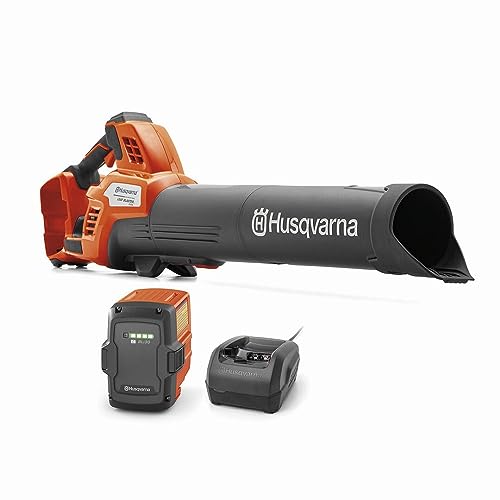
Best Runtime: Husqvarna Leaf Blaster 350iB
Wirecutter and TechGearLab both highlight the Husqvarna’s exceptional runtime. At 30 minutes on high speed, it outlasts most competitors by 5 to 10 minutes, critical for large properties.
- Airflow: 620 CFM / 132 MPH
- Battery: 40V Lithium-Ion (included)
- Runtime: 30 minutes on high; 60+ minutes on eco mode
- Weight: 10 lbs with battery
- Noise Level: 59 dB (eco) to 69 dB (boost)
- Key advantage: Boost mode provides temporary power surge for wet leaves; excellent ergonomic balance
Yard application: Best for large, open properties where you need sustained blowing without battery swaps. The lightweight design reduces fatigue during 30+ minute sessions.
Best Low-Noise: Ryobi 40V HP Brushless Whisper Series
Stihl pioneered noise reduction systems, but Ryobi’s Whisper Series brings low-noise technology to a more accessible price point. At 59 dB on low, it’s quieter than normal conversation.
- Airflow: 730 CFM / 170 MPH
- Battery: 40V Lithium-Ion (included)
- Runtime: Up to 45 minutes on low; 20 minutes on turbo
- Weight: 11.5 lbs with battery
- Noise Level: 59 dB (low) to 67 dB (turbo)
- Key advantage: Brushless motor increases efficiency and reduces noise; compatible with Ryobi 40V battery ecosystem
Yard application: Perfect for early-morning or evening leaf cleanup in noise-sensitive neighborhoods. Also ideal for professionals working near occupied buildings.
Best Value: Greenworks 40V Brushless Leaf Blower
Greenworks delivers strong performance at a lower price point, especially if you already own Greenworks 40V or 80V outdoor equipment. The battery platform compatibility adds significant value.
- Airflow: 550 CFM / 130 MPH
- Battery: 40V Lithium-Ion (included)
- Runtime: Up to 35 minutes on high
- Weight: 9.5 lbs with battery
- Noise Level: 61 dB (low) to 70 dB (high)
- Key advantage: Budget-friendly entry point; shares batteries with Greenworks mowers, trimmers, and chainsaws
Yard application: Excellent for homeowners with yards under 7,000 square feet who want a complete cordless ecosystem without premium pricing.
How to Choose: Diagnostic Decision Matrix
Use this step-by-step diagnostic to match a blower to your specific needs:
Step 1: Measure Your Yard
- Measure total square footage of areas requiring leaf blowing (lawn, driveway, walkways, garden beds)
- Add 20% buffer for irregular shapes and obstacles
- Classify your yard size: Small (under 5,000 sq ft), Medium (5,000 to 12,000 sq ft), Large (12,000+ sq ft)
Step 2: Assess Debris Type
| Debris Condition | Required CFM | Required MPH | Recommended Models |
|---|---|---|---|
| Dry, loose leaves | 400 to 550 | 100 to 130 | Greenworks 40V, Ryobi 40V |
| Damp, partially matted leaves | 550 to 650 | 130 to 150 | Husqvarna 350iB, EGO LB7654 |
| Wet, heavy leaves or mixed debris | 650 to 800 | 150 to 200 | EGO LB7654 (turbo mode) |
| Pine needles, acorns, small rocks | 500+ | 140+ | Any premium model with turbo |
Step 3: Consider Noise Restrictions
Many municipalities now enforce noise ordinances for outdoor power equipment. Check your local regulations before purchasing. If noise is a concern:
- Look for models rated under 65 dB on low speed
- Consider backpack models, which position the motor away from your ears
- Verify the blower meets OSHA equipment safety regulations if using for commercial purposes
Step 4: Evaluate Battery Ecosystem
If you already own cordless outdoor equipment, prioritize brands with compatible battery platforms. This saves $100 to 200 per additional battery purchase and ensures you can swap batteries between tools during extended yard work sessions.
For a deeper analysis of power source tradeoffs, see our gas or electric leaf blower comparison guide.
Cordless vs. Gas: Performance Reality Check
The cordless vs. gas debate has shifted dramatically since 2023. Modern 56V and 80V cordless blowers now match or exceed most residential gas blowers in CFM output. Here’s the honest comparison:
| Factor | Cordless | Gas |
|---|---|---|
| Maximum CFM | 600 to 800 | 700 to 1,000+ |
| Startup | Instant (push button) | Pull cord or electric start |
| Maintenance | Minimal (clean air filter annually) | Regular (oil changes, spark plugs, fuel stabilizer) |
| Noise | 59 to 75 dB | 70 to 100+ dB |
| Runtime | 20 to 45 minutes per charge | 30 to 60+ minutes per tank |
| Weight | 9 to 13 lbs | 10 to 15 lbs |
| Emissions | Zero | Carbon monoxide, hydrocarbons |
| Operating Cost | Electricity (~$0.05/charge) | Fuel + maintenance (~$0.50 to 1.00/hour) |
Bottom line: For 90% of homeowners, cordless blowers now provide sufficient power. Gas remains necessary only for commercial landscapers clearing large properties continuously or those dealing with extreme debris volume.
Handheld vs. Backpack: Which Form Factor?
Your choice between handheld and backpack cordless blowers depends on session duration and physical comfort:
Handheld Cordless Blowers
- Weight: 9 to 13 lbs total
- Best for: Sessions under 30 minutes, small to medium yards
- Advantages: Lower cost, easier storage, lighter weight
- Limitations: Arm fatigue during extended use; limited battery capacity
Backpack Cordless Blowers
- Weight: 15 to 22 lbs (distributed across shoulders and back)
- Best for: Sessions over 30 minutes, large properties, commercial use
- Advantages: Higher battery capacity, reduced arm fatigue, often higher CFM
- Limitations: Higher cost, bulkier storage, heavier overall
For a detailed comparison of these form factors, read our backpack vs handheld blowers analysis.
Maintenance and Troubleshooting
Cordless blowers require minimal maintenance compared to gas models, but proper care extends battery life and maintains performance.
Battery Care Protocol
Lithium-ion batteries degrade faster if mistreated. Follow these steps to maximize battery lifespan (typically 3 to 5 years with proper care):
- Storage: Keep batteries at 40 to 60% charge when not in use for extended periods. Never store fully charged or fully depleted.
- Temperature: Store indoors between 50 to 80°F. Extreme cold temporarily reduces capacity; extreme heat causes permanent damage.
- Charging: Use only manufacturer-approved chargers. Avoid charging immediately after heavy use, let the battery cool for 15 to 20 minutes first.
- Cleaning: Wipe battery contacts with a dry cloth monthly. Never use water or solvents on battery terminals.
Common Issues and Solutions
| Problem | Likely Cause | Solution |
|---|---|---|
| Blower won’t start | Dead battery or loose connection | Charge battery fully; reseat battery until it clicks |
| Reduced airflow | Clogged air intake or debris in nozzle | Remove battery; clear intake screen and nozzle with compressed air |
| Battery drains quickly | Cold weather or old battery | Warm battery to room temperature before use; replace if over 3 years old |
| Motor overheating | Continuous turbo use or blocked airflow | Take 5-minute breaks every 15 minutes; ensure intake is unobstructed |
| Unusual noise or vibration | Loose screws or damaged fan | Tighten all housing screws; inspect fan blades for cracks (replace if damaged) |
Seasonal Maintenance Schedule
- Before fall season: Fully charge and test all batteries; clean air intake; inspect nozzle for cracks
- After each use: Empty debris from nozzle; wipe down housing; store battery at 40 to 60% charge
- End of season: Deep clean air filter; lubricate any moving parts per manufacturer instructions; store batteries indoors
- Annually: Inspect fan blades, check all fasteners, test battery capacity against original specifications
For comprehensive outdoor tool maintenance, including chainsaws and other equipment, visit our chainsaw and outdoor tool maintenance resource center.
Real-World Performance Expectations
Understanding what cordless blowers can and cannot do prevents frustration and ensures you select the right tool:
What Cordless Blowers Handle Well
- Dry leaves on flat surfaces (lawns, driveways, sidewalks)
- Grass clippings after mowing
- Light snow dusting (under 1 inch)
- Dust and debris from garages, workshops, and patios
- Pine needles and small twigs
Limitations to Accept
- Wet, heavy leaf piles may require multiple passes or a rake assist
- Deep snow removal (over 2 inches) requires a dedicated snow blower
- Large branches and heavy debris need manual removal
- Continuous commercial use (8+ hours daily) still favors gas or plug-in electric
Technique Tips for Maximum Efficiency
- Work with the wind: Position yourself upwind so the breeze assists leaf movement
- Blow in sections: Divide your yard into manageable zones; blow leaves toward a central collection point
- Use variable speed: Reduce power near flower beds, mulch, and gravel to avoid scattering
- Angle the nozzle: Point slightly downward (15 to 30 degrees) for maximum ground-level force
- Overlapping passes: Overlap each blowing path by 12 to 18 inches to prevent leaving leaf strips
Final Recommendations by Use Case
Your Situation Recommended Model Why Small yard, budget-conscious Greenworks 40V Brushless Best value; sufficient power for under 5,000 sq ft Medium yard, noise-sensitive neighborhood Ryobi 40V HP Whisper Series Lowest noise; 730 CFM handles most residential tasks Large yard, maximum runtime needed Husqvarna Leaf Blaster 350iB 30-minute runtime on high; excellent ergonomics Maximum power, mixed debris types EGO Power+ LB7654 765 CFM with turbo; handles wet leaves and heavy debris Already own cordless outdoor equipment Match your existing battery platform Save $100 to 200 per battery; swap between tools
| Your Situation | Recommended Model | Why |
|---|---|---|
| Small yard, budget-conscious | Greenworks 40V Brushless | Best value; sufficient power for under 5,000 sq ft |
| Medium yard, noise-sensitive neighborhood | Ryobi 40V HP Whisper Series | Lowest noise; 730 CFM handles most residential tasks |
| Large yard, maximum runtime needed | Husqvarna Leaf Blaster 350iB | 30-minute runtime on high; excellent ergonomics |
| Maximum power, mixed debris types | EGO Power+ LB7654 | 765 CFM with turbo; handles wet leaves and heavy debris |
| Already own cordless outdoor equipment | Match your existing battery platform | Save $100 to 200 per battery; swap between tools |
For our complete rankings with detailed testing data, visit our cordless leaf blowers review page where we update scores quarterly based on new model releases and long-term reliability data.
Cordless leaf blowers have reached a tipping point where they outperform gas models for most residential applications while eliminating noise, emissions, and maintenance headaches. The models reviewed above represent the best balance of power, runtime, and value available in 2026. Choose based on your yard size, debris type, and noise requirements, and you’ll never miss the gas can.
Options Among Cordless Blowers
Cordless blowers are popular because they start without a pull cord and need less routine maintenance than gas engines. Batteries and chargers are the main costs to plan for. For general information on electrical safety in outdoor tools, see American National Standards Institute (ANSI).