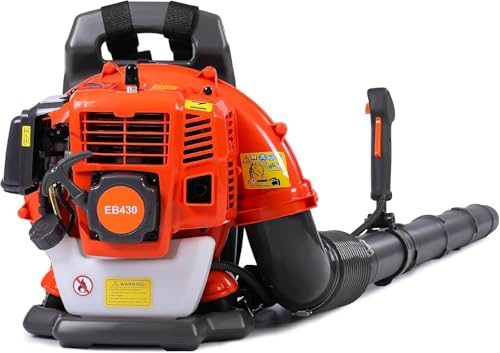
Quick Answer: What Does Cfm Mean For Leaf Blowers
CFM stands for Cubic Feet per Minute, measuring the volume of air a blower moves. For residential yards, aim for 450 to 600 CFM. For heavy-duty or commercial clearing, target 700+ CFM. Higher CFM moves more debris per pass, while MPH measures air speed for stubborn, wet leaves.

Pros
- Features a high-output Strato-Charged engine
- AutoTune carburetor provides automated fuel management
- Padded harness with waist belt and ventilated back pad
- LowVib technology helps minimize operator vibration
- Integrated service port enables quick maintenance access
Cons
- Gas engine requires routine upkeep and fuel mixing
- Bulkier footprint compared to smaller handheld units

Pros
- Cordless mobility without battery runtime limitations
- Sturdy construction suited for tough yard and property clearing
- Standard handheld configuration
Cons
- Gas engine requires manual fuel mixing and regular maintenance
- Weighs 11 pounds, which is heavier than most cordless alternatives

Pros
- Handheld design offers portable maneuverability
- Recognized Stihl BG 56 platform for property care
Cons
- Product specifications and airspeed ratings are not provided
- Gas engine requires fuel mixing and engine maintenance
Understanding CFM: The Physics of Air Volume
When evaluating outdoor power equipment, CFM (Cubic Feet per Minute) is the primary metric for air volume. It represents the total amount of air passing through the blower’s nozzle in sixty seconds. While MPH (Miles Per Hour) measures the velocity or “punch” of the air, CFM determines the “width” of the air stream and its ability to move large piles of debris.
Think of it like a river: MPH is how fast the water flows, but CFM is how wide and deep the river is. A fire hose has high MPH, but a wide river has high CFM. In leaf blowing, you need enough volume (CFM) to get under the leaves and lift them, and enough speed (MPH) to push them where you want them to go. Before finalizing equipment decisions, refer to our comprehensive how to choose leaf blower comparison.
The Mathematical Relationship
CFM is calculated by multiplying the air velocity by the cross-sectional area of the nozzle. The formula is:
CFM = Air Velocity (FPM) × Nozzle Area (sq ft)
This is why a backpack blower with a wide nozzle can have a massive CFM rating even if its MPH isn’t the highest on the market. The larger opening allows a greater volume of air to pass through, which is essential for clearing wide swaths of wet, heavy leaves.
CFM vs. MPH: Why You Need Both
A common mistake is focusing solely on MPH. High MPH without sufficient CFM results in a narrow, laser-like stream that might blow individual leaves with force but takes forever to clear a driveway. Conversely, high CFM without enough MPH creates a gentle breeze that moves dry leaves but struggles with wet grass or stuck debris.
Diagnostic Matrix: Matching Specs to Debris
Use this diagnostic guide to determine which metric matters most for your specific task:
| Debris Type | Primary Need | Recommended Specs |
|---|---|---|
| Dry leaves on pavement | Volume (CFM) | 400+ CFM, 150+ MPH |
| Wet, matted leaves | Force (MPH) | 500+ CFM, 180+ MPH |
| Grass clippings | Volume (CFM) | 450+ CFM, 160+ MPH |
| Stuck debris in cracks | Force (MPH) | 400+ CFM, 200+ MPH |
| Large commercial areas | Both (High CFM + MPH) | 700+ CFM, 200+ MPH |
For a deeper dive into power sources, check out our gas or electric leaf blower comparison.
Small Yards (Under 1/2 Acre)
For small, manicured lawns with light debris, a handheld blower in the 450 to 550 CFM range is ideal. These units are lightweight, easy to maneuver, and sufficient for weekly maintenance. If you are looking for portability, see our guide on cordless leaf blowers.
Medium Yards (1/2 to 1 Acre)
For properties with moderate tree cover, look for 550 to 700 CFM. At this level, you can handle larger piles of dry leaves and move grass clippings efficiently without excessive fatigue.
Large Yards and Commercial Properties (1+ Acres)
For expansive properties or professional landscaping, you need 700 to 1000+ CFM. Backpack blowers dominate this category because they distribute weight more evenly, allowing for extended use. For more on ergonomics, read our backpack vs handheld blowers guide.
Factors That Influence Effective CFM
The CFM rating on the box is a “free air” measurement, meaning it is measured without any resistance. In the real world, several factors reduce the effective CFM:
Nozzle Design and Attachments
Narrowing the nozzle tip increases MPH but significantly decreases CFM. If you use a concentrator nozzle for tight spaces, you are sacrificing volume for speed. Always use the widest nozzle appropriate for the task to maximize air volume.
Air Intake and Filter Maintenance
A clogged air filter restricts the engine’s ability to pull in air, directly reducing the CFM output. For gas blowers, check the filter every 10 hours of use. For electric blowers, ensure the intake vents are free of dust and debris. Regular maintenance is crucial; visit our chainsaw and outdoor tool maintenance section for general upkeep tips.
Tube Length and Diameter
Longer tubes create more friction, which can slightly reduce air velocity and volume. Ensure the tube is fully locked in place; gaps at the connection points allow air to escape, lowering the effective CFM at the nozzle.
Step-by-Step: How to Test Your Blower’s Performance
If you suspect your blower is underperforming, follow these diagnostic steps to identify the issue:
- Visual Inspection: Check the air intake and exhaust for obstructions like twigs or packed leaves.
- Filter Check: Remove the air filter. If it is grey or black with dirt, tap it out or replace it. A dirty filter is the #1 cause of lost power.
- Seal Integrity: Run the blower and feel around the tube connections. If you feel air escaping, the seals are worn or the tube isn’t seated correctly.
- Nozzle Test: Switch between the standard tube and any concentrator nozzles. If the airflow feels significantly weaker with the concentrator, it is functioning as designed (trading CFM for MPH).
Safety and Regulatory Compliance
High-powered blowers generate significant noise and can propel debris at dangerous speeds. Always wear hearing protection and safety glasses. Be aware of local noise ordinances and operational hours. For workplace safety standards, refer to OSHA equipment safety regulations.
Frequently Asked Questions About What Does Cfm Mean For Leaf Blowers
Is 400 CFM enough for a leaf blower?
400 CFM is sufficient for very light tasks, such as clearing dry grass clippings from a sidewalk or blowing dust off a driveway. It is generally considered entry-level and may struggle with large piles of leaves or wet debris.
What is a good CFM for a backpack blower?
A good backpack blower should offer at least 650 CFM. Professional-grade models often exceed 900 CFM to handle wet leaves and heavy debris on large properties.
Does higher CFM mean more noise?
Generally, yes. Higher CFM requires a more powerful motor or engine, which typically generates more noise. However, modern electric and battery-powered blowers are becoming much quieter while maintaining high air volume.
Meaning of CFM for Blowers
CFM means cubic feet per minute, which tells you the volume of air a blower moves. It works best when read alongside air speed, nozzle size and the type of debris you clear. For plain safety basics on handling blowers, consult American National Standards Institute (ANSI).