
Quick Answer: What Is A Reel Lawn Mower?
A reel lawn mower is a type of lawn mower that uses a cylindrical reel with multiple horizontal blades to cut grass. As you push the mower forward, the rotating reel spins against a stationary blade positioned below it, creating a precise scissor-like cutting action. Reel mowers are typically operated manually by pushing, though motorized versions exist. They are known…
How Does a Reel Lawn Mower Work?
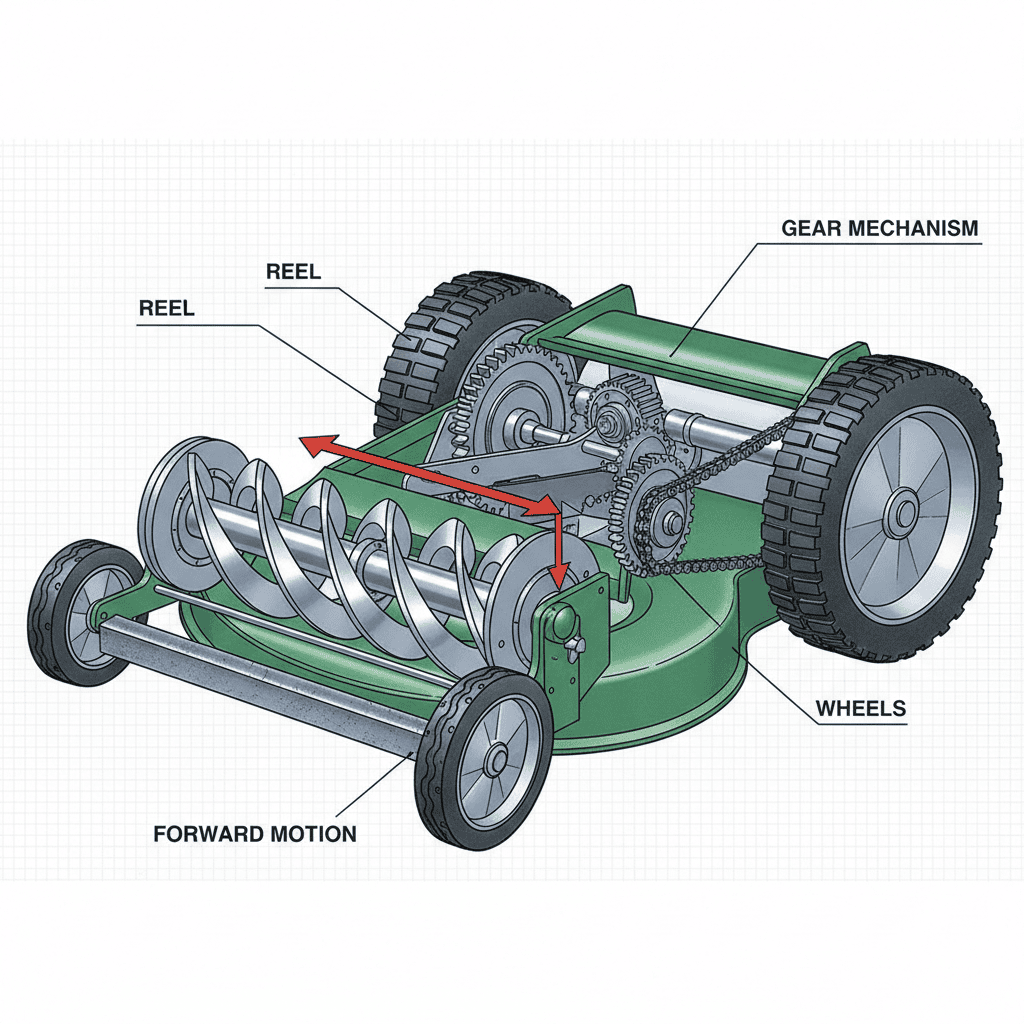
Understanding the mechanical operation of a reel mower helps explain why it produces such a precise cut.
The Basic Cutting Mechanism
A reel lawn mower operates on a simple but effective principle: the rotating reel blade works in tandem with a stationary blade called the bedknife. The reel contains 5 to 10 curved blades arranged in a spiral pattern around a horizontal cylinder. As the reel rotates, each blade passes over the bedknife, and the grass caught between them is cut cleanly, similar to how scissors work.
The Role of Forward Motion
Unlike rotary mowers that rely solely on blade speed to cut grass, reel mowers depend on forward motion to function effectively. When you push the mower forward, the wheels drive a gear system that causes the reel to spin. The faster you push, the faster the reel rotates. This direct mechanical link between forward motion and blade rotation means that reel mowers cannot cut grass effectively if you stand still, you must keep moving for the blades to turn and cut.
Scissor-Cut Grass Quality
The scissor-like cutting action of reel mowers produces a clean cut at the grass blade’s edge, rather than the tearing or bruising that can occur with rotary mowers. This clean cut reduces water loss from the grass blade and promotes faster healing, resulting in healthier-looking turf with a fine, uniform appearance.
Manual vs. Motorized Reel Mowers
Reel mowers come in two primary variations, each suited to different user preferences and lawn sizes.
Manual Reel Mowers
Manual reel mowers are powered entirely by human effort. You push the mower forward, and the wheels mechanically drive the reel through a gear system. These mowers are:
- Lightweight and easy to maneuver
- Quiet and emission-free
- Require no fuel, oil, or electricity
- Ideal for small to medium lawns (under 5,000 square feet)
- More physically demanding than motorized options
Manual reel mowers are popular among environmentally conscious homeowners and those with smaller properties who don’t mind the physical exertion.
Motorized Reel Mowers
Motorized reel mowers use a gasoline or electric motor to power the reel, reducing the physical effort required. They are: For complementary field maintenance guidelines, examine our breakdown of marshall stanmore iii vs harman kardon onyx studio 8.
- Suitable for larger lawns (5,000+ square feet)
- Less physically demanding to operate
- Available in gas-powered and electric models
- More expensive than manual versions
- Require regular maintenance (gas models) or battery charging (electric models)
Motorized versions are better suited for homeowners with larger properties or those who prefer not to rely on manual pushing power.
Key Characteristics of Reel Lawn Mowers
Cutting Height Range
Reel mowers typically offer cutting heights between 0.5 inches and 3.5 inches, though some specialty models can cut lower. Most standard residential reel mowers operate in the 1.5 to 2.5-inch range, which is ideal for maintaining a neat, manicured appearance. The cutting height is usually adjusted by raising or lowering the wheels relative to the reel. To evaluate matched hardware tolerances, consult our detailed overview of dyson v8 cyclone vs bissell featherweight stick.
Cutting Width
Reel mowers typically have cutting widths ranging from 14 to 20 inches for residential models. Wider decks cover more ground per pass but are heavier and more difficult to maneuver in tight spaces. Narrower decks are lighter and more agile but require more passes to mow the same area.
Blade Configuration
The number of blades on the reel affects the quality and frequency of cuts. Mowers with more blades (8-10) produce more cuts per unit of distance traveled, resulting in a finer, more uniform cut. Mowers with fewer blades (5-7) are lighter and easier to push but may leave a slightly less refined finish. When planning workspace deployment, consider the engineering criteria outlined in our bissell crosswave hydrosteam vs shark stainforce guide.
Maintenance Requirements
Reel mowers require regular maintenance to function optimally:
- Blade sharpening: The reel and bedknife must be kept sharp and properly adjusted for a clean cut. Dull blades tear grass rather than cut it cleanly.
- Reel-to-bedknife adjustment: The gap between the reel and bedknife must be properly calibrated. Too tight, and the mower becomes difficult to push; too loose, and grass won’t be cut cleanly.
- Lubrication: Regular oiling of the reel bearings and gear system keeps the mower operating smoothly.
- Cleaning: Grass clippings and debris should be removed after each use to prevent rust and buildup.
Motorized models also require engine maintenance, including oil changes, spark plug replacement, and seasonal tune-ups.
Reel Mowers vs. Rotary Mowers
The most common alternative to reel mowers is the rotary mower, which uses a single horizontal blade spinning at high speed. Understanding the differences helps you choose the right mower for your needs.
Cutting Mechanism
Reel mowers use a scissor-like cutting action with multiple blades, producing a clean, precise cut. Rotary mowers use a single blade spinning at high speed (3,000+ RPM) that impacts and tears grass blades. The rotary action is less precise but more forgiving of uneven terrain and taller grass.
Cut Quality
Reel mowers produce a superior cut quality with minimal grass blade damage. This clean cut is especially beneficial for fine turf grasses and manicured lawns. Rotary mowers can leave torn or ragged grass blade edges, particularly if the blade is dull. However, for general homeowner use, the difference is often not visually significant.
Grass Type Compatibility
Reel mowers perform best on:
- Fine, uniform grass species (bentgrass, bluegrass, perennial ryegrass)
- Well-maintained, manicured lawns
- Lower cutting heights
Rotary mowers are more versatile and perform well on:
- Coarse grass species (tall fescue, zoysia)
- Unmaintained or overgrown lawns
- Higher cutting heights
- Uneven terrain
Terrain and Conditions
Rotary mowers handle rough, uneven terrain better because the blade doesn’t need to contact every blade of grass. Reel mowers require relatively level, well-maintained lawns to function properly. Bumps and dips can cause uneven cutting or scalping (cutting too short in some areas).
Noise and Emissions
Manual reel mowers are silent and produce zero emissions. Motorized reel mowers are quieter than rotary mowers of similar power. Gas-powered rotary mowers produce significant noise and emissions, while electric rotary mowers are quieter but still louder than reel mowers.
Cost Comparison
Manual reel mowers are typically the least expensive option ($150-$400). Motorized reel mowers range from $500-$2,000+. Rotary mowers vary widely but generally range from $200-$1,500 for residential models.
Benefits and Limitations of Reel Mowers
Advantages of Reel Mowers
- Superior cut quality: The scissor-like cutting action produces a clean, uniform cut that promotes lawn health.
- Environmentally friendly: Manual models produce zero emissions and require no fuel or electricity.
- Quiet operation: Manual models are silent; motorized models are quieter than rotary mowers.
- Low maintenance (manual models): No engine maintenance required for manual versions.
- Cost-effective: Manual reel mowers are affordable and have no fuel or electricity costs.
- Improved lawn health: The clean cut reduces grass blade damage and promotes faster recovery.
- Precise cutting height control: Easy adjustment for different lawn preferences.
Limitations of Reel Mowers
- Physical effort required: Manual models demand significant pushing power, which can be tiring on larger lawns.
- Requires level terrain: Uneven ground causes uneven cutting or scalping.
- Not ideal for tall or thick grass: Reel mowers struggle with overgrown or coarse grass species.
- Maintenance-intensive: Requires regular blade sharpening and reel-to-bedknife adjustment for optimal performance.
- Slower mowing speed: Manual models require slower, more deliberate pushing compared to rotary mowers.
- Limited cutting width: Smaller cutting decks mean more passes required for large lawns.
- Motorized models are expensive: Motorized reel mowers cost significantly more than manual versions.
Best Lawn Conditions for Reel Mowers
Reel mowers are best suited for:
- Small to medium-sized lawns (under 10,000 square feet for manual models)
- Well-maintained, level terrain
- Fine, uniform grass species
- Homeowners who prioritize cut quality and lawn health
- Properties where quiet operation is important
- Environmentally conscious users
- Lower cutting heights (under 3 inches)
Frequently Asked Questions About Reel Lawn Mower
Can a reel mower cut thick or overgrown grass?
Reel mowers are not ideal for thick, overgrown, or coarse grass. The scissor-like cutting mechanism works best on well-maintained turf. If grass is too tall or dense, the reel may not rotate effectively, or you may need to make multiple passes. For severely overgrown lawns, a rotary mower is a better choice.
How often do reel mower blades need sharpening?
Blade sharpening frequency depends on lawn size and mowing frequency. For typical residential use, professional sharpening once per season is recommended. Some users sharpen blades more frequently (every 2-3 months) for optimal cut quality. Dull blades should be sharpened promptly, as they tear grass rather than cut it cleanly.
Are manual reel mowers suitable for large lawns?
Manual reel mowers are practical for lawns up to about 5,000 square feet, though some users successfully maintain larger properties. Beyond this size, the physical effort becomes substantial. For lawns larger than 10,000 square feet, a motorized reel mower or rotary mower is more practical.
What is the difference between a reel mower and a cylinder mower?
These terms are often used interchangeably. A cylinder mower is another name for a reel mower, referring to the cylindrical shape of the rotating reel. There is no functional difference between the two terms.