Quick Answer
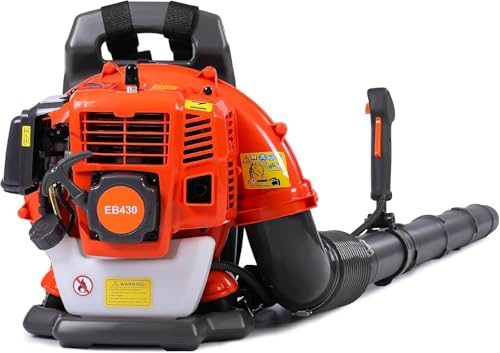
The best leaf blower for most yards is a cordless handheld rated around 600 to 650 CFM for typical leaves. For wet oak, pine needles, or very large lots, a 700 CFM or higher backpack blower works better. Runtime is the real limit, so plan for about 15 to 30 minutes per charge at high speed.

Pros
- Features a high-output Strato-Charged engine
- AutoTune carburetor provides automated fuel management
- Padded harness with waist belt and ventilated back pad
- LowVib technology helps minimize operator vibration
- Integrated service port enables quick maintenance access
Cons
- Gas engine requires routine upkeep and fuel mixing
- Bulkier footprint compared to smaller handheld units

Pros
- Cordless mobility without battery runtime limitations
- Sturdy construction suited for tough yard and property clearing
- Standard handheld configuration
Cons
- Gas engine requires manual fuel mixing and regular maintenance
- Weighs 11 pounds, which is heavier than most cordless alternatives

Pros
- Handheld design offers portable maneuverability
- Recognized Stihl BG 56 platform for property care
Cons
- Product specifications and airspeed ratings are not provided
- Gas engine requires fuel mixing and engine maintenance
Every fall, the same question lands in my service bay and my inbox: what is the best blower for leaves? The honest answer is that “best” is a physics problem before it is a shopping problem. A blower that moves 700 cubic feet of air per minute (CFM) through a narrow 2-inch nozzle will underperform a 500 CFM unit with a wide, flat concentrator nozzle on the same lawn, because what moves leaves is not raw fan output, it is the momentum delivered to a specific patch of ground. This guide breaks down the exact physics, the diagnostic steps to size a blower to your yard, and the maintenance intervals that keep any unit running for a decade.
How A Leaf Blower Actually Moves Leaves: The Physics
A leaf blower is a centrifugal fan in a housing. Air enters axially, is flung outward by the impeller, and exits through a nozzle. Two numbers define its performance, and they work against each other: To evaluate matched hardware tolerances, consult our detailed overview of how to choose leaf blower.
CFM vs. MPH: Air Volume vs. Air Velocity
CFM (cubic feet per minute) is volume, how much air the fan moves. MPH (miles per hour) is velocity, how fast that air exits the nozzle. The force a blower applies to a leaf is governed by momentum: Force ≈ mass-flow × velocity. Mass-flow is directly proportional to CFM. So a blower’s effective “push” scales with CFM multiplied by velocity, which is why manufacturers quote both.
| Blower Class | Typical CFM | Typical MPH | Best For |
|---|---|---|---|
| Budget handheld (20V-40V) | 300 to 450 | 100 to 130 | Patios, driveways, light dry leaves |
| Mid-range handheld (56V) | 500 to 650 | 140 to 170 | Suburban lots up to ½ acre, mixed dry/damp leaves |
| Pro handheld (56V-80V) | 650 to 800 | 170 to 200 | Large lots, wet leaves, pine needles, post-storm cleanup |
| Backpack (gas or battery) | 700 to 1,100+ | 150 to 250 | Acre-plus properties, heavy wet oak, commercial work |
Notice the inverse relationship in the table: as CFM climbs, MPH often drops, because the same motor power is spread over more air. This is why nozzle design matters. A flat “fan” nozzle spreads air wide for sweeping dry leaves off a lawn; a round concentrator nozzle focuses the stream for digging into wet piles. The best units ship with both.
Why Wet Leaves Are 3× Harder To Move
Water adds mass. A wet oak leaf can weigh 2 to 3× its dry weight, and the surface tension of water films glues leaves to grass blades and to each other. To break that bond you need higher static pressure, the ability of the airstream to push against resistance, not just more CFM. This is the single most common reason buyers are disappointed: they buy a 450 CFM unit for a yard full of wet maple, and it simply cannot break the leaves free. Rule of thumb: if your leaves are routinely wet or matted, size up one full class (e.g., from mid-range handheld to pro handheld or backpack).
Step-By-Step: How To Size A Blower To Your Yard
Work through these five steps before you spend a dollar. They take ten minutes and will save you from buying the wrong tool.
Step 1: Measure Your Clearing Area
Walk your property and estimate the square footage you actually clear each fall, not your total lot size. A 1-acre lot with a 2,000 sq ft lawn, a driveway, and a patio is effectively a “half-acre job.” If your real clearing area is under 5,000 sq ft, a mid-range handheld is plenty. Over 20,000 sq ft, look at backpack units.
Step 2: Identify Your Leaf Type
Tree species determine leaf mass and matting behavior:
- Maple, birch, poplar, light, dry easily, move well with 400+ CFM.
- Oak, heavy, leathery, holds water. Minimum 600 CFM, preferably a backpack.
- Pine, spruce, fir needles, small, dense, pack into turf. Need high velocity (170+ MPH) and a concentrator nozzle.
- Sycamore, sweetgum, large, heavy, blow around unpredictably. High CFM with a wide nozzle.
Step 3: Assess Your Terrain
Flat turf is the easiest surface. Gravel driveways are harder, too much velocity lifts stones and can crack siding or windows. Steep slopes make heavy backpacks punishing; a lighter handheld with a shoulder strap is safer. Dense ground cover (ivy, tall grass) requires more static pressure than open lawn.
Step 4: Estimate Runtime Needs
Battery runtime is the Achilles’ heel of cordless. Manufacturers quote runtime at the lowest speed setting; real-world high-speed runtime is typically 40 to 60% of that figure. A unit rated “up to 30 minutes” will realistically deliver 15 to 18 minutes on high, and 8 to 12 minutes on turbo. If your cleanup takes 45+ minutes, you need either two batteries, a rapid charger, or a gas unit. For context on the tradeoffs, see our gas or electric leaf blower comparison.
Step 5: Match Weight To Your Physical Capacity
Handheld units weigh 6 to 9 lbs bare, 8 to 12 lbs with battery. Backpack units weigh 15 to 25 lbs fully loaded. If you have shoulder, back, or grip issues, weight is not a secondary consideration, it is the primary one. A powerful blower you cannot hold for 20 minutes is a useless blower.
Diagnostic Matrix: Matching Blower To Scenario
| Your Scenario | Recommended Class | Target Specs | Why |
|---|---|---|---|
| Condo/townhouse patio, dry leaves | Budget handheld (20V-40V) | 350 to 450 CFM, 110 to 130 MPH | Low noise, light weight, short runtime is fine |
| ¼-acre suburban lot, mixed leaves | Mid-range handheld (56V) | 500 to 650 CFM, 140 to 170 MPH | Best balance of power, weight, and price |
| ½-1 acre, oak or wet leaves | Pro handheld or entry backpack | 650 to 800 CFM, 170+ MPH | Static pressure needed to break wet matting |
| 1+ acre, heavy pine needles | Backpack (gas or 80V battery) | 800+ CFM, 200+ MPH, concentrator nozzle | Velocity required to lift needles from turf |
| Commercial landscaping, daily use | Pro gas backpack | 900 to 1,100 CFM, tube throttle | Unlimited runtime, proven durability |
| Noise-restricted neighborhood | Cordless handheld, any class | Under 65 dB at 50 ft | Many municipalities ban gas blowers outright |
Cordless vs. Gas: The Real Tradeoffs
The cordless revolution is real, but it has boundaries. Here is the unvarnished comparison based on field use, not marketing copy.
Where Cordless Wins
- Instant start, no pull cord, no choke, no carburetor issues.
- Low noise, typically 55 to 65 dB vs. 70 to 80 dB for gas. Critical in HOA and municipal-restricted areas.
- No emissions or fuel mixing, no two-stroke oil smell, no spilled gas on the garage floor.
- Low maintenance, no spark plugs, air filters, or carburetor rebuilds.
- Shared battery platform, one 56V battery powers your blower, trimmer, chainsaw, and mower.
Where Gas Still Wins
- Runtime, a gas tank runs 45 to 90 minutes continuously. No battery matches that.
- Sustained power, no fade as the battery drains. Full CFM from first minute to last.
- Refuel in seconds, vs. 30 to 60 minutes for a battery recharge, even with a rapid charger.
- Cold-weather performance, lithium-ion loses 20 to 40% of its capacity below 32°F. Gas does not.
For a deeper dive into both platforms, read our cordless leaf blowers guide and the full gas or electric leaf blower comparison.
Handheld vs. Backpack: Which Form Factor Fits
Form factor is not a luxury choice, it determines how long you can work before fatigue degrades your technique. A tired operator holds the nozzle too high, scatters leaves instead of moving them, and quits early.
Handheld Blowers
Best for lots under half an acre, quick patio/driveway cleanups, and users who value portability. Weight is carried entirely by one arm and shoulder. Modern 56V handhelds with turbo buttons deliver surprising bursts of power for digging into piles, but sustained high-speed use fatigues most people in 20 to 30 minutes. A shoulder strap is not optional, use it.
Backpack Blowers
Best for acre-plus properties, heavy wet leaves, and commercial work. Weight is distributed across both shoulders and hips via a padded harness, allowing 60 to 90 minute sessions. The tradeoff: higher cost, more weight to store, and a learning curve for tube-throttle control. If you have significant tree coverage and clear leaves for more than 30 minutes at a time, a backpack pays for itself in reduced fatigue. Our backpack vs handheld blowers guide covers this in depth.
Nozzle Physics: The Most Overlooked Performance Lever
You can double the effective performance of a blower by changing the nozzle, no motor upgrade required. Here is why:
When you constrict the exit area of a blower tube, the same CFM is forced through a smaller opening, and velocity increases (continuity equation: Q = A × v, so if area A drops, velocity v rises for constant flow Q). This is Bernoulli’s principle in action. The practical effect:
- Round concentrator nozzle, narrow exit, high velocity. Use for pine needles, wet leaves stuck in turf, gravel driveways (carefully), and digging into piles.
- Flat fan nozzle, wide exit, lower velocity, broader coverage. Use for sweeping dry leaves across open lawn, clearing light snow off walkways, and drying wet surfaces.
- Ridge/scraper nozzle, some units include a notched tip that “cuts” into matted leaves, breaking the surface tension before the main airstream lifts them.
Pro technique: start with the concentrator to break leaves free from turf and edges, then switch to the flat nozzle to sweep the loosened material into piles. Two passes, two nozzles, half the effort.
Maintenance Intervals: Keeping Any Blower Running
Whether you spend $80 or $800, maintenance is what separates a 2-season tool from a 10-season tool. Follow this schedule:
| Task | Cordless | Gas | Why It Matters |
|---|---|---|---|
| Inspect/clean air intake screen | Every use | Every use | Blocked intake drops CFM by 20 to 40% |
| Check impeller for debris | Monthly in season | Monthly in season | Twigs and gravel chip the fan, causing vibration |
| Clean or replace air filter | N/A | Every 10 to 15 hours | Dirty filter richens the mixture, fouls plugs |
| Replace spark plug | N/A | Annually | Hard starting is usually a plug problem |
| Drain/stabilize fuel | N/A | End of season | Ethanol-blended gas gums carburetors in 30 to 60 days |
| Battery storage charge | Store at 40 to 60% | N/A | Full charge degrades lithium cells; deep discharge kills them |
| Battery storage temperature | Indoors, above freezing | N/A | Freezing destroys cells permanently |
| Inspect tube/nozzle cracks | Annually | Annually | Cracks leak pressure and cut effective CFM |
| Lubricate throttle linkage | N/A | Annually | Sticky throttles cause surging and poor idle |
For chainsaw and shared outdoor power equipment maintenance, especially if you run a multi-tool battery platform, see our chainsaw and outdoor tool maintenance guide.
Common Diagnostic Problems And Fixes
Problem: Blower Runs But Barely Moves Leaves
Diagnosis: Check the air intake screen first, a clogged screen is the number one cause of weak output. Next, inspect the impeller for cracked or missing vanes (usually caused by vacuuming up gravel). Finally, check for cracks in the tube or housing that leak pressure. If all three are clear, the unit is simply undersized for the task; you need a higher-CFM class.
Problem: Battery Dies In Under 10 Minutes
Diagnosis: You are likely running turbo/high speed continuously. Turbo mode can draw 2 to 3× the current of high speed. Use high for bulk work and reserve turbo for 30-second bursts into piles. If runtime is still inadequate, the battery may be aged, lithium cells lose 20%+ capacity after 300 to 500 full cycles. A replacement battery often restores “like-new” runtime for a fraction of the cost of a new tool.
Problem: Gas Blower Won’t Start Or Runs Rough
Diagnosis: Nine times out of ten it is fuel. Old ethanol-blended gas degrades in 30 to 60 days, gumming the carburetor and clogging the main jet. Drain the tank, replace fuel with fresh ethanol-free gas mixed at the correct ratio (typically 50:1 for modern two-strokes), and clean or replace the spark plug. If it still won’t start, the carburetor likely needs a rebuild kit ($15-$25), a straightforward DIY job.
Problem: Excessive Vibration Or Noise
Diagnosis: On gas units, check engine mounts and the throttle cable adjustment. On any unit, inspect the impeller for imbalance, a single pebble lodged against a vane creates noticeable vibration and will eventually crack the housing. Turn the unit off, remove the tube, and spin the impeller by hand while watching for wobble or contact.
Safety And Noise Compliance
Leaf blowers are among the most frequently regulated outdoor power tools in the United States. Many municipalities restrict or ban gas blowers by decibel level or time of day. Before purchasing, check your local ordinances, a powerful gas blower you cannot legally use is a wasted investment. For workplace use (landscaping crews, property management), employers must comply with OSHA equipment safety regulations on noise exposure, hearing protection, and machine guarding.
Personal safety basics: always wear eye protection (debris kicks up constantly), hearing protection for gas units and high-CFM cordless, sturdy closed-toe shoes, and never point the nozzle at people, pets, or fragile surfaces at close range. On gravel, reduce velocity to avoid projectile stones.
Common Questions on What Is The Blower For Leaves Answered
Is 650 CFM enough for most yards?
Yes. For typical suburban lots under half an acre with mixed deciduous leaves, 600 to 650 CFM at 150 to 170 MPH is the sweet spot. It has enough static pressure to lift damp leaves without being so powerful that you lose control on gravel or light debris.
How long should a cordless leaf blower last?
The tool itself, motor, housing, electronics, routinely lasts 8 to 12 years with basic care. The battery is the wear item: expect 3 to 5 years or 300 to 500 full charge cycles before noticeable capacity loss. Store batteries indoors at 40 to 60% charge to maximize lifespan.
Are backpack blowers worth the extra cost?
If you clear more than 30 minutes at a time, have over half an acre, or deal with heavy wet leaves regularly, yes. The harness distributes weight across your torso instead of one shoulder, reducing fatigue dramatically. For small patios and quick cleanups, a handheld is more convenient and just as effective.
Can I use a leaf blower for snow?
Yes, for light powdery snow (under 2 inches) on walkways, decks, and vehicles. High-CFM units with a flat nozzle work best. Wet, heavy snow will not move, you need a shovel or snow blower for that.
Final Verdict: Choosing the Right What Is The Blower For Leaves
The best blower for leaves is the one matched to your yard’s actual physics: area, leaf type, moisture, and your own stamina. For most homeowners, a 56V cordless handheld rated 600 to 650 CFM with both a concentrator and flat nozzle covers 90% of real-world scenarios with minimal maintenance and neighborhood-friendly noise. Step up to a backpack, gas or high-voltage battery, only when your clearing time exceeds 30 minutes or your leaves are routinely wet and heavy. Buy the nozzle kit, follow the maintenance schedule, and any quality blower will serve you for a decade.
Blowers Suited to Fallen Leaves
Leaves are light but can clump on wet lawns, so a blower with steady airflow and a slim nozzle often works well. Choose a model that is comfortable to hold for long stretches. Those who handle blowers often find American National Standards Institute (ANSI) a helpful reference for safety.