Quick Answer
The best electric leaf blower depends on whether you need cord-free freedom or steady power near an outlet. Cordless models suit most yards, while corded units work well for small areas close to an outlet. Match airflow to the debris you handle, and pick a battery platform you already own when possible.

Pros
- 3-in-1 design switches tool-free between modes
- Six-blade metal impeller with rated 16:1 mulching
- Delivers up to 500 CFM and 210 MPH airflow
- Includes 6.0Ah ARC Lithium battery and 320W charger
- Weather-resistant IPX5-rated housing
Cons
- Relatively heavy package at 28 pounds
- Maximum 90-minute runtime applies only to low setting

Pros
- Delivers up to 880 CFM and 200 MPH air speed in turbo mode
- Includes two 4.0Ah 56V ARC Lithium batteries for extended runtime
- Integrated digital display monitors charge level and cruise lock
- Variable speed dial easily adjusts output from 270 to 700 CFM
- Includes both tapered and spread nozzles for task versatility
Cons
- Maximum 880 CFM power is restricted to short turbo bursts
- Full runtime of up to 90 minutes requires lower power settings

Pros
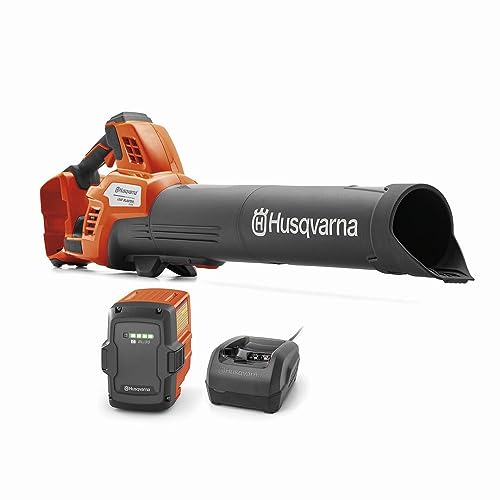
- Includes an AK 20 battery pack
- Comes with an AL 101 dedicated charger
- Cordless design eliminates engine fuel maintenance
- Compact footprint measuring under 40 inches long
Cons
- Runtime and airflow ratings are not specified
- Battery platform limits use across non-Stihl tools
Why “Best” Is A Physics Problem, Not A Brand Problem
Every retailer ranking and lab test converges on the same conclusion: the right electric leaf blower depends on your yard’s debris load, not on a single winning model. The EGO Power+ 615 CFM (LB6151) is the strongest value pick at 615 CFM and 176 MPH on a 56V platform, but a 7-amp corded BLACK+DECKER at 180 CFM will outperform it per dollar on a small paved driveway. The physics below tells you which one to buy.
The Two Numbers That Actually Matter: CFM vs MPH
Manufacturers advertise two airflow specs, and they measure different things: For troubleshooting and reliability insights, consult our in-depth how to choose leaf blower report.
| Spec | Unit | What It Measures | What It Governs |
|---|---|---|---|
| CFM | Cubic feet per minute | Volume of air moved per minute | How much debris you can move at once (leaf piles, wet leaves, gravel) |
| MPH | Miles per hour | Velocity of air at the nozzle | How hard you can dislodge stuck debris (mud, wet grass, leaves stuck in turf) |
Force on a leaf scales with the square of velocity (F ∝ ρAv²), but the amount of material you clear scales with volume flow (CFM). A 200 MPH blower with 90 CFM will blow a single wet leaf off concrete but cannot move a pile. A 615 CFM blower at 176 MPH does both. This is why the EGO 615 and the Husqvarna Leaf Blaster 350iB (rated at hurricane-force output in lab tests) dominate rankings, while 180 MPH / 180 CFM corded units are limited to light, dry debris.
Sizing Table: Match CFM To Your Yard
| Yard / Debris Profile | Minimum CFM | Recommended Type | Typical Runtime Need |
|---|---|---|---|
| Small patio, driveway, light dry leaves (<1,500 sq ft) | 150 to 350 | Corded 7 to 12 amp handheld | Unlimited (corded) |
| Suburban lot, mixed dry leaves, 1/4 acre | 400 to 550 | 40V-56V cordless handheld | 25 to 45 min per charge |
| Heavy oak/maple, wet leaves, 1/3 to 1/2 acre | 550 to 700 | 56V-80V cordless or backpack | 45 to 75 min, 2 batteries |
| 1+ acre, dense canopy, hills, gravel | 700+ (or gas-equivalent) | Backpack electric (80V) or gas | Extended, multi-battery |
For context on how these classes compare in real yards, see our breakdown of cordless leaf blowers and the full gas or electric leaf blower comparison.
Power Source Physics: Corded, Battery, And Why Voltage Matters
Corded Electric (7 to 12 Amp, 120V)
Power = volts × amps. A 12-amp corded blower at 120V draws 1,440 watts, roughly equivalent to a mid-tier 40V battery blower at full load, with zero runtime limit. The constraint is the extension cord itself: a 14-gauge cord under 50 feet is acceptable; beyond 100 feet, use 12-gauge or you will starve the motor of voltage, cutting CFM by 20 to 30% and risking overheating. Corded units are the correct engineering choice for small, cord-accessible spaces.
Battery Electric (20V-80V)
Battery platforms are defined by pack voltage and amp-hour (Ah) rating. Energy (watt-hours) = voltage × Ah. A 56V 5.0Ah pack stores 280 Wh; a 20V 2.0Ah pack stores 40 Wh, seven times less energy. Runtime scales with watt-hours divided by motor load. The EGO 56V 7.5Ah pack (420 Wh) is why the LB6151 can sustain 615 CFM for up to 75 minutes on low. Buying the largest battery your platform offers is the single most effective upgrade, a point repeated across professional and consumer field reports.
| Voltage Class | Typical CFM Range | Best For | Trade-off |
|---|---|---|---|
| 20V | 100 to 250 | Debris, decks, light leaves | Cannot move wet or piled leaves |
| 40V | 350 to 500 | Suburban yards, dry-to-damp leaves | Runtime drops sharply under heavy load |
| 56V-60V | 500 to 650 | Most residential properties, wet leaves | Higher battery cost per pack |
| 80V | 600 to 750+ | Large lots, backpack format, hills | Heavier, premium price |
Diagnostic Matrix: Troubleshooting Weak Airflow
If your blower underperforms its published CFM, work through this matrix before assuming a defective motor. Most “weak blower” complaints trace to airflow restriction or power delivery, not the motor itself.
| Symptom | Likely Root Cause | Diagnostic Test | Fix |
|---|---|---|---|
| Airflow drops after 5 to 10 minutes | Battery voltage sag under load; thermal cutoff | Check battery temperature and charge level mid-run | Use a larger Ah pack; let battery cool 15 min; avoid storing at 0% charge |
| Weak output from day one | Extension cord too long/thin (corded); clogged intake | Swap to a shorter 12-gauge cord; inspect intake screen | Use ≤50 ft 12-gauge; clear debris from intake |
| Rattling or grinding noise | Impeller contact, debris ingestion, bearing wear | Disconnect power; spin impeller by hand; inspect for bent blades | Remove foreign object; replace impeller if blades are chipped |
| Motor runs but no air at nozzle | Cracked housing, loose tube connection, blocked tube | Inspect tube joints and interior for packed leaves | Re-seat tube; clear blockage; replace cracked housing |
| Blower cuts out intermittently | Loose battery seat; failing switch; thermal protector | Reseat battery; test with a second charged pack | Clean battery contacts; replace switch if defective |
| Reduced CFM in cold weather | Battery chemistry loses capacity below 40°F (4°C) | Compare runtime warm vs cold; check pack age | Store batteries indoors; keep a spare pack warm |
Step-By-Step: Choosing Your Blower In 5 Decisions
Step 1: Measure Your Debris Load
Walk your property and note tree types. Oak, maple, and sycamore produce heavy, wet-prone leaf mass that demands 550+ CFM. Birch, willow, and ornamental trees produce lighter litter that 400 CFM handles easily. If you mulch leaves with a mower instead of blowing, your CFM requirement drops one full class.
Step 2: Choose Corded Or Battery
Corded wins for small, flat, outlet-adjacent spaces and unlimited runtime. Battery wins for anything beyond 1/8 acre, anywhere with no outdoor outlets, or any job requiring mobility. If you already own a 20V or 40V tool battery ecosystem (DeWalt, Ryobi, Milwaukee, Greenworks), staying inside that platform saves $100-$200 versus buying a new kit.
Step 3: Decide Handheld Or Backpack
Handheld units under 8 lbs reduce fatigue for jobs under 45 minutes. Backpack format distributes weight across shoulders and hips, critical for properties over half an acre or hilly terrain. The trade-off is cost and storage. For a full comparison of formats, see backpack vs handheld blowers.
Step 4: Verify Battery Ecosystem And Warranty
Check the manufacturer’s battery platform coverage and warranty terms before purchasing. Greenworks 24V, for example, carries a 3-year tool/battery warranty; EGO and Ryobi offer multi-year coverage on 40V+ platforms. A blower is only as reliable as its battery supply chain five years from now.
Step 5: Budget For The Second Battery
Real-world field reports consistently note that runtime anxiety is the top cordless complaint. A second battery doubles effective work time for $80-$150 and eliminates the mid-job recharge stop. Factor this into your purchase price from the start.
Maintenance Intervals For Maximum CFM And Motor Life
| Interval | Task | Why It Matters |
|---|---|---|
| Every use | Empty collection bag/vacuum port; clear intake screen of leaves and grit | A clogged intake can cut CFM by 40% and overheat the motor |
| Every 5 uses | Inspect impeller for chips, cracks, or bent blades; wipe down housing vents | Damaged impellers unbalance the motor and reduce airflow efficiency |
| Monthly (heavy season) | Check battery contacts for corrosion; clean with isopropyl alcohol if needed | Corroded contacts increase resistance, causing voltage sag and weak output |
| End of season | Store batteries at 40 to 60% charge in a climate-controlled space (50 to 70°F) | Full-charge storage accelerates lithium-ion degradation; freezing kills capacity |
| Annually | Inspect power cord (corded) for nicks; test GFCI outlet; check tube joints for cracks | Damaged cords are a shock hazard and a fire risk |
Outdoor power equipment maintenance follows the same principles as other motorized yard tools. For cross-platform guidance on impeller care, air filter service, and seasonal storage, see our chainsaw and outdoor tool maintenance guide.
Noise, Emissions, And Neighborhood Considerations
Electric blowers typically operate at 60 to 75 dB at the operator’s ear, versus 75 to 100 dB for gas models. Many municipalities now restrict gas blowers by ordinance due to noise and two-stroke emissions. Electric units eliminate exhaust emissions at the point of use, though the electricity source still matters. For noise-sensitive neighborhoods and HOA-restricted areas, electric is often the only compliant option. Review OSHA equipment safety regulations for workplace noise exposure limits if you operate blowers professionally.
Final Recommendation By User Profile
| User Profile | Recommended Class | Specific Direction |
|---|---|---|
| Small yard / patio / driveway only | Corded 7 to 12 amp, 150 to 400 CFM | BLACK+DECKER LB700 class or equivalent 12-amp unit; no battery cost |
| Suburban 1/4 acre, mixed leaves | 40V-56V cordless, 400 to 600 CFM | EGO Power+ 615 CFM (LB6151) or Ryobi 40V; buy the 2-battery kit |
| Heavy oak/maple, wet leaves, 1/3 to 1/2 acre | 56V-80V cordless, 600+ CFM | EGO 56V with 7.5Ah pack or Greenworks 80V; Husqvarna 350iB for max thrust |
| 1+ acre, hills, dense canopy | Backpack 80V or gas | Greenworks 80V backpack or EGO backpack; gas only if runtime demands exceed battery budget |
| Already invested in a 20V tool platform | 20V-60V compatible blower | DeWalt 20V MAX or Milwaukee M18 FUEL; reuse existing batteries |
The EGO Power+ 615 CFM LB6151 remains the best overall electric leaf blower for 2026 because it hits the CFM threshold that handles wet, heavy debris while staying light enough for extended handheld use, and its 56V battery platform offers the best runtime-per-dollar in its class. Buy the largest battery you can afford, keep a spare charged, and match CFM to your actual debris load rather than chasing the highest MPH number on the box.
Electric Blowers for Routine Upkeep
Electric blowers, corded or cordless, suit routine upkeep on decks, patios and modest lawns. Corded models need a nearby outlet and a safe extension cord, while cordless models depend on battery charge. Broad guidance on electrical safety for outdoor tools sits at American National Standards Institute (ANSI).