Mechanical safety standards, operational tolerances, and protective gear guidelines align with benchmark specifications established by the American National Standards Institute (ANSI).
For more hands-on benchmarks and buying recommendations, consult our guides on residential zero-turn lawn mower guide.
Quick Answer: What Is The Best Line Trimmer?
There is no universal best line trimmer. Choose the tool whose power source, cutting head, weight, and compatible trimmer line fit your vegetation, yard size, terrain, and comfort. Gas suits large or overgrown areas; battery suits most suburban lawns with less noise and no mixed fuel; corded electric suits small yards near an outlet. Match line diameter and shape to…

Pros
- Six-pack bundle listed in the product title
- Square profile line named in the product title
- Commercial 5 lb size listed for heavier use
Cons
- Trimmer compatibility is not verified in manufacturer listing

Pros
- Six-pack bundle listed in the product title
- Star profile line named in the product title
- Commercial 5 lb size listed for heavier use
Cons
- Line length and trimmer fit are not stated in manufacturer listing

Pros
- Title lists 1280 feet of line length
- Square profile named in the product title
- Lists a 5 lb line rating
- Title describes it as commercial-style line

Pros
- Title lists .095-inch square nylon line
- Lists 1280 feet of line length
- Manufacturer states fit with most string trimmers
- Lists a 5 lb line rating
What a line trimmer is—and how it differs from related yard tools
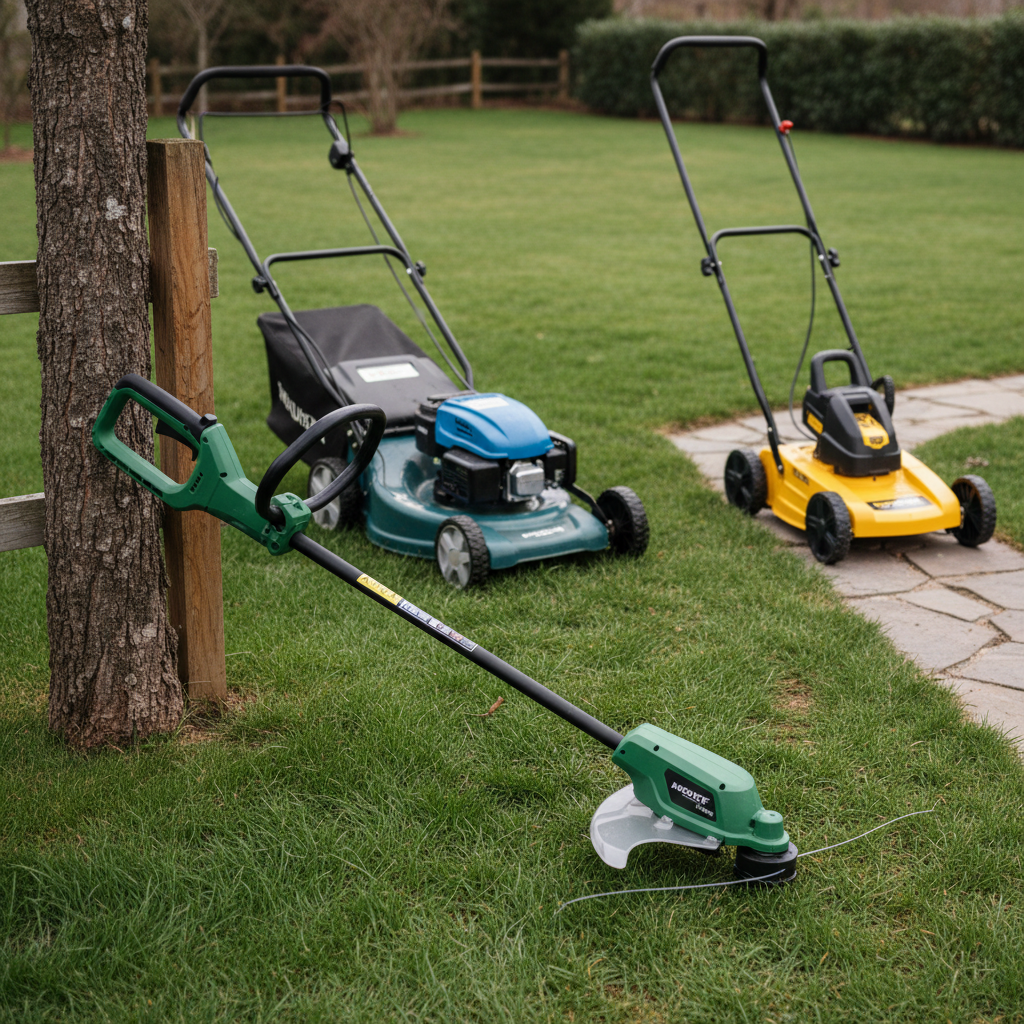
A line trimmer, also called a string trimmer, is a handheld yard tool that cuts grass and light weeds with flexible polymer line. A motor or engine spins a cutting head. Short lengths of trimmer line extend from that head and whip through vegetation. The same idea appears under informal store names, but those labels are marketing, not separate tool types.
The machine is built for edges, fence lines, tree bases, slopes, and other places a mower deck cannot reach cleanly. It is a finishing and cleanup tool, not a substitute for mowing a large open lawn. Used well, it tidies what the mower leaves. Used as a primary cutter on thick growth, it becomes slow, tiring, and hard on the line and head.
Spinning line versus a metal blade
Flexible line is the defining cutter. It can nick bark, kick stones, and snap on fences, but it is meant for grass and weeds, not woody stems. Some related tools use a metal blade or a dedicated brush-cutter head. That change raises cutting capacity, kickback risk, and the skill needed. A blade conversion is only appropriate when the manufacturer designed that setup. Retrofitting a string head with metal is not a safe improvisation.
How it differs from a mower, a lawn edger, and a brush cutter
A lawn mower uses a deck and a rigid blade (or mulching system) to cut a wide, even swath of turf at a set height. A line trimmer cannot match that width or consistency, and it should not be used to “mow” an entire yard unless the area is tiny or the mower cannot reach it.
A dedicated lawn edger is built to cut a crisp vertical edge along walks and beds, often with a rigid blade and a guide wheel. Many line trimmers can tilt or rotate for a rough edge, and some add an edging guide, but they are less precise than a purpose-built edger.
A brush cutter or clearing saw is a heavier class of tool for dense brush and woody growth. It may share a similar shaft layout, but the cutter, harness, and technique are different. If the job is saplings, brambles, or thick woody stalks, a string head is the wrong tool even if the engine is strong.
The parts that actually decide whether a setup works
When you judge a line trimmer, look at the system, not a single badge on the box:
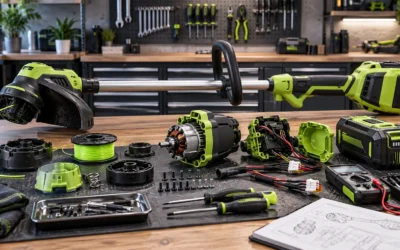
- Power unit: gas engine, battery motor, or corded electric motor.
- Shaft: the tube that sets reach, balance, and whether you can work under fences or along beds. Curved shafts are often shorter and handy for light lawn work. Straight shafts usually reach farther under obstacles and can feel more natural for edging, depending on the handle.
- Cutting head: the housing that holds and feeds trimmer line. Bump-feed, auto-feed, and fixed-line designs load and waste line differently.
- Cutting guard: the shield that deflects debris and usually includes a knife that trims line to a safe working length. A missing or damaged guard is a safety problem, not a performance upgrade.
- Handle and harness points: these decide whether you can keep the head level, absorb vibration, and work more than a few minutes without losing control.
People who search for the best line trimmer sometimes already own a capable machine. Their real problem is worn line, the wrong diameter, a packed head, or a shape that does not bite their weeds. Replacing the line—or matching it to the head—can matter more than buying a new tool.
A line trimmer is the wrong first choice when the vegetation is woody, the open lawn is large enough for a mower, or the user cannot safely control the weight and vibration. In those cases, a different tool or a hired service is the better match. For additional operational safety benchmarks, see our published testing notes on marshall stanmore iii vs harman kardon onyx studio 8.
Power types: gas, battery, and corded electric
Consumer line trimmers are commonly powered by gasoline, a rechargeable battery, or a corded electric motor. Power source does not crown a winner. It changes runtime, noise, exhaust, starting effort, storage, and how much upkeep you will accept.
Gas trimmers: two-stroke and four-stroke consumer models
A gas trimmer is typically chosen for large lots, remote property, thick growth, or work far from an outlet and a charger. Continuous runtime is limited mainly by the fuel you can carry, not by a pack that needs swapping. That advantage comes with noise, exhaust, vibration, and more service. To compare alternative configurations, check our hands-on review of dyson v8 cyclone vs bissell featherweight stick.
Many consumer gas models use two-stroke engines that require a fuel mix of gasoline and two-stroke oil in the ratio the manufacturer specifies. Four-stroke consumer engines usually keep oil in a separate system, which changes how you refuel and check lubrication. Exact mix ratios, oil types, and service intervals are model-specific. Follow the manual rather than a generic rule from a store aisle.
Day-to-day gas use also includes cold starts, stale fuel after storage, spark-plug and air-filter attention, and safe fuel handling. If you dislike mixing fuel, storing gasoline, or pulling a starter after the tool sits, gas is a poor comfort match even when the lot is large. Users looking for related component recommendations can explore our bissell crosswave hydrosteam vs shark stainforce breakdown.
Battery trimmers: voltage class, packs, and swapping in general terms
A battery trimmer is typically the better fit for ordinary suburban lawns when quieter operation, easier starting, and no fuel mixing matter more than unlimited runtime. There is no exhaust at the tool, indoor storage is simpler than storing gasoline, and most users can start work with a trigger instead of a choke-and-pull ritual.
Runtime depends on pack capacity, how hard you load the head, vegetation density, and temperature. Manufacturers publish voltage and amp-hour figures, but those numbers are not a reliable way to compare brands without knowing the whole system. A spare pack on a shared battery platform can extend a session if other tools in the household already use that system. Charging time, pack weight, and whether you can swap packs mid-job matter more than a single voltage number on a box.
Cold weather, a pack that was stored empty, or forcing thick line through wet, heavy weeds can make a battery tool feel weak even when the motor is sound. That is a system limit, not proof that “battery cannot cut.”
Corded electric trimmers: reach and outlet limits
A corded electric trimmer can be enough for a small yard close to an outdoor outlet. It can run as long as it has power, and it avoids fuel and battery charging. The cord is the constraint. You need an outdoor-rated extension cord of a length and gauge suitable for the tool, a path that does not cross the cutting head, and a layout that will not trip you or saw through the cord.
If the work wraps around beds, fences, and outbuildings far from power, the cord becomes a second job. In that case a battery or gas tool is usually the more usable match, even if the corded motor itself is adequate for the grass.
How fuel, charging, and cords change daily use
Power choice is also a habit choice:
- Gas: fuel mix or separate oil checks, stale-fuel problems after sitting, louder operation, and exhaust that neighbors and enclosed spaces will notice.
- Battery: charge planning, spare packs for long sessions, charger placement, and reduced output as packs age or get cold.
- Corded: outlet access, outdoor-rated cords, and constant awareness of the cord path.
User constraints should steer the choice as much as lot size. Limited strength, hearing sensitivity, close neighbors, apartment or garage storage rules, and local fuel restrictions can make a “more powerful” gas unit the worse tool. A quieter battery or corded model that the user will actually run every week is a better match than a heavier machine that stays in the shed.
Features that affect cutting performance and comfort
Two trimmers in the same power class can feel completely different. Build and controls decide whether you can keep the line in the grass, follow a fence, and finish without fatigue.
Curved versus straight shafts
Shaft shape and length change reach and posture. A curved shaft often sits the head in a natural position for light lawn trimming and can feel compact. A straight shaft typically slides farther under decks and fences and can make it easier to flip the head for edging, depending on the handle and how the motor is mounted. Neither shape is universally better. People who work under obstacles or want more distance from debris often prefer straight shafts. People doing short weekly edges on flat turf may prefer the lighter feel of a compact curved design. Exact lengths vary by model; judge them by lifting the tool, not by a number on a spec sheet.
Bump-feed, auto-feed, and fixed-line heads
The cutting head is how trimmer line meets the job:
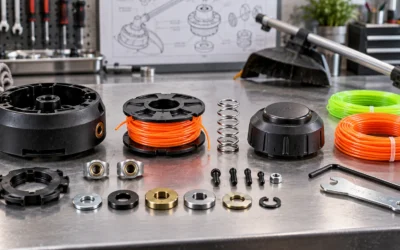
- A bump-feed head releases more line when you tap it on the ground while the head is spinning. It is common and flexible, but it wastes line if you bump too often or if the spool is poorly wound.
- An auto-feed head advances line without a bump, which some users find convenient. It can also overfeed or fail to feed if the mechanism is dirty, the line is the wrong diameter, or the coil is tangled.
- A fixed-line or pre-cut head uses short pieces of line inserted into the head. Loading is simple and there is no inner spool to weld together, but you carry spare pieces and stop more often to replace them.
No feed system is universally more reliable. What matters is whether you can load it correctly, whether the eyelets (line outlets) are in good condition, and whether the head is designed for the diameter you intend to use.
Dual-line heads and the cutting guard
A dual-line head sends two ends of line out of the housing. All else equal, two lines often cut a wider or more even path than a single line of the same diameter, and they can feel more balanced. They also use line faster. A well-designed cutting guard still matters more than a second strand: it deflects debris, keeps the cut height more consistent, and usually trims oversized line so the motor is not dragging extra length.
Never remove the guard to “get more reach.” Extra exposed line increases debris speed toward the operator and can overload the power unit.
Weight, balance, vibration, and handles
Comfort is not a luxury feature. Weight, balance, handle shape, vibration, and a trigger lock decide whether a powerful tool is actually usable. A nose-heavy trimmer forces your wrists to hold the head up. High vibration numbs hands and makes precise edges sloppy. A loop handle versus a bicycle-style handle changes leverage on slopes and along long fence runs. Some models accept a shoulder harness, which can make a heavier gas or high-output battery unit controllable for longer sessions.
In a store or when a listing allows it, lift the tool as you would use it. Check whether the head is easy to open, whether the guard fully covers the rearward debris path, and whether the documented line range is printed on the housing or in the manual. Convertible edging wheels, split shafts for storage or attachments, and shared battery platforms are real feature categories—but they are model-specific. Do not assume every tool in a power class has them.
Which box “specs” are meaningful
Useful information includes the intended vegetation (grass versus heavy weeds), the approved line diameter range, whether the head is dual-line, and the power class in qualitative terms. Marketing language about unlimited runtime, zero maintenance, or cutting “anything” is not a specification. Voltage, displacement, or a dramatic cutting-width claim means little if the head cannot feed the line you need or if you cannot hold the tool level.
Also check how you will reload line and replace a worn head. A trimmer that is miserable to restring will sit unused after the first tangle. If you already own batteries on a platform, compatibility can outweigh a small difference in advertised power.
What trimmer line is, and how shape and thickness change results
The secondary question—what is the best trimmer line—has the same answer as the tool itself: there is no single best line. Trimmer line is the flexible cutting element, usually a nylon-type polymer, sold in various diameters and shapes. It must match the cutting head’s rated range and loading method. The “best” spool is the one that fits the head, bites the plants you actually have, and does not stall, weld, or shatter in normal use.
Diameter and head limits
Line diameter is the first compatibility check. The head and eyelets are designed for a limited range, printed in the manual or on the spool housing. Thinner line is generally adequate for tender, frequently cut grass. Thicker line is generally more aggressive on tougher weeds, but it needs a head and power unit that can drive it.
There is no universal “best” size in millimeters or inches for every trimmer. Using line that is too thick may prevent feeding, stress the head, or stall the motor. Line that is too thin or left too short usually breaks faster and leaves a ragged cut. If the packaging and the head disagree, the head wins.
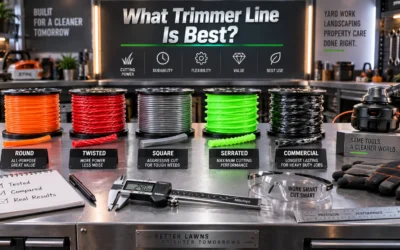
Round, twisted, and multi-sided shapes
Shape changes how the line hits stems, how it wears, and how much noise it makes. Patterns are qualitative, not lab rankings:
- Round line is the common baseline. It is often quieter and sufficient for regular grass. It can glance off thicker weeds instead of cutting them cleanly.
- Twisted line is still rounded in section but not a simple cylinder. Many users find it a middle ground: a bit more bite or a slightly different sound profile than plain round line, without the sharp corners of multi-sided profiles.
- Multi-sided line (square, star, and similar) presents edges to the plant. It often bites tougher weeds better than round line of a similar diameter. It can also wear the eyelets faster, demand more power, and sound harsher. It may not fit a light-duty head even when the diameter looks close.
Do not treat a shape claim such as “lasts twice as long” as a fact. Wear depends on fences, gravel, dirt, heat, and technique as much as on the profile.
When line breaks, welds, or refuses to feed
Line fails in a few repeatable ways. It snaps when it hits wire, stones, or chain-link, or when it is too thin for the job. It frays when dragged through abrasive soil. It can weld or fuse on the spool when heat and friction build up—too much line packed in the head, the wrong diameter, worn eyelets, or forcing the spinning head into dirt and hard edges. Fused line then fails to advance, which feels like a “dead” trimmer even though the motor still spins.
Line that is too long past the guard overloads the power unit and increases debris throw. The guard knife exists to keep length in a safe window. Cutting with a half-broken stub of line is just as unhelpful: the effective swath collapses and you start scalping or missing stems.
Restringing versus replacing the spool
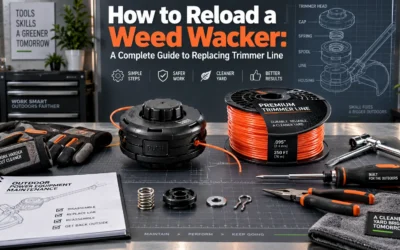
You can usually rewind bulk line onto a reusable spool or buy a prewound cartridge if the head is designed for one. Replace the whole spool or head when the housing is cracked, the eyelets are egg-shaped, or the feed mechanism no longer holds line. Loading mistakes waste more line than brand choice: overlapping coils, mixing diameters, winding against the marked direction, or stuffing more line than the cavity can hold all cause tangles and welds.
If the machine still has power and a sound head, changing diameter (within the rated range) or switching from round to a more aggressive profile is often a cheaper experiment than replacing the entire trimmer.
How to match the trimmer and the line to your yard
Because yard size, terrain, and plants are unknown to any article, the useful method is a short decision path. Answer the questions first, then pick a power class and a line range—not a trophy product.
Questions to answer before you buy
- How large is the area you actually trim, not the whole property?
- Is there a convenient outdoor outlet, and will you accept a cord?
- Can you charge and store batteries, and do you already own a battery platform?
- What do you cut most weeks: tender turf edges, mixed weeds, wet grass, or neglected stalks?
- Are there slopes, fences, gravel, decorative stone, or tight beds?
- Who will use the tool, and what are their limits for weight, noise, starting effort, and vibration?
- Where will fuel, chargers, or spare line live, and are there household or local rules about gasoline?
Light weekly edges versus mixed weeds or neglected lots
Typical fit—not a guarantee—looks like this:
- Small, frequently mowed yards near power: a corded electric trimmer or a compact battery model with lighter, usually round line is often enough. The job is tidy edges, not clearing a field.
- Typical suburban lots with mixed grass and weeds: a mid-class battery trimmer, optionally with a spare pack, plus mid-range line in a shape that matches the weeds, is a common match. Gas is optional, not required, unless you dislike charging or work far from the house.
- Large, remote, or overgrown properties: a gas trimmer or a high-output battery system with extra packs is more often appropriate, paired with thicker or multi-sided line if the head allows it. Continuous heavy cutting still benefits from a harness and conservative technique.
Wet, dense grass loads any head harder than dry turf. Woody stalks are not a line-diameter problem; they are a tool-class problem that points toward a brush cutter and extra training, or toward hiring the work out.
Terrain, obstacles, and one-handed versus two-handed control
Slopes, retaining walls, and long fence lines punish poor balance. A straight shaft and a two-handed grip usually give more control when the head is away from your feet. Tight beds and under-deck work favor a slimmer head and a shaft that reaches without forcing your back into a twist. If you cannot keep both hands on the tool and the cutting path visible, the setup is too heavy or the job needs a different cutter.
Gravel, pavers, and chain-link destroy line. No shape “solves” that. Slow down, keep the line off the abrasive surface, and expect more frequent reloads.
Reuse the machine by changing line before replacing it
If an existing trimmer still starts, feeds, and has an intact guard, try the line system first. Confirm the rated diameter. Replace worn eyelets or a cracked spool if parts exist. Move from thin round line to a rated thicker or multi-sided line for tougher weeds, or back to thinner round line if the motor bogs and the job is only grass. Many “weak trimmer” complaints are short line, fused coils, or a head packed with debris.
Comparing two options without lab tests
In a store or a detailed listing, compare what you can actually inspect:
- Lift and sweep the tool as if trimming; notice balance, not only listed weight.
- See how the head opens and how line is loaded.
- Check guard coverage and whether the cutoff knife is present.
- Read the documented line diameter range.
- Note harness points, handle adjustment, and whether batteries or heads are shared with tools you already own.
- Ask locally about parts, line, and chargers. A spec-sheet advantage is worthless if you cannot buy a spool next season.
Hire a service or use a different tool when the growth is woody, the lot is too large for the user to control a heavier unit safely, or noise and fuel storage are not acceptable at home. Buying “up” into a blade-capable or large gas machine is not automatically the responsible choice.
Safety, setup, and maintenance that decide whether a trimmer is usable
A theoretically powerful trimmer is a poor match if it throws debris at the operator, will not start after storage, or shakes so hard that control fades. Safety and upkeep are part of selection, not an afterthought.
Flying debris, snags, hearing fatigue, and vibration
Spinning line throws stones, wire, clippings, and broken line at high speed. Eye injury is the standout risk. The head can also snag on fences, hidden wire, or dense stalks and yank the shaft sideways. That is not identical to chainsaw kickback, but it is a sudden loss of control. Hearing fatigue and hand numbness from vibration make those surprises more likely on long jobs.
Baseline practice is conservative and simple: wear eye protection; keep bystanders, children, and pets well clear of the work area; wear long pants and sturdy closed-toe shoes; use hearing protection; keep both hands on the tool when it is designed that way; never lift a spinning head toward people or windows; stop the tool before clearing jams or pulling line from a fence. Keep the cutting guard in place. Follow the manufacturer’s stance and starting instructions rather than copying a video that removes shields.
If vibration or noise leaves lasting numbness, ringing, or pain, stop and seek medical guidance and check the tool’s isolation and balance. Do not treat a hobby article as a diagnosis.
Fuel, batteries, chargers, and outdoor cords
Gas models involve flammable fuel and hot exhaust. Mix and store fuel only as the manual and the fuel-container label allow. Refuel with the engine off and cool enough that spilled fuel is not landing on a hot muffler. Do not run a gas trimmer in an enclosed space. Local storage rules vary; the manual and local regulations outrank informal advice.
Charge batteries with the matched charger, on a hard, nonflammable surface, in the temperature range the manufacturer specifies. Do not crush, incinerate, or leave a damaged pack in use. A swollen, leaking, or overheated pack is a shop or manufacturer issue, not a home repair project.
Outdoor extension cords must be rated for outdoor use, in a gauge suitable for the tool’s load and the cord length, and kept entirely out of the cutting path. Inspect cords for cuts before each use. Indoor lamp cord has no place on a trimmer.
Owner-level checks versus shop-level work
Before a session, inspect line length and condition, eyelets, the guard, and fasteners on the head and handle. Clear packed grass from the head so the line can exit and the housing can cool. After use, wipe debris off vents and the guard knife.
Owner-level tasks generally include cleaning, reloading line, a visual check of the air filter on gas models, and battery care (recharge on a schedule the manual describes, store packs as directed). Spark plugs, carburetors, gear-head lubrication, and electrical faults are shop-level unless the manual clearly walks through a simple inspection and you are competent to do it. Do not disassemble or defeat safety parts to “gain power.”
Storage habits that keep the setup usable
Stale fuel is a common reason a gas trimmer will not start in spring. Either run the system dry as the manual allows or use fuel-handling practices the manufacturer recommends before long storage. Batteries stored empty or in extreme heat or cold may not deliver a full session later; follow the pack’s storage guidance rather than a generic temperature rumor. Line left in a hot shed can get brittle; keep spare line reasonably cool and replace coils that crack when flexed. A cracked spool or missing guard should be fixed before the next use, not ignored because the motor still runs.
Caveats when there is no single “best” model
Reviews and “best of” lists fail when the reviewer’s yard, user strength, noise limits, and line choice differ from yours. A gas unit that clears a neglected fence line can be miserable for a small courtyard. A compact battery trimmer that is perfect for weekly bed edges will bog in wet, woody weeds. The secondary keyword has the same trap: the best trimmer line on a packaging claim may be the wrong diameter for your head.
Claims to treat skeptically
Be cautious with unlimited runtime, zero maintenance, “cuts anything,” and dramatic comparisons that treat one power source as universally stronger. Performance is a system of motor or engine, head condition, correct line, cutting technique, and how wet or woody the plants are. Local parts, chargers, fuel, and after-sales service can outweigh a spec-sheet advantage.
When poor cutting is a line problem versus a tool-class problem
A trimmer often feels weak for ordinary reasons: line worn too short, coils fused in the head, debris packed around the spool, the wrong diameter, melted or rounded tips, cutting too large a bite at once, a dirty air filter on a gas model, or a cold, low pack on a battery model. Those are line, technique, or maintenance issues.
It is a tool-class problem when the vegetation is woody, the area is too large for the user’s endurance, the head cannot accept a thicker rated line, or the power source cannot be supported (no fuel, no charged packs, no safe cord path). A new line shape will not turn a light string head into a brush cutter, and it will not double cutting speed by magic.
Verify locally what you can actually support: replacement heads, the correct line diameter, a battery platform you already own, fuel and oil if you choose gas, and someone who can service the tool. The best line trimmer for your yard is the combination of power type, controllable build, and compatible trimmer line that you can run safely every week—not a single named winner.