

The Direct Answer: What Lawn Mower Is Best for You
There is no single “best” lawn mower because the right choice depends entirely on your situation. For small residential yards under half an acre with relatively flat terrain, a push mower or self-propelled model delivers excellent results at low cost. If your property spans 0.5 to 2 acres or has slopes, a riding mower becomes practical and reduces physical effort significantly. For established lawns larger than 1 acre, or if convenience matters most, robotic mowers provide hands-off maintenance, though they work best on level terrain without major obstacles. Your decision hinges on four factors: yard size, terrain complexity, how much maintenance you’ll tolerate, and budget.

Pros
- True wire-free design with no RTK needed enables quick out-of-box setup for clear-boundary small lawns.
- AI vision combined with sensors provides reliable detection and avoidance of over 300 obstacle types.
- Dual systematic or random mowing modes improve efficiency and prevent track patterns on the lawn.
- Smart auto-recharge, rain protection, and comprehensive safety sensors ensure hands-off reliability.
- Supports multi-zone scheduling and remote guidance for adaptable control on varied layouts.
Cons
- Limited to a maximum of 0.15 acre coverage, restricting use to small lawns only.
- Boundary stakes for setting virtual fences in open areas are sold separately and not included.
- Complex or multi-area layouts may require app mapping or remote control rather than fully automatic operation.
The RoboUP Raccoon 2 SE is a compact wire-free robotic lawn mower built for small lawns with clear boundaries. It delivers an immediate impression of simplicity and intelligence through its AI-focused design that prioritizes easy button-start operation without cables or complex antennas, making it a practical upgrade from manual mowers.
Performance centers on efficient coverage of up to 0.15 acre with multi-zone support and customizable modes. Advanced AI vision plus bumper sensors enable automatic lawn detection and avoidance of people, pets, and over 300 obstacle types. The electric cutting height adjusts from 1.18 to 3.15 inches, while the 5Ah battery provides 150 minutes of runtime and recharges in 70 minutes. It handles 20-degree slopes, narrow passages, and uneven ground, switching between systematic parallel mowing for efficiency and random patterns, with auto-return for rain or low battery.
Key considerations include the restriction to small 0.15 acre areas and the separate purchase needed for boundary stakes in open properties. Complex layouts benefit from remote guidance or app mapping rather than pure autonomy, and basic use works best on straightforward lawns.
The Raccoon 2 SE offers strong value for homeowners with compact, simple yards who want quiet, safe, and low-maintenance robotic mowing. It suits those prioritizing wire-free convenience and AI features over large-area capacity.
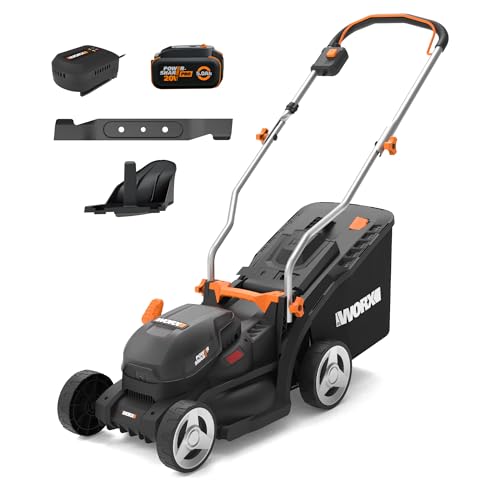
Pros
- True 2-in-1 mulching and bagging capability for versatile yard maintenance
- Brushless motor delivers efficient power and longer potential runtime
- 5.0 Ah battery and charger included for ready-to-use cordless convenience
- Single-lever 6-position height adjustment from 1 to 3 inches for quick setup
- Cut-to-edge design enables precise cutting along borders and obstacles
Cons
- 14-inch cutting width limits efficiency on larger lawns requiring more passes
- Manual push operation lacks self-propulsion, increasing physical effort
- No specified runtime data means battery may need recharging for bigger jobs
The WORX WG733.1 is a 14-inch cordless electric walk-behind lawn mower built for homeowners seeking a lightweight alternative to gas-powered models. Its compact design and included 5.0 Ah battery plus charger create an immediate impression of convenience and readiness for small yard maintenance without cords or fumes.
Performance centers on practical features that shine in everyday use. The 2-in-1 mulching and bagging system lets users switch modes easily for either nutrient return or clean collection. The cut-to-edge design allows closer trimming along fences and beds, while the brushless motor supports efficient operation. A single-lever control provides six cutting heights from 1 to 3 inches to match varying lawn conditions, and the PowerShare compatibility extends the battery's value across other WORX tools.
Drawbacks stem from the core specifications. The smaller 14-inch deck requires more time on larger properties, and as a pure push mower it demands continuous manual effort without self-propel assistance. Available data does not detail runtime, so users of bigger areas should plan for potential battery swaps or recharges.
This mower delivers the most value to owners of small to medium lawns who prioritize easy storage, quiet cordless operation, and simple adjustments. It is especially appealing for those already using WORX tools or looking for an affordable entry into battery-powered lawn care.
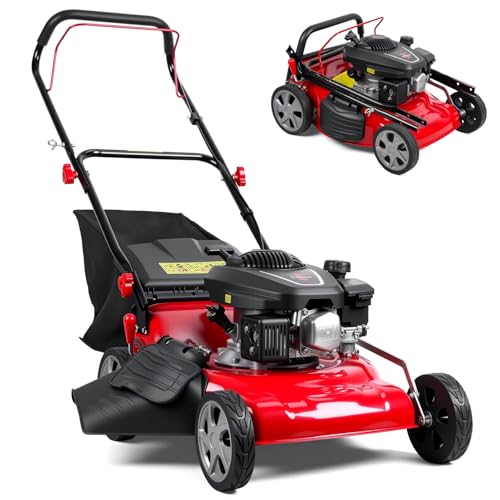
Pros
- Versatile 3-in-1 mulching, bagging and side-discharge modes for flexible lawn care
- Generous 50L grass collection capacity with easy-empty design
- Fuel-efficient 131cc 4-cycle engine with low-noise operation
- Lightweight construction and large wheels improve maneuverability
- Cutting height adjustment and easy-start features suit various users
Cons
- Gas engine requires ongoing fuel, oil and basic maintenance unlike electric models
- Exact cutting width and detailed height settings are not specified in available data
- Push-focused design may still demand physical effort on large or rough properties
The YOXIER 131cc 4-Cycle Gas Lawn Mower is a walk-behind model aimed at residential lawns, yards and gardens. It features a lightweight frame, large wheels and a 50L grass tank that create a practical first impression for everyday home use.
In performance the durable blade handles thick weeds and overgrowth while the 3-in-1 system supports mulching, side discharge or rear bagging. The 131cc engine is described as fuel-efficient and low-noise, with position cutting height adjustment and push-button start adding convenience. Rear-wheel drive is claimed to help on slopes and uneven terrain.
Drawbacks include the need for regular gas and oil maintenance. Precise cutting width and full height range details are missing from the specifications, so buyers should verify fit for larger or very dense areas. Physical pushing effort may remain depending on the terrain despite self-propelled mentions.
Overall this mower delivers solid value for homeowners with medium-sized yards who want a budget-friendly gas option with multi-mode clipping control and simple operation. It suits users comfortable with basic gas mower upkeep rather than those seeking fully electric convenience.
Understanding Your Lawn Mower Needs: Four Key Questions
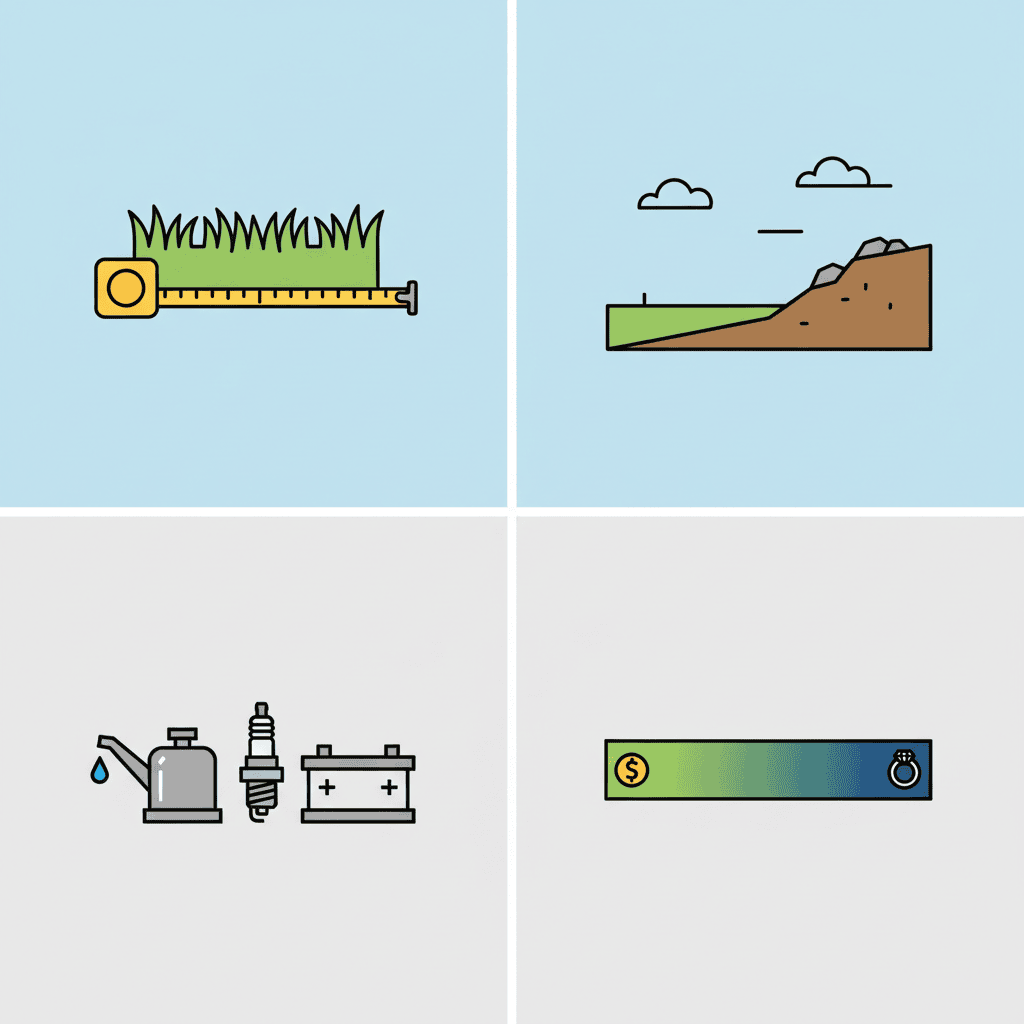
Before comparing mower types, answer these questions honestly:
- What size is your lawn? Measure or estimate your yard in acres. Under 0.25 acres is small, 0.25 to 1 acre is medium, and 1+ acres is large. This single factor eliminates most unsuitable options.
- What is your terrain like? Flat, open yards favor any mower type. Sloped terrain limits self-propelled push mowers and robotic options. Obstacles (trees, flower beds, rocks) increase operator skill requirements.
- How much maintenance will you realistically do? Gas mowers need seasonal tune-ups, spark plug changes, and fuel system cleaning. Electric and battery mowers require minimal maintenance. Be honest, if you dread maintenance, avoid gas-powered equipment.
- What’s your budget? Push mowers cost $200-$600. Self-propelled models run $400-$1,200. Riding mowers start around $1,500 and climb to $5,000+. Robotic mowers range from $800 to $3,000+. Initial cost matters, but factor in fuel, maintenance, and lifespan.
The Four Main Mower Types: Tradeoffs Explained
Push Mowers (Manual or Gas-Powered)
Push mowers are the entry-level standard. You propel them forward by hand, controlling speed and direction. Gas-powered push mowers are most common; cordless electric versions are gaining popularity.
Best for: Yards under 0.25 acres, flat or gently sloped terrain, budget-conscious buyers, people who don’t mind physical effort.
Pros: Low cost ($250-$600), easy storage, minimal maintenance on electric models, simple operation, good cutting quality.
Cons: Physically demanding for larger yards or sloped terrain, slower mowing speed, gas models require seasonal maintenance and tune-ups, noise and emissions from gas versions.
Typical runtime: Covers 0.25 acres in 30 to 45 minutes. Battery electric models run 30 to 60 minutes per charge depending on deck size and grass thickness.
Self-Propelled Push Mowers
The engine drives the wheels forward; you control speed (usually with a lever) and direction. A significant step up in convenience.
Best for: Yards 0.25, 0.75 acres, slightly rolling terrain, users who want reduced physical effort without a riding mower, budget under $1,200. For additional operational safety benchmarks, see our published testing notes on marshall stanmore iii vs harman kardon onyx studio 8.
Pros: Easier than push mowers on larger or sloped yards, still affordable ($400-$1,200), good cutting quality, faster mowing speed, better control on inclines, cordless electric options available.
Cons: More complex than push mowers (more parts to maintain), heavier (harder to turn or lift), gas models require tune-ups, still demanding for properties over 1 acre. To compare alternative configurations, check our hands-on review of dyson v8 cyclone vs bissell featherweight stick.
Typical runtime: Covers 0.5 acres in 45 to 75 minutes.
Riding Mowers
You sit on the mower and operate it like a small tractor. Most use gasoline engines; zero-turn models offer excellent maneuverability. Users looking for related component recommendations can explore our bissell crosswave hydrosteam vs shark stainforce breakdown.
Best for: Yards 1+ acres, properties with obstacles (trees, mulch beds) you need to navigate around, users who prioritize comfort and speed, steep terrain (especially zero-turn models).
Pros: Fastest mowing for large properties, much less physical effort, excellent terrain handling on slopes, comfortable for extended mowing, can handle thick or overgrown grass, many offer mulching or bagging options.
Cons: High cost ($1,500-$5,000+), requires storage space, higher maintenance, fuel and oil changes, blade sharpening, seasonal prep and storage, learning curve for first-time users, overkill for small yards.
Typical runtime: Covers 1 to 3 acres per hour depending on cutting width and grass density.
Robotic Mowers
Autonomous mowers that navigate your lawn independently, cutting frequently in small amounts and returning to charge automatically. They’re becoming mainstream as technology improves.
Best for: Established lawns with consistent grass, moderate properties (0.25 to 1.5 acres), owners who prioritize convenience and hands-off operation, relatively flat or gently rolling terrain.
Pros: Set-and-forget convenience, frequent light mowing keeps grass healthier, quiet and emissions-free, low maintenance, can mow while you’re away, excellent for working professionals, ideal for properties with regular schedules.
Cons: High upfront cost ($800-$3,000+), setup complexity (perimeter wire installation), doesn’t handle obstacles well (toys, sticks, uneven terrain), performs poorly on steep slopes, can’t clear overgrown areas, requires flat or gently rolling terrain, slower coverage than human-operated mowers, weather-dependent operation.
Typical coverage: Automated units handle 0.5 to 1.5 acres depending on model. Mowing happens in cycles multiple times per week.
Fuel Type Tradeoffs: Gas vs. Electric vs. Battery
| Fuel Type | Initial Cost | Operating Cost/Year | Maintenance | Power/Performance | Best For |
|---|---|---|---|---|---|
| Gasoline | $250-$5,000 | $80-$200 | High (tune-ups, oil changes, spark plugs, seasonal prep) | Strong, consistent power; handles thick/wet grass | Large properties, overgrown yards, commercial use |
| Battery Electric (Cordless) | $300-$2,000 | $20-$50 | Low (charge battery, occasional blade sharpening) | Good for residential yards; may struggle with very thick grass | Small to medium yards, budget-conscious buyers who value convenience |
| Corded Electric | $200-$600 | $10-$30 | Very low (no engine maintenance) | Adequate for flat, small yards; limited by cord length | Very small yards, buyers with nearby outlets |
| Propane | $1,000-$3,000 | $100-$150 | Moderate (fewer emissions, easier seasonal storage than gas) | Strong power, cleaner emissions | Commercial operations, environmentally conscious buyers |
Battery electric dominates residential mowing today. Runtime per charge ranges from 30 to 90 minutes depending on deck width and motor power. Most homeowners can cover their yard on a single charge, and battery technology improves annually. Gas remains the choice for commercial properties, overgrown yards, or extremely dense grass where maximum power matters.
Matching Mower Type to Lawn Size: The Decision Matrix
Small Yards (Under 0.25 Acres)
Recommended: Push mower (gas or battery electric).
A simple push mower is ideal, mowing takes 30 to 45 minutes and requires minimal storage. Battery electric push mowers are increasingly popular here because they eliminate gas engine maintenance and smell. Cost: $300-$600. One battery charge covers the entire yard comfortably.
Medium Yards (0.25 to 0.75 Acres)
Recommended: Self-propelled push mower or entry-level robotic mower.
Self-propelled models ($500-$1,200) reduce physical effort significantly and mow in 60 to 90 minutes. If your terrain is flat and well-maintained, a robotic mower ($1,000-$2,000) offers convenience, set it to run 3 to 4 times per week and rarely touch it. For budget priorities, a quality self-propelled gas or battery model is the better value.
Large Yards (0.75 to 2 Acres)
Recommended: Riding mower or premium robotic system.
Mowing with a push mower (even self-propelled) becomes tedious at this scale. A riding mower ($1,500-$3,500) cuts mowing time to 1 to 2 hours and handles terrain better. If your property is flat, established, and obstacle-free, a high-end robotic mower or multi-unit setup ($2,000-$4,000) can handle 1 to 2 acres with autonomous operation. Most homeowners at this scale choose a mid-range riding mower for reliability and speed.
Very Large Properties (2+ Acres)
Recommended: Zero-turn riding mower or commercial equipment.
Standard riding mowers still work, but zero-turn models ($2,000-$5,000+) offer superior maneuverability around obstacles. Mowing takes 2 to 4 hours depending on terrain and equipment. For properties over 3 acres used commercially (farms, rental properties), consider dedicated commercial equipment or hiring a lawn service.
Key Specifications That Matter When Comparing Models
Cutting Deck Width
Measured in inches, this determines grass coverage per pass. Wider decks cover more area faster but are harder to maneuver in tight spaces.
- Push mowers: 18 to 22 inches (standard residential)
- Self-propelled: 20 to 24 inches
- Riding mowers: 30 to 54 inches (larger properties benefit from 42 to 48 inches)
- Robotic: 18 to 24 inches (size doesn’t matter as much because they mow frequently)
Cutting Height Settings
Healthy grass should be cut to 2.5 to 3.5 inches depending on species. Look for mowers with multiple height adjustments (typically 6 to 10 settings) to adapt to seasonal needs. Spring and summer grass prefers slightly taller cutting; fall allows shorter cuts.
Mulching vs. Bagging
Mulching: Finely chops grass and returns nutrients to soil. Requires less maintenance but works best with dry grass. Excellent for healthy lawns.
Bagging: Collects clippings in a hopper. Better for thick or wet grass, and ideal if you compost or have lawn debris you want to remove. Requires emptying bags (tedious on large yards) but gives a clean appearance.
Most modern mowers offer both options. For residential use, mulching is increasingly preferred because it reduces yard waste and improves soil health.
Engine Power (cc) and Motor Watts (Electric)
Higher power handles thick, wet, or overgrown grass better but uses more fuel/battery. For normal residential lawns:
- Push mowers: 140 to 190 cc gas engines or 40 to 60 watts electric
- Self-propelled: 160 to 210 cc or 50 to 80 watts
- Riding mowers: 500+ cc
Unless your yard has thick, difficult grass, don’t overspend on power. Most residential properties need basic power levels.
Battery Runtime (For Electric Models)
Critical for cordless mowers. Runtime depends on deck width, grass thickness, and battery capacity (measured in amp-hours, Ah).
- 30-minute battery: Small yards only (under 0.2 acres)
- 40 to 60 minute battery: Standard residential (0.25 to 0.5 acres)
- 90+ minute battery: Larger properties or faster mowing preference
Many battery mowers allow battery upgrades later, so starting with a smaller battery is acceptable if you plan to expand.
Maintenance Requirements by Mower Type
Gas Push and Riding Mowers (Highest Maintenance):
- Pre-season tune-up and fuel system check
- Oil changes (typically every 50 hours of operation)
- Spark plug replacement annually
- Blade sharpening every 20 to 30 hours
- Air filter cleaning/replacement
- Winter storage with fuel stabilizer or drain
- Estimated annual cost: $100-$250
Battery Electric Push Mowers (Minimal Maintenance):
- Blade sharpening every 30 to 50 hours
- Battery care (store indoors, avoid deep discharge)
- Deck cleaning after mowing
- No oil changes, tune-ups, or seasonal prep needed
- Estimated annual cost: $20-$50
Robotic Mowers (Low Maintenance):
- Blade replacement every 2 to 3 months (quick and inexpensive)
- Perimeter wire inspection and repair if damaged
- Charging dock cleaning
- Software updates via app
- No fuel, oil, or seasonal prep
- Estimated annual cost: $50-$100
Bottom line: If maintenance headaches deter you, battery electric or robotic mowers eliminate gas engine upkeep entirely.
Common Mistakes When Choosing a Mower
Oversizing Your Mower
Buying a 48-inch riding mower for a 0.5-acre yard wastes money and makes the mower harder to maneuver. Match equipment to actual yard size. You can always upgrade later.
Ignoring Terrain Complexity
A robotic mower won’t handle slopes over 20 degrees or obstacle-filled yards. A self-propelled push mower struggles on steep inclines. Don’t assume any mower works everywhere; test on your specific property or ask neighbors with similar yards what they use.
Prioritizing Brand Over Fit
A premium brand’s small push mower won’t outperform a mid-range self-propelled model if you have a medium-sized yard. Choose based on mower type first, then brand within that category for reliability.
Forgetting About Parts Availability
Avoid obscure brands or models from retailers without local support. If your mower breaks during mowing season, you need replacement parts and service quickly. Major brands (John Deere, Honda, Toro, Husqvarna, Craftsman) have widespread dealer networks.
Overlooking the Rental Option
For one-time projects or properties you don’t mow frequently, renting a riding mower for $50-$100 per day often beats purchasing. Home Depot and landscaping equipment rental shops stock quality equipment.
Your Step-by-Step Decision Framework
Step 1: Measure your yard in acres or estimate size.
Step 2: Assess your terrain: flat or slopes? Many obstacles?
Step 3: Decide your maintenance tolerance: minimal upkeep or willing to service gas engines?
Step 4: Set a realistic budget including fuel and maintenance over 5 years.
Step 5: Choose mower type using the decision matrix above (size-based recommendations).
Step 6: Within that type, compare models by cutting deck width, fuel type, battery runtime (electric), and brand reliability.
Step 7: Check reviews on specific models for real-world performance and durability. Look for 4+ star ratings from verified buyers.
Step 8: Visit a local dealer to sit on riding mowers or hold push mowers before buying. Comfort and weight matter.
Common Questions on What Lawn Mower Is Best Answered
How often should I sharpen mower blades?
Every 20 to 30 hours of mowing, or roughly every 4 to 8 weeks for residential yards mowed weekly. Dull blades tear grass and leave brown tips, inviting disease. Sharp blades create clean cuts and healthier lawns. Hire a service ($15-$30 per blade set) or learn to sharpen yourself using a metal file.
Is a robotic mower worth the cost?
Yes, if your lawn is established, flat, and obstacle-free, and you value convenience. Robotic mowers excel at frequent light mowing, which keeps grass healthier than weekly deep cuts. Upfront cost ($1,000-$3,000) is steep, but low maintenance offsets it over 5 years. If your property has slopes over 20 degrees, dense obstacles, or rough terrain, skip it, robots perform poorly in those conditions.
Should I buy a used mower?
Used gas mowers from reputable brands (John Deere, Honda, Toro) often outlast new cheap models. Inspect the engine condition, ask for maintenance records, and test-run it before buying. Budget $100-$300 for repairs in your first year. Battery electric mowers are harder to assess used because battery degradation is unpredictable; unless you’re certain of battery health, buy new. Robotic mowers are best bought new because perimeter wire installation and warranty support matter.
What size deck width do I actually need?
For push mowers under 0.5 acres: 18 to 21 inches is standard and sufficient. For self-propelled or riding mowers on 0.5 to 2 acres: 24 to 36 inches balances coverage with maneuverability. On 2+ acres: 40 to 48 inches saves significant time. Wider decks are heavier and harder to turn in tight spaces, so avoid oversizing. Your yard’s obstacle density matters as much as size, fewer trees and flower beds justify wider decks.
Related Maintenance and Operating Guides
To keep your equipment running at peak operating efficiency, explore our related technical walkthroughs and maintenance tutorials:
- Consult our detailed breakdown on heavy-duty chainsaw buyer guide.
Broader Context for Mower Choices
The best mower depends on lawn size, terrain, and how much storage space and maintenance time you can give it. Shoppers who want a wider reference on outdoor power equipment may review American National Standards Institute (ANSI) before deciding.









