Quick Answer: Where Is Lawn Mower Carburetor?
The carburetor is mounted on the side or top of your lawn mower’s small engine, typically positioned directly between the air filter housing and the fuel tank. It connects to the air intake on one end and receives fuel from the fuel line on the other. The exact location varies depending on whether you have a push mower, riding mower,…
Understanding the Carburetor’s Role and Why Location Matters
Before locating your carburetor, it helps to understand what it does. The carburetor is a fuel system component that mixes air and gasoline in precise proportions, then delivers that mixture to the engine’s combustion chamber. When the engine runs, the carburetor automatically adjusts this ratio based on throttle position and engine speed.
Knowing where your carburetor is located matters for several reasons:
- Maintenance and cleaning: Carburetors can become clogged with old fuel varnish, especially if the mower sits unused for extended periods. Accessing it requires knowing its exact location.
- Fuel system troubleshooting: If your mower won’t start or runs rough, the carburetor is often a likely culprit, and you need to know where to inspect it.
- Seasonal preparation: Many mower owners drain or stabilize fuel in the carburetor before winter storage to prevent damage.
- Replacement or repair: Should you need to replace a faulty carburetor, you must locate and safely remove it first.
Carburetor Location on Push Mowers
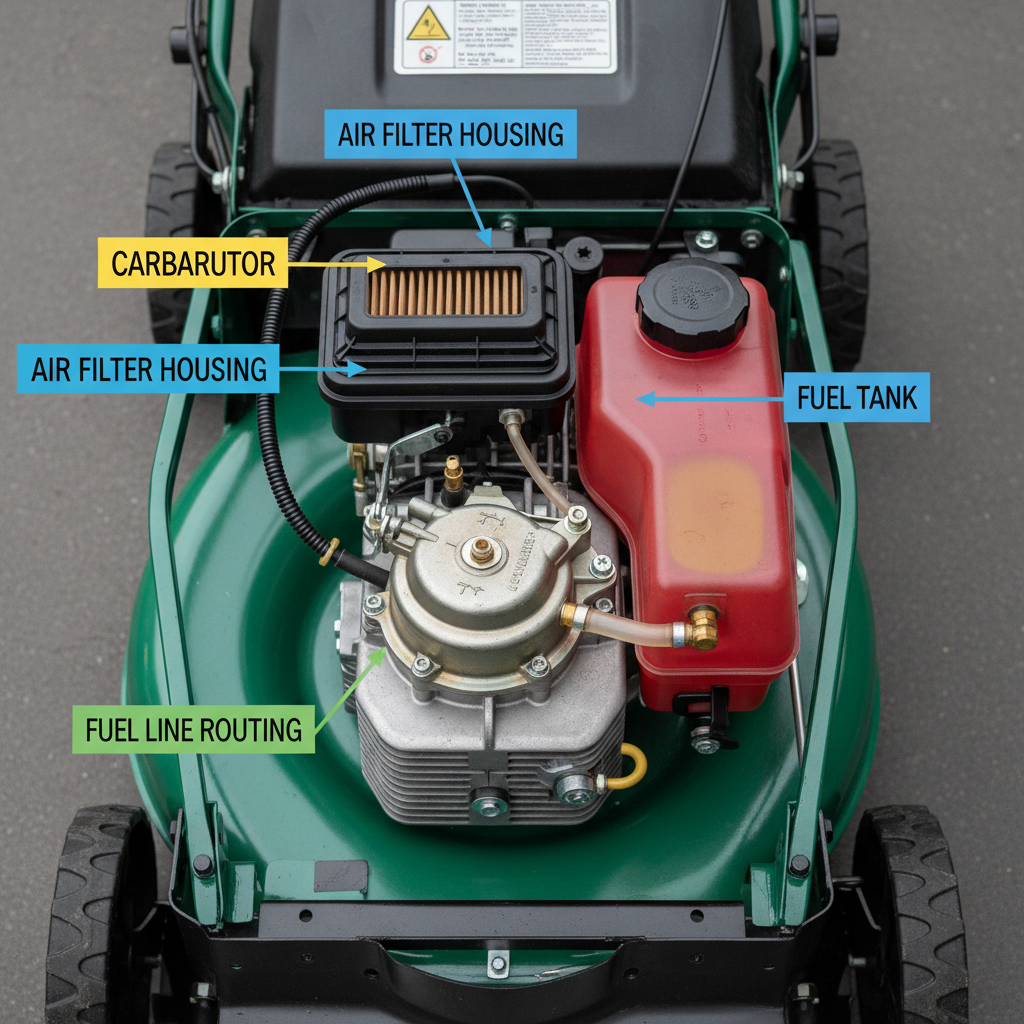
Push mowers are the most common residential lawn mower type, and their carburetors are relatively easy to access once you know where to look.
Typical location: On most push mowers, the carburetor sits on the top or upper side of the engine, immediately adjacent to the air filter housing. You’ll typically see it mounted directly to the engine block with a few bolts or fasteners. The air filter (usually a foam or paper element) sits on top or to the side of the carburetor.
- Follow the fuel line from the tank, it connects directly to the carburetor inlet.
- Look for a small metal or plastic component with visible adjustment screws on the outside.
- The carburetor will have a throttle linkage connecting it to your mower’s speed control handle.
- You’ll see metal or rubber hoses attached to the bottom (fuel inlet) and top (to the air intake manifold).
On most residential push mowers with Briggs & Stratton or similar small engines, the carburetor is within 12-18 inches of the mower deck and is accessible after removing the air filter cover.
Carburetor Location on Riding Mowers
Riding mowers have larger engines and different deck configurations, but the carburetor location follows similar principles.
Typical location: The carburetor on a riding mower is mounted on the side or top of the engine, which is typically located under the seat or toward the rear of the mower. You’ll need to tilt the seat forward or remove panels to access it. The carburetor sits between the air filter box and the fuel tank, just as on push mowers, but may be slightly more recessed due to the mower’s overall design.
- Riding mower carburetors often require removing the air filter box or engine shroud first.
- The fuel tank on riding mowers is frequently positioned beside or above the engine, making fuel line access more complicated.
- You may need to safely secure the mower (engage parking brake, remove key) and tilt the deck or seat to reach the carburetor comfortably.
Carburetor Location on Zero-Turn Mowers
Zero-turn radius mowers are high-performance commercial or semi-commercial equipment with more powerful engines.
Typical location: The carburetor on zero-turn mowers is mounted similarly to riding mowers, on the side or top of the engine, but the engine is often more centrally positioned under the operator platform. Access typically requires removing a side or top engine panel and working around hydraulic lines and control systems. Readers comparing setup options can review our technical analysis on dyson v8 cyclone vs bissell featherweight stick.
Key differences:
- Zero-turn mowers often have more complex engine compartments with additional systems (hydraulic pumps, alternators, etc.) crowding the carburetor area.
- Carburetors on larger commercial engines may be more robust and require more effort to remove.
- These mowers often use fuel systems with additional filters or regulators between the tank and carburetor.
Carburetor Location by Engine Brand
Briggs & Stratton engines: The most common engine brand on residential mowers. The carburetor is mounted directly to the side of the engine block, typically with the fuel inlet facing the fuel tank and the air outlet facing upward toward the air filter. The automatic choke lever usually protrudes from the side. For complementary field maintenance guidelines, examine our breakdown of bissell crosswave hydrosteam vs shark stainforce.
Honda engines: Known for reliable small engines on push and riding mowers. Honda carburetors are positioned similarly (side-mounted), but Honda engines often have a more compact design. The fuel shutoff solenoid may be attached directly to the carburetor body.
Kohler engines: Commonly found on commercial and higher-end riding mowers. Kohler carburetors are typically positioned on the side of the engine with a similar fuel-to-air orientation as Briggs & Stratton models, though the overall engine dimensions may differ.
Kawasaki engines: Used on commercial and premium residential equipment. Kawasaki carburetors follow the same general location principles but may include electronic fuel management components alongside the traditional carburetor.
How to Identify Your Carburetor Once You Locate It
Knowing what to look for helps confirm you’ve found the right component.
Physical characteristics:
- The carburetor is typically a small metal or plastic casting, roughly 2-4 inches in length and 1-3 inches in diameter, depending on engine size.
- It has a visible fuel inlet (where the fuel line connects) and an air outlet (where fuel-air mixture exits toward the engine intake).
- The outside features small adjustment screws (usually for idle speed and air-fuel mixture).
- A metal or plastic float bowl hangs from the bottom, this reservoir holds fuel and helps regulate fuel flow into the carburetor.
Connected components that confirm identification:
- Fuel line: A rubber or plastic hose connects the fuel tank or fuel pump to the carburetor’s fuel inlet.
- Air intake hose or filter: The carburetor’s air outlet connects to the air filter box or directly to the engine’s intake manifold.
- Throttle linkage: A mechanical rod or cable runs from your mower’s throttle control to the carburetor’s throttle arm, allowing you to control engine speed.
- Choke control: Many carburetors have a separate choke mechanism (manual or automatic) that enriches the fuel mixture for cold starts.
Step-by-Step: Locating Your Mower’s Carburetor
Step 1: Shut down and cool the engine. Never work on a hot engine. Turn off the mower, remove the ignition key, and wait at least 5-10 minutes for the engine to cool.
Step 2: Locate the air filter. The air filter is almost always directly adjacent to the carburetor. Find the air filter cover (usually a plastic or metal box on top or side of the engine) and remove it to expose the filter element.
Step 3: Trace the fuel line. Follow the fuel line running from the fuel tank toward the engine. It will lead directly to the carburetor’s fuel inlet port. This is often the quickest way to pinpoint the carburetor.
Step 4: Look at the engine block. The carburetor is bolted to the side or top of the engine block, typically close to where the air intake manifold attaches. It sits between the air filter box and the fuel tank in most mower designs.
Step 5: Confirm with the throttle linkage. If you gently move your mower’s throttle control handle, you should see a corresponding movement in a small metal rod or cable connected to the carburetor. This confirms you’ve identified the correct component.
Safety precautions:
- Always remove the spark plug wire or disconnect the spark plug before working on the engine to prevent accidental starting.
- Ensure adequate ventilation if you’re working in an enclosed space.
- Keep the fuel tank valve closed if you plan to disconnect fuel lines.
- Wear safety glasses and work gloves when handling fuel system components.
When to Clean or Service Your Carburetor
Understanding when your carburetor needs attention helps you act before small problems become major issues.
Signs your carburetor may need cleaning:
- Engine won’t start or struggles to start, especially after the mower has sat for several weeks or months.
- Rough or uneven idling, or the engine dies when you reduce throttle.
- Black smoke from the exhaust (indicating a too-rich fuel mixture).
- Poor fuel economy or loss of power during mowing.
- Fuel leaking from the carburetor body or float bowl drain.
- Difficulty adjusting idle speed with the standard adjustment screws.
Maintenance intervals: Most manufacturers recommend carburetor cleaning as part of seasonal maintenance if the mower sits unused for more than 30 days. For frequently used mowers, cleaning may be needed annually or every 2-3 years. If you use a fuel stabilizer during off-season storage, you can extend this interval.
DIY carburetor cleaning basics: Many homeowners can clean a carburetor themselves by removing the float bowl, soaking internal passages in carburetor cleaner, and gently brushing away varnish buildup. However, complete carburetor removal and rebuilding typically requires more experience and specialized tools. If you’re uncertain, a small engine repair shop can handle the job professionally.
Frequently Asked Questions About Where Is The Lawn Mower Carburetor
What does a carburetor look like on a lawn mower?
A lawn mower carburetor is a small metal or plastic casting (roughly 2-4 inches long) mounted directly to the engine block. It has a fuel inlet port where the fuel line connects, an air outlet, a float bowl underneath (a small reservoir), and visible adjustment screws on the side. It sits between the air filter and the engine’s intake manifold.
Can I access my carburetor without removing other parts?
On most push mowers, yes. You can often see and access the carburetor after removing the air filter cover. On riding or zero-turn mowers, you may need to remove additional components like the air filter box, engine shroud, or control panels. Always consult your mower’s manual for specific guidance.
Is carburetor maintenance something I can do myself?
Basic cleaning of accessible parts is often possible for DIY enthusiasts. However, removing the carburetor, disassembling it, and reassembling it properly requires mechanical skill and sometimes special tools. If you’re unfamiliar with small engines, having a professional perform carburetor service is a safer choice.
Why does my carburetor have fuel dripping from it?
Fuel leaking from the float bowl drain or overflow tubes usually indicates a stuck float, a worn needle valve, or debris blocking fuel passages. This is a sign the carburetor needs cleaning or repair. Do not run the mower with active fuel leaks, as this is a fire hazard.