

Quick Answer: What Is A Zero Turn Lawn Mower?
A zero-turn lawn mower is a specialized type of riding mower that utilizes a dual-lever steering system instead of a traditional steering wheel. This unique design allows the machine to pivot 180 degrees in place, achieving what is known as a zero-turn radius. This capability enables highly efficient and precise maneuvering around obstacles like trees, flower beds, and lawn furniture,…

Pros
- Commercial-grade electric performance with instant torque and no gas engine maintenance.
- Large included battery package and fast charger improve runtime and turnaround time.
- Heavy-duty 54-inch fabricated deck is built for durability and wider coverage per pass.
- Comfort-focused operator features are better than many basic riding mowers in this class.
- Backed by a 4-year limited warranty for added purchase confidence.
Cons
- At 848.78 pounds, it is very heavy and will be difficult to move manually or transport without proper equipment.
- The large footprint, with dimensions of 76.77 x 73.23 x 56.3 inches, requires substantial storage space.
- The premium feature set and battery system may be more than many small-yard owners need.
Overview & Design: The Greenworks 80V 54" MaximusZ Zero Turn Riding Lawn Mower is a commercial-style electric mower built for large residential properties. Its 54-inch 10-gauge fabricated steel deck, zero-turn layout, and premium operator seat give it a serious, heavy-duty feel right away.
Performance & Key Features: This model is positioned as a 41HP gas-equivalent machine with instant torque, a constant 17,900 FPM blade speed, and SmartCut technology that adapts to changing grass conditions. The included battery kit with (2) 16.0Ah and (4) 6.0Ah batteries is designed to support up to 4+ acres per charge, while the 1.5kW fast charger helps reduce downtime.
Drawbacks & Considerations: The mower is extremely heavy at 848.78 pounds, so it is not easy to move or store in tight spaces. It is also a major investment and may be excessive for smaller yards or users who do not need the runtime and power of a large battery-electric zero-turn.
Verdict: This is a strong fit for homeowners with large lawns who want powerful, low-maintenance mowing performance and premium comfort features. Buyers who need a wide cutting deck, long runtime, and electric operation will likely get the most value from it.
Pros
- High-efficiency brushless motors maximize power output and durability over traditional motors
- Up to 2 acres runtime with three included 10.0 Ah batteries supports substantial mowing sessions
- Zero-emission operation with gas-equivalent 20 HP power for quieter environmentally friendly use
- Six-port auto-switchover battery system provides flexible extended runtime options
- Durable 42-inch steel deck plus included mulch and towing kits add immediate functionality
Cons
- Runtime is limited to approximately 70 minutes or 2 acres which may require recharging for larger properties
- Fully battery-dependent design means performance relies on charge levels and spare battery availability
- 42-inch deck size may require more passes on expansive lawns compared to wider commercial models
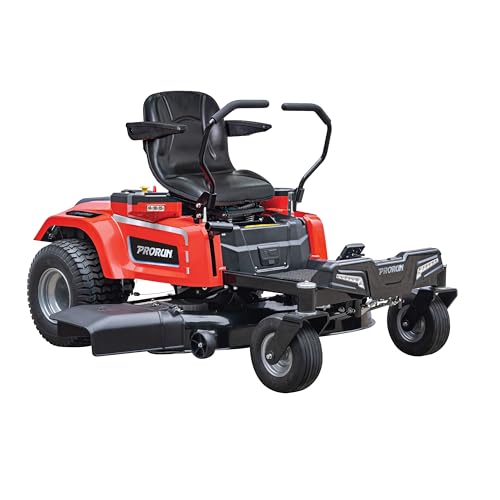
The PRORUN PZT60V42 is a fully electric 60V zero-turn riding lawn mower built for residential and light commercial use. Its primary design centers on a robust 42-inch 14-gauge stamped steel twin blade deck powered by direct-drive brushless motors, giving an immediate impression of solid construction and modern battery-focused engineering. The mower arrives complete with three 10.0 Ah batteries, a charger, mulch kit, and towing kit for ready-to-work versatility.
In performance terms, four high-efficiency brushless motors deliver power equivalent to a 20 HP gas engine while producing zero emissions. The system supports up to 2.0 acres or 70 minutes of runtime, and six battery ports with auto switchover intelligently manage all PRORUN 60V battery sizes for continuous operation. A washout port on the steel deck further simplifies post-mow maintenance during real-world sessions.
Potential drawbacks include the finite 70-minute runtime window which can limit coverage on larger properties without spare batteries or recharge breaks. As a fully electric model, it also depends entirely on battery charge levels rather than continuous fuel refills, and the 42-inch deck width may demand extra passes compared with wider traditional options.
Overall the PRORUN PZT60V42 offers strong value for homeowners and small-property managers who want gas-like cutting power without emissions or noise. Those with medium-sized lawns seeking quiet efficient zero-turn performance and included accessories will benefit most from this electric mower.

Pros
- Strong 24HP FR730 engine power for demanding cutting conditions
- Wide 54-inch FAB deck reduces total mowing time
- Zero turn design delivers excellent maneuverability
- Fabricated deck supports durable everyday operation
Cons
- Sparse details beyond engine and deck leave other features unspecified
- Gas-powered FR730 engine needs regular fuel and maintenance
- Large 54-inch deck size may feel oversized on compact properties
The Husqvarna Z254F is a zero turn mower from the established Husqvarna brand in the riding lawn mowers category. It centers on a solid build that pairs a 24HP 726cc FR730 engine with a 54-inch FAB deck for straightforward residential grass care.
Performance stems directly from the listed specifications. The FR730 engine delivers the horsepower needed for steady operation across typical lawns while the wide FAB deck completes passes efficiently. Zero turn handling improves control in real yard layouts based on the model design.
Considerations arise from the limited data available. Secondary elements such as comfort features fuel capacity or extras receive no mention and the gas engine format involves routine upkeep. The large deck suits open areas better than confined spaces.
The Husqvarna Z254F provides the most value for owners of medium or large properties who want reliable engine power and a broad cutting width. Users with smaller lots or those seeking extensive accessory options should weigh the core specs carefully before purchase.
Understanding the Core Concept: The Zero-Turn Radius
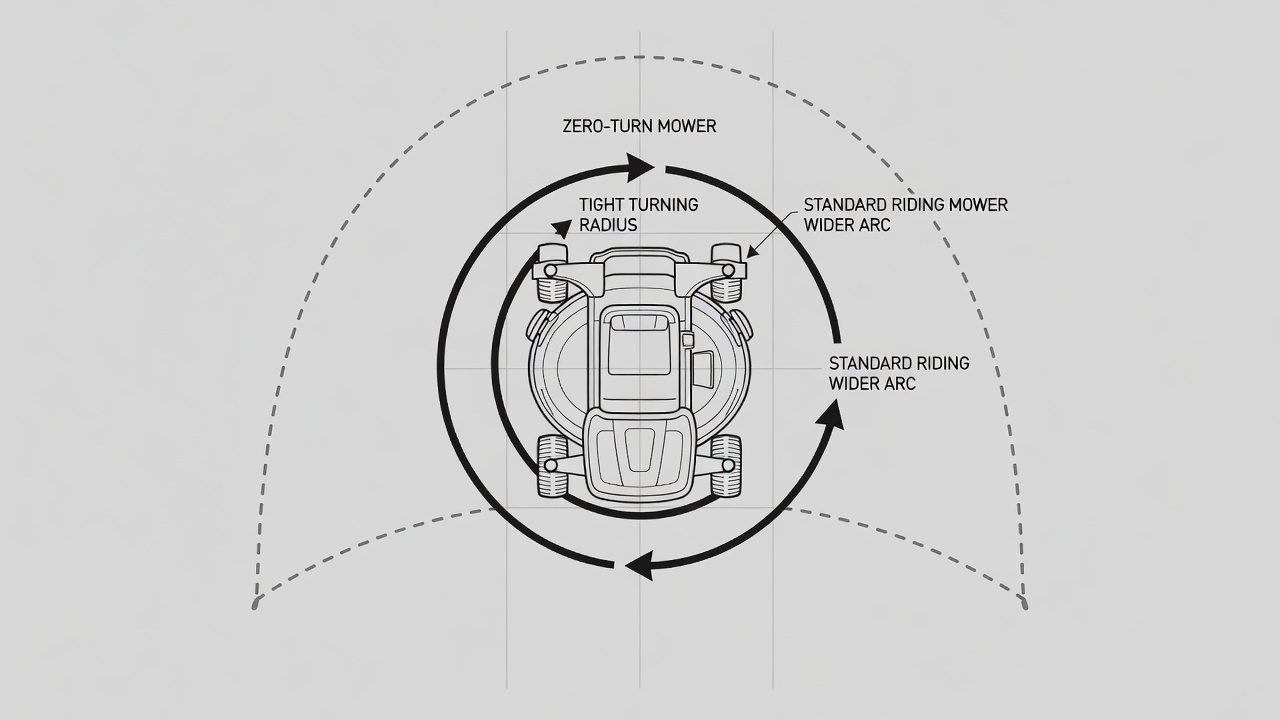
The term “zero-turn” refers to the mower’s ability to make a complete turn within its own footprint. Unlike a standard riding mower or tractor that has a wide turning radius and requires significant space to change direction, a zero-turn mower can spin on the spot. This is made possible by its steering and drive system.
In a zero-turn mower, the operator controls two independent drive wheels, typically the rear wheels, using separate levers. Pushing both levers forward moves the mower straight ahead. Pulling both back moves it in reverse. To turn, the operator manipulates the levers in opposite directions: pushing the left lever forward while pulling the right lever back (or vice versa) causes the mower to pivot sharply. This direct control over each rear wheel is the key to its exceptional maneuverability.
Key Features and Components
Zero-turn mowers are engineered for performance and agility. Their primary features include:
- Dual-Lever Steering System: The most defining feature. Two lap bars or levers replace the steering wheel, providing intuitive, responsive control over direction and speed.
- Independent Rear Wheel Drive: Each rear wheel is powered by its own hydraulic pump and motor, allowing for independent speed and direction control, which is essential for the zero-turn capability.
- Front Caster Wheels: Instead of steerable front wheels, zero-turn mowers use freely rotating caster wheels. These wheels swivel 360 degrees, following the direction dictated by the rear drive wheels without resistance.
- Large Mower Deck: Most models feature a wide, mid-mounted cutting deck (often 42 to 60 inches) for efficient coverage of large areas. The deck is typically suspended and can often be adjusted to different cutting heights.
- Powerful Engine: To drive the hydraulic system and cutting deck, zero-turn mowers are equipped with robust gasoline engines, often with higher horsepower than standard lawn tractors.
How It Differs from Other Mowers
Understanding the distinction between a zero-turn mower and other common types helps clarify its purpose.
Zero-Turn vs. Standard Riding Mower (Lawn Tractor)
A standard riding mower or lawn tractor uses a steering wheel connected to the front wheels for steering. It has a much wider turning radius, often requiring a multi-point turn to navigate around obstacles. While excellent for straight-line mowing on open lawns, it is less efficient in yards with many trees or garden beds. Zero-turn mowers excel in these complex environments.
Zero-Turn vs. Push Mower
A push mower (manual or self-propelled) is designed for small to medium-sized lawns. It requires the operator to walk behind and guide it. While highly maneuverable in tight spaces, it is impractical and time-consuming for large properties. A zero-turn mower is a commercial-grade or large-residential solution focused on speed and coverage.
Who Is a Zero-Turn Mower For?
Zero-turn mowers are not for every lawn. They are best suited for specific scenarios:
- Large Residential Lawns: Properties with over half an acre of grass, especially those with numerous obstacles, benefit greatly from the time savings and precision.
- Commercial Landscapers: Professionals who maintain multiple large properties daily rely on zero-turn mowers for their speed, durability, and efficiency.
- Lawns with Complex Landscaping: Yards with intricate flower beds, trees, shrubs, and pathways are ideal, as the mower can navigate tight turns without damaging plants.
Conversely, a traditional riding mower might be more suitable for very large, open fields with few obstacles, or for users who prioritize stability on slopes over maneuverability.
Evaluating if a Zero-Turn Mower Is Right for You
Before investing, consider these practical factors: To evaluate matched hardware tolerances, consult our detailed overview of marshall stanmore iii vs harman kardon onyx studio 8.
- Lawn Size and Layout: Measure your lawn and map out obstacles. The more complex the layout, the greater the advantage of a zero-turn.
- Terrain: Zero-turn mowers perform best on relatively flat ground. While some models handle gentle slopes, steep hills can be challenging and potentially unsafe due to the high center of gravity and caster wheel design.
- Comfort and Ergonomics: The operator sits in a different position than on a lawn tractor, often with a more upright posture. Test the comfort of the seat and the ease of using the control levers.
- Maintenance Requirements: The hydrostatic transmission system requires regular maintenance, including checking hydraulic fluid levels. The deck and blades also need routine care.
- Learning Curve: Mastering the dual-lever controls takes some practice. Most new operators can become proficient within a few uses, but it feels different from steering a wheel.
Common Questions on Zero Turn Lawn Mower Answered
Is a zero-turn mower hard to operate?
There is a short learning curve. The dual-lever controls are intuitive once you understand that each lever controls the speed and direction of the corresponding rear wheel. Most users become comfortable after a few practice sessions on an open area of the lawn.
Can zero-turn mowers handle hills?
They are designed primarily for flat to gently sloping terrain. While some models can handle moderate slopes, they are generally less stable than lawn tractors on steep hills due to their design. Always check the manufacturer’s specifications for slope ratings. When planning workspace deployment, consider the engineering criteria outlined in our dyson v8 cyclone vs bissell featherweight stick guide.
What is the main advantage of a zero-turn mower?
The primary advantage is maneuverability. The ability to pivot in place allows for precise trimming around obstacles, reducing the need for secondary trimming with a string trimmer and significantly cutting down overall mowing time on complex lawns.
How does the maintenance differ from a riding mower?
The core maintenance (blade sharpening, oil changes, air filter) is similar. The key difference is the hydrostatic transmission system, which requires periodic checks of the hydraulic fluid. The drive belts and deck components also need regular inspection due to the mower’s performance-oriented use. For additional operational safety benchmarks, see our published testing notes on bissell crosswave hydrosteam vs shark stainforce.
Technical Standards and Compliance
Mechanical safety standards, operational tolerances, and protective gear guidelines align with benchmark specifications established by the American National Standards Institute (ANSI).









