
What Is a Reel Mower? Direct Answer
A reel mower is a lawn mower that cuts grass using a rotating cylindrical blade (called a reel) with multiple cutting edges that press grass blades against a stationary blade, producing a clean, precise cut similar to scissors. Reel mowers are available in two main types: manual push models powered by your walking motion, and motorized versions with gasoline or electric engines. Unlike rotary mowers that use a spinning blade to hack grass, reel mowers use a scissor-cut action that produces a neater edge, promotes grass health, and operates much more quietly.

Pros
- Lightweight construction with composite wheels for easy pushing and turning
- Heat-treated alloy steel blades maintain sharpness over time
- Fully adjustable cutting height for versatile lawn care
- Quiet manual reel design eliminates noise pollution and emissions
- Simple tool-less assembly for convenient setup
Cons
- Manual push operation requires physical effort and is best suited for small flat lawns
- Cutting height limited to a maximum of 2.5 inches which may not suit taller grass varieties
- No powered assist or self-propulsion features for larger or hilly yards
The Great States 415-16 is a manual mechanical reel lawn mower built for homeowners who value simplicity and eco-friendly yard care. Its lightweight frame combines a 16-inch cutting width with 10-inch composite wheels and a comfortable T-style cushioned grip handle. Immediate impressions highlight the clean design and straightforward tool-less assembly that gets the mower ready quickly.
In real-world use the 5-blade ball bearing reel powered by high-quality heat-treated alloy steel blades delivers a clean even cut across the adjustable 1 to 2.5 inch height range. The absence of gas or oil means completely quiet operation free from fumes while the lightweight build and large wheels enhance maneuverability around tight spaces and garden features. These specs make it effective for maintaining neat lawns without the bulk of traditional power mowers.
Potential drawbacks center on its fully manual nature which demands physical pushing effort and works best on smaller flat areas. The cutting height tops out at 2.5 inches so very tall or thick grass may require multiple passes or pre-trimming. Users should also note the lack of any bagging or powered assist options based on the core specifications.
Overall the Great States 415-16 offers strong value for environmentally minded gardeners with modest lawns who want a reliable quiet alternative to gas models. It shines for those prioritizing low maintenance sharp lasting blades and easy handling over high power features.

Pros
- Completely pollution-free and noise-free operation as an eco-friendly manual alternative
- Lightweight design with polymer wheels for easy handling and low physical strain on small to medium lawns
- Hand sharpener included for convenient blade maintenance without extra tools or costs
- Durable 5-blade reel produces a clean scissor cut that promotes healthier grass growth
- Simple adjustable cutting height range suits basic residential lawn needs
Cons
- Limited cutting height adjustment of only 1 to 2.25 inches may not suit users wanting taller grass options
- Requires increased overlap and more frequent passes for grass over 4 inches or wet conditions
- Fully manual push design demands physical effort and is less practical for large properties
The American Lawn Mower 1304-14SK2 is a classic 14-inch 5-blade reel mower built by the American Lawn Mower Company for walk-behind use. Its straightforward mechanical design features durable 10-inch polymer wheels and a compact frame that feels light and agile right out of the box, giving an immediate impression of simple, no-frills quality focused on reliability rather than power features.
In real-world performance the 5-blade reel delivers a clean scissor-action cut across the 14-inch width while the adjustable blade height of 1 to 2.25 inches lets you set the desired finish. The included hand sharpener makes it easy to keep blades effective, and the overall lightweight construction combined with low maintenance needs means the mower stays quiet, emission-free, and ready for frequent light mowing sessions that keep lawns healthy.
Drawbacks center on the purely manual nature of the tool. Users must push it themselves, which can become tiring on larger areas, and the limited height range plus guidance to increase overlap for taller grass or avoid wet conditions means it rewards careful lawn habits rather than tackling neglected growth in one pass.
Overall the American Lawn Mower 1304-14SK2 is best suited for homeowners with small to medium yards who prioritize an eco-friendly, quiet, and low-cost mowing solution. If you value simplicity, environmental benefits, and easy blade care, this reel mower delivers solid everyday value.

Pros
- Delivers a precise scissor-like cutting action that supports healthier grass growth
- Offers 4 adjustable cutting heights between 1 and 2.5 inches for customization
- Features an eco-friendly motorless design with no gas or battery needs
- Provides strong maneuverability via 14-inch width and 10-inch front wheels
- Uses durable hardened steel blades for long-term reliability
Cons
- Demands manual pushing effort that can fatigue users on larger or uneven lawns
- Restricts maximum cutting height to 2.5 inches which may not suit taller grass
- Uses a 14-inch cutting path requiring more passes on bigger yards than wider models
The LawnMaster LMRM1401 Push Reel Lawn Mower stands out as a compact walk-behind option for environmentally minded users. Built with quality materials and durable hardened steel blades, it creates an immediate impression of a simple, reliable tool free from motors or fuel systems. Its lightweight reel design prioritizes ease of use in residential settings without the bulk of powered alternatives.
Performance centers on a scissor-like cut that avoids grass tearing for better lawn health. The 4 cutting positions let you set heights from 1-inch to 2.5-inches while the 14-inch width and 10-inch front wheels enable smooth navigation around edges and obstacles. The motorless construction ensures quiet, emission-free operation ideal for frequent small-yard maintenance.
Key considerations include the physical effort needed to push the unit, which may prove tiring on expansive or sloped properties. The limited height range and narrower deck also mean more time spent on larger areas compared to wider powered mowers.
This mower delivers solid value for eco-conscious homeowners with small to medium flat lawns seeking a quiet, low-cost maintenance solution. It works best for those who prioritize healthy grass results and zero emissions over powered convenience.
How a Reel Mower Works
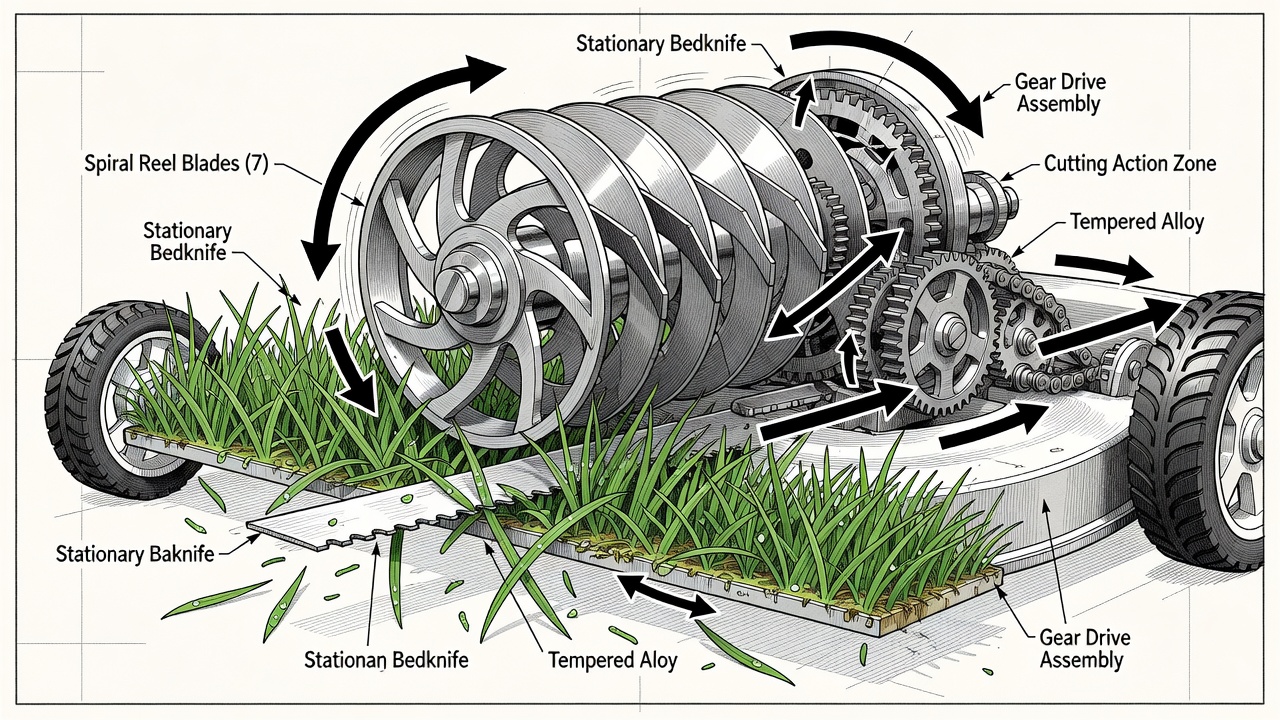
Understanding the cutting mechanism helps explain why reel mowers produce a different quality cut than rotary models.
The Cutting Action: A reel mower consists of a cylindrical drum with 5 to 10 spiral-arranged blades that rotate as the mower moves forward. As the reel turns, each blade sweeps across a stationary blade (called the bedknife) positioned directly below it. Grass is caught between the rotating reel blade and the stationary bedknife, where it is cleanly clipped rather than torn or chopped.
The Stationary Blade’s Role: The bedknife is critical to the reel mower’s function. It remains motionless while the reel spins above it, acting as an anvil. The grass is pinched and cut between these two blades in a shearing motion, similar to how scissors work. For the cut to be clean, the gap between the reel and bedknife must be precisely adjusted. If the gap is too wide, grass won’t be caught cleanly; if too tight, the mower will jam.
How Manual Reel Mowers Operate: In manual push models, the wheels turn a gear system as you push the mower forward. This mechanical connection directly drives the reel, so the faster you walk, the faster the reel spins. No engine is required, your forward momentum powers the cutting action.
How Motorized Reel Mowers Operate: Engine-powered reel mowers use a gasoline or electric motor to drive the reel independently of the wheels. This allows the operator to control reel speed separately from forward speed, providing more precise cutting control and less physical effort than manual models. For additional operational safety benchmarks, see our published testing notes on z890 vs x870e motherboard.
Manual Push Reel Mowers vs. Motorized Reel Mowers
The two primary variants serve different needs and lawn sizes.
- Power source: Human effort, no fuel, electricity, or batteries required.
- Best for: Small to medium lawns (typically under 5,000 square feet), homeowners seeking quiet operation and minimal maintenance, and those preferring chemical-free lawn care with no emissions.
- Physical demand: Requires consistent pushing effort; modern designs are lighter than older models, but physical strength and mobility are factors.
- Maintenance: Minimal, occasional blade sharpening and occasional lubrication of gears. No spark plugs, oil changes, or seasonal storage procedures.
- Operating cost: One-time purchase price only; no ongoing fuel or electricity costs.
Motorized Reel Mowers:
- Power source: Gasoline engine or electric motor (battery or corded).
- Best for: Larger lawns (5,000+ square feet), professional grounds maintenance, sports field upkeep, and homeowners who prefer minimal physical exertion.
- Physical demand: Primarily steering and directional control; engine handles the cutting work.
- Maintenance: Gas models require seasonal tune-ups, spark plug changes, oil checks, and fuel stabilization. Electric models need battery charging or outlet access and occasional blade maintenance.
- Operating cost: Fuel, electricity, or battery replacement; periodic tune-ups and repairs.
- Performance: Consistent cut quality regardless of operator pace; faster mowing speeds than manual models.
Reel Mowers vs. Rotary Mowers: Key Differences
Most homeowners are familiar with rotary mowers. Understanding how reel mowers differ mechanically and functionally clarifies why some prefer one type over the other. Users looking for related component recommendations can explore our dyson v8 cyclone vs bissell featherweight stick breakdown.
| Feature | Reel Mower | Rotary Mower |
|---|---|---|
| Cutting mechanism | Scissor-like shearing action between rotating reel and stationary blade | Single spinning blade that impacts and tears grass |
| Cut quality | Clean, precise edge; no ragged tips | Coarser cut; blade tips may fray if dull |
| Noise level | Manual: very quiet (60-65 dB). Motorized: quiet to moderate (75-80 dB) | Loud, especially gas models (85-95 dB) |
| Grass health impact | Clean cut reduces disease entry points; promotes faster healing | Torn blade tips are more susceptible to fungal infection and browning |
| Maintenance frequency | Occasional blade sharpening; minimal maintenance | Frequent blade sharpening; more moving parts require regular servicing |
| Best grass types | Cool-season grasses (fescue, bluegrass, perennial ryegrass) | Works on all grass types but less efficient on very thick or overgrown lawns |
| Lawn conditions | Best on well-maintained, relatively even lawns; struggles with very tall or thick grass | More versatile; handles taller, tougher growth and uneven terrain better |
| Fuel/power requirements | None (manual); minimal (electric); moderate (gas) | Requires fuel (gas) or electricity (electric rotary) |
Benefits of Using a Reel Mower
Superior Cut Quality: The scissor-like cutting action of reel mowers produces a cleaner edge than rotary mowers. This matters because grass blades with clean cuts heal faster and are less susceptible to fungal diseases, brown tips, and stress. Professional sports field groundskeepers and golf course managers rely on reel mowers for this reason.
Grass Health Advantages: Because reel mowers create clean cuts rather than tearing grass blades, they reduce the surface area exposed to disease and environmental stress. The grass plant can focus energy on growth rather than recovering from damage. Over time, a lawn mowed with a reel mower typically appears healthier and denser than one maintained with a rotary mower. Before finalizing equipment decisions, refer to our comprehensive bissell crosswave hydrosteam vs shark stainforce comparison.
Quiet Operation: Manual reel mowers are exceptionally quiet, so quiet you can have a conversation while mowing. Even motorized reel mowers are significantly quieter than gas rotary mowers. This allows early morning or evening mowing without disturbing neighbors.
Environmental Benefits: Manual reel mowers produce zero emissions and consume no fossil fuels. Motorized electric reel mowers eliminate gas fumes and reduce your carbon footprint compared to gas rotary models.
Low Maintenance: Reel mowers have fewer moving parts than rotary mowers and require less frequent servicing. Manual models, in particular, need only occasional sharpening and lubrication.
Cost Efficiency: While quality reel mowers have a higher upfront cost than basic rotary mowers, manual models eliminate fuel and electricity costs. Over a decade of lawn care, the total cost of ownership can be lower than gas-powered equipment.
Precise Height Control: Reel mowers allow you to set exact cutting heights and maintain consistency across the lawn, resulting in a more uniform appearance.
When to Choose a Reel Mower
Ideal Lawn Size: Manual reel mowers are practical for lawns up to about 5,000 square feet. Beyond that, the physical effort becomes significant, and motorized or rotary options become more practical. Motorized reel mowers handle lawns up to 2-3 acres, depending on the model and engine power.
Grass Type Considerations: Reel mowers work best on cool-season grasses commonly found in northern climates: perennial ryegrass, tall fescue, Kentucky bluegrass, and fine fescues. These grasses are typically maintained at shorter heights (1 to 3 inches) where reel mower advantages are most apparent. Warm-season grasses (Bermuda, zoysia, St. Augustine) are sometimes mowed with reel mowers but are more commonly cut with rotary mowers at slightly higher settings.
Lawn Condition Requirements: Reel mowers perform best on lawns that are relatively even and well-established. Very thick, overgrown, or weedy lawns may clog a reel mower. If your lawn is in rough condition, a rotary mower may be more practical initially; switch to a reel mower once the lawn is established.
Physical Capability: Manual reel mowers require reasonable physical fitness and mobility. If pushing effort is a concern, a motorized option or traditional rotary mower may be better suited.
Noise and Environmental Priorities: If quiet operation, zero emissions, or minimal maintenance align with your values, a reel mower is an excellent choice.
Budget Considerations: Manual reel mowers range from $200 to $600 for quality residential models. Motorized reel mowers start around $1,500 and can exceed $5,000 for commercial-grade equipment. Compare this to rotary mowers ($300-$2,000) to determine your budget fit.
Maintenance and Care
Blade Sharpening: The reel blades and bedknife should be sharpened 1-2 times per season or whenever you notice the cut quality declining. Dull blades result in torn grass tips rather than clean cuts. Many manufacturers recommend professional sharpening to maintain precise blade-to-bedknife alignment.
Gap Adjustment: The clearance between the reel and bedknife must be minimal for a clean cut. Check this adjustment before the season and after sharpening. Most modern reel mowers have user-friendly adjustment mechanisms.
Cleaning and Storage: After each use, remove grass clippings and debris from the reel, blades, and undercarriage. Before winter storage (for gas models), drain fuel or use fuel stabilizer, change the oil, and store in a dry location.
Lubrication: Periodically lubricate gears, wheels, and pivot points with appropriate lubricants. Check your manual for specific points and recommended products.
Frequently Asked Questions About Reel Mower
Do I need to be strong to use a manual reel mower?
Modern manual reel mowers are significantly lighter than older models and are engineered for efficiency. Most people of average strength can operate them comfortably on well-maintained lawns. The key is consistent, steady pushing rather than forceful effort. If you have mobility concerns, a motorized model is a better option.
Can a reel mower handle tall or thick grass?
Reel mowers work best when grass is maintained at regular cutting heights. If your lawn has grown very tall or thick (more than 3-4 inches), a reel mower may struggle or clog. For overgrown lawns, use a rotary mower first to bring the grass down to manageable height, then switch to a reel mower for ongoing maintenance.
How often should I sharpen reel mower blades?
For residential use, blade sharpening 1-2 times per season is typical. If you mow frequently (weekly) or have a large lawn, you may need sharpening more often. A dull reel mower produces visibly torn grass tips rather than clean cuts, this is the signal to sharpen.
Are electric reel mowers as effective as gas or manual models?
Yes, electric reel mowers are very effective. They offer the quiet, low-maintenance benefits of reel mowing with easier operation than manual models and without gas fumes. The trade-off is battery runtime, most electric reel mowers handle 1-2 acres per charge, making them suitable for residential and small commercial applications. Battery technology continues to improve.
What’s the difference between a reel mower and a cylinder mower?
Reel mower and cylinder mower are often used interchangeably; they refer to the same equipment. The cylindrical rotating blade is the defining feature, and both terms describe this design. Some professionals use “cylinder mower” more frequently in regions outside North America.
Related Maintenance and Operating Guides
To keep your equipment running at peak operating efficiency, explore our related technical walkthroughs and maintenance tutorials:
- Consult our detailed breakdown on marshall stanmore iii vs harman kardon onyx studio 8.
Reel Mowers and Their Cutting Action
A reel mower uses a cylinder of blades that spins past a fixed bedknife to slice grass cleanly. Without an engine, these machines are quiet and need no fuel, though they suit flatter lawns best. For general safety reading on hand-pushed cutting equipment, look to American National Standards Institute (ANSI).