

Direct Answer: Is Toro a Good Lawn Mower?
Yes, Toro is generally considered a good lawn mower brand. It has earned a solid reputation for durability, build quality, and reliable performance among both homeowners and professional landscapers. Toro mowers typically offer better longevity and lower maintenance costs than entry-level competitors, though they sit in the mid-to-premium price range. Whether Toro is the right choice for you depends on your specific lawn size, preferred mower type, budget, and willingness to maintain the equipment properly.

Pros
- 30-inch cutting width enables significantly faster mowing sessions compared to standard decks
- Dual blade mulching system produces fine clippings that nourish the lawn without bagging
- Push-button start and battery power provide consistent, low-maintenance operation
- Dual LED headlights and Quick Stow handle add practical convenience for day-to-night use and storage
- Compatible with multiple 60V Max battery sizes for customizable power and runtime
Cons
- Battery and charger are not included, requiring an additional purchase of compatible 60V Max batteries
- Actual runtime and total operating cost depend entirely on the chosen battery capacity and number of packs
- Larger 30-inch deck and frame may feel bulkier for users with very compact storage or tight yard access
The Toro 60V MAX 30 in. eTimeMaster Personal Pace Lawn Mower is a cordless walk-behind model built for efficient yard maintenance. Its durable steel deck and cast aluminum frame create a sturdy impression right out of the box, while the Quick Stow handle offers two storage positions for compact placement in limited spaces. Battery and charger are sold separately, allowing users to select from recommended 60V Max 4.0Ah through 7.5Ah packs based on their needs.
In performance, the 30-inch deck is designed to save up to 40 percent of mowing time by covering more ground per pass. Dual Force Dual Blade Technology shreds grass into fine mulch for a clean finish and improved lawn health. Push-button start ensures reliable ignition every time, dual LED headlights support early or late sessions, and the Personal Pace system adjusts propulsion to match walking speed for reduced effort across medium and large properties.
Key considerations include the absence of a battery and charger in the package, so buyers must factor in extra cost and plan for adequate runtime capacity. The wider deck, while efficient, may require more maneuvering room in tight areas compared with narrower mowers. No customer reviews are yet available to confirm long-term durability under varied conditions.
Overall, this Toro eTimeMaster model delivers strong value for homeowners seeking faster coverage, quality mulching, and low-maintenance battery operation on larger lawns. Those prepared to add compatible 60V Max batteries will appreciate the time savings and convenience features most.

Pros
- Personal Pace Auto-Drive adjusts seamlessly to your walking speed
- SmartStow vertical folding saves floor space during storage
- Super Recycler cutting system delivers fine lawn clippings
- Push-button electric start eliminates pull-cord hassles
Cons
- 60V battery and charger are not included
- Relatively heavy at 78 pounds without the battery
What Makes Toro a Trusted Lawn Mower Brand
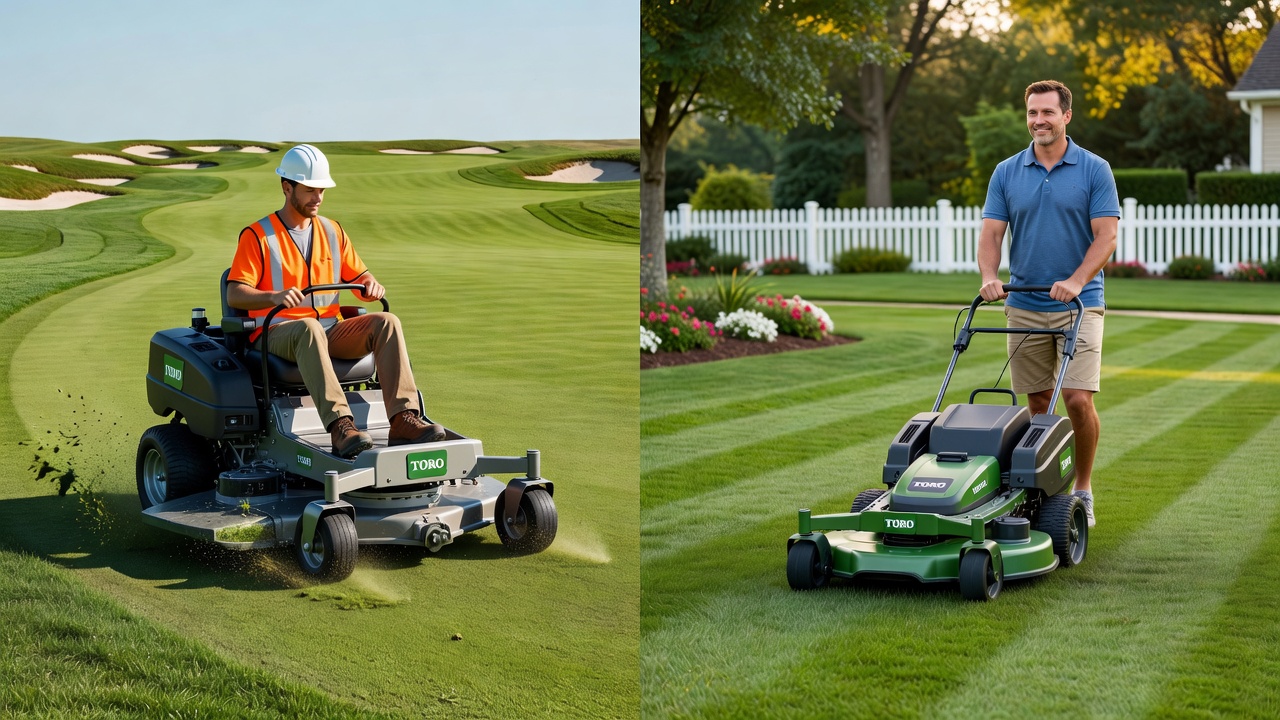
Toro has been manufacturing outdoor equipment since 1914, giving it over a century of engineering experience in lawn care equipment. The company manufactures a wide range of mowers, from push models to zero-turn riders, and serves both residential homeowners and professional landscaping contractors.
Across consumer review platforms and industry evaluations, Toro consistently ranks well for reliability and customer satisfaction. The brand’s longevity in the market reflects consistent product performance and customer trust. Professional landscapers frequently choose Toro equipment for commercial use, which signals durability and uptime reliability, contractors cannot afford equipment that breaks down mid-season.
Key reasons Toro has built its reputation:
- Durability: Toro mowers are known for multi-season performance with proper maintenance
- Parts availability: A wide dealer network and long product support windows mean replacement parts are accessible
- Engine reliability: Toro partners with established engine manufacturers like Honda and Kohler, contributing to dependable power
- Design focus: The brand emphasizes ease of maintenance and serviceability in design
Understanding Toro’s Lawn Mower Range
Toro manufactures several mower categories, and “good” depends partly on choosing the right type for your needs:
- Push mowers: Manually propelled models for small to medium lawns; lightweight and simple to maintain
- Self-propelled mowers: Engine-driven forward motion reduces user fatigue; suitable for larger properties or hilly terrain
- Riding mowers: Seated operator position for properties over 1 acre; faster cutting times
- Zero-turn mowers: High maneuverability for properties with obstacles; faster than traditional riders
Each category has different reliability profiles. Push mowers have fewer moving parts and tend to require minimal maintenance. Self-propelled and riding models involve transmission systems and more complex engines, offering greater convenience but requiring more regular upkeep. Toro builds quality across all categories, but a push mower is inherently simpler and less likely to develop problems than a zero-turn radius rider.
Key Factors That Determine If Toro Is the Right Choice for You
Lawn Size
For lawns under 0.5 acres, a Toro push or self-propelled mower is typically efficient and cost-effective. Properties between 0.5 and 2 acres benefit from a riding mower. Anything larger may justify a zero-turn model for time savings. Toro offers competitive options at each scale, so the brand can serve most homeowners regardless of property size.
Price and Value Positioning
Toro is not a budget brand. Entry-level Toro push mowers start around $300-$500, while mid-range self-propelled models run $600-$1,200. Riding mowers typically range from $1,500 to $3,500+, depending on features. Compared to discount brands, Toro costs more upfront but delivers better longevity, meaning the cost per year of ownership is often lower. If you’re comparing Toro to premium brands like Honda or professional-grade commercial equipment, Toro often represents better value without sacrificing quality.
Maintenance Demands and Your Willingness to Maintain
All lawn mowers require seasonal maintenance: oil changes, spark plug replacement, air filter cleaning, and blade sharpening. Toro mowers are designed for straightforward maintenance, with accessible components and clear owner manuals. However, if you’re unwilling or unable to perform basic upkeep, any mower, including Toro, will underperform or fail prematurely. Budget-conscious buyers sometimes choose Toro specifically because maintenance is simple and parts are affordable, offsetting the higher initial cost. Readers comparing setup options can review our technical analysis on marshall stanmore iii vs harman kardon onyx studio 8.
Parts Availability and Service Network
Toro has an extensive dealer network across North America and strong international presence. This means replacement parts are generally available within days, not weeks. If your local area has limited Toro dealers, this advantage diminishes. Before purchase, verify dealer proximity and parts availability in your region.
Toro vs. Competitor Brands: How It Stacks Up
vs. Honda: Honda mowers are premium-priced with excellent reliability. Toro typically offers similar durability at a lower price point, though Honda engines (when used in Toro mowers) are particularly prized by enthusiasts. For complementary field maintenance guidelines, examine our breakdown of dyson v8 cyclone vs bissell featherweight stick.
vs. Husqvarna: Husqvarna competes directly in the mid-to-premium range. Both brands are respected; Toro often edges out for residential ease-of-use, while Husqvarna has stronger recognition in the professional contractor segment.
vs. John Deere: John Deere dominates the premium riding and zero-turn market with agricultural heritage. Toro offers comparable residential mowers at lower cost, though John Deere holds a stronger brand prestige factor.
vs. Budget brands (Craftsman, MTD, etc.): Budget mowers are cheaper initially but typically fail or require major repairs by year 3, 4. Toro costs 50, 100% more but routinely lasts 8, 10 years with proper maintenance, making it better value long-term. To evaluate matched hardware tolerances, consult our detailed overview of bissell crosswave hydrosteam vs shark stainforce.
The consensus: Toro occupies the sweet spot between affordability and durability for most residential buyers. It’s not the absolute cheapest, nor is it the premium luxury choice, but it delivers reliable performance at a justified price.
Toro’s Strengths and Limitations
Strengths
- Longevity: Toro mowers commonly operate reliably for 8 to 10+ years with basic maintenance
- Ease of maintenance: Simple design and accessible components make upkeep straightforward for homeowners
- Resale value: Used Toro mowers hold value better than budget brands, reflecting durability reputation
- Cutting quality: Blade design and deck engineering produce consistent, even cuts
- Wide product range: Buyers can find a Toro model for nearly any lawn size and preference
- Warranty and support: Reasonable warranty periods and accessible customer support
Limitations and Potential Drawbacks
- Higher upfront cost: Budget buyers may balk at Toro’s price compared to lesser-known brands
- Fewer “smart” features: Toro has not heavily invested in app-connected or robotic residential mowers compared to some competitors
- Dealer dependency: Service and parts rely on dealer network; rural areas may have limited support
- Occasional quality control issues: Like all manufacturers, some buyers report defective units, though this is not systematic
- Engine choices: Toro’s own-brand engines are solid but lack the prestige some buyers seek from Honda or Briggs & Stratton exclusivity
How to Evaluate a Specific Toro Model for Your Needs
Specifications to Compare
When narrowing down a Toro model, focus on:
- Cutting width: Wider decks (21 to 22 inches for push mowers) cover more area per pass but are heavier
- Engine power: Measured in horsepower or cc; more power handles thick grass and slopes better but consumes more fuel
- Self-propulsion or transmission: Variable-speed self-propulsion offers more control than fixed-speed; hydrostatic transmissions on riders provide smooth operation
- Mulching, bagging, and side-discharge options: Determines how clippings are handled; mulching returns nutrients to soil
- Warranty period: Residential mowers typically carry 2 to 3 year warranties; compare what’s covered (parts, labor, engine)
Questions to Ask Before Buying
- Is there a Toro dealer nearby for service and parts?
- What does the warranty cover, and what is excluded?
- Are replacement parts reasonably priced and readily available?
- Does the model have a reputation for any common issues (check online forums and reviews)?
- Does the engine choice (Toro, Honda, Kohler) matter to you?
Common Questions on Is Toro A Good Lawn Mower Answered
How long do Toro lawn mowers typically last?
With proper seasonal maintenance (oil changes, spark plug replacement, blade sharpening), a Toro mower typically operates reliably for 8 to 10 years or longer. Many users report 15+ years of service from well-maintained models. Lifespan depends on usage frequency, terrain difficulty, and maintenance consistency; heavy commercial use shortens lifespan compared to residential weekly mowing.
Are Toro mowers more expensive to repair than other brands?
Toro repair costs are competitive with other mid-premium brands. Parts are often cheaper than premium brands like Honda or John Deere because Toro has higher production volume. Labor costs depend on your local dealer; Toro’s wide dealer network may offer more competitive service pricing than areas dominated by a single brand.
Should I buy a Toro push mower or self-propelled model?
Choose push for lawns under 5,000 square feet on relatively flat terrain if you’re physically able. Self-propelled models are better for slopes, larger properties, or if you prefer less physical strain. Self-propelled costs $200-$400 more but reduces fatigue and cuts mowing time. Toro makes quality versions of both; the choice is about your property and preference, not brand reliability.
Can I find replacement parts and service for Toro mowers in my area?
Toro has one of the broadest dealer networks among residential lawn equipment brands. Check Toro’s dealer locator on their website before purchase to confirm local availability. If your area has no Toro dealers, consider a brand with stronger local presence, as parts and service access will affect your long-term ownership experience.
The Bottom Line
Toro is a good lawn mower brand for most homeowners seeking a balance of reliability, ease of maintenance, and reasonable pricing. The brand’s century-long track record, professional contractor adoption, and strong parts availability support this reputation. However, “good” is contextual: Toro excels at mid-to-premium residential mowing but is not the cheapest option for budget-conscious buyers, nor does it claim the luxury prestige of premium competitors. Evaluate your lawn size, budget, terrain, and maintenance willingness before choosing; then, a Toro mower suited to your specific needs will reliably serve you for a decade or more.
Technical Standards and Compliance
Mechanical safety standards, operational tolerances, and protective gear guidelines align with benchmark specifications established by the American National Standards Institute (ANSI).









