

Direct Answer: How to Measure a Lawn Mower Belt
To measure a lawn mower belt, first disconnect the spark plug wire and allow the engine to cool. Remove the belt from the pulleys, then use a flexible tape measure to find the inside circumference of the belt loop. Alternatively, lay the old belt flat on a clean surface and measure its length from end to end with a tape measure or a piece of string.
Quick answer: The most reliable measurement is the inside circumference of the belt loop. If the belt is broken, lay the pieces end to end and measure the total length. Always compare your measurement with the mower model number and any printed numbers on the belt before ordering a replacement.

Pros
- Wide compatibility with Craftsman 42-inch LT series and many Husqvarna models plus multiple OEM part replacements
- Premium polyester and rubber materials provide superior stretch resistance and 30 percent reduced wear
- Simple DIY-friendly design requires no special tools for fast belt swaps
- Heat-resistant build and zigzag stitching ensure reliability in demanding mowing environments
Cons
- Does not fit 46-inch LT2000 mower decks so exact model and deck size verification is required before purchase
- Aftermarket nature means users should cross-check listed part numbers carefully to guarantee precise fitment
- Limited to the specified 42-inch configurations without broader universal sizing options
The Tecreddy 144959 is a replacement mower deck belt sized at 1/2 inch wide by 95.5 inches long and built from high-quality polyester fiber with natural rubber. It targets Craftsman 42-inch riding lawn mowers such as the LT1000 LT2000 LT3000 and DYT4000 along with compatible Husqvarna Poulan AYP and Ariens models. The design creates an immediate impression of robust construction focused on a snug pulley fit for everyday lawn care maintenance.
Performance stands out through polyester fiber cores that resist stretching under heavy loads plus heat-resistant rubber compounds that handle high-torque stop-and-go mowing. Zigzag stitching stops fraying while a low-friction coating cuts pulley wear. Lab tests confirm 30 percent less wear than standard belts so users gain longer service intervals. It replaces key part numbers like 144959 532144959 532130801 and others for reliable real-world operation across listed tractor models.
Drawbacks center on strict sizing limits. This belt does not fit the 46-inch LT2000 mower deck so buyers must verify their exact deck size and original part number. As an aftermarket option precise matching of the compatibility list is essential to prevent installation issues even though no special tools are needed.
The Tecreddy 144959 delivers strong value for owners of matching 42-inch Craftsman and Husqvarna riding mowers who want a durable affordable belt that reduces replacement frequency and simplifies DIY repairs. It is a practical choice for keeping lawn equipment productive with minimal downtime.

Pros
- Direct OEM part number GX23501 compatibility for accurate replacement
- New condition ensures ready-to-install quality
- Specifically supports John Deere JS26, JS28, and JM26 walk behind models
- Includes one complete drive belt in the package
- Straightforward option for restoring mower drive systems
Cons
- Limited exclusively to JS26, JS28, and JM26 John Deere models
- No detailed dimensions or material specifications available
- Package contains only the single belt with no tools or guides included
The JZGRDN GX23501 is a replacement drive belt built for John Deere walk behind lawn mowers. It matches the original part number GX23501 and comes in new condition, providing a basic yet functional option for owners focused on restoring their equipment.
In terms of performance and key features, this belt serves as a direct compatible part for models JS26, JS28, and JM26. It supports the drive system needed for standard lawn mowing tasks, allowing users to maintain operation based strictly on the listed model compatibility and new condition status.
Drawbacks and considerations include its restriction to only the specified John Deere models and the absence of any expanded technical details such as measurements or materials. The package offers just one belt, so installation may require separate tools or expertise from the user.
This product delivers the most value to owners of John Deere JS26, JS28, or JM26 walk behind lawn mowers who need a simple new drive belt replacement matching the GX23501 part number for basic repairs.

Pros
- High-quality materials engineered for durability in mechanical applications
- Consistent power transfer for smooth mower operation
- Precision manufacturing for optimal fit and reduced slippage
- Straightforward design for quick and easy installation
- Suitable for demanding walk-behind mower AWD systems
Cons
- Limited to 22-inch size which may not suit other mower configurations
- No detailed compatibility list for specific mower models provided
- Generic feature descriptions without model-specific performance metrics
The Husqvarna 586124201 AWD Belt is a 22-inch replacement component specifically designed for walk-behind mowers. Built with high-quality materials, it offers a solid first impression of durability suited to mechanical demands in outdoor equipment.
In performance, this belt focuses on reliable power transmission to deliver consistent transfer between rotating shafts and pulleys. Precision engineering helps maintain tension and minimize slippage, while the straightforward design supports easy installation for efficient maintenance of AWD systems.
Drawbacks include its fixed 22-inch length, which restricts use to matching mower setups, and the absence of extensive model-specific compatibility details or user-reported long-term data in available information.
Overall, the Husqvarna 586124201 provides strong value for owners of compatible walk-behind mowers seeking a dependable AWD belt replacement that prioritizes durability and straightforward power delivery.

Pros
- Accurate OEM size match of 33-1/4 inches by 3/8 inch for secure fit
- Extensive list of compatible Toro models including 20xxx and 21xxx series
- Direct replacement design simplifies installation for DIY users
- Suitable for Toro Recycler and related lawn mower drive systems
Cons
- Aftermarket construction from Tormurbutl may offer different longevity than genuine Toro belts
- Restricted to only the specifically listed Toro models for proper fitment
- No included accessories or detailed installation guidance based on available data
The Tormurbutl 115-4669 is a replacement lawn mower drive belt created as a compatible alternative to the original Toro 115-4669 part. It features a standard V-belt design with a length of 33-1/4 inches and width of 3/8 inch, delivering a focused solution for restoring drive capability on supported residential mowers.
Performance centers on accurate sizing that enables efficient power delivery in real-world use on models such as the Toro 20332, 20333, 20334, 20338, and many others including Recycler 22 variants. The belt engages properly for self-propelled functions when matched to the listed equipment, supporting consistent mowing operations based on its specified dimensions.
Key considerations include its third-party origin, which means material resilience and wear characteristics could differ from factory Toro components. Users should also confirm their exact mower model against the full compatibility roster to prevent incorrect purchases.
This product delivers solid value for Toro owners seeking a correctly dimensioned drive belt for the supported series, especially those maintaining Recycler models at home who prioritize fit over brand-original sourcing.
Why Accurate Measurement Matters
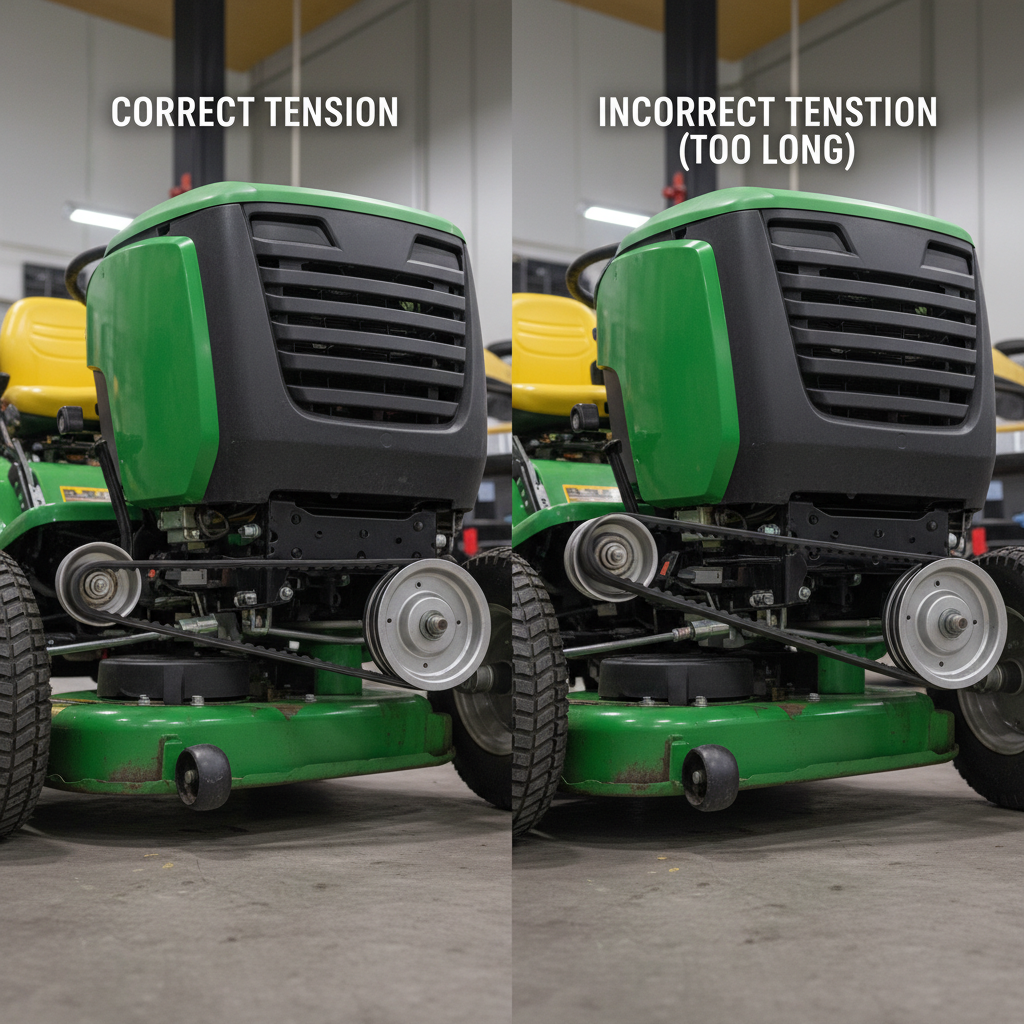
Using the correct lawn mower belt size is essential for safe and efficient operation. A belt that is too short will be difficult to install, put excessive strain on the pulleys, and may cause the engine to labor. A belt that is too long will slip, fail to engage the blades or drive wheels properly, and wear out quickly. In both cases, the mower will not cut evenly, and you risk damaging the belt, pulleys, or spindle bearings.
Lawn mowers generally use two main types of belts: drive belts and deck belts. The drive belt transfers power from the engine to the transmission or wheels, while the deck belt turns the blades. Some mowers also have a separate transmission belt. Each belt may have a different width, length, and cross-section shape, so you need to measure the exact belt you are replacing.
Belt measurements can be expressed as outside circumference, inside circumference, or effective length. Most replacement parts are listed by outside circumference or by a manufacturer part number. Understanding the difference between these measurements will help you avoid ordering the wrong part.
Tools and Safety Preparation
Before you start measuring, gather the following tools:
- Flexible tape measure (cloth or vinyl)
- Piece of string or thin rope
- Marker or pen
- Notepad and pencil
- Wrench or socket set
- Flashlight
- Work gloves
- Clean, flat surface
Safety is the most important part of any lawn mower maintenance task. Always follow these steps before touching the belt:
- Turn off the mower engine and remove the ignition key.
- Disconnect the spark plug wire and secure it away from the spark plug. This prevents accidental starting.
- Wait for the engine and muffler to cool completely.
- If you need to lift the mower, use jack stands or blocks. Never rely on the mower deck lift alone.
- Wear work gloves to protect your hands from sharp metal edges on the deck and pulleys.
Once the mower is safe to work on, you can access the belt. On many mowers, you will need to remove the belt guard or lower the mower deck. Refer to your owner’s manual if you are unsure how to access the belt.
Method 1: Measuring the Inside Circumference of the Belt Loop
This is the most common and accurate method for measuring a lawn mower belt that is still in one piece. The inside circumference is the distance around the inner edge of the belt loop. Replacement belts are often listed by this measurement, especially when the belt is a V-belt or deck belt.
Step-by-Step Instructions
- Remove the belt from the mower. Carefully release tension from the idler pulley and slide the belt off the pulleys. Do not force it; if it is stuck, check for a belt keeper or guide that needs to be loosened.
- Clean the belt. Wipe off grease, grass, and dirt so you can see the full loop clearly.
- Hold the belt in a natural circle. Place the belt on a clean, flat surface and form it into a loop without twisting it. Do not stretch it.
- Position the tape measure along the inside edge. Place the end of a flexible tape measure at any point on the inside edge of the belt loop. Run the tape along the inside edge, following the curve of the belt, until you return to the starting point.
- Read the measurement. Note the number where the tape meets the starting end. This number is the inside circumference in inches.
- Repeat the measurement. Measure two or three times to ensure accuracy. If you get different numbers, use the average.
If you do not have a flexible tape measure, use a piece of string. Wrap the string around the inside of the belt loop, mark the point where the string overlaps, then lay the string flat and measure it with a ruler or metal tape measure.
Tips for Accuracy
- Do not stretch the belt while measuring. A stretched measurement will be too long.
- Make sure the belt is not twisted. A twisted belt will give a shorter or inconsistent reading.
- Measure the inside edge, not the outside edge, unless you know the manufacturer lists belts by outside circumference.
- If the belt has a directional arrow or wear pattern, note it; this can help you install the new belt correctly.
Method 2: Measuring the Old Belt Laid Flat
If the belt is already removed, broken, or cut, you can measure it by laying it flat. This method is also useful when you want to compare a used belt with a new one.
Step-by-Step Instructions
- Lay the belt flat on a clean surface. Make sure the belt is not coiled or twisted. If the belt is broken, arrange all pieces end to end in a straight line.
- Use a flexible tape measure. Place the tape measure along the top edge of the belt from one end to the other. For a V-belt, measure along the outside edge, not the inside groove.
- Record the length. This is the outside length of the belt. Many replacement belts are listed by outside circumference, so this measurement may match the part number.
- For a broken belt, measure all pieces. Lay the pieces end to end with the cut ends touching. Measure the total length with a tape measure or string.
If you are measuring a belt that is still in a loop but you cannot use the inside circumference method, you can cut the belt and lay it flat. However, this destroys the belt, so only do this if the belt is already damaged and you have no other way to measure it. Users looking for related component recommendations can explore our marshall stanmore iii vs harman kardon onyx studio 8 breakdown.
String Method for a Broken Belt
If you do not have a tape measure long enough, use a piece of string. Lay the string along the full length of the belt or belt pieces. Mark the string at the end of the belt, then measure the string with a ruler or yardstick.
Accounting for Belt Wear and Stretch
Lawn mower belts stretch slightly over time. A used belt may measure a half-inch or more longer than a new belt. If you rely only on the measurement of a worn belt, you may order a belt that is too long. To avoid this problem, look for printed numbers on the belt and compare them with the mower model number. When in doubt, choose the replacement size recommended by the manufacturer rather than the exact measurement of a stretched old belt. Before finalizing equipment decisions, refer to our comprehensive dyson v8 cyclone vs bissell featherweight stick comparison.
How to Verify Your Measurement and Find the Right Replacement
Once you have your measurement, you need to confirm that it is correct before ordering a replacement. A single measurement is not always enough because different manufacturers use different numbering systems.
Check the Belt Itself
Many lawn mower belts have numbers printed or embossed on the outside surface. These numbers may include the width and length, such as ‘1/2 x 92’ or ‘3/8 x 84’. The first number is the width in inches, and the second number is the length in inches. The length may be the outside circumference or the effective length, depending on the brand. For broader ecosystem context, read through our operational guide on bissell crosswave hydrosteam vs shark stainforce.
If the numbers are worn off, clean the belt and look again. Sometimes the numbers are on the flat side of the belt rather than the top.
Check the Mower Model and Deck Model
The most reliable way to find the correct belt is to use the mower’s model number and serial number. You can find these on a sticker or metal plate under the seat, on the deck, or near the engine. Write these numbers down and look up the parts diagram for your exact model. The parts diagram will show the correct belt part number and often the belt dimensions.
Compare with the Owner’s Manual
Your owner’s manual will list the correct belt part number and sometimes the belt size. Use this information to double-check your measurement.
Use a Replacement Parts Lookup
Most lawn mower manufacturers and online parts retailers allow you to enter your model number to find the correct belt. Enter the model number and look for the deck belt or drive belt in the parts diagram. Compare the part number with the number printed on your old belt.
Measurement and Part Number Table
| Belt Type | Typical Measurement | Notes |
|---|---|---|
| Deck belt | Inside circumference or outside length | Usually a V-belt; check for width as well |
| Drive belt | Outside circumference | May be longer and narrower than deck belt |
| Transmission belt | Effective length | Check manufacturer part number |
| Broken belt | Total length of all pieces | Measure end to end without overlapping |
If your measurement is between two sizes, always verify with the model number. Do not choose a belt that is too short just to make it fit. A belt that is too short can damage the pulleys and bearings.
Common Questions on How To Measure A Lawn Mower Belt Answered
Can I measure a lawn mower belt without removing it?
Yes, but it is less accurate. You can use a piece of string to trace the belt path around the pulleys, then measure the string. However, the belt tension and pulley position can affect the measurement. For a replacement belt, it is better to remove the belt and measure it directly.
What do the numbers on a lawn mower belt mean?
Belt numbers usually indicate the width and length. For example, a belt marked 1/2 x 92 is approximately 1/2 inch wide and 92 inches long. The length may be the outside circumference or the effective length, so always check the manufacturer’s parts list.
Does belt stretch affect the measurement?
Yes. A worn belt can stretch, making it slightly longer than a new belt. If you measure only the old belt, you might order a belt that is too long. Use the printed part number or the mower model number to confirm the correct size.
What tools do I need to measure a lawn mower belt?
You need a flexible tape measure or a piece of string and a ruler. You may also need a wrench or socket set to remove the belt guard or loosen the idler pulley. Always wear work gloves and disconnect the spark plug wire before starting.
Related Maintenance and Operating Guides
To keep your equipment running at peak operating efficiency, explore our related technical walkthroughs and maintenance tutorials:
- Consult our detailed breakdown on heavy-duty chainsaw buyer guide.
Technical Standards and Compliance
Mechanical safety standards, operational tolerances, and protective gear guidelines align with benchmark specifications established by the American National Standards Institute (ANSI).









