
Direct Answer: When Was the Lawn Mower Invented?
The lawn mower was invented in 1830 by Edwin Budding in England. Budding patented the first practical mechanical lawn mower, which featured a cylinder (or reel) cutting mechanism that revolutionized lawn care by replacing manual scything. This groundbreaking invention laid the foundation for all modern lawn mowing technology.

Pros
- Powerful 80V brushless motor delivers 32HP gas-equivalent performance with quiet fume-free operation and no engine maintenance.
- Complete kit includes four 6.0Ah batteries and 600W charger for substantial runtime up to 1.5 acres.
- SmartCut technology and 42-inch heavy-duty steel deck ensure consistent cuts without bogging in tough conditions.
- Versatile towing up to 350 lbs and optional cargo hauling plus comfort features like high-back seat and LED lights.
- Strong 4-year limited warranty and full compatibility with the Greenworks 80V tool ecosystem.
Cons
- Rear utility cargo bed for 200 lb hauling is sold separately and not included in the kit.
- Runtime of up to 1.5 acres varies with conditions and may require recharging or battery swaps on larger properties.
- As a fully cordless model continuous operation depends on battery levels unlike gas engines with unlimited runtime.
The Greenworks 80V 42" CrossoverT Cordless Riding Lawn Tractor is a ready-to-mow zero-emission tractor designed for homeowners managing medium to large lawns. It features a reinforced 42-inch stamped steel deck of 12-gauge construction along with premium comfort elements such as a high-back padded seat with foldable armrests. The overall build emphasizes durability and user convenience right out of the box with the included battery and charger set.
Performance centers on the 80V TruBrushless motor that provides 32HP gas-equivalent power with instant torque and quiet fume-free operation. SmartCut technology senses grass conditions and automatically adjusts power to maintain a consistent cut even in tall thick or wet areas. The four 6.0Ah batteries support runtime for up to 1.5 acres depending on conditions while dual LED headlights and a 7-position deck height range from 1.5" to 4.5" add practicality. Front and rear attachments further allow towing up to 350 lbs for added yard utility.
Key considerations include that the rear utility storage bin capable of hauling 200 lbs is sold separately so full cargo functionality requires an extra purchase. Runtime remains condition-dependent and may fall short for properties significantly larger than 1.5 acres without using the 600W charger or swapping batteries. The cordless design prioritizes ease and low maintenance but trades off the continuous runtime of traditional gas models.
This tractor delivers strong value for eco-conscious owners of residential properties who want gas-like power without the emissions noise or upkeep. It suits those who already use or plan to expand into the Greenworks 80V family of tools and who appreciate the 4-year limited warranty. Users with exceptionally large or commercial-scale lawns should evaluate battery logistics carefully before purchase.

Pros
- Delivers strong 21 horsepower equivalent power comparable to gas riding mowers.
- Provides up to 1.5 acres of runtime on a full charge with the six included batteries.
- Features low-maintenance dual brushless motors without belts for greater durability.
- Offers versatile 12-position cutting height adjustment from 1.5 to 4.5 inches.
- Includes digital controls for blade settings, drive speeds, and cruise control.
Cons
- Limited to 1.5 acres of cutting per charge without purchasing additional batteries for bigger lawns.
- Requires recharging time for the six 56V batteries after each use session.
- Relies solely on battery power with no hybrid or gas backup option for extended operation.
The EGO Power+ TR4204 is a cordless electric riding lawn mower built as a modern tractor alternative for residential use. It features a robust 42-inch stamped steel deck and arrives ready to go with six 56V 6.0Ah batteries plus a charger, creating an immediate impression of convenience and solid construction free from gas engine complexity.
Performance shines through its equivalent 21 horsepower output and top speed of 6 MPH, allowing efficient coverage of up to 1.5 acres on a single charge. Dual brushless cutting motors operate without belts for added durability and less upkeep, while the digital display lets users select three blade settings, three drive speeds, and cruise control. The 12 adjustable heights ranging from 1.5 to 4.5 inches combined with anti-scalp wheels deliver precise results across varied terrain.
Drawbacks center on battery dependency, as larger properties beyond 1.5 acres require extra batteries and recharging intervals can interrupt workflow. The fully electric design eliminates fuel storage needs but demands access to power sources between sessions.
This mower suits homeowners with medium to large yards who value quiet, emission-free operation and reduced maintenance. Those seeking expandable battery capacity for bigger areas will find the EGO Power+ TR4204 a strong long-term investment in cordless lawn care.
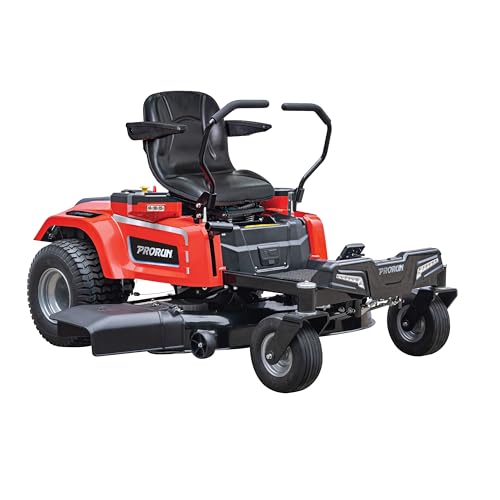
Pros
- High-efficiency brushless motors maximize power output and durability over traditional motors
- Up to 2 acres runtime with three included 10.0 Ah batteries supports substantial mowing sessions
- Zero-emission operation with gas-equivalent 20 HP power for quieter environmentally friendly use
- Six-port auto-switchover battery system provides flexible extended runtime options
- Durable 42-inch steel deck plus included mulch and towing kits add immediate functionality
Cons
- Runtime is limited to approximately 70 minutes or 2 acres which may require recharging for larger properties
- Fully battery-dependent design means performance relies on charge levels and spare battery availability
- 42-inch deck size may require more passes on expansive lawns compared to wider commercial models
The PRORUN PZT60V42 is a fully electric 60V zero-turn riding lawn mower built for residential and light commercial use. Its primary design centers on a robust 42-inch 14-gauge stamped steel twin blade deck powered by direct-drive brushless motors, giving an immediate impression of solid construction and modern battery-focused engineering. The mower arrives complete with three 10.0 Ah batteries, a charger, mulch kit, and towing kit for ready-to-work versatility.
In performance terms, four high-efficiency brushless motors deliver power equivalent to a 20 HP gas engine while producing zero emissions. The system supports up to 2.0 acres or 70 minutes of runtime, and six battery ports with auto switchover intelligently manage all PRORUN 60V battery sizes for continuous operation. A washout port on the steel deck further simplifies post-mow maintenance during real-world sessions.
Potential drawbacks include the finite 70-minute runtime window which can limit coverage on larger properties without spare batteries or recharge breaks. As a fully electric model, it also depends entirely on battery charge levels rather than continuous fuel refills, and the 42-inch deck width may demand extra passes compared with wider traditional options.
Overall the PRORUN PZT60V42 offers strong value for homeowners and small-property managers who want gas-like cutting power without emissions or noise. Those with medium-sized lawns seeking quiet efficient zero-turn performance and included accessories will benefit most from this electric mower.

Pros
- Strong 24HP FR730 engine power for demanding cutting conditions
- Wide 54-inch FAB deck reduces total mowing time
- Zero turn design delivers excellent maneuverability
- Fabricated deck supports durable everyday operation
Cons
- Sparse details beyond engine and deck leave other features unspecified
- Gas-powered FR730 engine needs regular fuel and maintenance
- Large 54-inch deck size may feel oversized on compact properties
The Husqvarna Z254F is a zero turn mower from the established Husqvarna brand in the riding lawn mowers category. It centers on a solid build that pairs a 24HP 726cc FR730 engine with a 54-inch FAB deck for straightforward residential grass care.
Performance stems directly from the listed specifications. The FR730 engine delivers the horsepower needed for steady operation across typical lawns while the wide FAB deck completes passes efficiently. Zero turn handling improves control in real yard layouts based on the model design.
Considerations arise from the limited data available. Secondary elements such as comfort features fuel capacity or extras receive no mention and the gas engine format involves routine upkeep. The large deck suits open areas better than confined spaces.
The Husqvarna Z254F provides the most value for owners of medium or large properties who want reliable engine power and a broad cutting width. Users with smaller lots or those seeking extensive accessory options should weigh the core specs carefully before purchase.
The 1830 Invention: Edwin Budding’s Cylinder Mower
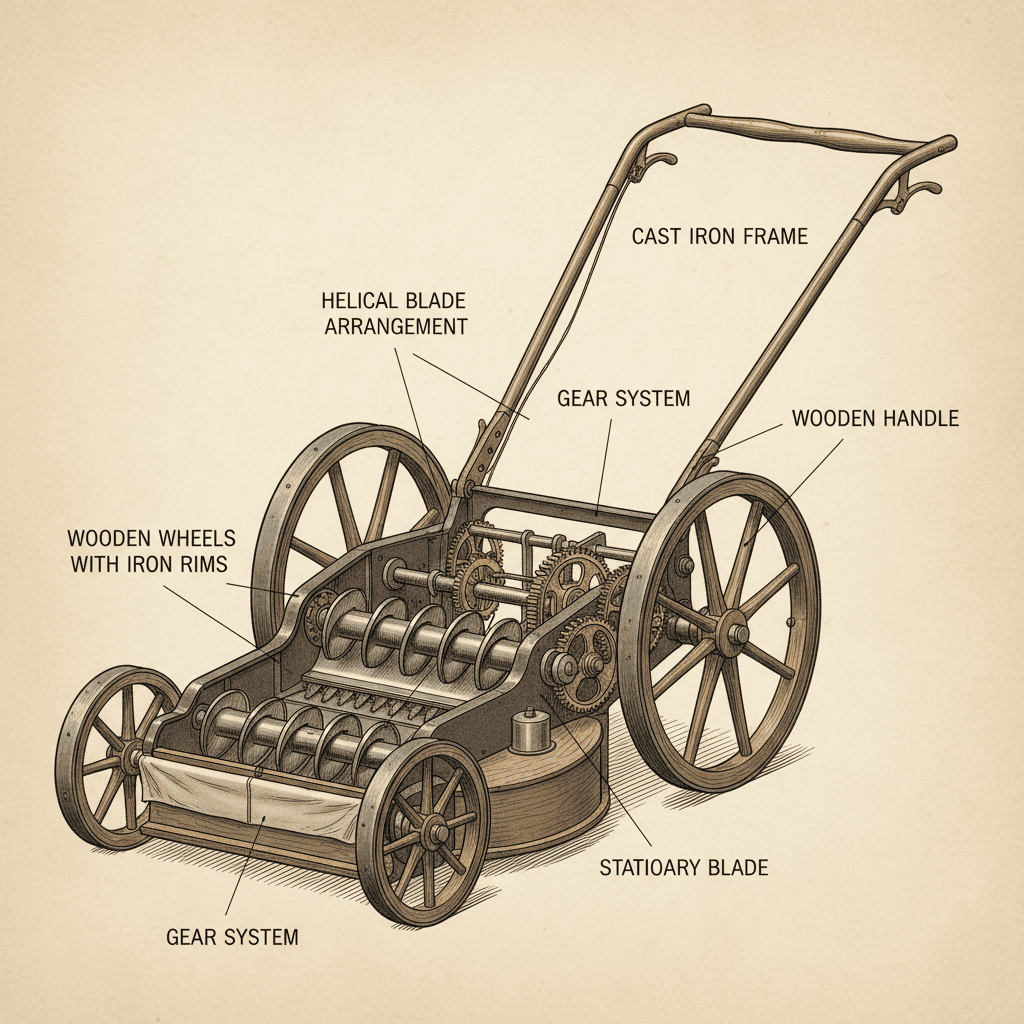
Edwin Budding’s invention of the mechanical lawn mower in 1830 marked a turning point in gardening and landscaping history. Before this innovation, maintaining a manicured lawn required laborers to manually cut grass using scythes, a time-consuming, physically demanding process that limited lawn ownership to the wealthy elite.
Budding’s cylinder mower design featured a revolutionary approach: a series of rotating blades arranged in a helical pattern around a cylinder that cut grass against a stationary blade as the mower moved forward. This mechanism mimicked the cutting action of scissors and proved far more efficient and precise than manual scything.
The invention was patented in England and quickly gained recognition for its practical application. Unlike previous attempts at mechanical grass-cutting devices, Budding’s design was actually usable and effective, making it the first truly practical mechanical lawn mower. The patent documentation highlighted the cylinder mower’s ability to cut grass uniformly and cleanly, producing the neat, manicured appearance that became synonymous with well-maintained lawns.
The significance of Budding’s 1830 invention cannot be overstated. It democratized lawn care by making it accessible to the middle class and eventually to homeowners of all economic backgrounds. What once required hired labor and considerable expense could now be accomplished by homeowners themselves with a mechanical device.
How the Early Mechanical Lawn Mower Worked
Understanding how Budding’s original cylinder mower functioned helps explain why it was such a revolutionary advancement.
The Cylinder Cutting Mechanism
The cylinder mower operates on a simple but ingenious principle. A rotating cylinder with multiple blades arranged in a helical pattern spins rapidly as the mower is pushed forward. These blades pass over a stationary blade positioned along the bottom of the mower. As grass enters between the rotating and stationary blades, it is cut cleanly and precisely, similar to how scissors work.
This design offered several advantages over manual scything: For broader ecosystem context, read through our operational guide on z890 vs x870e motherboard.
- Uniform cutting height: The mower naturally maintained a consistent cutting height across the entire lawn
- Cleaner cuts: The scissor-like action produced clean cuts rather than the ragged edges created by scythe blades
- Reduced physical strain: Pushing the mower required far less effort than manually swinging a scythe
- Faster operation: Larger areas could be mowed in significantly less time
Materials and Construction
Early mechanical lawn mowers were constructed primarily from cast iron and steel, materials that provided durability and strength necessary to withstand the repetitive cutting action. The cylinder itself was typically made of cast iron, as were the frame and wheels. Steel was used for the blades and other components requiring sharpness and resilience.
The wheels were a crucial component, they needed to be large enough to navigate uneven ground while providing the mechanical advantage necessary to rotate the cylinder as the mower was pushed. Early designs featured wooden wheels with iron rims, later transitioning to all-metal wheels for improved durability. For troubleshooting and reliability insights, consult our in-depth marshall stanmore iii vs harman kardon onyx studio 8 report.
Manual Power Source
Budding’s original 1830 cylinder mower, and all mechanical lawn mowers of the 19th century, were powered entirely by human muscle. A person pushed the mower across the lawn, and the forward motion of the wheels engaged gears that rotated the cylinder. This meant that operating a mechanical lawn mower required physical effort, though considerably less than manual scything.
The gear ratio was carefully designed so that the cylinder rotated multiple times for each rotation of the wheels, ensuring efficient cutting action. This mechanical advantage made it possible for an average person to operate the mower without excessive strain. Readers comparing setup options can review our technical analysis on dyson v8 cyclone vs bissell featherweight stick.
Evolution: From Manual Push Mowers to Motorized Versions
While the 1830 cylinder mower was a tremendous advancement, lawn mower technology continued to evolve significantly over the following decades.
The Late 1800s: Introduction of Motorized Mowers
By the late 19th century, as gasoline engines became more practical and affordable, inventors began experimenting with motorized lawn mowers. The transition from manual to motorized power represented the next major innovation in lawn care technology. Gasoline-powered engines were adapted to drive the cylinder mechanism, eliminating the need for human-powered pushing.
These early motorized mowers were heavy, loud, and required significant maintenance, but they offered a compelling advantage: they could cover large areas with minimal physical effort. Initially, motorized mowers were luxury items affordable only to wealthy homeowners and professional landscapers, but as manufacturing improved and prices declined, they gradually became more accessible.
The Rotary Mower Innovation
While cylinder mowers dominated the market for decades, a different cutting mechanism eventually emerged: the rotary mower. Rather than a helical cylinder passing over a stationary blade, rotary mowers featured a single or multiple blades that rotated horizontally at high speed, cutting grass through impact rather than the scissor-like action of cylinder mowers.
Rotary mowers offered distinct advantages for certain applications:
- Simpler design: Fewer moving parts made rotary mowers easier to manufacture and maintain
- Better for rough grass: The impact-cutting action was more effective on thick, coarse vegetation
- More forgiving: They could handle slightly longer grass and minor obstacles better than cylinder mowers
- Easier to sharpen: Rotary blades were simpler to maintain than cylinder blade systems
Today, rotary mowers dominate the residential market, while cylinder mowers remain popular for golf courses, sports fields, and other applications requiring extremely precise cutting.
Modern Lawn Mower Innovations
Since the introduction of motorized and rotary designs, lawn mower technology has continued to advance:
- Riding mowers: Introduced in the early 20th century, these allowed operators to sit while mowing large areas
- Self-propelled mowers: Engines powered the wheels as well as the cutting mechanism, requiring minimal physical effort
- Electric mowers: Battery and corded electric mowers emerged as quieter, cleaner alternatives to gasoline engines
- Robotic mowers: Autonomous mowers that navigate lawns automatically represent the latest technological frontier
Impact of the Lawn Mower on Lawn Care and Landscaping
The invention of the mechanical lawn mower in 1830 had profound effects that extended far beyond lawn care itself.
Democratization of Lawn Ownership
Before the mechanical lawn mower, maintaining a manicured lawn was a status symbol accessible only to the wealthy, who could afford to employ laborers for the endless task of manual scything. The invention of the mechanical mower changed this dynamic fundamentally. Middle-class homeowners could now maintain attractive lawns themselves, leading to a dramatic increase in lawn popularity during the late 19th and early 20th centuries.
The Rise of Suburban Lawns
The mechanical lawn mower was instrumental in the development of suburban culture. As homeownership expanded and suburban developments proliferated, the ability to maintain attractive lawns became a defining feature of suburban life. The lawn mower made it practical for homeowners to maintain the manicured landscapes that became synonymous with the suburban ideal.
Landscaping as a Profession
The availability of mechanical lawn mowers enabled landscaping to develop as a professional trade. Landscapers could now maintain larger properties more efficiently, making professional lawn care services economically viable. This led to the emergence of landscaping companies and the professionalization of grounds maintenance.
Agricultural and Sports Applications
Beyond residential use, mechanical lawn mowers found applications in agriculture, sports, and public spaces. Golf courses, in particular, became major drivers of lawn mower innovation, as the precise cutting requirements of golf greens demanded continuous technological advancement. The need to maintain golf courses at the highest standards spurred innovations that eventually benefited residential mowers.
Timeline of Lawn Mower Innovations After 1830
| Year/Period | Innovation | Significance |
|---|---|---|
| 1830 | Edwin Budding’s cylinder mower patent | First practical mechanical lawn mower invented |
| 1850s-1870s | Improvements to cylinder mower design | Better materials, more efficient gearing, wider cutting widths |
| Late 1800s | Motorized lawn mowers introduced | Gasoline engines adapted for lawn mowing |
| Early 1900s | Riding mowers developed | Large-area mowing became practical for homeowners |
| Mid-1900s | Rotary mowers gain popularity | Simpler design, easier maintenance, better for rough grass |
| Late 1900s | Electric and self-propelled mowers | Quieter, cleaner, and easier to operate options |
| 2000s-Present | Robotic and battery-powered mowers | Autonomous operation and zero-emission alternatives |
Key Distinctions: Understanding Lawn Mower Types
When discussing the invention of the lawn mower, it’s important to understand the distinctions between different types:
Cylinder (Reel) Mowers
The original 1830 invention and still used today, cylinder mowers feature helical blades rotating against a stationary blade. They produce the finest, cleanest cuts and are preferred for formal lawns, golf courses, and sports fields. They require more maintenance but deliver superior results on well-maintained turf.
Rotary Mowers
Invented later and now the most common residential type, rotary mowers use high-speed spinning blades to impact-cut grass. They’re simpler, more durable, and more forgiving of rough conditions, making them ideal for typical residential lawns.
Hover Mowers
A variation of rotary design that uses air cushion technology to float above the ground, hover mowers are particularly useful on slopes and uneven terrain.
Mulching Mowers
Modern mowers designed to cut grass into fine pieces that decompose on the lawn, returning nutrients to the soil rather than requiring collection and disposal.
Everything You Need to Know: When Was The Lawn Mower Invented FAQ
Who invented the lawn mower?
Edwin Budding, an English inventor, invented the first practical mechanical lawn mower in 1830. Budding patented his cylinder mower design, which revolutionized lawn care by replacing manual scything with an efficient mechanical alternative. While others had attempted to create mechanical grass-cutting devices, Budding’s design was the first to be truly practical and commercially viable.
What year was the lawn mower patented?
The lawn mower was patented in 1830. Edwin Budding’s patent for his cylinder mower design marked the official recognition of this revolutionary invention. The patent documentation detailed the innovative cutting mechanism that would become the foundation for lawn mower technology for decades to come.
What was the original design of the mechanical lawn mower?
The original mechanical lawn mower featured a cylinder (or reel) with multiple blades arranged in a helical pattern. As the cylinder rotated, these blades passed over a stationary blade positioned at the base of the mower, creating a scissor-like cutting action. The mower was powered entirely by human effort, pushing it forward caused gears to engage and rotate the cylinder. This design was remarkably efficient and produced clean, uniform cuts across the lawn.
How did the lawn mower change over time?
After the 1830 invention, lawn mower technology evolved through several major phases. In the late 1800s, gasoline engines were adapted to power mowers, eliminating the need for manual pushing. The early 1900s saw the introduction of riding mowers for larger areas. Mid-20th century innovations included rotary mower designs and self-propelled mechanisms. Modern developments include electric mowers, battery-powered options, and robotic autonomous mowers. Each innovation made lawn care more accessible, efficient, and convenient.
Conclusion
The invention of the mechanical lawn mower by Edwin Budding in 1830 represents one of the most consequential innovations in the history of landscaping and suburban development. What began as a practical solution to the labor-intensive task of manual grass cutting evolved into a technology that fundamentally transformed how people maintain their homes and outdoor spaces.
From Budding’s original cylinder mower to today’s sophisticated robotic and battery-powered alternatives, lawn mower technology reflects broader trends in mechanization, democratization of consumer goods, and environmental consciousness. Understanding the history and evolution of the lawn mower provides insight into how a single invention can ripple through society, influencing everything from suburban development patterns to leisure time and environmental practices.
Whether you’re interested in lawn care history, considering which type of mower to purchase, or simply curious about how everyday tools came to be, the story of the lawn mower demonstrates the power of practical innovation to reshape the world around us.
History Reading on Mowers
Early mowing machines appeared in the nineteenth century, and their design has changed a great deal since then. Those interested in the background of outdoor power equipment can find general context at American National Standards Institute (ANSI).