
Quick Answer: How to Fix a Pull Cord on a Lawn Mower
To fix a lawn mower pull cord, first diagnose whether the cord is broken or the recoil spring is faulty. For a broken cord, remove the recoil starter assembly, detach the old rope, wind the spring, thread and knot the new cord, then reassemble. For a non-retracting cord, the spring likely needs re-tensioning or replacement. Always disconnect the spark plug wire before starting any repair.

Pros
- 23.5HP Kawasaki FX730 V-Twin OHV engine
- 726cc displacement per listing
- 60-inch cutting width in the product name
Cons
- No features, description, or reviews to verify performance
- Listed weight of 930 pounds complicates transport

Pros
- Stated 1,600-pound capacity and 22 cubic feet
- Hand-pull or foot-pedal dumping options
- 16x8-inch pneumatic tires listed for grass, mud, and gravel
- Reinforced hitch and side rails per the listing
- Removable rear panel
Cons
- Heavy at about 118 pounds before loading
- Requires a hitch that accepts a 0.47-inch pin

Pros
- Manufacturer-rated 600 lb capacity and 17 cu. ft. storage
- Hand-pull and foot-pedal dumping options
- Three-sided guardrails to help contain loads
- 16-inch pneumatic tires for uneven ground
- Listed 0.47-inch (12mm) pin for hitch connection
Cons
- Listed weight of about 99 lb adds to towing load
- Capacity and build claims are manufacturer-stated, not verified
How to Diagnose the Pull Cord Problem
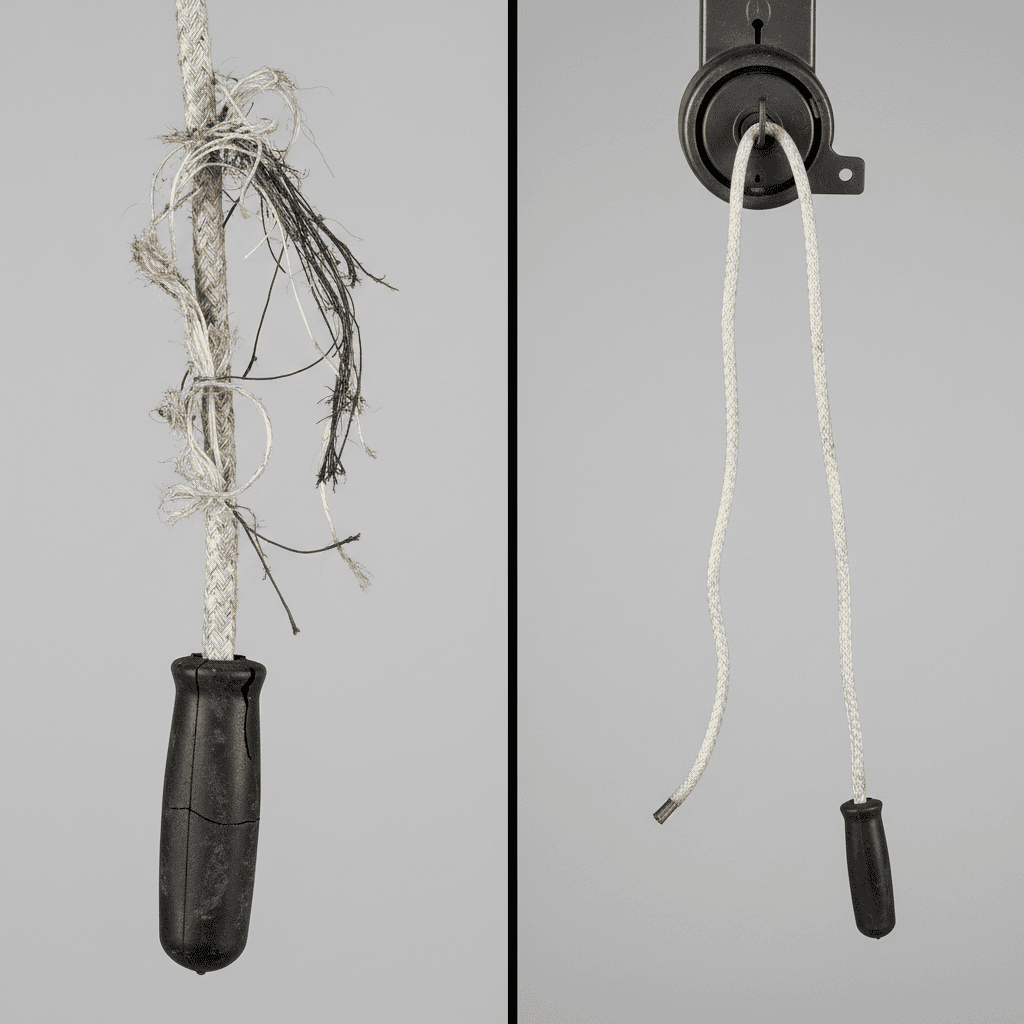
Before you reach for any tools, look closely at how the cord is failing. A broken cord, a frayed cord, and a cord that won’t retract all have different causes and different fixes. Diagnosing the problem correctly saves you time and prevents you from replacing parts that are still in good working order.
Signs of a Broken Pull Cord vs. a Faulty Recoil Spring
If the cord snaps completely or pulls out with no resistance at all, the rope is broken. You will usually see a frayed end still attached to the starter handle, or the remaining stub inside the starter housing.
If the cord pulls out but does not spring back, the rope itself is usually intact and the problem is the recoil spring. The spring may have slipped off its anchor, lost tension, or snapped inside the housing.
- Broken cord: rope snaps, no resistance when pulling, frayed ends visible.
- Frayed cord: rope still works but shows wear, usually near the handle or the knot inside the housing.
- Non-retracting cord: rope pulls out but stays out; the recoil spring is the likely culprit.
- Hard to pull cord: could be a seized engine, not a starter problem at all.
How to Check if the Cord Is Frayed or the Spring Mechanism Is Stuck
Start by inspecting the visible portion of the rope. Look for fuzzy spots, thin sections, or a worn area where the rope rubs against the starter housing or the rope guide. If the rope looks perfect but won’t retract, gently pull it out a few inches and release it. If it stays out, the spring is stuck, broken, or unhooked.
You can also listen for a grinding or clicking sound when you pull. A rhythmic click often means the spring has come off its anchor point inside the reel. A dull thud with no retraction usually means a snapped spring. To evaluate matched hardware tolerances, consult our detailed overview of z890 vs x870e motherboard.
When to Replace the Entire Recoil Starter Assembly
Sometimes it is smarter to replace the whole recoil starter assembly rather than repair it. Consider a full replacement if:
- The starter housing is cracked or the mounting ears are broken.
- The recoil spring has snapped into multiple pieces.
- The plastic pulley (reel) is stripped or warped.
- The starter assembly is very old and the cost of a new assembly is close to the price of replacement parts plus your time.
For most push mowers, a complete recoil starter assembly is inexpensive and can be swapped out in under 30 minutes with basic hand tools. When planning workspace deployment, consider the engineering criteria outlined in our marshall stanmore iii vs harman kardon onyx studio 8 guide.
Tools and Materials Needed for the Repair
Gather everything before you start. Most pull cord repairs require only basic tools you likely already own.
Tools You Need to Remove the Recoil Starter Assembly
- Socket wrench or ratchet with the correct socket size for the starter mounting bolts (usually 8mm, 10mm, or 1/2 inch).
- Phillips or flat-head screwdrivers for removing the starter housing screws.
- Needle-nose pliers for handling the spring and pulling the knot through the pulley.
- Zip tie or small C-clamp to hold the recoil spring under tension while you work.
- Work gloves and safety glasses to protect your hands from the spring and your eyes from debris.
What Type of Replacement Pull Cord Should You Buy?
Most lawn mower starter ropes are made of twisted or braided nylon rope. Look for a cord that is about 3/16 inch (4.5–5 mm) in diameter, which fits the rope channel on most standard mower pulleys. Generic starter rope is sold by the foot at hardware stores and online, or you can buy a pre-cut replacement kit for your specific mower brand. For additional operational safety benchmarks, see our published testing notes on dyson v8 cyclone vs bissell featherweight stick.
As a general rule, a replacement cord should be roughly 3 to 4 feet long before knotting. It is better to start slightly longer and trim the excess after installation than to cut it too short. Avoid using cotton clothesline or thin nylon twine, which will stretch, fray, or snap quickly under the force of pulling an engine over.
Are Specialized Tools Required for Rewinding the Recoil Spring?
No specialized tools are strictly required. A zip tie is the most helpful trick for holding the spring tension while you re-spool the new cord. Some mechanics use a small screwdriver or punch to lock the pulley in place. If your starter has a spring-holding clip or notch, a flat-head screwdriver is all you need. Do not use power tools to wind the spring; it is easy to over-tension and break it. To compare alternative configurations, check our hands-on review of bissell crosswave hydrosteam vs shark stainforce.
Step-by-Step Guide to Replacing a Broken Pull Cord
This procedure works for the vast majority of walk-behind push mowers with a vertical-shaft engine. Before doing anything, remove the spark plug wire from the spark plug and secure it away from the plug. This prevents the engine from accidentally firing while you work.
Step 1: Safely Remove the Recoil Starter Housing
- Disconnect the spark plug wire and move it out of the way.
- Remove the starter housing from the engine. On most mowers, it is held on by 3 to 4 bolts or screws around the top of the engine. Some models use a large center bolt with a fan cover.
- If the cord is still intact, let the starter handle rest on the ground so the spring stays relaxed.
- Set the assembly on a clean workbench with the pulley facing up.
On some mowers, the rope guide is part of the housing and the cord is routed through it. Note how the rope is routed before you remove the old cord so you can thread the new one the same way.
Step 2: Detach the Old Rope and Remove the Knot
- Pull out any remaining rope from the handle side.
- Look inside the pulley for the knot. The rope is typically held in a slot or hole in the pulley by a simple knot.
- Use needle-nose pliers to loosen the knot and pull the rope out of the pulley.
- Discard the old rope. Inspect the pulley for cracks or wear while you have it apart.
Step 3: Wind or Verify the Recoil Spring
If the spring is still intact and you are only replacing the rope, leave the spring in place. If the spring has come loose, re-anchor it. If it is broken, replace it at this point.
- Make sure the outer end of the spring is seated in the notch of the housing and the inner end is hooked into the pulley hub.
- If the spring is loose, carefully wind it by rotating the pulley counterclockwise (as viewed from the top) until you feel resistance. Do not wind it fully yet.
- Hold the pulley with one hand or secure it with a zip tie so the spring cannot unwind while you install the new rope.
Step 4: Thread and Knot the New Pull Cord
- Cut a piece of starter rope about 3 to 4 feet long. Melt the cut ends with a lighter to prevent fraying, or use a rope with pre-fused ends.
- Feed one end of the rope through the guide hole in the housing (if your mower has one), then through the hole or slot in the pulley.
- Tie a secure knot at the end of the rope inside the pulley. A double overhand knot or a figure-eight knot works well. Pull the knot tight so it cannot slip back through the hole.
- Pull the rope snug so the knot seats firmly in the pulley recess.
Step 5: Rewind the Spring and Wrap the Cord
- If you secured the pulley with a zip tie, remove it now.
- Wind the pulley counterclockwise by hand, wrapping the new rope around the pulley groove. Keep the wraps tight and in the groove, leaving about 6 to 8 inches of rope outside the housing.
- The spring is correctly tensioned when the pulley resists further turning but you can still rotate it comfortably by hand.
- Let the pulley unwind slightly so the rope sits naturally, then pull the rope out and release it to test retraction. The rope should reel in smoothly.
Step 6: Reassemble and Test
- Tie the starter handle onto the free end of the rope with a secure knot.
- Pull the rope out gently and release it a few times to confirm it retracts fully.
- Mount the starter assembly back onto the engine and tighten the mounting bolts evenly.
- Reconnect the spark plug wire.
- Pull the cord firmly and confirm the engine turns over smoothly.
How to Fix a Pull Cord That Won’t Retract
A cord that pulls out but does not spring back is almost always a recoil spring problem. The spring itself can be repaired, but in most cases it is easier and more reliable to replace it.
How to Re-Tension the Recoil Spring If the Cord Is Stuck
- Remove the starter assembly as described above.
- Remove the center screw or clip that holds the pulley to the housing.
- Carefully lift the pulley out. The spring may be loose, so wear gloves.
- Re-seat the outer end of the spring in its anchor notch inside the housing.
- Re-hook the inner end of the spring into the slot on the pulley hub.
- Before reinstalling the pulley, wind the spring by turning the pulley a few full rotations counterclockwise. You should feel even, increasing tension.
- Reinstall the pulley, add the new cord if needed, and test the retraction.
If the spring will not hold tension, or if you see a kink or a break, replace it.
What Causes the Recoil Spring to Lose Tension?
Recoil springs lose tension from normal use, corrosion, or fatigue. Over time the metal weakens and the spring no longer winds the rope back fully. Humidity and rust accelerate this process. A spring can also pop out of its anchor if the mower is tipped or dropped, which makes the cord suddenly stop retracting even though the spring itself is fine.
When to Replace the Recoil Spring vs. Just Re-Tension It
Try re-tensioning once. If the cord retracts strongly after re-tensioning, the spring was simply dislodged. If the spring still feels weak, or if you see rust, cracks, or a visible break, replace it. Recoil springs are inexpensive and available for most mower models. Replacing a faulty spring is a 15-minute job and eliminates the frustration of a cord that barely pulls back.
Safety Precautions and Troubleshooting Tips
Starter springs are under significant tension and can cause cuts or eye injuries. Work slowly, wear eye protection, and never let the spring fly out of the housing without control.
What Safety Steps Must I Take Before Working on the Starter System?
- Disconnect the spark plug wire. This is non-negotiable. It prevents the engine from accidentally starting while you turn the flywheel or pull the rope.
- Work on a flat, stable surface. Place the mower on a level area and chock the wheels if necessary.
- Wear safety glasses and gloves. The recoil spring is sharp and under tension.
- Never let go of a tightly wound spring. It can uncoil violently and cause injury.
- Keep loose clothing and fingers clear of the rope and pulley while testing.
Why Does My New Pull Cord Jam or Feel Too Tight After Installation?
There are a few common culprits:
- The cord is too thick. An oversized rope binds in the rope guide. Use 3/16 inch rope or the diameter specified in your mower’s manual.
- The spring is over-wound. If you wound the pulley too many times, the spring binds and the rope feels locked. Remove a turn or two of pre-wind.
- The knot is too large. A bulky knot catches on the housing. Use a smaller, tighter knot.
- Screws are too long. If you replaced screws, a long screw can catch on the pulley. Use the original hardware.
How Do I Adjust the Cord Length and Tension for Smooth Operation?
Start with the rope wrapped most of the way around the pulley, leaving roughly 6–8 inches protruding through the guide. After tying the handle, the handle should rest near the rope guide with about 1–2 inches of slack. If the handle sits too far away, the rope is too short; re-spool with a longer piece. If the handle presses tightly against the housing, the rope is too long or the spring is over-tensioned. The cord should pull out smoothly with even resistance and retract fully without slapping the housing.
What Should I Do If the Mower Still Won’t Start After Fixing the Pull Cord?
First, confirm the engine actually turns over when you pull the rope. If it does, the starter is fixed and the no-start issue is fuel, spark, or air related. Check the fuel level and freshness, the spark plug condition and gap, the air filter, and the primer bulb or choke operation. If the rope pulls freely but the engine will not spin, the flywheel key may be sheared or the engine may be seized. In that case, consult your mower manual or a small-engine technician.
Frequently Asked Questions About Fix A Pull Cord On A Lawn Mower
Can I fix a lawn mower pull cord without removing the starter assembly?
In almost all cases, no. You must remove the recoil starter housing to access the pulley and the knot that holds the rope. Trying to thread a new cord without removing the assembly usually results in a tangled spring or a rope that will not retract. Removal is quick and safe, and it gives you a clear view of the spring and pulley.
How much does it cost to replace a lawn mower pull cord?
Replacement starter rope costs just a few dollars per foot, and a pre-cut cord with a handle often costs less than $10. A complete recoil starter assembly typically costs between $15 and $40 depending on the mower brand. If you take the mower to a repair shop, expect to pay a service fee plus parts, which can total $50 to $100 or more. Doing it yourself is a low-cost, beginner-friendly repair.
Why does my lawn mower pull cord keep breaking?
Repeated breakage usually points to a sharp edge inside the starter housing or rope guide that is fraying the rope, or a worn pulley groove. Check for burrs or rough spots and sand them smooth. Also make sure you are using a quality nylon starter rope of the correct diameter, and that the engine is not hard to pull due to a seized piston, a stuck blade, or a bad starter clutch, which puts extra stress on the rope.
What size pull cord do I need for my lawn mower?
Most walk-behind mowers use a 3/16 inch (about 4.5–5 mm) diameter nylon starter rope. Some larger engines use 1/4 inch rope, and some small trimmers use thinner cord. Check your owner’s manual or measure the groove in the pulley to confirm. The rope should sit snugly in the groove without binding, and it should be about 3 to 4 feet long before knotting.
Wrap-Up: Which Model Delivers True Value?
Fixing a pull cord on a lawn mower is one of the easiest small-engine repairs you can do at home. Start by diagnosing whether the cord or the spring is the problem, gather the few basic tools listed above, and follow the steps in order. Always disconnect the spark plug wire first, and never let a wound spring get away from you. With a new length of starter rope and about 30 minutes of work, you will have a smooth-pulling recoil starter that fires the engine reliably for many more seasons.
Related Maintenance and Operating Guides
To keep your equipment running at peak operating efficiency, explore our related technical walkthroughs and maintenance tutorials:
- Consult our detailed breakdown on residential zero-turn lawn mower guide.
Pull Cord Repair Safety
Repairing a pull cord involves a recoil spring under tension, which can release suddenly if handled poorly. General safety reading on this kind of mechanical repair is offered by American National Standards Institute (ANSI).