Field-Verified Equipment & Replacement Hardware
Our editorial team’s recommended OEM-grade replacement parts and heavy-duty equipment selections to ensure optimal reliability and performance.

Pros
- Lightweight 37.47 lb build facilitates easy maneuvering in tight spaces
- Brushless motor provides efficient cordless cutting performance
- 2-in-1 design supports both mulching and rear bagging
- 6-position cutting height adjustment from 1.5 to 3.15 inches
- Battery is compatible with the Greenworks 60V tool ecosystem
Cons
- Narrow 17-inch deck requires more passes on larger lawns
- Up to 40-minute stated runtime may limit single-session coverage
- 90-minute battery recharge time pauses mowing if depleted
Pros
- Up to 45 minutes of cordless runtime from two included 4.0Ah batteries
- Lightweight rust-resistant 17-inch poly deck for easy handling
- Virtually maintenance-free with no gas, oil, or emissions
- Quiet operation and simple push-button start
- Versatile 2-in-1 mulch and rear bag capability with 5 height settings
Cons
- Push-only design requires more physical effort than self-propelled models
- 17-inch cutting deck is better suited for smaller lawns than large properties
- Runtime can drop below 45 minutes depending on grass thickness and terrain
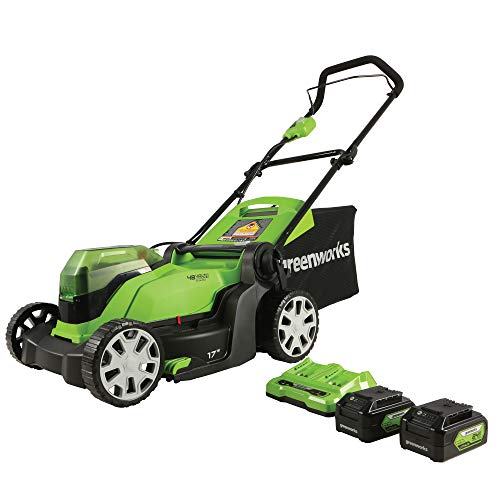
The Greenworks 48V (24V x 2) 17" Cordless Push Lawn Mower is a compact electric walk-behind mower built for homeowners seeking gas-free convenience. It features a durable yet lightweight poly deck that resists rust and makes the unit easy to handle during storage or transport. Immediate impressions highlight the clean cordless design and inclusion of two 4.0Ah batteries plus a dual port rapid charger for ready-to-use performance.
In real-world use the dual battery system supplies up to 45 minutes of runtime that varies with grass conditions and operator technique. The single lever 5-position height adjustment and 2-in-1 mulch or rear bag system provide flexible cutting options while the quiet electric motor delivers gas-like power without fumes or pull cords. Compatibility with over 200 Greenworks 24V tools adds long-term value to the battery platform.
Key considerations include the push-only configuration which demands more physical effort on slopes or thick turf compared to self-propelled alternatives. The 17-inch deck covers ground efficiently on small to medium yards but may feel limiting on expansive properties. Storage and operation are restricted to temperatures between 32°F and 113°F.
Overall this Greenworks 48V 17" cordless push mower is an excellent choice for eco-conscious owners of modest lawns who prioritize low maintenance, quiet operation, and a versatile battery ecosystem. Those with very large areas or who prefer powered propulsion may want to explore larger or self-propelled options within the same brand lineup.
Pros
- Extremely lightweight design for easy pushing and storage
- No gas or oil needed with zero emissions for cleaner operation
- Instant push button start and quiet performance
- Versatile mulch or rear bag collection in one unit
- Simple 5-position single lever height control
Cons
- Push-only operation without self-propulsion requires more manual effort
- Runtime limited to roughly 1/3 acre depending on grass and technique
- 16-inch deck width may require extra passes on wider areas
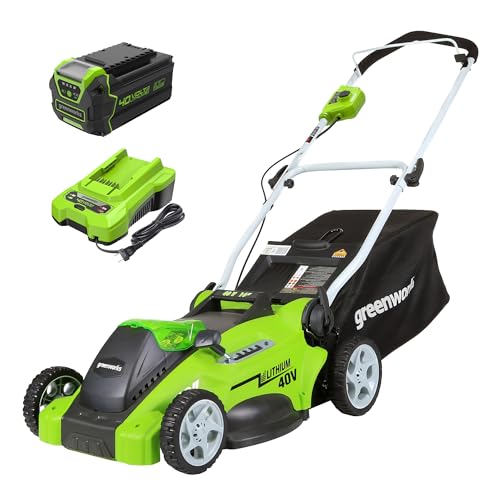
The Greenworks 40V 16" Cordless Lawn Mower is a compact push model built for residential yards. Its ultra lightweight frame feels noticeably easier to handle than traditional steel deck mowers and creates a practical first impression for users wanting an electric option free of gas smells and mess.
Performance centers on the included 4.0Ah battery that supports cutting up to 1/3 acre, with results varying by grass density and mowing style. The single lever 5-position height adjuster lets operators dial in the desired cut quickly, while the 2-in-1 system switches between mulching and rear bagging for tidy results. Instant push button start, quiet running, and zero emissions make it a low-maintenance choice that still delivers solid power for typical home use. Compatibility with the broader 40V tool family adds further value.
Drawbacks to consider include the pure push design that demands physical effort without self-propel assistance, plus the relatively narrow 16-inch deck that can increase pass counts on larger or irregular lawns. Battery capacity is also finite, so properties exceeding 1/3 acre will need spare batteries or multiple charges.
This Greenworks mower is an excellent fit for homeowners with smaller lawns who prioritize lightweight handling, quiet electric operation, and system expandability. Those seeking self-propelled convenience or larger cutting decks may want to explore other options in the lineup.
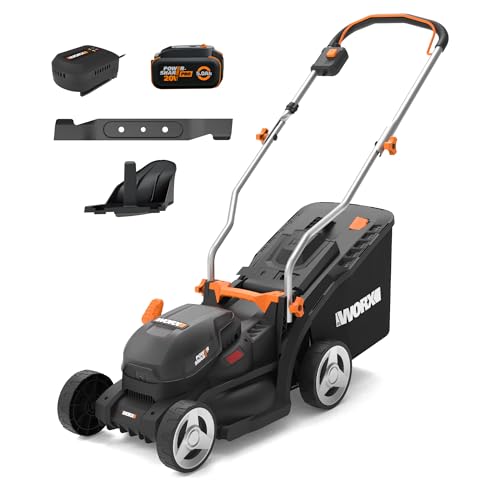
Pros
- True 2-in-1 mulching and bagging capability for versatile yard maintenance
- Brushless motor delivers efficient power and longer potential runtime
- 5.0 Ah battery and charger included for ready-to-use cordless convenience
- Single-lever 6-position height adjustment from 1 to 3 inches for quick setup
- Cut-to-edge design enables precise cutting along borders and obstacles
Cons
- 14-inch cutting width limits efficiency on larger lawns requiring more passes
- Manual push operation lacks self-propulsion, increasing physical effort
- No specified runtime data means battery may need recharging for bigger jobs
The WORX WG733.1 is a 14-inch cordless electric walk-behind lawn mower built for homeowners seeking a lightweight alternative to gas-powered models. Its compact design and included 5.0 Ah battery plus charger create an immediate impression of convenience and readiness for small yard maintenance without cords or fumes.
Performance centers on practical features that shine in everyday use. The 2-in-1 mulching and bagging system lets users switch modes easily for either nutrient return or clean collection. The cut-to-edge design allows closer trimming along fences and beds, while the brushless motor supports efficient operation. A single-lever control provides six cutting heights from 1 to 3 inches to match varying lawn conditions, and the PowerShare compatibility extends the battery's value across other WORX tools.
Drawbacks stem from the core specifications. The smaller 14-inch deck requires more time on larger properties, and as a pure push mower it demands continuous manual effort without self-propel assistance. Available data does not detail runtime, so users of bigger areas should plan for potential battery swaps or recharges.
This mower delivers the most value to owners of small to medium lawns who prioritize easy storage, quiet cordless operation, and simple adjustments. It is especially appealing for those already using WORX tools or looking for an affordable entry into battery-powered lawn care.
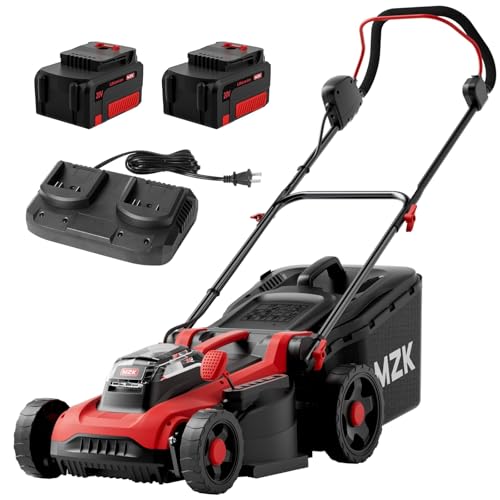
Pros
- Brushless motor provides cutting speeds up to 3400 RPM
- Includes two 20V 4.0Ah batteries and a dual-port charger
- Versatile 2-in-1 capability supports mulching and rear bagging
- 5-position single adjustment ranges from 1.4 to 3 inches
- Generous 40-liter (approx. 11-gallon) grass collection bag
Cons
- Manual push design lacks self-propelled drive
- Actual battery life varies depending on grass height and terrain

Pros
- Brushless 3,000 RPM motor providing up to 1,200W maximum output
- 17-inch cutting deck with 6 height adjustments from 1 to 3 inches
- Dual 20V 4.0Ah batteries covering up to 5,380 sq. ft. per charge
- Lightweight 30 lb (14 kg) design simplifies transport and storage
- Simple push-button and pull-bar starting mechanism
Cons
- Up to 40-minute runtime may limit coverage on larger properties

Pros
- Brushless motor delivers quiet operation with low maintenance
- Single lever offers 5 cutting height settings from 1 to 2.5 inches
- Quick-fold handle allows compact storage in tight sheds or garages
- Included 5.0Ah battery doubles as a portable device power bank
- Includes a 9-gallon grass catcher bag for quick cleanup
Cons
- 14-inch cut width requires more passes than larger mowers
- Up to 30 minutes of runtime per charge limits yard coverage
- Maximum 2.5-inch cutting height may not suit taller turf

Pros
- 13-inch cutting width and 3400 RPM motor enable easy handling in small yards and tight garden spaces
- Five height settings from 1 to 2.5 inches plus 8-gallon collection bag for versatile clean mowing
- Lightweight foldable design with carrying handle simplifies transport and storage in limited areas
- Included 4.0Ah universal battery offers series compatibility and multi-device charging flexibility
- Low-noise high-performance motor ensures quieter operation with reduced maintenance needs
Cons
- Continuous runtime limited to about 15 minutes per full charge, requiring pauses for larger jobs
- 13-inch deck size means more passes needed compared to wider mowers on bigger lawns
- Maximum cutting height of 2.5 inches may not suit very tall or dense grass types
The Litheli U20 Handy+ is a 13-inch cordless walk-behind electric lawn mower from the LiTHELi brand, built for garden, yard, and farm use. Its lightweight construction pairs with an adjustable folding handle and carrying handle to create a portable tool that stores easily in tight spaces while promoting comfortable posture during operation. The overall design focuses on cordless freedom and simplicity for everyday users.
In performance, this mower relies on a high-performance 20V motor spinning at 3400 RPM to handle medium-sized lawns up to 1,300 sq. ft. on a single charge. Users can select from five height adjustments between 1 inch and 2.5 inches and capture clippings in the 8-gallon bag for a tidy finish. The low-noise, low-maintenance motor delivers smooth running, while the included 4.0Ah lithium-ion battery powers 15 minutes of continuous work and integrates with the broader Litheli series plus emergency charging for phones, tablets, and computers.
Key considerations include the relatively short 15-minute continuous runtime that may call for recharging on larger properties, the compact 13-inch width that increases the number of passes required, and the height range capped at 2.5 inches which could limit options for taller grass. These factors stem directly from the core specifications and suit users with modest lawn sizes best.
Overall, the Litheli U20 Handy+ offers solid value for homeowners with small to medium gardens who want an easy-to-store, battery-powered alternative to gas or corded mowers. It is especially practical for those seeking quiet operation, multi-tool battery versatility, and straightforward maintenance supported by a 3-year machine warranty and 2-year battery coverage.

Pros
- Brushless electric motor is completely maintenance-free with no oil changes or spark plugs needed
- Lightweight construction and adjustable handle make it easy to push and store for users of all ages
- Cordless 5.0Ah battery offers fade-free runtime up to 30 minutes covering mid-sized lawns without cords or gas
- Grass collection bag and multi-height settings produce a clean finish while reducing cleanup effort
- Battery also functions as a power bank for emergency outdoor device charging
Cons
- Maximum cutting height of only 2.5 inches may struggle with overgrown or taller grass varieties
- 14-inch cutting deck suits small to mid yards but requires more passes on larger properties
- Approximately 30-minute runtime per charge means larger jobs may need a mid-session recharge
The LiTHELi Cordless Lawn Mower is a compact 14-inch walk-behind push mower built for effortless maintenance of small to mid-sized yards. Its lightweight frame, adjustable ergonomic handle, and quick-fold design create an immediate impression of user-friendly storage and comfortable operation, especially for women and seniors seeking a healthy posture during use.
Performance & Key Features stand out through the upgraded brushless motor that delivers reliable power without noise, emissions, or traditional upkeep. The included 5.0Ah battery and charger support coverage up to 3000 sq. ft. with roughly 30 minutes of runtime, while the single-lever 5-position height adjustment from 1 to 2.5 inches and 9-gallon grass bag enable customized clean cuts that minimize raking. The battery uniquely doubles as a power bank for outdoor device charging, adding practical versatility backed by a 3-year tool and 1-year battery warranty.
Drawbacks & Considerations include the limited maximum cutting height of 2.5 inches, which may not handle very tall or dense growth effectively. The 14-inch deck, while highly maneuverable, covers less ground per pass than larger models, and the 30-minute battery window could require recharging for bigger areas. As a pure push design without self-propulsion, users should expect moderate physical effort on slopes or thick turf.
Verdict: This mower is an excellent value for homeowners with lawns up to 3000 sq. ft. who prioritize quiet cordless convenience, zero maintenance, and compact storage. It delivers the most benefit to casual users, seniors, and those upgrading from corded or gas models seeking simple reliable performance.

Pros
- Versatile 3-in-1 design for seamless mowing, trimming, and edging tasks
- Powerful 6.5 amp motor delivering speeds up to 8000 RPM for strong cutting performance
- Automatic Feed Spool enables uninterrupted work without manual spool adjustments
- Lightweight build with adjustable features for enhanced user comfort and control
- Includes essential accessories such as detachable mower deck, AF-100 spool, auxiliary handle, and guard
Cons
- Corded design requires proximity to a power outlet which limits mobility on larger areas
- 12-inch cutting width is optimized only for small lawns and compact spaces
- No cordless battery option available, relying fully on continuous electrical supply
The BLACK+DECKER BESTA512CM is a compact 3-in-1 corded electric tool that combines lawn mowing, weed eating, and edging functions in one unit. Its lightweight construction with adjustable handle and height positions creates a user-friendly design suited for precision tasks. The package includes the string trimmer, MTD100 detachable mower deck, AF-100 spool, auxiliary handle, and guard for immediate readiness.
Performance centers on the 6.5 amp motor with POWERDRIVE Transmission that handles tough weeds and thick grass effectively at speeds up to 8000 RPM. The Automatic Feed Spool system allows uninterrupted cutting, while the 12-inch width and 1.6-inch height support accurate results in small areas. Cord retention helps maintain consistent power flow during use.
Key considerations include the corded operation that ties the tool to electrical outlets and reduces free range. The compact size focuses on small lawns, so it may require more passes on bigger properties.
This product delivers solid value for owners of small lawns seeking a simple multi-purpose electric solution with reliable features and a 2 year limited warranty. It works best for those prioritizing versatility and ease over heavy-duty coverage in expansive yards.
Quick Answer: How to Replace a Briggs & Stratton Pull Cord
Disconnect the spark plug wire, remove the recoil starter housing (3–4 bolts), extract the broken cord from the pulley and handle, thread a new cord through the pulley hole and grip, knot both ends securely, preload the recoil spring by rotating the pulley 4–6 turns before feeding the cord through, then bolt the housing back on. Match the replacement rope to your engine model number—most Briggs & Stratton recoil starters use a 3.5 mm diameter starter rope.
What You Need Before You Start (Tools & Replacement Parts)
Tools Required
- Socket set (typically 5/16 in. or 3/8 in. for housing bolts)
- Flathead and Phillips screwdrivers
- Needle-nose pliers (to pull the old cord knot from the pulley)
- Scissors or a utility knife (to trim the new rope cleanly)
- Lighter or matches (to melt-seal the cut end of a nylon rope and prevent fraying)
- Clamp or locking pliers (to hold pulley tension during cord threading)
Replacement Parts
- Starter rope: Most Briggs & Stratton recoil starters use a 3.5 mm diameter cord. Rope is sold by the foot—measure the old cord before discarding it, or use approximately 90–100 cm (36–39 in.) as a starting point for walk-behind mower engines.
- Replacement pull handle/grip (if the old one is cracked or melted)
- OEM vs. aftermarket cord: Briggs & Stratton OEM starter rope is available through authorized dealers and carries exact diameter and tensile specifications for your engine series. Aftermarket nylon rope from a hardware store works for most repairs provided the diameter matches—verify against your engine’s parts catalog before purchasing.
Finding Your Briggs & Stratton Model Number
The model, type, and code numbers are stamped directly on the engine block, typically near the valve cover or on the blower housing. Locate these before buying parts. Enter them at the Briggs & Stratton parts lookup tool (briggsandstratton.com) to confirm the correct starter rope part number for your specific engine series—such as the 450E, 500E, or 675EX. For additional operational safety benchmarks, see our published testing notes on jbl partybox club 120 vs sony srs xv500.
Safety First: Disconnect the Spark Plug Wire
Before touching any part of the engine, pull the spark plug wire off the spark plug and tuck it away from the plug terminal. This prevents accidental engine firing while your hands are inside the starter housing. Do not skip this step. For additional operational safety benchmarks, see our published testing notes on jbl partybox club 120 vs sony srs xv500.
How to Remove the Old Pull Cord and Starter Housing
Step 1 — Remove the Recoil Starter Housing
The recoil starter housing sits on top of (or beside) the engine and is secured by 3 to 4 bolts, depending on the engine series. Use the appropriate socket to remove them. Lift the housing away from the engine carefully—the recoil spring inside holds tension even on a broken cord, so keep the housing face-up and avoid jarring it.
Step 2 — Release Remaining Spring Tension Safely
Before removing the pulley or cord, release any stored spring tension. Pull any remaining cord out fully by hand, then allow the pulley to unwind slowly under control. Do not allow the recoil spring to snap loose suddenly. A released recoil spring can eject from the housing with significant force and cause lacerations. Keep the housing resting flat on your work surface, face-up, throughout disassembly. To compare alternative configurations, check our hands-on review of z890 vs x870e motherboard.
Step 3 — Remove the Old Cord from the Pulley
Once tension is released, locate the knot anchor point in the pulley—usually a small slot or hole on the inner face of the pulley drum. Use needle-nose pliers to grip and pull the knotted end free. Feed the old rope back through the housing guide hole and out through the pull handle. Inspect the pulley and recoil spring at this stage: if the spring is dislodged, cracked, or has lost its coil shape, replace the full recoil starter assembly rather than only the cord.
Inspecting the Recoil Spring and Starter Pawl
While the housing is open, check the starter pawl (also called the ratchet or dog)—the small metal tab that engages the engine flywheel on each pull. If the pawl is worn, bent, or missing, the mower will not crank even with a perfect new cord. Replace the pawl if damaged. Also confirm the recoil spring is seated correctly in its housing cup before proceeding. Users looking for related component recommendations can explore our marshall stanmore iii vs harman kardon onyx studio 8 breakdown.
How to Install the New Pull Cord and Set the Correct Tension
This section covers the most error-prone part of the repair: setting spring preload. Getting the tension wrong is the primary reason new cords fail to retract fully.
Step 1 — Preload the Recoil Spring (Wind the Pulley)
Before threading the new rope, you must preload the recoil spring so it has enough stored energy to retract the cord after each pull. Before finalizing equipment decisions, refer to our comprehensive dyson v8 cyclone vs bissell featherweight stick comparison.
- Hold the starter housing face-up on your work surface.
- Block the rope guide hole with your thumb or a clamp to prevent the pulley from unwinding during this step.
- Rotate the pulley by hand in the winding direction (typically counterclockwise when viewed from the front/top of the housing—check your engine’s service manual for confirmation) 4 to 6 full turns. The correct number of turns varies by engine series; consult the service manual for your specific model (e.g., Briggs & Stratton Series 450E, 500E, 675EX) to confirm the preload specification.
- Align the pulley’s rope slot with the housing’s guide hole.
- Use a clamp or locking pliers on the pulley to hold the tension in place while you thread the cord.
Step 2 — Thread the New Cord Through the Housing and Pulley
- Cut the new rope to match the length of the old cord, or to approximately 90–100 cm for a standard walk-behind mower. Melt-seal the cut end with a lighter to prevent fraying.
- Feed the sealed end of the rope through the guide hole in the housing from the outside, then through the slot in the pulley.
- Tie a secure knot in the pulley end of the rope. A figure-eight knot is preferred over a simple overhand knot—it is less likely to slip under repeated pull loads. Pull the knot tight and seat it firmly in the pulley’s anchor slot.
Step 3 — Attach the Pull Handle
- Thread the free end of the rope through the pull handle/grip.
- Tie another figure-eight knot (or overhand knot, depending on handle design) to secure the rope inside the handle cavity.
- Pull the knot firmly into the handle recess so it seats flush and cannot pull through during use.
Step 4 — Release the Pulley and Check Retraction
Remove the clamp from the pulley and allow the spring tension to slowly retract the cord. The handle should pull smoothly toward the housing and seat against it without slack. If the cord retracts too aggressively (handle slams into housing) or not at all, see the troubleshooting notes in the next section.
Reassembly, Testing, and Common Mistakes to Avoid
Reattaching the Starter Housing
- Position the housing back over the engine, aligning the bolt holes.
- Thread the bolts in by hand first to avoid cross-threading, then tighten with a socket wrench to snug—do not overtighten on aluminum housings.
- Reconnect the spark plug wire.
- Perform 3–4 slow test pulls before attempting a full engine start. The cord should extend smoothly and retract fully each time.
Common Mistakes and How to Fix Them
| Problem | Likely Cause | Fix |
|---|---|---|
| Cord does not retract after replacement | Insufficient spring preload—too few pulley turns wound before threading | Remove cord, re-wind pulley 1–2 additional turns, re-thread |
| Cord retracts but handle slams hard | Excessive spring preload—too many turns wound | Remove cord, release one pulley turn, re-thread |
| Knot pulls through the pulley slot | Overhand knot used instead of figure-eight; rope diameter too small | Re-knot with a figure-eight; confirm rope is 3.5 mm diameter |
| Cord too short—cannot reach full extension | Replacement rope cut too short | Measure old rope before discarding; use 90–100 cm minimum |
| Mower still won’t start after cord replacement | Cord repair is complete but engine has a separate fault (spark, fuel, compression) | Pull cord is not the ignition system—check spark plug, air filter, and fuel |
| Recoil spring ejects during disassembly | Spring tension not released before pulley removal | Recoil spring can be re-wound into the housing cup using pliers—work slowly, keep housing face-up |
How Long Should a Replacement Pull Cord Last?
A properly installed nylon starter rope on a Briggs & Stratton engine should last several seasons under normal residential use. Cord wear accelerates when the engine is hard to start (requiring many pulls per session), when the rope rubs on a misaligned housing guide, or when an incorrect-diameter rope is used. OEM Briggs & Stratton replacement rope is manufactured to the exact tensile and diameter specification for your engine and will generally outlast generic hardware-store nylon cord. For broader ecosystem context, read through our operational guide on bissell crosswave hydrosteam vs shark stainforce.
Side-Mount vs. Top-Mount Recoil Starters: Does It Change the Process?
Most walk-behind Briggs & Stratton lawn mower engines use a top-mount recoil starter—the housing sits directly on top of the engine and pulls upward. The process described above applies to this configuration.
Some horizontal-shaft engines (commonly used on riding mowers, generators, and pressure washers) use a side-mount recoil starter, where the housing is bolted to the side of the engine block and the cord pulls horizontally. The cord replacement process is mechanically identical—remove the housing, release tension, replace the rope, set preload, reinstall—but the housing bolt locations and access angles differ. Horizontal-shaft engines may require removing additional shrouding or covers to access the starter housing bolts.
Vertical-Shaft vs. Horizontal-Shaft Engines
- Vertical-shaft engines (blade mounted directly to crankshaft below the engine): standard walk-behind mowers. Top-mount recoil is the norm. The procedure in this guide applies directly.
- Horizontal-shaft engines (crankshaft exits from the side): riding mowers, tillers, generators. Side-mount or front-mount recoil. The cord replacement steps are the same; access and bolt count may vary by model.
Are Recoil Starter Parts Interchangeable Across Briggs & Stratton Engine Series?
Starter rope diameter (3.5 mm) is consistent across most Briggs & Stratton consumer engine series, but the full recoil starter assembly is not universally interchangeable. Housing bolt patterns, pulley diameters, and spring dimensions vary between engine families. Always source replacement assemblies using your engine’s model, type, and code numbers from the official Briggs & Stratton parts catalog or an authorized dealer to ensure fitment.
Buyer FAQs: Replace Lawn Mower Pull Cord Briggs And Stratton Solved
How do I know if I need to replace just the cord or the entire recoil starter assembly?
Replace only the cord if the rope is broken or frayed but the pulley turns freely, the recoil spring is intact and seated, and the starter pawl is undamaged. Replace the entire recoil starter assembly if the spring is cracked, dislodged beyond re-seating, the pulley is cracked, or the pawl is missing. A complete assembly is often only marginally more expensive than individual components and is faster to install.
What size pull cord does a Briggs & Stratton lawn mower use?
Most Briggs & Stratton recoil starters use a 3.5 mm diameter starter rope. Confirm the exact specification for your engine by entering your model and type number into the Briggs & Stratton parts lookup at briggsandstratton.com before purchasing. Using an undersized rope increases knot slip risk; an oversized rope may bind in the housing guide hole.
How many turns do I wind the pulley when replacing a Briggs & Stratton pull cord?
The standard starting point is 4 to 6 full turns of preload on the recoil spring before threading the new cord. The precise number varies by engine series—check the service manual for your specific model. If the cord retracts sluggishly after reassembly, add one turn at a time until retraction is crisp. If the handle slams back forcefully, reduce by one turn.
Can I replace a Briggs & Stratton pull cord without removing the engine from the mower?
Yes. The recoil starter housing bolts directly to the top or side of the engine and is accessible with the engine in place on the mower deck. You do not need to remove the engine. Disconnect the spark plug wire, clear access to the housing bolts, and proceed with the steps above. On some riding mower configurations, the hood or engine cover must be raised or removed first to reach the housing bolts.

For more detailed testing breakdowns and top recommendations, check our in-depth guide to residential zero-turn lawn mower guide.
For more hands-on benchmarks and buying recommendations, consult our guides on heavy-duty chainsaw buyer guide, as well as high-CFM commercial leaf blower guide, as well as durable ride-on lawn tractor guide, as well as automated robotic lawn mower guide.
Mechanical safety standards, operational tolerances, and protective gear guidelines align with benchmark specifications established by the American National Standards Institute (ANSI).