

How to Start a Ride on Mower (Quick-Start Answer)
Direct Answer: Engage the parking brake, disengage the blades (PTO off), sit fully in the seat, set the throttle to half (use choke if cold), insert the ignition key, and turn to Start. Release the key the moment the engine fires. The mower will not crank if the seat switch, blade engagement, or parking brake interlock is not in the correct position.
Follow this numbered sequence for any standard gas-powered lawn tractor or rear-engine rider. Zero-turn mower differences are covered in a dedicated section below. Jump to: Cold Start | Zero-Turn | Won’t Start
- Park on level ground — never start on a steep slope.
- Engage the parking brake — press or pull the brake lever or pedal until it locks.
- Disengage the blades — move the blade engagement lever or PTO switch to the OFF/DISENGAGED position.
- Sit fully in the operator seat — your full weight must activate the seat safety switch or the ignition circuit stays open.
- Set the throttle — move the throttle lever to the half-speed position (or FAST for some models). For a cold engine, engage the choke or move the throttle to the CHOKE position if your model combines them.
- Insert the ignition key — turn it clockwise to the START position and hold.
- Release the key once the engine fires — do not crank for more than 5–7 seconds at a time. If it does not start, wait 10 seconds before trying again.
- Disengage the choke — after 30–60 seconds of warm-up on a cold engine, move the choke to the OFF/RUN position.
That sequence covers the vast majority of gas-powered ride on mowers sold under brands such as Husqvarna, John Deere, Cub Cadet, Troy-Bilt, and Craftsman. Always confirm with your specific operator manual, as control locations vary.
Pre-Start Safety Checklist
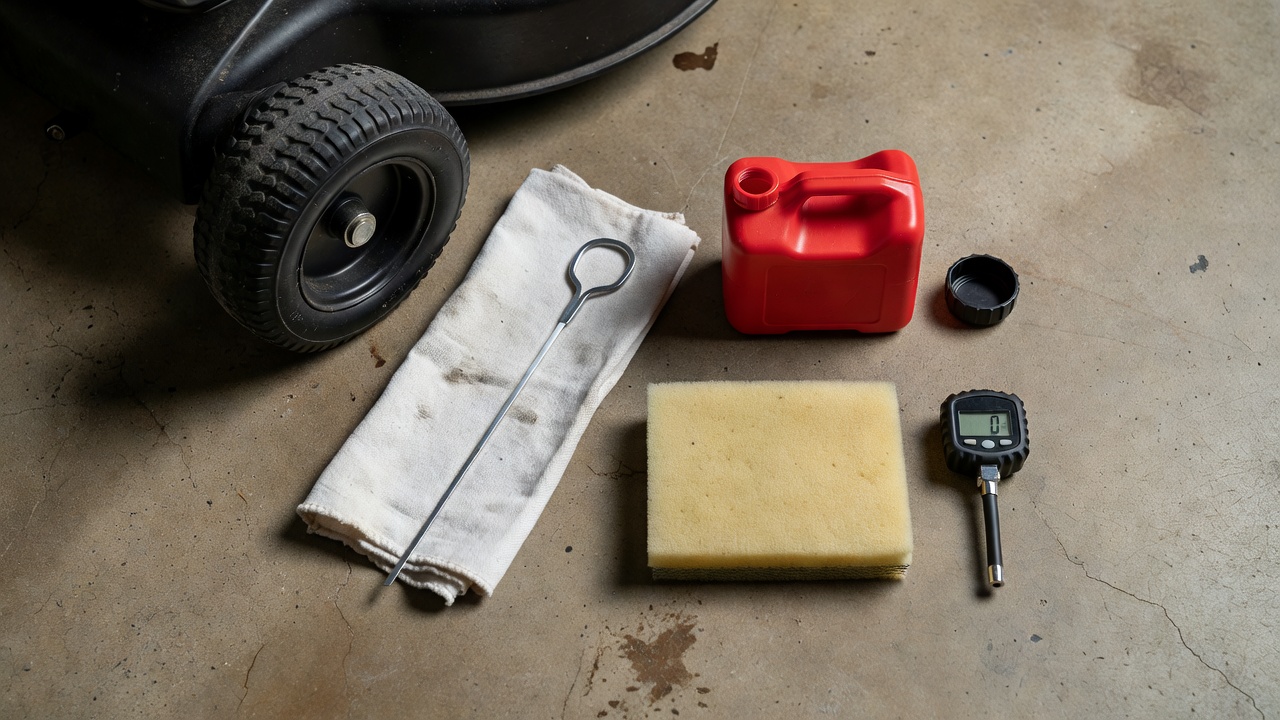
Running through a pre-start checklist before the ignition sequence protects both the engine and the operator. Skip these checks and you risk engine damage, a no-start condition, or a safety incident.
Engine Oil
Pull the dipstick, wipe it clean, reinsert fully, then pull again. Oil level must sit between the MIN and MAX marks. Running a riding mower with low oil triggers the low-oil shutdown sensor on many modern engines — the engine either refuses to start or shuts off seconds after firing. Use the oil grade specified on the dipstick or in the operator manual (commonly SAE 30 or 10W-30). Readers comparing setup options can review our technical analysis on jbl partybox club 120 vs sony srs xv500.
Fuel Level
Check the fuel gauge or remove the fuel cap and inspect visually. Use fresh, clean gasoline. Ethanol-blended gasoline (E10) degrades within 30 days and is a leading cause of hard-start and no-start conditions in small engines, according to Briggs & Stratton’s fuel guidance. If the mower has sat unused for more than 30 days, treat the fuel with a fuel stabilizer or drain and refill with fresh fuel before starting. Readers comparing setup options can review our technical analysis on jbl partybox club 120 vs sony srs xv500.
Air Filter
A clogged air filter restricts airflow and causes hard starting, especially in dusty conditions. Tap a paper element clean or replace it if it is visibly dark and packed with debris. For complementary field maintenance guidelines, examine our breakdown of z890 vs x870e motherboard.
Tire Pressure
Low or uneven tire pressure causes uneven cutting and can make the mower pull to one side on slopes. Check the label on the tire sidewall for the correct PSI.
Cutting Area
Walk the mowing area before starting. Remove sticks, rocks, wire, and toys. Clear bystanders — particularly children and pets — from the area. ANSI B71.1, the U.S. safety standard for ride-on mowers, specifies that no bystanders should be within the mowing zone while the machine is in operation. For complementary field maintenance guidelines, examine our breakdown of z890 vs x870e motherboard.
Drive Belt and Blade Condition
Visually inspect the underside of the deck for cracked or frayed drive belts and bent or damaged blades. Do not operate with damaged components.
Understanding the Safety Interlock System
Modern ride on mowers use a network of safety interlocks — electronic switches that prevent the engine from cranking or that shut the engine off if an unsafe condition is detected. Understanding this system explains why the ignition sequence must follow a specific order, and it is the first thing to diagnose when a mower refuses to start. To evaluate matched hardware tolerances, consult our detailed overview of marshall stanmore iii vs harman kardon onyx studio 8.
Seat Safety Switch
A pressure-activated switch sits beneath the operator seat. The switch closes the ignition circuit only when the operator’s weight is fully on the seat. If the operator rises from the seat while the blades are engaged, the seat safety switch cuts the engine — a requirement codified in operator manuals from Husqvarna, John Deere, and other major OEMs, and aligned with ANSI B71.1 safety standards. This is the single most common interlock that causes a no-start: the operator sits too far forward or is not fully settled, and the switch does not register.
Parking Brake Interlock
The parking brake must be fully engaged before the engine will crank. This prevents unintended movement during startup. On lawn tractors the brake is typically a foot pedal that locks into a notch; on some rear-engine riders it is a hand lever. Partially engaged brakes often fail to close the interlock switch. When planning workspace deployment, consider the engineering criteria outlined in our dyson v8 cyclone vs bissell featherweight stick guide.
PTO / Blade Engagement Interlock
The PTO (Power Take-Off) switch or blade engagement lever must be in the OFF/DISENGAGED position. Attempting to start with the blades engaged places an immediate load on the engine and, on most machines, the interlock circuit prevents cranking entirely. On older machines without electronic interlocks, starting with the blades engaged risks belt damage and loss of control.
How the Interlocks Work Together
These three switches are wired in series. All three must be satisfied simultaneously for the starter motor to engage. One faulty or incorrectly positioned switch breaks the entire circuit. This is why a mower that clicks once or does nothing when the key turns is almost always an interlock issue rather than a dead battery — though a dead battery produces the same symptom. For additional operational safety benchmarks, see our published testing notes on bissell crosswave hydrosteam vs shark stainforce.
How to Cold Start a Ride on Mower
A cold start — starting an engine that has been sitting at ambient temperature, typically below 60 °F (15 °C) or after an extended shutdown — requires richer fuel mixture to fire. The choke restricts airflow to the carburetor, increasing the fuel-to-air ratio for easier ignition.
Choke Position
Move the choke lever to the CLOSED/FULL CHOKE position before cranking. On many lawn tractors the throttle and choke are combined on a single lever: pushing the lever fully toward the FAST or CHOKE symbol engages the choke. On engines with a separate choke knob — common on Kohler Command and Kawasaki FS-series engines — pull the knob out fully before turning the key.
Primer Bulb (Where Applicable)
Some smaller rear-engine riders and entry-level lawn tractors equipped with Briggs & Stratton Quantum or 500-series engines use a primer bulb instead of a choke. Press the primer bulb three times before cranking. Do not over-prime — excess fuel floods the carburetor.
Cold Start Ignition Sequence
- Complete all pre-start checks.
- Engage parking brake, disengage PTO, sit fully in seat.
- Set choke to FULL CHOKE or press primer bulb three times.
- Set throttle to FAST (if separate from choke).
- Turn key to START; hold for no more than 5–7 seconds.
- Once the engine fires, hold the choke in FULL CHOKE for 10–15 seconds.
- Gradually move the choke to the OFF/RUN position over the next 30–60 seconds as the engine warms — consistent with cold-start guidance from Briggs & Stratton, Kohler, and Kawasaki engine documentation. Moving the choke off too quickly on a cold engine causes it to stall.
- Allow the engine to idle at half-throttle for 1–2 minutes before engaging the blades.
Flooded Engine
If the engine does not fire after two or three attempts, it may be flooded. Move the choke to the OFF/RUN position, set the throttle to FAST, and crank for 5 seconds. Wait 30 seconds and try again. Repeat up to three times. Persistent flooding suggests a carburetor issue.
How to Start a Zero-Turn Mower
Zero-turn mowers share the same core safety interlock logic — seat switch, PTO off, brake engaged — but the physical controls differ significantly from a lawn tractor. The most critical difference is the lap bar neutral position requirement.
Lap Bars Must Be in the Outward (Neutral) Position
Zero-turn mowers steer via two independent lap bars (also called motion control levers). Both bars must be pushed outward to the locked neutral position — away from the operator — before the engine will crank. This is the zero-turn equivalent of the parking brake interlock. If either bar is even slightly inward, the neutral interlock switch is open and the starter will not engage. This is the number-one reason zero-turn owners report a no-start on their first use.
Zero-Turn Start Sequence
- Sit fully in the operator seat.
- Push both lap bars outward to the locked neutral/park position.
- Verify the PTO switch is OFF.
- Set throttle to half or FAST; engage choke if cold.
- Insert the ignition key and turn to START.
- Release the key once the engine fires.
- Allow the engine to warm for 1–2 minutes before moving the lap bars inward to engage drive.
Other Zero-Turn Differences
- No traditional parking brake pedal — the lap bar neutral position serves as the parking position on most models, though some commercial units (Scag, Ferris) add a dedicated parking brake lever.
- PTO switch location — typically a rocker or push-button switch on the control panel rather than a lever under the seat.
- Electric start is standard — battery condition is more critical on zero-turns because commercial models draw higher starter amperage.
Ride on Mower Won’t Start: Common Causes and Fixes
Work through this diagnostic table in order before concluding the engine or carburetor needs service.
| Symptom | Most Likely Cause | Fix |
|---|---|---|
| Key turns, nothing happens (no click, no crank) | Safety interlock not satisfied | Confirm: seat switch depressed, parking brake fully engaged, PTO/blades off, lap bars out (zero-turn). Re-test each one individually. |
| Single loud click, then nothing | Dead or weak battery | Test battery voltage with a multimeter — should read 12.6 V fully charged. Charge or replace a battery below 12.0 V. Check battery terminals for corrosion; clean with a wire brush. |
| Engine cranks but does not fire | Stale fuel, clogged fuel line, or flooded carburetor | Drain old fuel; refill with fresh gasoline. Check that the fuel shutoff valve (if equipped) is open. For flooding, follow the flooded-engine procedure above. |
| Engine cranks but does not fire (fuel confirmed fresh) | Faulty or fouled spark plug | Remove the spark plug, inspect for carbon buildup or cracked porcelain. Gap to spec (commonly 0.030 in for Briggs & Stratton; confirm in engine manual). Replace if in doubt — spark plugs are inexpensive. |
| Engine starts, then dies within seconds | Faulty seat safety switch or choke pulled off too fast | On a cold engine: keep choke engaged longer. If warm: press down firmly on the seat and re-test. A switch that fails in the open position can be temporarily bypassed by a technician for diagnosis, but should be replaced — never permanently disabled. |
| Engine starts, runs rough, then dies | Clogged carburetor (stale fuel varnish) | Add a carburetor cleaner to the fuel tank. If the problem persists, the carburetor requires disassembly and cleaning or replacement. |
| Starter motor spins freely, engine does not crank | Worn starter gear or sheared flywheel key | Requires mechanical inspection. A sheared flywheel key is common after a blade strike on a hard object. |
Battery Maintenance Note
Riding mower batteries discharge during winter storage. Connect a trickle charger or battery tender during off-season storage to maintain charge. A battery that holds under 12.0 V after a full charge should be replaced before the mowing season begins.
Common Questions on How To Start A Ride On Mower Answered
Why does my ride on mower turn over but not start?
An engine that cranks but does not fire points to a fuel or ignition problem rather than an electrical one. The most common causes in order: stale or contaminated fuel, a flooded carburetor, a fouled spark plug, or a closed fuel shutoff valve. Confirm fresh fuel is reaching the carburetor, then inspect the spark plug. If the plug is wet with fuel, the engine is flooded — follow the flooded-engine procedure (choke off, throttle fast, crank 5 seconds, wait 30 seconds, repeat).
Can a bad seat safety switch prevent a ride on mower from starting?
Yes. The seat safety switch is wired in series with the starter circuit. A switch that has failed in the open position breaks the ignition circuit regardless of key position — the engine produces no crank and no click. Diagnose by sitting firmly and fully centered in the seat and retrying. If the mower starts inconsistently depending on how you sit, the switch is faulty and must be replaced. Do not permanently bypass it; the seat switch is a primary injury-prevention device.
Do you need to use the choke every time you start a riding mower?
Only on cold starts. Once the engine is at operating temperature — after 5 or more minutes of running — the choke is not needed and should remain in the OFF/RUN position. Using the choke on a warm engine over-richens the mixture, causing rough running, black exhaust smoke, and potential spark plug fouling. If your warm engine requires choke to start, the carburetor main jet is likely partially blocked.
What position do the lap bars need to be in to start a zero-turn mower?
Both lap bars must be pushed fully outward to the locked neutral/park position — away from the operator. This closes the neutral interlock switch and allows the starter to engage. Even one bar that is slightly inward will prevent cranking. After the engine is running and warmed, pull both bars inward toward your hips to engage the drive system and begin moving.

Pros
- Large-size design named in product title
- Sharpening and balancing functions listed
- Listed as a new upgraded version

Pros
- Adjustable 15-to-45-degree range in title
- Sharpening and balancing functions listed

Pros
- Sharpener and balancer functions in title
- 15-to-45-degree adjustable setting listed
- Built for lawn mower blade maintenance
Pros
- Includes replacement gaskets and a 98079-55846 spark plug
- Matches Honda HRR216 and HRS216 lawn mower models
- Designed around the 16100-Z8B-901 carburetor specification
Cons
- Restricted to select Honda GCV160 mower applications
- Installation requires basic mechanical tools and skills
For more hands-on benchmarks and buying recommendations, consult our guides on high-CFM commercial leaf blower guide.
Mechanical safety standards, operational tolerances, and protective gear guidelines align with benchmark specifications established by the American National Standards Institute (ANSI).









