What Is a Mulch Lawn Mower? (Direct Answer)
A mulch lawn mower — also called a mulching mower — is a mower fitted with a specially curved, enclosed deck and a re-curved mulching blade that shreds grass clippings into fine pieces multiple times before depositing them back onto the lawn surface. The clippings are cut small enough to fall between grass blades, decompose rapidly, and return nitrogen and other nutrients directly to the soil. Unlike a bagging mower or side-discharge mower, a mulching mower produces no clipping waste to collect or dispose of.

Pros
- Manufacturer-stated 15 Amp corded power
- 18-inch size listed in the title
- Six steel tines per the listing
- Adjustable wheels included in the listing
Cons
- Corded design limits range to nearby outlets
- Power and tilling claims are unverified

Pros
- 13.5 Amp corded electric power stated
- 16-inch size listed in the title
- Steel tines per the listing
- Model SUJ-TJ604E identified
Cons
- Corded design limits range to nearby outlets
- Power and performance claims are unverified
Pros
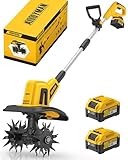
- Two 4.0Ah batteries and charger listed
- 360 RPM speed per the manufacturer
- 9-inch tilling width stated
- 6.6-inch tilling depth stated
Cons
- RPM, width and depth figures are unverified claims

Pros
- Battery-powered for cord-free tilling
- Designed for gardening and garden rototilling
Cons
- Battery, dimensions and power details not supplied
Common confusion: Some homeowners use the term “mulch mower” to describe a mower used to shred garden-bed material such as leaves or wood chips. That is a separate application. This article covers mulching in the lawn-care sense: re-cutting and recycling grass clippings back into the turf.
How a Mulching Mower Works: Blade and Deck Design
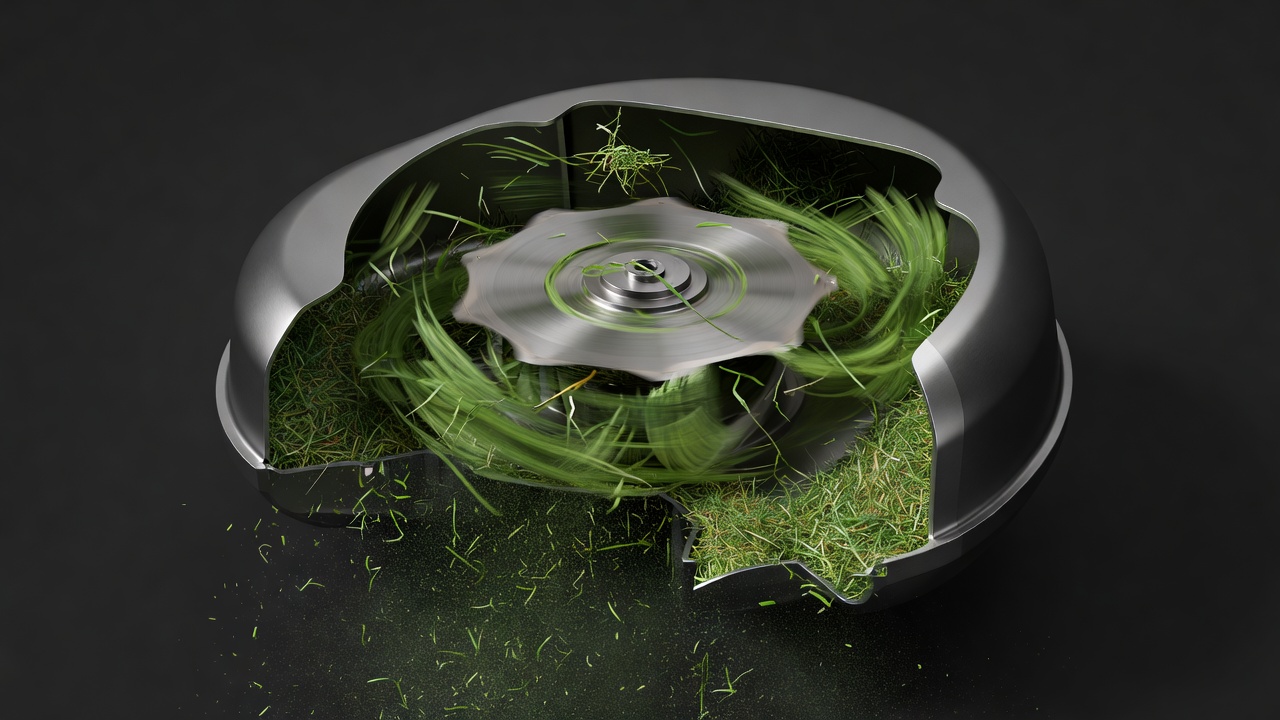
The performance difference between a mulching mower and a standard mower comes down to two mechanical features working together: the mulching blade and the mulching deck.
The Mulching Blade
A standard mower blade has a single horizontal cutting edge with a slight lift angle that pushes clippings upward and out through a discharge chute. A mulching blade — sometimes called a “high-lift” or “all-purpose” blade — has additional curved cutting surfaces along its length and a more aggressive angle. This geometry re-cuts each clipping several times as it circulates inside the deck before falling onto the lawn. The result is particles fine enough to slip through the grass canopy and reach the soil surface. Users looking for related component recommendations can explore our jbl partybox club 120 vs sony srs xv500 breakdown.
The Mulching Deck
The mulching deck is fully enclosed with no side-discharge opening (or with that opening blocked by a plug on a convertible model). The dome-shaped or baffled interior recirculates clippings back under the blade repeatedly. Without an exit chute, clippings cannot escape until they are reduced to a size small enough to settle through the turf. The enclosed design is what separates a true mulching mower from a standard mower whose discharge opening has simply been covered. Users looking for related component recommendations can explore our jbl partybox club 120 vs sony srs xv500 breakdown.
How Many Times Are Clippings Re-Cut?
There is no universal fixed number — it depends on blade speed, deck geometry, and grass volume — but the combined effect of blade curvature and deck recirculation typically reduces each clipping to roughly one-quarter to one-tenth of its original length before it exits the deck. The finer the particle, the faster it decomposes and returns nutrients to the soil.
What Happens to the Clippings: Decomposition and Soil Benefit
Grasscycling and Nitrogen Return
The practice of returning grass clippings to the lawn is formally called grasscycling. Grass clippings are approximately 80–85% water and contain meaningful concentrations of nitrogen, phosphorus, and potassium. University extension research — including work from Texas A&M AgriLife Extension — indicates that grass clippings can return roughly 0.5 to 1.0 lb of nitrogen per 1,000 sq ft per growing season, depending on mowing frequency and grass species. Over a full season, consistent grasscycling may reduce the total synthetic fertilizer needed by approximately 25%, according to turfgrass management guidance from several land-grant university programs. Before finalizing equipment decisions, refer to our comprehensive z890 vs x870e motherboard comparison.
How Fast Do Clippings Decompose?
Finely shredded clippings from a mulching mower decompose within one to two weeks under typical warm, moist conditions, according to cooperative extension guidance from the University of California. In cool or dry weather, decomposition slows. Because the particles are small, microbial activity breaks them down quickly without visible residue remaining on the lawn surface between mowing sessions — provided mowing frequency is maintained.
Does Mulching Cause Thatch?
This is one of the most persistent myths in lawn care. Mulching does not cause thatch buildup. Thatch is a layer of undecomposed stems, roots, and crowns — tough lignin-rich plant material that resists microbial breakdown. Grass clippings are predominantly soft leaf tissue and water; they decompose readily and do not accumulate as thatch. Research from turfgrass scientists at Purdue University and the University of Minnesota confirms that returning clippings to the lawn does not measurably increase thatch depth when the lawn is mowed at the correct frequency. For broader ecosystem context, read through our operational guide on marshall stanmore iii vs harman kardon onyx studio 8.
Mulching vs. Bagging vs. Side-Discharge: Key Differences
| Feature | Mulching Mower | Bagging Mower | Side-Discharge Mower |
|---|---|---|---|
| Clipping disposal | Re-deposited onto lawn | Collected in attached bag | Expelled through side chute onto lawn in rows |
| Nutrient return | High — nitrogen cycles back to soil | None — clippings removed from lawn | Partial — clippings remain but are not finely cut |
| Lawn appearance after mowing | Clean — no visible clumps if mowed on schedule | Very clean — no surface clippings | Visible clipping rows; can look untidy |
| Ideal grass conditions | Dry grass, mowed frequently (no more than one-third of blade length removed) | Wet, long, or diseased grass where clippings need removal | Large open areas; tall or heavy grass |
| Fertilizer savings | Significant — reduces synthetic fertilizer need | None | Minimal — coarse clippings decompose slowly |
| Cleanup time | Low — no bag to empty | High — bag must be emptied and clippings disposed of | Medium — may need raking if clumps form |
| Performance in wet/long grass | Poor — clippings clump and clog deck | Good — bag removes excess material | Good — open chute handles volume |
| Best suited for | Regular residential lawns mowed on a consistent schedule | Lawns with disease pressure, very long growth, or show-quality appearance requirements | Large properties, fields, or rough terrain |
Types of Mulching Mowers: 2-in-1, 3-in-1, and Dedicated Mulch-Only
Dedicated Mulching Mowers
A dedicated mulching mower has a permanently enclosed deck with no discharge chute option. It is optimized entirely for recirculating and finely cutting clippings. Because there is no mode-switching hardware, the deck geometry and blade lift are tuned specifically for mulching performance. These models are best for homeowners who have settled on grasscycling as their primary approach and do not need bagging flexibility.
2-in-1 Mulching Mowers
A 2-in-1 mower can mulch or bag. The deck includes a discharge chute that can be fitted with a collection bag, and a mulching plug is inserted to close the chute when mulching mode is desired. This flexibility makes 2-in-1 models practical for lawns where conditions vary — mulching in dry periods, bagging when grass gets ahead of schedule or after heavy rain. For troubleshooting and reliability insights, consult our in-depth dyson v8 cyclone vs bissell featherweight stick report.
3-in-1 Mowers
A 3-in-1 mower adds side-discharge capability to the mulch-and-bag options above. The discharge chute directs clippings out to the side when neither mulching nor bagging is wanted — useful for clearing large volumes of growth quickly. Most mid-range to premium walk-behind and self-propelled mowers sold today are 3-in-1 models. The trade-off is that the deck must compromise slightly between three functions, meaning it may not mulch quite as finely as a dedicated mulching-only machine.
Mulching Blade Conversion Kits
Some standard mowers can be partially converted for mulching by replacing the factory blade with a mulching blade conversion kit — a mulching blade paired with a discharge-plug insert. Conversion improves clipping fineness compared to a standard blade with a blocked chute, but the deck shape is not redesigned, so performance falls short of a purpose-built mulching deck. This approach suits homeowners who want improved clipping breakdown without purchasing a new mower. Blade compatibility varies by mower brand and deck diameter — confirm fit before purchasing a kit. Readers comparing setup options can review our technical analysis on bissell crosswave hydrosteam vs shark stainforce.
Is a Mulching Mower Right for Your Lawn? Key Factors to Consider
Lawn Size
Mulching mowers work well at any residential lawn size. Walk-behind mulching mowers suit lots up to roughly half an acre. For larger properties, riding mulching mowers and zero-turn models with mulching decks are widely available. The key constraint is not size but mowing frequency — see below.
Grass Type
Both cool-season grasses (Kentucky bluegrass, tall fescue, perennial ryegrass) and warm-season grasses (Bermuda, Zoysia, St. Augustine) respond well to grasscycling. Dense, fine-textured grasses such as Bermuda and Zoysia produce finer clippings naturally, which decompose faster. Coarser grasses such as St. Augustine produce larger clippings; finely cutting them requires the mower to run at full blade speed and the lawn to be mowed before growth becomes excessive.
Mowing Frequency
Mowing frequency is the single most important variable in mulching performance. The one-third rule applies: never remove more than one-third of the grass blade in a single session. For most cool-season grasses mowed at 3 inches, that means mowing before the lawn exceeds 4.5 inches — typically every 5 to 7 days during the growing season. Waiting too long between sessions produces large clipping volumes that clump on the surface rather than settling through the canopy. Clumped clippings block light and can smother grass if left unattended.
Clipping Volume and Wet Conditions
Mulching in wet or long grass produces clumping regardless of mower quality. Wet clippings stick together and do not re-cut cleanly, clogging the deck and leaving visible mats on the lawn surface. When grass is wet or has grown beyond the one-third threshold, bagging or side-discharge is the more practical choice. A 2-in-1 or 3-in-1 mower provides this flexibility; a dedicated mulch-only mower does not.
Disease Pressure
If your lawn has an active fungal disease — dollar spot, brown patch, or gray leaf spot, for example — returning clippings can distribute fungal spores across the lawn. During active disease periods, bagging and disposing of clippings off-site is recommended. Return to mulching once the disease is resolved and conditions no longer favor pathogen spread.
Pros and Cons of Mulching Mowers
Advantages
- Free natural fertilizer: Returning clippings supplies nitrogen, phosphorus, and potassium with no additional cost — potentially cutting synthetic fertilizer applications by around 25%.
- Reduced disposal effort: No bag to empty, haul, or dispose of. Mowing sessions are faster from start to finish.
- Environmental benefit: Fewer yard-waste bags enter the waste stream; less synthetic fertilizer production is needed.
- Improved soil health: Decomposing clippings feed soil microbes, improving long-term soil structure and water retention.
- Moisture retention: Fine clippings on the soil surface act as a thin mulch layer, marginally reducing moisture evaporation between mowing sessions.
Limitations
- Requires frequent mowing: The one-third rule must be respected. Skipping mowing sessions during peak growth quickly makes mulching impractical.
- Poor performance in wet or long grass: Wet clippings clump and clog the deck. Dedicated mulch-only mowers offer no fallback mode.
- Not suitable during disease outbreaks: Spreads fungal spores; bagging is required until disease pressure clears.
- Deck cleans less easily: The enclosed mulching deck accumulates compressed clippings on the underside more quickly than an open-discharge deck. Regular deck scraping is necessary.
- Less suitable for heavily thatched lawns: While mulching does not cause thatch, a lawn that already has a thick thatch layer may not allow fine clippings to reach the soil surface effectively. Dethatch first, then adopt grasscycling.
Common Questions on Mulch Lawn Mower Answered
Can any lawn mower be used as a mulching mower?
Not effectively with deck design alone. Blocking the discharge chute of a standard mower without a purpose-shaped mulching deck and mulching blade will recirculate clippings but not cut them finely enough for rapid decomposition. A proper mulching blade and, ideally, a mulching deck are both needed for consistent results. Many mower manufacturers sell mulching blade conversion kits that improve performance over a blocked-chute-only approach, though a dedicated mulching deck still outperforms a converted standard one.
Will mulched clippings make my lawn look messy?
Not if the one-third rule is followed. Clippings cut to the correct fine size drop between grass blades and are invisible within a day or two. Mowing when grass is too long, too wet, or at a dull blade produces visible clumps. Sharp blades and consistent mowing schedules eliminate surface residue in normal conditions.
How does mulching affect lawn fertilizer costs?
University extension programs estimate that consistent grasscycling can reduce annual nitrogen fertilizer requirements by approximately 25%. The exact saving depends on lawn size, grass species, mowing frequency, and the fertilizer product replaced. The saving is real but not a complete substitute for a structured fertilization program — it offsets a portion of the nitrogen input needed, not the entire annual requirement.
Is a 3-in-1 mower better than a dedicated mulching mower?
It depends on your lawn conditions. A 3-in-1 mower offers more flexibility — mulch when conditions are right, bag or side-discharge when they are not. A dedicated mulching mower may perform fractionally better at mulching due to a fully optimized deck, but sacrifices all flexibility. For most homeowners dealing with variable weather and occasional missed mowing sessions, a 3-in-1 model is the more practical choice.
For more detailed testing breakdowns and top recommendations, check our in-depth guide to residential zero-turn lawn mower guide.
For more hands-on benchmarks and buying recommendations, consult our guides on heavy-duty chainsaw buyer guide, as well as high-CFM commercial leaf blower guide, as well as automated robotic lawn mower guide.
Mechanical safety standards, operational tolerances, and protective gear guidelines align with benchmark specifications established by the American National Standards Institute (ANSI).