

Direct Answer: How Much Oil Does a Lawn Mower Take?
Most walk-behind lawn mowers take 15–18 oz (about 0.47–0.53 qt) of oil. Riding mowers typically require 48–64 oz (1.5–2 qt). Exact capacity varies by engine brand and displacement — always verify using the dipstick or your owner’s manual before pouring.

Pros
- Large-size design named in product title
- Sharpening and balancing functions listed
- Listed as a new upgraded version

Pros
- Adjustable 15-to-45-degree range in title
- Sharpening and balancing functions listed

Pros
- Sharpener and balancer functions in title
- 15-to-45-degree adjustable setting listed
- Built for lawn mower blade maintenance
Pros
- Includes replacement gaskets and a 98079-55846 spark plug
- Matches Honda HRR216 and HRS216 lawn mower models
- Designed around the 16100-Z8B-901 carburetor specification
Cons
- Restricted to select Honda GCV160 mower applications
- Installation requires basic mechanical tools and skills
Quick-Reference Oil Capacity by Mower Type
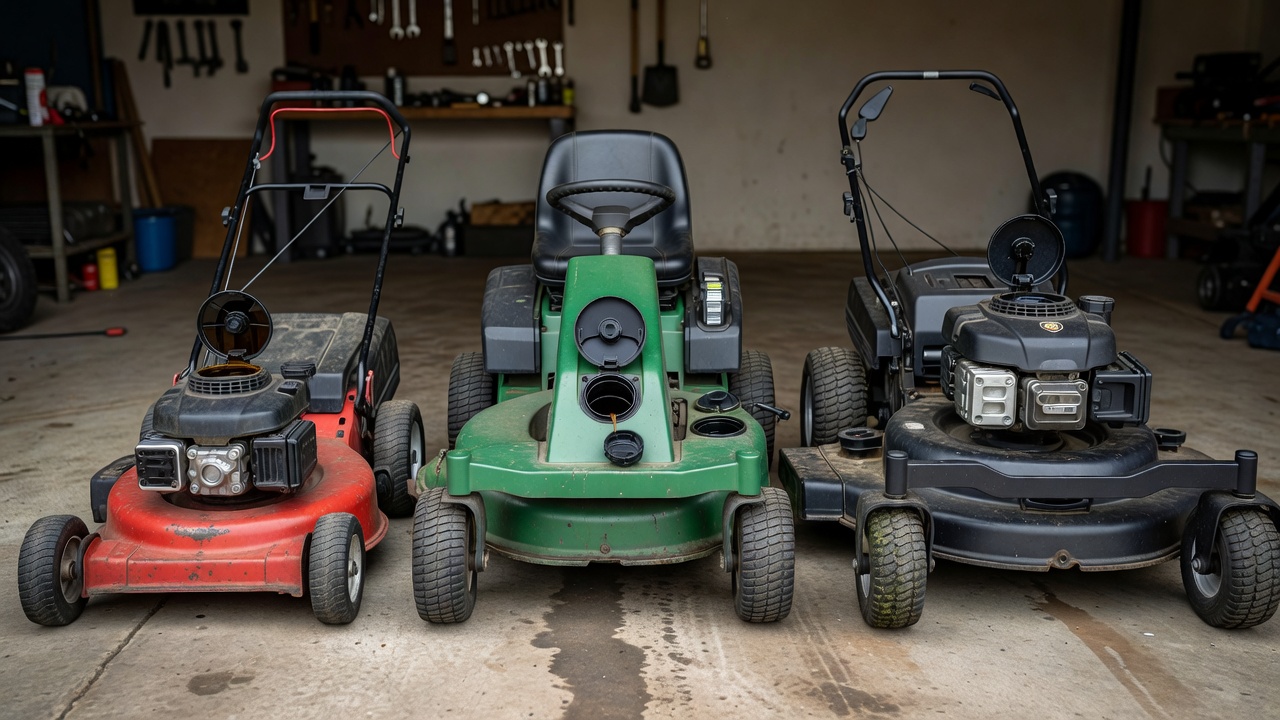
Use this table to find a starting estimate based on your mower category. These ranges reflect published OEM specifications across the most common consumer engine families.
| Mower Type | Typical Oil Capacity (oz) | Typical Oil Capacity (qt) | Common Engine Examples |
|---|---|---|---|
| Walk-Behind (small/standard) | 15–18 oz | ~0.47–0.53 qt | Briggs & Stratton 140cc, Honda GCV160 |
| Walk-Behind (large/self-propelled) | 18–20 oz | ~0.56–0.63 qt | Briggs & Stratton 190cc, Honda GCV190 |
| Riding Mower (standard) | 48–56 oz | 1.5–1.75 qt | Briggs & Stratton Single-Cylinder, Kohler SV series |
| Riding Mower (large/twin-cylinder) | 56–64 oz | 1.75–2 qt | Kohler Command Pro, Kawasaki FR series |
| Zero-Turn Mower (residential) | 48–64 oz | 1.5–2 qt | Kawasaki FR651V, Kohler 7000 series |
| Zero-Turn Mower (commercial) | 64–80 oz | 2–2.5 qt | Kawasaki FX series, Kohler Command Pro EFI |
| Electric / Battery Mower | None | None | No combustion engine — no oil required |
Important: These figures are representative ranges from manufacturer documentation. Always treat them as a starting point — your specific model may fall outside these ranges based on engine variant, model year, or trim level. Before finalizing equipment decisions, refer to our comprehensive jbl partybox club 120 vs sony srs xv500 comparison.
Oil Capacity by Engine Brand and Size
Engine displacement (measured in cubic centimeters, or cc) directly determines crankcase volume and therefore oil capacity. Two mowers that look identical on the outside can hold meaningfully different amounts of oil if they carry different engines. Before finalizing equipment decisions, refer to our comprehensive jbl partybox club 120 vs sony srs xv500 comparison.
Briggs & Stratton
Briggs & Stratton is the most common engine brand in North American residential mowers. Capacity scales with displacement: For broader ecosystem context, read through our operational guide on z890 vs x870e motherboard.
- 140cc (450–500 series): 15 oz (0.47 qt)
- 163cc (550–575 series): 15 oz (0.47 qt)
- 190cc (625–675 series): 18–19 oz (0.56–0.60 qt)
- Single-cylinder riding engines (Intek 344–500cc): 48 oz (1.5 qt)
Briggs & Stratton’s published maintenance documentation confirms the 15 oz figure for their most widely sold 140cc walk-behind powerplants and the 48 oz figure for their standard single-cylinder Intek riding engines.
Honda GCV Series
- Honda GCV160 (160cc): 15.2 oz (0.45 qt) — Honda’s own operator manual specifies this figure for the GCV160 powering the HRX and HRR series mowers.
- Honda GCV190 (190cc): 18.6 oz (0.55 qt) — confirmed in Honda’s GCV190 operator manual for HRX217 variants.
Honda engines tend to run at the lower end of the capacity range for their displacement class due to their compact crankcase design. For broader ecosystem context, read through our operational guide on z890 vs x870e motherboard.
Kohler Engines
- Kohler SV470–SV600 (single-cylinder, 15–20 hp): 48 oz (1.5 qt)
- Kohler 7000 series (twin-cylinder, 20–26 hp): 56–64 oz (1.75–2 qt)
- Kohler Command Pro (commercial twin, 23–27 hp): 64 oz (2 qt)
Kohler’s published service manuals for the Command and 7000 series engines list these capacities at a cold fill to the full mark on the dipstick.
Kawasaki Engines
- Kawasaki FR651V (726cc, twin-cylinder): 57.5 oz (1.8 qt)
- Kawasaki FR730V (726cc high-output twin): 57.5 oz (1.8 qt)
- Kawasaki FX Series (commercial, 603–999cc): 64–80 oz (2–2.5 qt) depending on displacement
The Kawasaki FR series is widely used in residential zero-turn mowers from brands like Husqvarna, Ariens, and Gravely. Their service documentation confirms the 57.5 oz figure for the FR651V and FR730V. For troubleshooting and reliability insights, consult our in-depth marshall stanmore iii vs harman kardon onyx studio 8 report.
How to Check Your Mower’s Exact Oil Capacity
Published tables give a reliable starting range, but the dipstick is the only tool that tells you what your specific engine needs right now — accounting for any oil already present and the exact tolerances of your unit.
Step 1: Locate the Oil Fill Port
On walk-behind mowers, the oil fill port is typically a yellow or black cap on the side of the engine block, often labeled with an oil-can symbol. On riding and zero-turn mowers, it is usually accessible under the hood or seat, on the engine block near the front or top of the crankcase. Readers comparing setup options can review our technical analysis on dyson v8 cyclone vs bissell featherweight stick.
Step 2: Clean the Area Around the Dipstick
Wipe the dipstick tube opening and surrounding area with a clean rag before removing the dipstick. Debris entering the crankcase causes accelerated engine wear.
Step 3: Remove, Wipe, Reinsert, and Read
- Remove the dipstick fully and wipe it clean with a lint-free cloth.
- Reinsert the dipstick all the way — seat it fully without threading it in if it is a screw-in type, then withdraw it again.
- Read the oil level against the MIN and MAX (or ADD and FULL) marks etched or stamped on the dipstick blade.
Oil should appear between the two marks. If it reads at or below MIN/ADD, add oil in small increments (2–3 oz at a time), rechecking after each addition. For complementary field maintenance guidelines, examine our breakdown of bissell crosswave hydrosteam vs shark stainforce.
What Happens If You Overfill Oil?
Overfilling is a common and damaging mistake. When oil level exceeds the MAX mark, excess oil can be drawn into the combustion chamber, causing white smoke, fouled spark plugs, and in severe cases, hydraulic lock — a condition where incompressible liquid prevents piston travel and bends connecting rods. Briggs & Stratton’s service documentation explicitly warns against overfilling for this reason. If you overfill, drain the excess through the drain plug or oil fill port before starting the engine.
Check Your Owner’s Manual
Every mower ships with an owner’s manual that lists the exact oil capacity for that engine in the specifications table — usually under “Lubrication” or “Engine Specifications.” If the physical manual is lost, search the engine model number (stamped on the engine block) on the manufacturer’s website to download the PDF. This is the most authoritative source for your specific unit.
Which Oil Type and Viscosity to Use
Oil capacity (volume) and oil type (viscosity grade) are separate decisions. Getting both right protects the engine.
SAE 30 vs. 10W-30
- SAE 30: Recommended for ambient temperatures consistently above 40°F (4°C). It is a single-grade oil with a stable viscosity profile suited to warm-weather mowing. Most Briggs & Stratton and Honda small engines list SAE 30 as the primary recommendation for typical mowing season temperatures.
- 10W-30: A multi-grade oil recommended when temperatures vary or dip below 40°F (4°C) — for example, early spring or late fall mowing. The “10W” rating means it flows adequately at cold start without the thickening that can starve bearings during initial cranking. Briggs & Stratton and Honda both list 10W-30 as an acceptable alternative across their consumer engine lines.
Synthetic Oil
Full synthetic 5W-30 or 10W-30 is acceptable in most modern small engines and offers better high-temperature stability and longer change intervals. Honda, Briggs & Stratton, Kohler, and Kawasaki all approve the use of API SJ-rated or higher synthetic oil. Synthetic is particularly beneficial in commercial zero-turn applications where engines run for extended periods at high load. Switching from conventional to synthetic does not require engine break-in modification on engines already past their initial 5-hour break-in period.
Temperature-Based Viscosity Quick Reference
| Ambient Temperature Range | Recommended Viscosity |
|---|---|
| Below 40°F (4°C) | 5W-30 or 10W-30 (multi-grade) |
| 40°F–100°F (4°C–38°C) | SAE 30 or 10W-30 |
| Above 100°F (38°C) | SAE 30 (consult manual — some engines approve 10W-40) |
| Year-round / variable climates | 10W-30 or synthetic 5W-30 |
Do Electric and Battery Lawn Mowers Use Oil?
No. Battery-powered and corded electric mowers have no internal combustion engine and require no engine oil. There is no crankcase, no dipstick, and no oil change interval. If you own an electric mower and searched this question, this page does not apply to your powertrain.
Electric mower maintenance focuses on different items: blade sharpening, deck cleaning, battery terminal inspection, and wheel lubrication (grease, not engine oil). Consult your mower’s manual for the specific maintenance schedule relevant to electric models.
When and How Often to Change Lawn Mower Oil
Oil capacity tells you how much to pour in; change interval tells you when to replace it entirely.
Standard Interval Guidance
- New engines: Change oil after the first 5 hours of operation. This initial change removes metal particles shed during engine break-in.
- Walk-behind mowers: Change every 50 hours of use or once per season, whichever comes first. Briggs & Stratton’s published maintenance schedule confirms this 50-hour benchmark for their consumer walk-behind engines.
- Riding and zero-turn mowers: Change every 50–100 hours depending on engine brand. Kohler Command Pro engines specify 100-hour intervals with full synthetic oil; Kawasaki FR series specifies 100 hours under normal conditions, 50 hours under severe (dusty or high-temperature) conditions.
- Seasonal mowers used infrequently: Change at the start of each mowing season regardless of hours logged. Oil degrades chemically even during storage due to moisture absorption and oxidation.
Signs Your Mower Needs an Oil Change
- Oil on dipstick appears black or gritty rather than amber or light brown.
- Engine runs noticeably louder or rougher than usual.
- Blue or white smoke from the exhaust during operation.
- Oil level dropping between checks without visible external leaks (sign of oil consumption, which warrants inspection alongside a change).
Replacing oil is inexpensive. Delaying it risks bearing wear, piston scoring, and premature engine failure — repairs that cost multiples of the mower’s value on mid-range units.
Everything You Need to Know: How Much Oil Goes Into A Lawn Mower FAQ
How many quarts of oil does a lawn mower take?
Walk-behind mowers take roughly 0.47–0.63 qt (15–20 oz). Riding mowers take 1.5–2 qt (48–64 oz). Zero-turn commercial mowers can require up to 2.5 qt. Always confirm with the dipstick or owner’s manual for your specific engine model.
Can I use car oil in my lawn mower?
Yes, with conditions. Standard passenger-car motor oil meeting API SJ or higher classification in the correct viscosity (SAE 30 or 10W-30) is acceptable in most small engines. Avoid oil with friction modifiers or energy-conserving additives (labeled “EC” on the API donut) — these can cause clutch slippage in engines with wet clutches. Full synthetic 5W-30 or 10W-30 rated API SJ or higher is widely approved by Briggs & Stratton, Honda, Kohler, and Kawasaki.
What happens if I put too much oil in my lawn mower?
Overfilling forces excess oil into the combustion chamber. Symptoms include white or blue smoke, a fouled spark plug, hard starting, and engine surging. In severe overfill cases, oil entering the cylinder can cause hydraulic lock, bending or breaking the connecting rod. If you overfill, do not start the engine — drain the excess through the drain plug or tilt the mower to pour out the surplus through the fill port, then recheck with the dipstick.
How do I find the oil capacity for my specific mower engine?
Locate the engine model number stamped on the engine block (not the mower deck label — the engine itself). Enter that number into the engine manufacturer’s website — Briggs & Stratton (briggsandstratton.com), Honda Power Equipment (powerequipment.honda.com), Kohler Engines (kohlerengines.com), or Kawasaki Engines (kawasaki-engines.com). Each manufacturer provides downloadable operator and service manuals listing exact oil capacity in the specifications section.
For more hands-on benchmarks and buying recommendations, consult our guides on heavy-duty chainsaw buyer guide, as well as high-CFM commercial leaf blower guide, as well as durable ride-on lawn tractor guide.
Mechanical safety standards, operational tolerances, and protective gear guidelines align with benchmark specifications established by the American National Standards Institute (ANSI).









