

How to Fix a Lawn Mower That Will Not Start (Direct Answer)
Work through these six causes in order, and you will fix the vast majority of lawn mower no-start problems yourself:

Pros
- Large-size design named in product title
- Sharpening and balancing functions listed
- Listed as a new upgraded version

Pros
- Adjustable 15-to-45-degree range in title
- Sharpening and balancing functions listed

Pros
- Sharpener and balancer functions in title
- 15-to-45-degree adjustable setting listed
- Built for lawn mower blade maintenance
Pros
- Includes replacement gaskets and a 98079-55846 spark plug
- Matches Honda HRR216 and HRS216 lawn mower models
- Designed around the 16100-Z8B-901 carburetor specification
Cons
- Restricted to select Honda GCV160 mower applications
- Installation requires basic mechanical tools and skills
- Fouled or dead spark plug — Remove it, inspect the electrodes, and replace it if they are black, oily, or corroded.
- Stale or empty fuel — Drain gasoline older than 30 days and refill with fresh fuel.
- Clogged carburetor — Spray carburetor cleaner through the jets, or rebuild the carburetor if fuel flow does not return.
- Dirty air filter — Tap clean or replace a paper filter; wash a foam filter with soapy water.
- Tripped or failed safety switch — Confirm the operator-presence bail lever, seat switch (riding mowers), or blade-engagement switch is fully engaged.
- Dead battery or failed starter motor (electric-start models) — Charge or replace the battery, then test the starter motor with a multimeter.
Before you touch any part, though, spend two minutes identifying your mower type and exact symptom. “Will not start” describes three mechanically different failures, and each points to a different root cause.
Step 1: Identify Your Mower Type and Exact Symptom
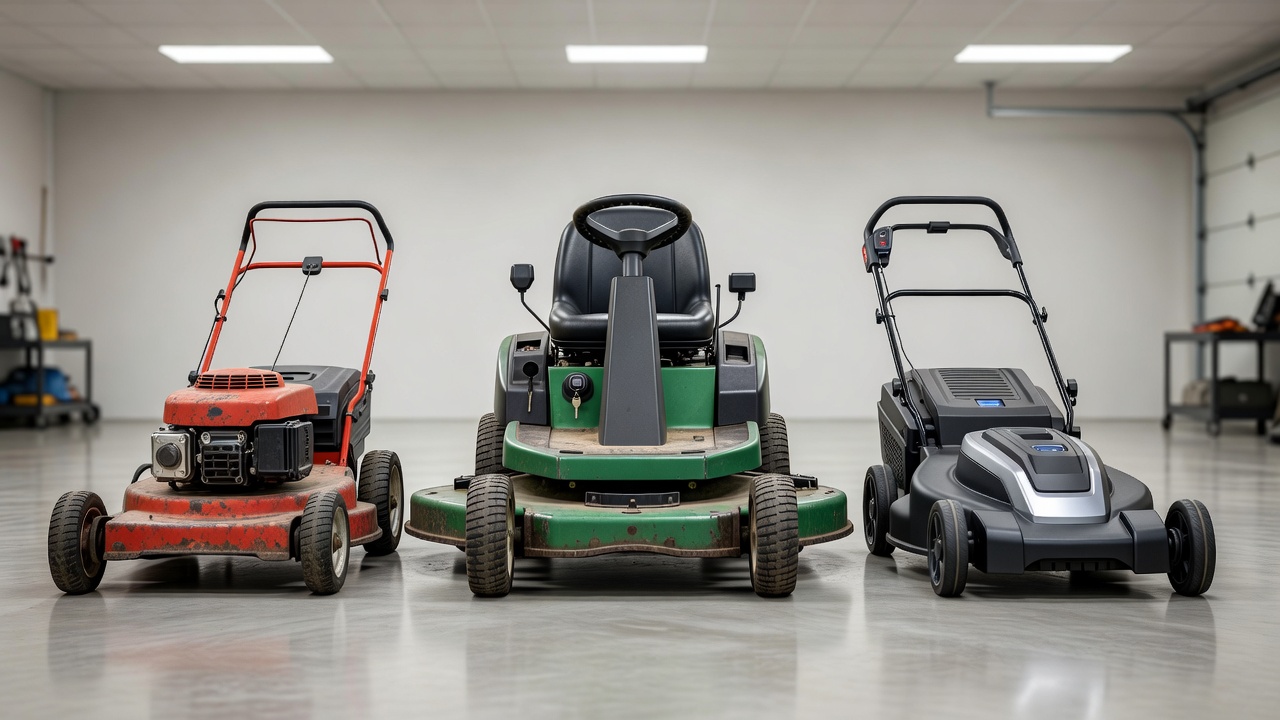
Troubleshooting a gas mower, an electric-start riding mower, and a battery-powered mower are completely different tasks. Classify your mower first: Users looking for related component recommendations can explore our jbl partybox club 120 vs sony srs xv500 breakdown.
- Gas pull-start push mower — A recoil cord starts a small single-cylinder engine.
- Gas electric-start mower or riding mower — Adds a battery, starter solenoid, and starter motor to the list of possible failure points.
- Battery-powered mower — No fuel, spark plug, or carburetor; the diagnosis is all electrical.
Next, define the exact symptom: Users looking for related component recommendations can explore our jbl partybox club 120 vs sony srs xv500 breakdown.
| What you observe | What it usually means |
|---|---|
| Nothing happens when you pull the cord or turn the key (no crank) | Electrical fault: dead battery, failed safety switch, bad starter, or seized engine |
| Engine cranks but will not fire | Fuel or ignition fault: stale gas, clogged carburetor, fouled spark plug, bad air filter |
| Pull cord will not move at all | Hydraulic lock from oil or water in the cylinder, or a seized engine |
| Engine starts then dies | Fuel delivery problem or dirty carburetor passages |
Step 2: Check the Spark Plug First
A fouled spark plug is the single most common reason a gas mower will not start. The plug must generate a strong spark to ignite the fuel-air mixture, and even small deposits can stop that from happening. Before finalizing equipment decisions, refer to our comprehensive z890 vs x870e motherboard comparison.
How to remove and inspect the spark plug
- Pull the rubber boot off the plug (twist gently if it is stuck).
- Use a socket wrench with a spark plug socket to unscrew it.
- Inspect the electrode end. Black, oily, or carbon-covered electrodes, cracked porcelain, or melted electrodes all mean the plug is fouled.
What a fouled plug looks like
- Black and sooty — The engine is running too rich or the plug is old.
- Oily and wet — Oil is getting into the cylinder, often from a worn engine or overfilled crankcase.
- Corroded, pitted, or white — The plug has overheated or worn out.
Cleaning vs. replacing
You can sometimes get a mildly dirty plug running again by scraping deposits off with a wire brush and checking the gap, but replacement is the reliable fix. Small-engine manufacturers (such as Briggs & Stratton) recommend replacing the spark plug annually or every 25 operating hours, and a new plug costs only a few dollars.
Set the correct spark plug gap
Use a feeler gauge to check the gap between the center electrode and the ground electrode. Most small lawn mower engines call for a gap of 0.020 to 0.030 inches (0.5 to 0.76 mm) — check the engine label or owner’s manual for the exact spec for your model. If the gap is too wide or too narrow, bend the ground electrode gently with the gauge or a gap tool. Before finalizing equipment decisions, refer to our comprehensive z890 vs x870e motherboard comparison.
Step 3: Drain and Replace Stale Fuel
Stale gasoline is the leading cause of no-starts after winter or after any storage longer than about a month. Gasoline degrades within 30 to 60 days without a fuel stabilizer, according to small-engine manufacturer guidance. As it oxidizes, it forms gums and varnish that clog the carburetor.
How long gas stays good
Ethanol-blended fuels break down faster than pure gasoline. Ethanol also absorbs water from the air, which can cause phase separation — the water and alcohol settle out of the fuel and sink to the bottom of the tank. Most manufacturers recommend against using blends above E10 in small engines for exactly this reason. For broader ecosystem context, read through our operational guide on marshall stanmore iii vs harman kardon onyx studio 8.
How to drain old fuel
- Siphon or drain the old fuel out of the tank into an approved container.
- Disconnect the fuel line from the carburetor and drain it too, if you can reach it.
- Use a turkey baster or siphon to remove any water pooled at the bottom of the tank.
- Refill with fresh 87-octane gasoline and add a fuel stabilizer if the mower will sit for more than a few weeks.
If the fuel is old and the mower still will not fire after refueling, the varnish has likely already reached the carburetor — move on to Step 4.
Step 4: Clean a Clogged Carburetor
A clogged carburetor is the second-most common no-start cause, and it almost always follows stale fuel. Varnish and sediment block the tiny jets and the needle valve that control fuel flow, starving the engine of gas even though the tank is full. For troubleshooting and reliability insights, consult our in-depth dyson v8 cyclone vs bissell featherweight stick report.
Symptoms of a clogged carburetor
- Engine cranks but will not start or starts only with starting fluid.
- Engine starts briefly and dies.
- Primer bulb does not fill with fuel.
Cleaning sequence
- Remove the air filter and its housing to expose the carburetor.
- Remove the float bowl (a small cup held by a bolt on the bottom) and empty out any cloudy fuel or sediment.
- Spray carburetor cleaner through the jets and passages while cranking the engine in short bursts. You are pushing the cleaner through to dissolve varnish.
- Reinstall the float bowl, reconnect everything, and try to start with fresh fuel.
If spraying does not restore fuel flow, you will need to remove the carburetor and clean it more thoroughly, or fit a carburetor rebuild kit (new gaskets, needle, and jets). Replacement carburetors for popular push mower engines are inexpensive and often cheaper than a rebuild kit plus your labor.
Step 5: Check the Air Filter, Primer Bulb, and Choke
These three quick checks take less than five minutes and fix a surprising number of no-starts. Readers comparing setup options can review our technical analysis on bissell crosswave hydrosteam vs shark stainforce.
Air filter
A severely clogged air filter starves the engine of air, producing a rich mixture that will not ignite. Pull the filter out and hold it up to light. Paper filters that are dark or clogged should be replaced; you can tap them gently to dislodge loose dirt in a pinch. Foam filters can be washed in soapy water, rinsed, dried, and lightly oiled before reinstalling.
Primer bulb
The primer bulb pushes fuel into the carburetor so the engine can start cold. Press it three to five times before pulling the cord. If the bulb is cracked, torn, or hard and brittle, it cannot draw fuel — replace it. You should hear or see fuel moving in the clear fuel line when you press it.
Choke position
For a cold engine, the choke should be closed (choke on) to enrich the mixture. For a warm engine, it should be open (run position). If the choke plate is stuck closed, the engine floods and will not fire; if it is stuck open on a cold day, there is not enough fuel vapor to ignite. Check that the choke lever or cable moves the plate freely at the carburetor.
Step 6: Inspect the Safety Switches (Especially on Riding Mowers)
Safety interlocks are the hidden electrical cause of a no-start. On a riding mower, a tripped or failed seat switch, blade-engagement (PTO) switch, or brake/clutch switch cuts the ignition circuit, so the engine will not crank even when the battery is fully charged.
- Seat switch — Usually under the seat; confirm it is pressed fully and that wiring is connected.
- Blade engagement switch — The mower must be in the disengaged position to crank.
- Brake/clutch switch — On many models, the brake must be fully depressed.
- Operator-presence bail (push mowers) — You must be holding the bail lever against the handlebar; even a worn or misadjusted bail can prevent starting.
How to test a safety switch with a multimeter
Disconnect the switch and set the multimeter to continuity or ohms. With the switch in the “engaged” position, you should read near zero ohms (closed circuit). When released, the meter should read infinite (open circuit). If the switch does not change state, it is failed and must be replaced.
Warning: You may temporarily jumper a safety switch to diagnose a no-start, but never permanently bypass safety interlocks. The seat and blade switches exist to prevent serious injury.
Electric-Start and Battery Mowers: Battery, Charger, and Starter Diagnosis
If your mower turns over slowly or not at all when you turn the key, the problem is in the electrical system.
Testing a 12-volt mower battery
- A fully charged lead-acid battery should read 12.6 V or higher at rest.
- Below about 12.4 V, the battery is partially discharged; below 12.0 V, it is largely depleted.
- A load test is the real check: under load, a good battery should stay above 9.6 V. Many auto-parts stores will load-test a battery for free.
- Clean corroded terminals with a wire brush and baking soda solution; a bad ground connection produces the same symptom as a dead battery.
Starter solenoid and starter motor
If the battery is good but the starter is silent, test the solenoid (the small relay near the battery). You should hear a click when the key is turned. If you hear a click but the engine does not crank, the starter motor is likely failed — confirm it by running 12 V directly to it (it should spin). A failed starter motor is a replacement part, not a repair.
Battery-powered mowers
For cordless electric mowers, check the charger first: is its indicator light on? If the pack will not charge, the battery management system (BMS) may have locked out a damaged cell. For lithium-ion packs, replacement is the standard fix when they will no longer hold a charge — most packs last 3 to 5 years with regular use.
What to Do If the Pull Cord Won’t Pull
A cord that is physically stuck — or limp with zero resistance — is a different failure than a no-fire engine.
Hydraulic lock
If the engine will not turn over, the cylinder may be filled with liquid (oil from an overfilled crankcase, or water). This condition, called hydraulic lock, prevents the piston from completing its stroke. Remove the spark plug and pull the cord several times to expel any liquid, then check the oil level before restarting. If the oil smells strongly of gasoline, change the oil — fuel has leaked past the rings.
Seized engine
An engine that ran hot or ran out of oil can seize, meaning the piston is stuck in the cylinder. Check the oil level first — if it is empty or black and sludge-like, that is a strong clue. A seized engine usually requires professional service or replacement.
Broken recoil starter
If the cord is limp and the engine turns freely by hand, the recoil starter assembly has failed. The starter rope, spring, or pawl can break. Recoil assemblies are sold as complete units that bolt onto the engine shroud and are a straightforward DIY replacement.
When to Stop DIY Repairs and Call a Technician
Know the limit of safe, sensible home repair. Take the mower to a shop if:
- Compression is below ~90 PSI. A compression tester costs little and screws into the spark plug hole. Most small engines need a minimum of roughly 90 PSI to run; low compression points to worn rings, a burned valve, or a blown head gasket.
- The ignition coil fails a spark test. If the plug is new but you see no spark when it is grounded against the engine while cranking, the coil is likely dead; replacing it is possible, but confirming it correctly requires a spark tester.
- The carburetor is damaged beyond cleaning — stripped threads, cracked body, or corroded passages.
- Any repair requires disassembling the engine block.
Also weigh the economics: if a mower is more than 8–10 years old and needs a new engine, replacement is usually the better value.
How to Prevent No-Start Problems: End-of-Season Checklist
The best fix is prevention. Follow this pre-storage routine and the “won’t start after winter” problem largely disappears:
- Fuel: Run the tank dry, or add fuel stabilizer and fill the tank to minimize air space.
- Spark plug: Replace annually or every 25 operating hours.
- Air filter: Clean or replace each season.
- Oil: Change it before storage — most small engines need an oil change after the first 5 hours on a new engine, then every 50 hours or annually.
- Deck and underside: Scrape off grass clippings and rinse; corrosion and debris shorten the machine’s life.
- Storage: Keep the mower in a dry, covered location off the ground.
Buyer FAQs: How To Fix A Lawn Mower That Will Not Start Solved
Why won’t my lawn mower start even though the spark plug is new?
Check fuel delivery next. If the gas is stale (older than 30–60 days), drain it and refill. Then inspect the carburetor for varnish, verify the choke is in the cold-start position, and confirm the air filter is not clogged. On push mowers, also check the primer bulb and make sure the operator-presence bail lever is pressed fully against the handlebar.
Why won’t my riding mower start even though the battery is charged?
The most common answer is a safety interlock. Test the seat switch, blade-engagement (PTO) switch, and brake/clutch switch with a multimeter; a failed switch will interrupt the ignition circuit and produce a no-crank symptom. If all switches pass and the battery reads 12.6 V or higher under load, test the starter solenoid and starter motor.
How do I know if the problem is fuel or spark?
Use the two-minute test: spray a small amount of starting fluid into the carburetor intake and pull the cord. If the engine fires briefly, you have a fuel delivery problem (stale gas, clogged carburetor). If it does not fire, test the spark plug — remove it, ground it against the engine block, and pull the cord; you should see a bright blue spark.
Is it worth fixing an old lawn mower that won’t start?
Often yes, because the most common fixes are inexpensive: a $3–8 spark plug, a carburetor cleaner treatment, or a $15–30 carburetor. If a compression test shows low pressure (below ~90 PSI) or the engine block is damaged, the repair cost will likely exceed the mower’s value, and replacement is the better choice.
For more hands-on benchmarks and buying recommendations, consult our guides on heavy-duty chainsaw buyer guide, as well as high-CFM commercial leaf blower guide, as well as durable ride-on lawn tractor guide.
Mechanical safety standards, operational tolerances, and protective gear guidelines align with benchmark specifications established by the American National Standards Institute (ANSI).









