

Quick Answer: How To Start Toro Guaranteed Start Lawn Mower?
To start most Toro mowers with the Guaranteed to Start feature, move the mower to a flat, dry surface and clear the area. For a cold engine, press the primer bulb 3 to 5 times until fuel appears in the bulb, then set the choke to the full choke or start position. Hold the blade control bar firmly against the…

Pros
- Large-size design named in product title
- Sharpening and balancing functions listed
- Listed as a new upgraded version

Pros
- Adjustable 15-to-45-degree range in title
- Sharpening and balancing functions listed
Pros
- Includes replacement gaskets and a 98079-55846 spark plug
- Matches Honda HRR216 and HRS216 lawn mower models
- Designed around the 16100-Z8B-901 carburetor specification
Cons
- Restricted to select Honda GCV160 mower applications
- Installation requires basic mechanical tools and skills
What Does Toro’s Guaranteed to Start Feature Mean?
Toro’s “Guaranteed to Start” is a marketing designation that combines a starting-system warranty with design features intended to make cold starting more reliable. This is not a single universal mechanism across all models, but rather a set of engineering choices, such as primer bulbs, simplified choke systems, and dependable starters, that Toro applies to many of its consumer mowers.
The term typically refers to Toro’s multi-year starting guarantee, which promises that the mower will start within a reasonable number of pulls under normal conditions. This warranty encourages buyers because starting difficulties are a common frustration with lawn equipment. However, the guarantee is conditional: it applies to properly maintained mowers using fresh fuel and following the correct starting procedure.
Different Toro models, whether push mowers, self-propelled mowers, or commercial equipment, may use different engine brands (Briggs & Stratton, Honda, or Toro’s own engines) and different starting systems (pull-cord, electric, or hybrid). As a result, “Guaranteed to Start” is more a promise of design intent than a uniform starting method across the entire Toro product line.
Key Factors That Affect Your Toro’s Starting Procedure
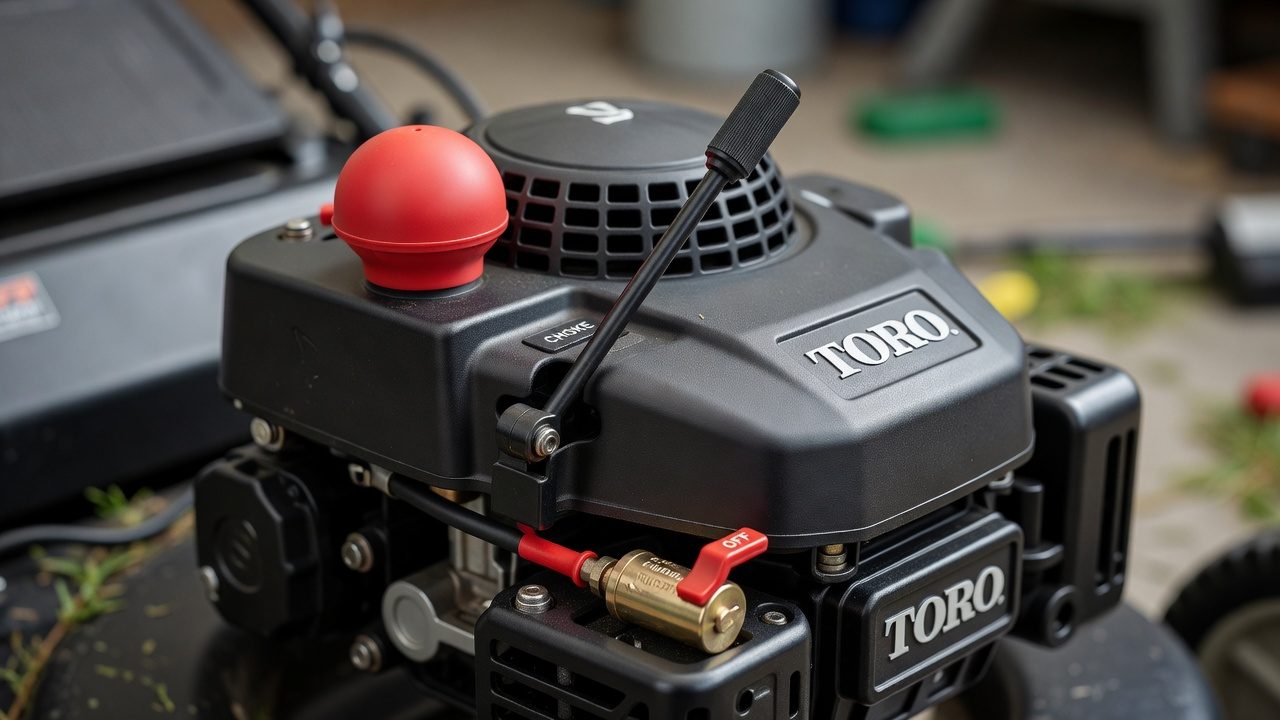
Before you pull the cord or turn the key, understanding which starting system your mower has will help you follow the correct steps:
- Engine type: Toro mowers use engines from various manufacturers. Briggs & Stratton and Honda engines have their own priming and choke procedures, which may differ slightly from Toro-branded engines.
- Primer bulb vs. choke: Some models have a manual primer bulb you press before starting. Others use a traditional choke lever. Many newer models combine both or use automatic choke systems that require minimal adjustment.
- Starter type: Pull-cord (recoil) starters are most common on consumer push mowers. Self-propelled or larger mowers may offer electric start with a key or button.
- Fuel valve: Many Toro mowers have a manual fuel shutoff valve. This must be turned on (open) before starting, or fuel cannot reach the engine.
- Engine temperature: Cold engines (first start of the season or after sitting overnight) require priming and full choke. Warm engines (already running or restarted shortly after shutdown) need little or no choke.
To identify which system your mower uses, locate your model number (usually on a label near the engine or on the deck) and check your owner’s manual. If you no longer have the manual, Toro’s website and other lawn equipment retailers often provide free downloads by model number.
Step-by-Step: Starting Your Toro Mower (Cold Start)
Follow this sequence for a cold engine, typically the first start of the season or after the mower has sat unused for several days:
- Prepare the mower. Move it to a flat, level outdoor surface away from obstacles, structures, and bystanders. Clear any debris from around the mower and the starting area.
- Check the fuel valve. If your model has a manual fuel valve (usually a small lever or knob on the fuel line), turn it to the on or open position. This allows fuel to flow to the carburetor.
- Prime the engine. Locate the primer bulb, a small rubber or plastic ball typically mounted on the side of the engine. Press it firmly 3 to 5 times until you see fuel fill the bulb or a small clear tube. Do not over-prime, as this can flood the carburetor.
- Set the choke. If your mower has a manual choke control (a lever or dial near the engine), move it to the full choke or start position, usually marked with a symbol or labeled “Choke” or “Start.” If the choke is automatic, you may skip this step or simply note its position.
- Engage the blade control bar. The blade control bar (also called the safety bail or dead-man switch) is the lever that runs from the engine or deck toward the handle. Hold it firmly against the handle with one hand. The mower will not start if this bar is not held in place.
- Pull the starter cord. With your other hand, grip the starter cord handle and pull it smoothly and steadily in one motion. Do not yank erratically or allow the cord to snap back uncontrolled. Most engines fire within one to three pulls on a cold start.
- Adjust the choke as the engine warms. Once the engine starts and begins to run, gradually move the choke lever toward the run or open position over 15 to 30 seconds. This prevents the engine from dying and allows it to warm up properly.
- Allow warm-up time. Let the mower idle for about one minute before beginning to mow. This helps the engine reach stable operating temperature.
Starting a Warm Engine or Restarting
If the engine has run recently or is already warm, the procedure is simpler:
- Ensure the blade control bar is held firmly against the handle.
- If the choke is in the start position, move it toward run before pulling the cord.
- Do not prime the bulb (or press it only once if the engine has been off for more than a few minutes).
- Pull the starter cord once or twice. A warm engine usually starts immediately.
Starting an Electric-Start Toro Mower
Some Toro models, particularly self-propelled or commercial-grade mowers, feature electric start: Before finalizing equipment decisions, refer to our comprehensive marshall stanmore iii vs harman kardon onyx studio 8 comparison.
- Ensure the fuel valve is open and the blade control bar is held against the handle.
- Insert the ignition key into the keyhole and turn it clockwise to the start position, or press the start button if your model has one.
- Hold the key or button for 2 to 3 seconds. The engine should fire and run.
- Once running, release the key and allow the engine to warm for a minute or so before mowing.
- If the engine does not start after 5 to 10 seconds of cranking, release the key, wait a few seconds, and try again. Continuous cranking can drain the battery.
Common Starting Variations by Mower Type
Push mowers: Standard push models typically use a pull-cord starter with a manual primer bulb and choke lever. These follow the cold-start sequence outlined above.
Self-propelled mowers: Self-propelled Toro mowers start the same way as push models but may have electric start, a larger engine, or an automatic transmission that requires you to disengage the drive before starting. Check your manual for transmission-specific instructions. For broader ecosystem context, read through our operational guide on dyson v8 cyclone vs bissell featherweight stick.
No-prime or automatic-choke models: Some newer Toro mowers feature automatic primer or choke systems that simplify the starting process. You may only need to hold the blade control bar and pull the cord without manual adjustments. Your owner’s manual will clarify whether your model has these features.
Troubleshooting: When a Guaranteed to Start Mower Won’t Start
If your mower does not start after following the correct procedure, check the following common causes: For troubleshooting and reliability insights, consult our in-depth bissell crosswave hydrosteam vs shark stainforce report.
- Old or stale fuel: Gasoline left in the mower over winter or for several months can gum up the carburetor and prevent starting. If you suspect old fuel, drain the tank and carburetor, then refill with fresh fuel. Run the mower briefly or use a carburetor cleaner to clear varnish.
- Dirty air filter: A clogged air filter restricts airflow and makes starting difficult. Remove the air filter cover and inspect the filter. If it appears dirty or clogged, clean or replace it according to your manual.
- Flooded engine: Excessive priming or pulling the cord many times without letting fuel drain can flood the carburetor. If you suspect flooding, turn off the fuel valve, wait 10 to 15 minutes for excess fuel to evaporate, then try starting again with minimal or no priming.
- Spark plug issues: A fouled or worn spark plug can prevent ignition. Consult your manual for the correct spark plug type and gap. If the plug appears black or wet, clean or replace it.
- Dead battery (electric-start models): If your mower uses electric start and the battery is depleted, the starter motor will not turn the engine. Recharge or replace the battery as needed.
- Fuel valve closed: Confirm that any manual fuel shutoff valve is in the open position. If closed, no fuel reaches the engine.
If your mower still does not start after checking these items, consult your owner’s manual or contact a qualified small-engine technician. Toro’s Guaranteed to Start warranty may cover service or repair if the mower fails to start under normal conditions and proper maintenance.
Essential Safety Reminders
- Always start outdoors in a well-ventilated area. Never start the mower inside a garage, shed, or enclosed space. Gasoline engines produce carbon monoxide, which is toxic.
- Start on flat, stable ground. Uneven terrain can cause the mower to tip or vibrate excessively during startup.
- Keep hands, feet, and long hair clear of the blade. Even though the blade control bar is held during starting, always maintain a safe distance from the cutting deck.
- Never start the mower while someone is nearby. Position yourself so that you control the mower fully before anyone else approaches.
- Do not pull the starter cord toward your body. Pull it to the side or downward to avoid injury if the cord snaps or the mower lurches.
- Let the engine cool before refueling. Hot engines and gasoline are a fire hazard.
When to Use Your Guarantee and Seek Professional Service
Toro’s Guaranteed to Start warranty is meant to give consumers confidence that their mower will start reliably when properly maintained and operated. If you follow the correct starting procedure, use fresh fuel, keep the air filter clean, and maintain the mower according to the manual, and the engine still fails to start within a few pulls, you may have a warranty claim.
Document what you have tried (e.g., priming, choke adjustment, fuel quality checks) and contact your local Toro dealer or authorized service center. Bring your model number and proof of purchase if available. Many dealers offer starting assistance or repair services under warranty if the mower meets the coverage terms.
For safety-sensitive repairs, such as carburetor cleaning, spark plug replacement, or fuel system work, consider having a qualified small-engine technician handle the service rather than attempting repairs yourself, especially if you are unfamiliar with small-engine mechanics.
Summary
Starting a Toro Guaranteed to Start lawn mower is straightforward when you follow the proper sequence: prepare the mower on flat ground, ensure the fuel valve is open, prime the engine with 3 to 5 bulb presses, set the choke to start, hold the blade control bar, and pull the starter cord smoothly. For warm engines, skip or reduce priming and move the choke toward run. Electric-start models simplify the process by replacing the pull cord with a key or button. If your mower does not start, check for common issues such as old fuel, a dirty air filter, or a flooded engine. Always consult your owner’s manual for model-specific instructions, and never hesitate to seek professional service if the starting problem persists. Proper maintenance and technique ensure reliable starts season after season.
Related Maintenance and Operating Guides
To keep your equipment running at peak operating efficiency, explore our related technical walkthroughs and maintenance tutorials:
- Consult our detailed breakdown on residential zero-turn lawn mower guide.
- Consult our detailed breakdown on heavy-duty chainsaw buyer guide.
Technical Standards and Compliance
Mechanical safety standards, operational tolerances, and protective gear guidelines align with benchmark specifications established by the American National Standards Institute (ANSI).









