

Quick Answer: Riding Lawn Mower Buying Guide Diagnostic & Solution
No single riding lawn mower is best for every buyer. The right choice depends on three variables: yard size (under 0.5 acre, 0.5–2 acres, or 2+ acres), terrain (flat vs. hilly), and budget (entry ~$1,500 / mid ~$3,000 / premium $5,000+). For most homeowners with 0.5–2 flat acres, a mid-range lawn tractor with a 42–54-inch cutting deck and a Kohler…

Pros
- Commercial-grade electric performance with instant torque and no gas engine maintenance.
- Large included battery package and fast charger improve runtime and turnaround time.
- Heavy-duty 54-inch fabricated deck is built for durability and wider coverage per pass.
- Comfort-focused operator features are better than many basic riding mowers in this class.
- Backed by a 4-year limited warranty for added purchase confidence.
Cons
- At 848.78 pounds, it is very heavy and will be difficult to move manually or transport without proper equipment.
- The large footprint, with dimensions of 76.77 x 73.23 x 56.3 inches, requires substantial storage space.
- The premium feature set and battery system may be more than many small-yard owners need.
Overview & Design: The Greenworks 80V 54" MaximusZ Zero Turn Riding Lawn Mower is a commercial-style electric mower built for large residential properties. Its 54-inch 10-gauge fabricated steel deck, zero-turn layout, and premium operator seat give it a serious, heavy-duty feel right away.
Performance & Key Features: This model is positioned as a 41HP gas-equivalent machine with instant torque, a constant 17,900 FPM blade speed, and SmartCut technology that adapts to changing grass conditions. The included battery kit with (2) 16.0Ah and (4) 6.0Ah batteries is designed to support up to 4+ acres per charge, while the 1.5kW fast charger helps reduce downtime.
Drawbacks & Considerations: The mower is extremely heavy at 848.78 pounds, so it is not easy to move or store in tight spaces. It is also a major investment and may be excessive for smaller yards or users who do not need the runtime and power of a large battery-electric zero-turn.
Verdict: This is a strong fit for homeowners with large lawns who want powerful, low-maintenance mowing performance and premium comfort features. Buyers who need a wide cutting deck, long runtime, and electric operation will likely get the most value from it.

Pros
- Brushless motor system delivers gas-equivalent power without emissions or excessive noise
- High-capacity battery kit enables cutting coverage of up to 4.4 acres per charge set
- Durable 10-gauge steel deck and constant high blade tip speed handle dense grass effectively
- Premium seating and lighting features support comfortable extended operation
- 4-year warranty provides strong protection for the investment
Cons
- Runtime tops out around 4.4 acres depending on conditions, requiring recharges for bigger properties
- Electric design depends on charging infrastructure and battery management rather than simple refueling
- Height adjustment is noted only basically without extensive position details in available specs
The Greenworks 60V MaximusZ Zero Turn Riding Lawn Mower is a commercial-grade electric machine built for large lawns. Its primary construction centers on a heavy-duty 60-inch 10-gauge fabricated steel deck that prioritizes durability and airflow, paired with premium comfort elements including an adjustable suspension seat with lumbar support and foldable armrests for a solid first impression of quality and user focus.
Performance shines through an intelligent brushless motor system offering power equivalent to a 31HP gas engine with zero emissions. Three high-torque brushless hub motors sustain a constant 17,900 FPM blade speed, while SmartCut Technology auto-adapts to prevent bogging in thick or wet grass. The complete kit supplies (2) 20.0Ah suitcase batteries plus (4) 8.0Ah batteries and a 1.5kW fast charger for up to 4.4 acres of cutting. Additional capabilities include a 4-in-1 deck for mulching, bagging, rear and side discharge, 300 lb towing capacity with front/rear hitch, dual LED headlights, and an LCD display.
Drawbacks and considerations include the practical need to recharge the battery set after maximum runtime, which can interrupt work on properties exceeding 4.4 acres. Being fully electric means reliance on power sources for recharging instead of fuel, and height adjustment is referenced only in basic terms without more granular position data in the specifications.
In verdict, the Greenworks 60V MaximusZ delivers the most value to homeowners and professionals managing medium-to-large properties who want quiet, emission-free commercial power, versatile cutting options, and the security of a 4-year warranty in a comfortable zero-turn package.

Pros
- Strong stated cutting capacity for large properties, with up to 4 acres per charge.
- Zero-turn design supports fast, precise mowing around obstacles.
- Uses battery power instead of gas, reducing maintenance-related chores and emissions.
- Includes six high-capacity batteries and a charger, so it is ready for use out of the box.
Cons
- Heavy at 720 pounds, which may make transport, storage, or maneuvering by hand difficult.
- Large dimensions require substantial garage or shed space.
- The high upfront cost may put it out of reach for buyers with smaller lawns or limited budgets.
Overview & Design: The EGO Power+ ZT5207L is a 52-inch electric riding lawn mower with a zero-turn radius, built for users who need efficient coverage on larger properties. Its black finish, substantial frame, and 720-pound weight reflect a serious, full-size riding mower designed for demanding residential mowing.
Performance & Key Features: EGO says Peak Power+ technology combines up to six 56V ARC Lithium batteries, and the mower is rated at a 25 HP-equivalent output. The 52-inch deck and zero-turn steering should help reduce mowing time and improve control around landscaping, while the included six 56V 12.0Ah batteries are stated to support up to 4 acres per charge.
Drawbacks & Considerations: This model is large and heavy, so it will not suit every storage space or every user. Its premium positioning also means buyers should be confident they need this much capacity, since smaller yards may not justify the size, weight, or cost.
Verdict: The ZT5207L is best for homeowners with expansive lawns who want battery-powered convenience and zero-turn efficiency in one machine. It is a compelling option if you value gas-like performance, broad deck coverage, and compatibility with EGO's 56V battery ecosystem.

Pros
- Offers quiet, emission-free electric operation with power matching traditional 22 HP gas mowers.
- Includes four high-capacity 56V 10.0Ah batteries for up to 2 acres of runtime right out of the box.
- Customizable LCD interface and multiple driving modes enhance user control and ride comfort.
- Versatile 10-position cutting height and 3-in-1 deck options provide flexible lawn finishing.
- Fast two-hour full recharge capability supports productive multi-session mowing days.
Cons
- Maximum single-charge coverage is limited to about 2 acres without purchasing additional batteries for bigger properties.
- Requires access to a power outlet for recharging, which may interrupt workflow on very large or remote lawns.
- Battery management and storage add extra steps compared to simple gas-powered alternatives.
The EGO Power+ ZT4204L is a premium electric zero-turn riding lawn mower built for homeowners seeking a clean alternative to gas models. It features a robust 42-inch stamped steel deck and includes four 56V 10.0Ah ARC Lithium batteries plus a charger, delivering an immediate impression of high-quality engineering focused on power and convenience.
In real-world use, this mower matches the performance of a 22 horsepower gas unit while reaching speeds up to 8 MPH. The zero-turn radius combined with three selectable driving modes via the LCD interface allows smooth navigation and efficient cutting of up to 2 acres per charge. Users can fine-tune the cut across 10 height positions from 1.5 to 4.5 inches and choose between mulching, bagging, or side discharge for complete lawn care flexibility. Full recharges take roughly two hours with the included Z6 charger.
Potential drawbacks include the 2-acre limit on the stock battery set, meaning larger properties will need extra batteries for uninterrupted operation. As a fully electric system, it also depends on regular charging access rather than quick refueling, and battery handling requires more attention than traditional gas mowers.
Overall, the EGO Power+ ZT4204L is an excellent choice for environmentally conscious homeowners with lawns up to a few acres who value quiet operation, low maintenance, and precise control. Those with extensive grounds should plan for additional battery capacity to maximize its benefits.
What Type of Riding Mower Do You Actually Need?
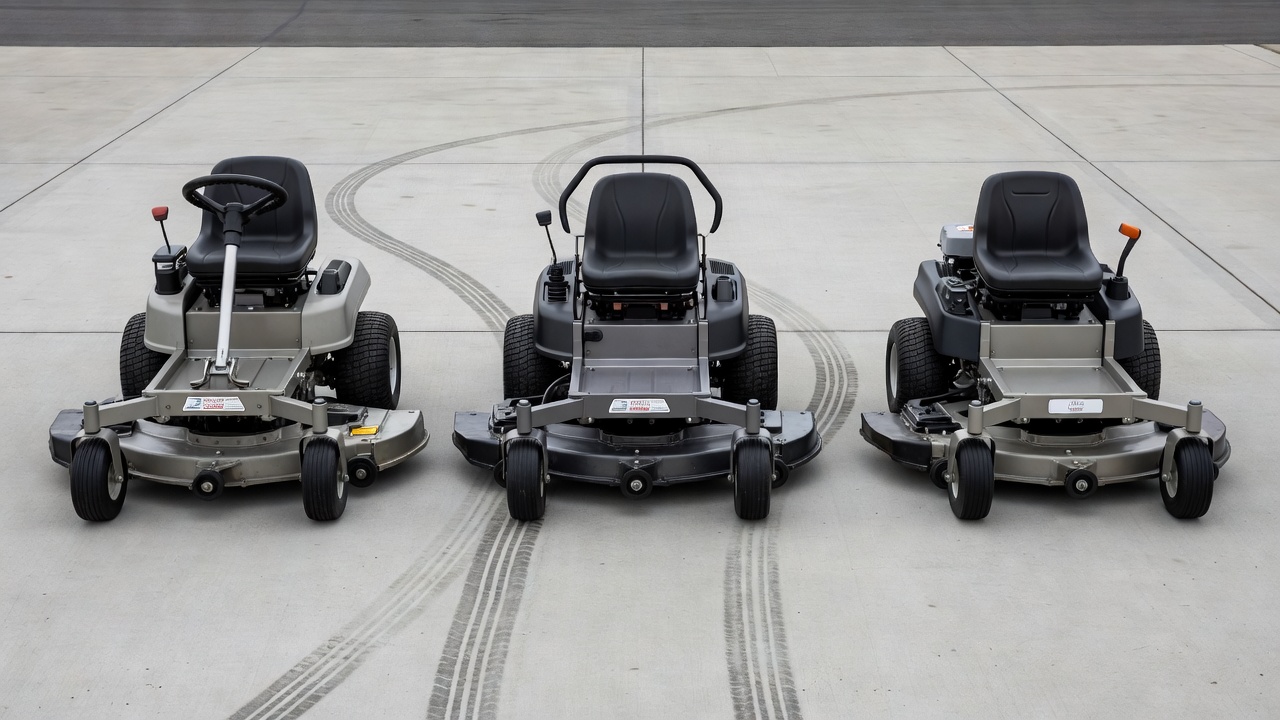
The term “riding mower” covers three fundamentally different machine categories. Understanding which type matches your property is the single most important decision — more important than brand or engine choice.
Lawn Tractors
Lawn tractors use a traditional steering wheel and front-wheel steering geometry. The cutting deck mounts mid-frame under the operator. They excel on flat to gently rolling terrain of 0.5 to 3 acres. Most accept attachments for snow removal, hauling, and aerating, making them versatile year-round tools. Turning radius typically ranges from 16 to 22 inches, so they need more room to maneuver around obstacles than zero-turn models. For complementary field maintenance guidelines, examine our breakdown of jbl partybox club 120 vs sony srs xv500.
Zero-Turn Mowers
Zero-turn mowers use dual-lever or steering-wheel controls that drive each rear wheel independently. This allows the machine to pivot 360 degrees within its own footprint — effectively a zero-inch turning radius. They cut mowing time by 30–50% on open, flat acreage because they eliminate the need to back up and re-align at the end of each pass. However, they are less stable on slopes, offer fewer attachment options, and have a steeper learning curve for new operators. For complementary field maintenance guidelines, examine our breakdown of jbl partybox club 120 vs sony srs xv500.
Rear-Engine Riding Mowers
Rear-engine riders place the engine behind the operator and use a smaller cutting deck (typically 30–34 inches). They are the most compact riding mowers, often fitting through standard garden gates. Their low center of gravity and rear-wheel drive provide better traction on moderate slopes than front-steer tractors. They suit yards under 1 acre with tight corners, gates, or moderate inclines where a full-size tractor or zero-turn would be impractical. To evaluate matched hardware tolerances, consult our detailed overview of z890 vs x870e motherboard.
Quick Comparison
| Feature | Lawn Tractor | Zero-Turn | Rear-Engine Rider |
|---|---|---|---|
| Best for | 0.5–3 acres, flat to rolling, multi-task | 1–5+ acres, flat, open, speed priority | Under 1 acre, tight spaces, moderate slopes |
| Turning radius | 16–22 inches | 0 inches (pivots in place) | 28–36 inches |
| Slope capability | Up to ~15° (varies by model) | Generally limited to ~10° | Up to ~20° (best of the three) |
| Attachments | Wide range (snow, cart, aerator) | Limited (mostly baggers) | Minimal |
| Learning curve | Low (steering wheel) | Moderate (dual levers) | Low (steering wheel) |
Is a zero-turn mower harder to operate than a lawn tractor? Most operators become comfortable with dual-lever controls in 15–30 minutes of practice. Steering-wheel zero-turn models reduce the learning curve further but may sacrifice some precision.
Can zero-turn mowers handle hills and slopes safely? Manufacturer guidelines typically restrict zero-turn use to slopes of 10–15 degrees maximum. On steeper grades, the risk of rollover or loss of traction increases significantly. Lawn tractors with rear-wheel drive or rear-engine riders are safer choices for sloped terrain.
Which mower type works best for small yards under half an acre? A rear-engine rider or a compact lawn tractor (38–42 inch deck) is usually sufficient. Zero-turn mowers offer little time savings on very small properties and their larger footprint can make storage difficult. To evaluate matched hardware tolerances, consult our detailed overview of z890 vs x870e motherboard.
How Yard Size Determines the Best Riding Mower for You
Acreage drives three critical specifications: cutting deck width, engine horsepower, and mower type. Matching these to your property size prevents under-buying (too slow) or over-buying (wasted money, storage issues).
Under 0.5 Acre
- Recommended deck: 30–42 inches
- Engine: 12–18 HP (single-cylinder adequate)
- Type: Rear-engine rider or compact lawn tractor
- Why: Maneuverability through gates and around landscaping matters more than raw speed.
0.5 to 2 Acres
- Recommended deck: 42–54 inches
- Engine: 18–24 HP (V-twin preferred for smoother power)
- Type: Lawn tractor (versatility) or zero-turn (speed)
- Why: This is the sweet spot where a mid-range lawn tractor balances cost, capability, and attachment flexibility.
2 to 4 Acres
- Recommended deck: 50–60 inches
- Engine: 22–26+ HP (V-twin, commercial-grade filtration)
- Type: Zero-turn strongly preferred; heavy-duty lawn tractor as alternative
- Why: Time savings from zero-turn maneuverability compound over large areas. Larger decks reduce passes but require adequate engine torque.
4+ Acres
- Recommended deck: 60–72 inches
- Engine: 25+ HP, often commercial-grade (Kawasaki FX, Kohler Command Pro)
- Type: Commercial or residential-commercial zero-turn
- Why: Durability and serviceability become primary concerns. Fabricated decks and hydrostatic transmissions rated for continuous duty are standard.
Does a larger deck always mean faster mowing? Not necessarily. Effective mowing speed depends on the overlap between passes, terrain roughness, and whether the engine can maintain blade tip speed under load. A 60-inch deck on an underpowered engine will bog down in thick grass, negating the width advantage. Match deck width to engine torque. When planning workspace deployment, consider the engineering criteria outlined in our marshall stanmore iii vs harman kardon onyx studio 8 guide.
At what yard size does a zero-turn mower start paying off over a lawn tractor? Most owners report noticeable time savings around 1.5–2 acres of mostly open, flat ground. Below that, the maneuverability advantage is offset by the learning curve and reduced versatility.
Key Specs to Compare When Buying a Riding Lawn Mower
Once you’ve narrowed the mower type by yard size and terrain, use these specifications to compare models within that category. For additional operational safety benchmarks, see our published testing notes on dyson v8 cyclone vs bissell featherweight stick.
Engine Brand and Configuration
The three dominant engine suppliers — Briggs & Stratton, Kawasaki, and Kohler — each offer tiered product lines from residential to commercial grade.
- Briggs & Stratton: Widely used across entry and mid-range models. The Vanguard commercial line competes directly with Kawasaki and Kohler premium engines. Parts availability is extensive.
- Kawasaki: The FR, FS, and FX series span residential to commercial. The FX series is widely regarded in the industry for durability in continuous-duty applications.
- Kohler: The 7000, Confidant, and Command Pro series cover similar tiers. Command Pro engines are a common OEM choice for commercial zero-turns.
What engine brands are most reliable in riding lawn mowers? In the mid-to-premium segment, Kawasaki FX and Kohler Command Pro engines have long track records in commercial fleets. Briggs Vanguard holds comparable standing. For residential use, any current V-twin from these three brands with proper maintenance will typically exceed the useful life of the mower frame. Single-cylinder engines are adequate for small yards but run hotter and vibrate more. To compare alternative configurations, check our hands-on review of bissell crosswave hydrosteam vs shark stainforce.
Transmission Type
- Hydrostatic: Uses hydraulic fluid to transfer power from engine to wheels. Infinitely variable speed, no shifting, smooth direction changes. Standard on virtually all modern riding mowers.
- Automatic / CVT: Belt-driven variable pulley systems. Less common on current models; generally less durable under heavy loads than hydrostatic units.
- Gear-driven: Legacy design requiring clutch/shift stops. Rare on new residential mowers.
For hills, look for a hydrostatic transmission with a differential lock or limited-slip feature — this prevents one wheel from spinning freely when traction is lost.
Cutting Deck Construction
- Stamped deck: Formed from a single sheet of steel. Lighter, less expensive, adequate for residential use. Thinner steel can flex under heavy impact.
- Fabricated deck: Welded from heavier plate steel (typically 10–12 gauge). More rigid, resists warping, handles debris better. Standard on commercial and higher-end residential models.
How does cutting deck material affect durability? Fabricated decks generally outlast stamped decks in heavy residential or commercial use because they resist cracking at stress points and maintain flatness for consistent cut quality. For a typical homeowner mowing 1–2 acres weekly, a stamped deck with reinforced edges may last 8–12 years; a fabricated deck can exceed 15.
Turning Radius
Measured as the diameter of the smallest circle the mower can cut. Lawn tractors: 16–22 inches. Zero-turns: effectively zero. Rear-engine riders: 28–36 inches. Smaller radius reduces trimming time around trees, beds, and fences.
Comfort and Ergonomics
- Seat suspension (spring vs. air-ride vs. isolated)
- Adjustable steering column and lap bar height
- Cup holder, USB charging, tool storage — convenience features that matter on 2+ hour mowing sessions
- Step-through frame (lawn tractors) vs. high step-over (zero-turns) — affects ease of mounting
What features matter most for mowing on hills or uneven terrain? Rear-wheel drive (or four-wheel drive on select tractors), low center of gravity, wide tire footprint, differential lock, and a roll-over protection structure (ROPS) with seat belt. Zero-turn mowers generally lack ROPS as standard on residential models.
How Much Should You Spend? Riding Lawn Mower Price Tiers Explained
Price correlates with engine grade, deck fabrication, transmission durability, and dealer support tier. The ranges below reflect typical U.S. retail pricing for new equipment; actual prices vary by region, dealer, and seasonal promotions.
Entry Level: Approximately $1,500–$2,200
- Lawn tractors with 38–42 inch stamped decks
- Single-cylinder engines (13–18 HP)
- Basic hydrostatic transmission, plastic hood/fenders
- 1–2 year limited warranty, limited dealer service network
- Best for: Flat yards under 1 acre, light use, budget-constrained buyers
Mid-Range: Approximately $2,500–$4,000
- Lawn tractors (42–54 inch decks) and entry zero-turns (42–50 inch)
- V-twin engines (18–24 HP) from Briggs, Kawasaki FR/FS, Kohler 7000/Confidant
- Heavy-duty hydrostatic transmissions (e.g., Hydro-Gear EZT or ZT-2800)
- Fabricated decks on zero-turns; reinforced stamped on tractors
- 3–4 year limited warranty, broader dealer network
- Best for: 0.5–3 acres, primary mower for homeowner, attachment use expected
Premium: Approximately $4,500–$7,000+
- Residential-commercial zero-turns (50–60+ inch fabricated decks)
- Commercial-grade engines (Kawasaki FX, Kohler Command Pro, Briggs Vanguard)
- Commercial hydrostatic transmissions (Hydro-Gear ZT-3400/3600 or Parker)
- Full tubular frame, isolated suspension seats, ROPS standard
- 4–5 year limited warranty, dedicated commercial dealer support
- Best for: 2+ acres, heavy weekly use, sloped terrain, owners who keep equipment 15+ years
Are premium riding mowers over $5,000 worth it for residential use? If you mow 3+ acres weekly, have significant slopes, or plan to keep the mower for 15–20 years, the upgraded frame, transmission, and engine durability often justify the cost. For 1–2 acres on flat ground, a well-chosen mid-range model typically delivers better value per mowing hour.
Is it better to buy a new or used riding lawn mower? New provides warranty, known history, and current safety features (ROPS, operator presence controls). Used can save 30–50% but requires mechanical inspection — check hour meter, deck spindle play, hydrostatic fluid condition, and tire wear. A used commercial zero-turn with 800 hours may outlast a new entry-level tractor.
What should you look for when buying a used riding mower? Compression test (if possible), hydrostatic operation in forward/reverse at operating temperature, deck engagement smoothness, frame cracks near spindle mounts, and maintenance records. Verify parts availability for the specific model before purchasing.
Gas vs. Electric Riding Lawn Mowers: Which Is Better?
Battery-electric riding mowers have entered the residential market from brands including Ryobi, EGO, Greenworks, and Cub Cadet. They address noise, emissions, and maintenance concerns but come with runtime and upfront cost trade-offs.</p
Runtime and Power
Current residential electric riders typically carry 3–6 kWh battery packs, delivering 1–2.5 acres of mowing per charge depending on grass density, terrain, and deck size. Cutting power is comparable to 18–22 HP gas engines in sustained conditions, but peak torque is instantaneous — an advantage in thick grass. Recharge time ranges from 4–10 hours on standard 120V; some models support 240V fast charging.
Maintenance Differences</n
- Gas: Oil changes, air filter, spark plug, fuel stabilizer, carburetor cleaning, belt replacement.
- Electric: Blade sharpening, tire pressure, battery health monitoring, deck cleaning. No fluids, filters, or ignition components.
Electric mowers eliminate winterization steps and stale-fuel issues. Battery degradation over 5–8 years is the primary long-term cost; replacement packs can approach 30–40% of mower MSRP.
Cost Comparison
Electric riders currently carry a $1,000–$2,500 premium over comparable gas models. Operating cost per acre favors electric where electricity rates are low and gas prices high, but payback periods often exceed 5–7 years for typical residential acreage.
Environmental Considerations
Electric mowers produce zero tailpipe emissions and significantly lower noise (typically 85–90 dB vs. 95–100 dB for gas). Lifecycle emissions depend on grid mix. Gas mowers with modern overhead-valve engines and catalytic converters (on some models) have reduced emissions versus older designs but still emit CO2, NOx, and hydrocarbons.
Are electric riding mowers powerful enough for large yards? For properties over 2 acres, current battery capacity usually requires mid-mow recharging or a second battery pack. They are best suited to 0.5–2 acre properties where a single charge completes the job. Commercial-grade electric zero-turns with swappable battery systems exist but remain rare in residential channels.
Which Riding Mower Brands Are Most Reliable?
Brand reputation in this category reflects three factors: engineering consistency, dealer network depth, and parts availability for 10+ year-old models. No brand is immune to model-specific issues, but the following patterns hold across the industry.
Husqvarna
Owns a broad portfolio spanning entry tractors to commercial zero-turns. Known for early adoption of fabricated decks on mid-range models and strong hydrostatic transmission specs. Dealer network is extensive but varies by region; some areas rely on big-box retail fulfillment with limited service support.
John Deere
Exclusive dealer network provides the most consistent pre-sale consultation and post-sale service in the industry. Residential models (S100, X300, X500 series) are built on dedicated chassis, not shared with other brands. Warranty claims process is generally straightforward. Premium pricing reflects dealer overhead and brand equity.
Cub Cadet
Strong value proposition in the mid-range zero-turn segment. The Ultima and XT1/XT2 lines use Hydro-Gear transmissions and fabricated decks at competitive price points. Dealer network is smaller than Deere or Husqvarna; big-box retail models may have different component specs than dealer-channel equivalents.
Craftsman
Currently manufactured by MTD (also produces Cub Cadet, Troy-Bilt, Yard Machines). Entry and mid-range tractors share platforms with sister brands. Warranty is typically 3 years limited. Parts availability is good due to MTD’s scale, but dealer service depth is thinner than Deere or dedicated outdoor power equipment dealers.
Toro
TimeCutter zero-turn line is a volume leader in the residential zero-turn category. MyRIDE suspension system on select models is a notable comfort feature. Dealer network is solid in many regions. Toro also owns Exmark (commercial), and engineering trickles down between brands.
Ariens
Known for heavy-gauge fabricated decks and robust frame construction across the lineup. The Apex and Zenith zero-turn lines use commercial-grade components at near-mid-range prices. Dealer network is smaller but tends to be independently owned outdoor power specialists with strong service orientation.</p
Which riding mower brands have the best parts availability and long-term support? John Deere and Husqvarna generally lead in parts availability for models 15+ years old due to dedicated dealer networks and centralized parts distribution. MTD brands (Cub Cadet, Craftsman, Troy-Bilt) benefit from shared platform parts across high production volumes. Toro and Ariens also maintain good parts depth, particularly for zero-turn models. Before purchasing, confirm that your local dealer stocks or can quickly obtain common wear items (spindles, belts, pulleys, hydrostatic filters) for the specific model.
Key Technical Factors to Consider Before Buying
Use this decision tree to narrow the field before you visit a dealer or compare specs online.
Step 1: Measure Your Yard and Assess Terrain
- Walk the property with a measuring wheel or use satellite imagery (Google Earth, county GIS) to calculate mowable acreage.
- Identify slopes: use a phone inclinometer app or a 4-foot level with a block. Slopes over 15° (27% grade) rule out most zero-turns.
- Note gate widths, tight corners, and obstacles (trees, beds, irrigation heads).
Step 2: Match Mower Type to Conditions
| If your yard is… | Start with this type |
|---|---|
| Under 0.5 acre, tight gates, moderate slopes | Rear-engine rider (30–34″ deck) |
| 0.5–2 acres, mostly flat, want attachments | Lawn tractor (42–54″ deck) |
| 1.5–4 acres, flat, open, speed priority | Zero-turn (48–60″ deck) |
| 2+ acres, slopes 10–20°, need attachments | Lawn tractor with rear-wheel drive + diff lock |
| 0.5–2 acres, flat, low noise/emissions priority | Battery-electric rider (42–52″ deck) |
Step 3: Set Budget and Engine Tier
- Under $2,200: Entry lawn tractor or rear-engine rider. Single-cylinder engine, stamped deck, 1–2 year warranty.
- $2,500–$4,000: Mid-range tractor or entry zero-turn. V-twin engine, fabricated deck (zero-turn), 3–4 year warranty.
- $4,500+: Premium zero-turn or heavy-duty tractor. Commercial-grade engine/transmission, ROPS, 4–5 year warranty.
- Add $1,000–$2,500: For electric equivalent in any tier.
Before You Buy
- Test drive. Most dealers allow 10–15 minute demos. Check seat comfort, control reach, visibility to deck edges, and ease of deck engagement.
- Ask about service. Does the dealer service what they sell? What’s the typical wait for warranty work in May?
- Time your purchase. Best pricing typically occurs late fall (October–November) when dealers clear current-year inventory, or early spring (February–March) during pre-season promotions. Avoid peak May–June demand.
- Read the manual first. Safety interlocks, slope limits, and maintenance intervals vary by model. The operator’s manual is the authoritative source for your specific machine.
Final Considerations
The “best” riding lawn mower is the one that matches your acreage, terrain, and budget without forcing compromises on safety or longevity. A mid-range lawn tractor with a V-twin engine and fabricated deck covers the widest range of homeowner needs. Zero-turn mowers earn their keep on large, flat properties where time savings compound. Rear-engine riders solve the small-yard, tight-access, moderate-slope niche that other types serve poorly. Electric riders are a viable choice for noise-sensitive or emissions-conscious buyers on 0.5–2 acre lots, provided the upfront premium fits your calculus.
Whichever category you choose, buy from a dealer who services what they sell, register the warranty immediately, and follow the break-in and maintenance schedule in the operator’s manual. A $3,000 mower maintained per spec will outlast a $5,000 mower that isn’t.
For more hands-on benchmarks and buying recommendations, consult our guides on heavy-duty chainsaw buyer guide, as well as high-CFM commercial leaf blower guide.
Mechanical safety standards, operational tolerances, and protective gear guidelines align with benchmark specifications established by the American National Standards Institute (ANSI).









