

Craftsman zero-turn lawn mowers are built by MTD, a major outdoor power equipment manufacturer that also produces machines for Cub Cadet and Troy-Bilt. The Craftsman brand itself is owned by Stanley Black & Decker, which purchased it from Sears Holdings in 2017. In 2021, Stanley Black & Decker acquired MTD, bringing the primary manufacturer of Craftsman zero-turns under the same corporate umbrella as the brand. Sears continues to sell Craftsman products under a licensing arrangement but no longer owns the brand. Earlier Craftsman mowers were built by other manufacturers, including Husqvarna and its predecessor AYP, so the factory behind a specific mower depends on its age and model line.
The Short Answer: Craftsman Is a Brand, Not a Factory
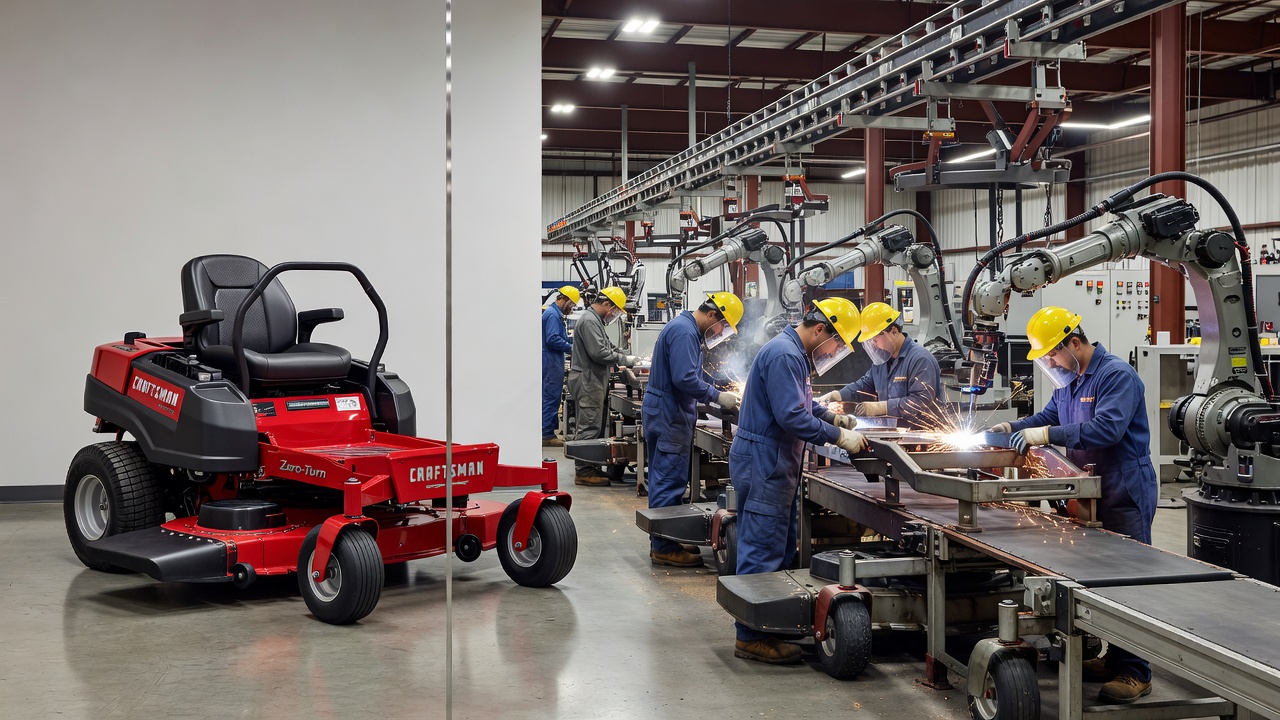
When you buy a Craftsman zero-turn mower, you are purchasing a product branded by Stanley Black & Decker but assembled by a contract manufacturer. For current zero-turn models, that manufacturer is MTD. This arrangement—where a brand owner contracts production to a specialist factory—is standard across the lawn and garden industry. The Craftsman name on the hood tells you who stands behind the warranty and design specifications, not which factory welded the frame or stamped the deck.
Stanley Black & Decker has owned the Craftsman brand since 2017, when it acquired the trademark and associated assets from Sears Holdings. Sears retained a license to keep selling Craftsman products in its stores and online, which is why you still see the brand at Sears today. The actual production of zero-turn mowers, however, has long been outsourced. MTD has been the primary contract manufacturer for Craftsman zero-turns for many model years, and since Stanley Black & Decker’s 2021 acquisition of MTD, the brand and its main builder are now sister companies within the same corporate group.
Brand Ownership vs. Manufacturing: Why the Distinction Matters
In the outdoor power equipment industry, the company whose name appears on the product is rarely the company that owns the factory where it is built. This model, known as contract manufacturing or original equipment manufacturing (OEM), allows brands to focus on design, marketing, distribution, and customer support while leveraging the specialized production capacity of large-scale manufacturers. For broader ecosystem context, read through our operational guide on jbl partybox club 120 vs sony srs xv500.

Pros
- Powerful 80V brushless motor delivers 32HP gas-equivalent performance with quiet fume-free operation and no engine maintenance.
- Complete kit includes four 6.0Ah batteries and 600W charger for substantial runtime up to 1.5 acres.
- SmartCut technology and 42-inch heavy-duty steel deck ensure consistent cuts without bogging in tough conditions.
- Versatile towing up to 350 lbs and optional cargo hauling plus comfort features like high-back seat and LED lights.
- Strong 4-year limited warranty and full compatibility with the Greenworks 80V tool ecosystem.
Cons
- Rear utility cargo bed for 200 lb hauling is sold separately and not included in the kit.
- Runtime of up to 1.5 acres varies with conditions and may require recharging or battery swaps on larger properties.
- As a fully cordless model continuous operation depends on battery levels unlike gas engines with unlimited runtime.
The Greenworks 80V 42" CrossoverT Cordless Riding Lawn Tractor is a ready-to-mow zero-emission tractor designed for homeowners managing medium to large lawns. It features a reinforced 42-inch stamped steel deck of 12-gauge construction along with premium comfort elements such as a high-back padded seat with foldable armrests. The overall build emphasizes durability and user convenience right out of the box with the included battery and charger set.
Performance centers on the 80V TruBrushless motor that provides 32HP gas-equivalent power with instant torque and quiet fume-free operation. SmartCut technology senses grass conditions and automatically adjusts power to maintain a consistent cut even in tall thick or wet areas. The four 6.0Ah batteries support runtime for up to 1.5 acres depending on conditions while dual LED headlights and a 7-position deck height range from 1.5" to 4.5" add practicality. Front and rear attachments further allow towing up to 350 lbs for added yard utility.
Key considerations include that the rear utility storage bin capable of hauling 200 lbs is sold separately so full cargo functionality requires an extra purchase. Runtime remains condition-dependent and may fall short for properties significantly larger than 1.5 acres without using the 600W charger or swapping batteries. The cordless design prioritizes ease and low maintenance but trades off the continuous runtime of traditional gas models.
This tractor delivers strong value for eco-conscious owners of residential properties who want gas-like power without the emissions noise or upkeep. It suits those who already use or plan to expand into the Greenworks 80V family of tools and who appreciate the 4-year limited warranty. Users with exceptionally large or commercial-scale lawns should evaluate battery logistics carefully before purchase.

Pros
- Delivers strong 21 horsepower equivalent power comparable to gas riding mowers.
- Provides up to 1.5 acres of runtime on a full charge with the six included batteries.
- Features low-maintenance dual brushless motors without belts for greater durability.
- Offers versatile 12-position cutting height adjustment from 1.5 to 4.5 inches.
- Includes digital controls for blade settings, drive speeds, and cruise control.
Cons
- Limited to 1.5 acres of cutting per charge without purchasing additional batteries for bigger lawns.
- Requires recharging time for the six 56V batteries after each use session.
- Relies solely on battery power with no hybrid or gas backup option for extended operation.
The EGO Power+ TR4204 is a cordless electric riding lawn mower built as a modern tractor alternative for residential use. It features a robust 42-inch stamped steel deck and arrives ready to go with six 56V 6.0Ah batteries plus a charger, creating an immediate impression of convenience and solid construction free from gas engine complexity.
Performance shines through its equivalent 21 horsepower output and top speed of 6 MPH, allowing efficient coverage of up to 1.5 acres on a single charge. Dual brushless cutting motors operate without belts for added durability and less upkeep, while the digital display lets users select three blade settings, three drive speeds, and cruise control. The 12 adjustable heights ranging from 1.5 to 4.5 inches combined with anti-scalp wheels deliver precise results across varied terrain.
Drawbacks center on battery dependency, as larger properties beyond 1.5 acres require extra batteries and recharging intervals can interrupt workflow. The fully electric design eliminates fuel storage needs but demands access to power sources between sessions.
This mower suits homeowners with medium to large yards who value quiet, emission-free operation and reduced maintenance. Those seeking expandable battery capacity for bigger areas will find the EGO Power+ TR4204 a strong long-term investment in cordless lawn care.
Pros
- High-efficiency brushless motors maximize power output and durability over traditional motors
- Up to 2 acres runtime with three included 10.0 Ah batteries supports substantial mowing sessions
- Zero-emission operation with gas-equivalent 20 HP power for quieter environmentally friendly use
- Six-port auto-switchover battery system provides flexible extended runtime options
- Durable 42-inch steel deck plus included mulch and towing kits add immediate functionality
Cons
- Runtime is limited to approximately 70 minutes or 2 acres which may require recharging for larger properties
- Fully battery-dependent design means performance relies on charge levels and spare battery availability
- 42-inch deck size may require more passes on expansive lawns compared to wider commercial models
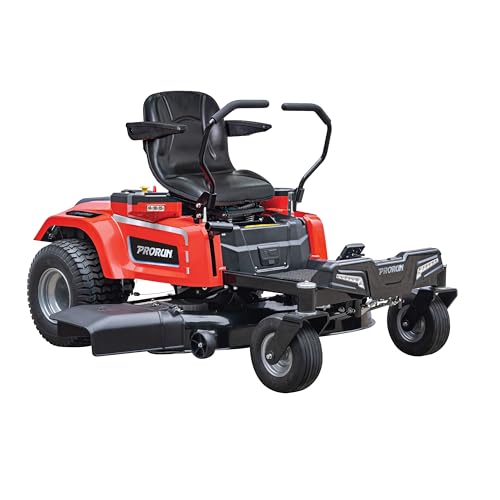
The PRORUN PZT60V42 is a fully electric 60V zero-turn riding lawn mower built for residential and light commercial use. Its primary design centers on a robust 42-inch 14-gauge stamped steel twin blade deck powered by direct-drive brushless motors, giving an immediate impression of solid construction and modern battery-focused engineering. The mower arrives complete with three 10.0 Ah batteries, a charger, mulch kit, and towing kit for ready-to-work versatility.
In performance terms, four high-efficiency brushless motors deliver power equivalent to a 20 HP gas engine while producing zero emissions. The system supports up to 2.0 acres or 70 minutes of runtime, and six battery ports with auto switchover intelligently manage all PRORUN 60V battery sizes for continuous operation. A washout port on the steel deck further simplifies post-mow maintenance during real-world sessions.
Potential drawbacks include the finite 70-minute runtime window which can limit coverage on larger properties without spare batteries or recharge breaks. As a fully electric model, it also depends entirely on battery charge levels rather than continuous fuel refills, and the 42-inch deck width may demand extra passes compared with wider traditional options.
Overall the PRORUN PZT60V42 offers strong value for homeowners and small-property managers who want gas-like cutting power without emissions or noise. Those with medium-sized lawns seeking quiet efficient zero-turn performance and included accessories will benefit most from this electric mower.

Pros
- Strong 24HP FR730 engine power for demanding cutting conditions
- Wide 54-inch FAB deck reduces total mowing time
- Zero turn design delivers excellent maneuverability
- Fabricated deck supports durable everyday operation
Cons
- Sparse details beyond engine and deck leave other features unspecified
- Gas-powered FR730 engine needs regular fuel and maintenance
- Large 54-inch deck size may feel oversized on compact properties
The Husqvarna Z254F is a zero turn mower from the established Husqvarna brand in the riding lawn mowers category. It centers on a solid build that pairs a 24HP 726cc FR730 engine with a 54-inch FAB deck for straightforward residential grass care.
Performance stems directly from the listed specifications. The FR730 engine delivers the horsepower needed for steady operation across typical lawns while the wide FAB deck completes passes efficiently. Zero turn handling improves control in real yard layouts based on the model design.
Considerations arise from the limited data available. Secondary elements such as comfort features fuel capacity or extras receive no mention and the gas engine format involves routine upkeep. The large deck suits open areas better than confined spaces.
The Husqvarna Z254F provides the most value for owners of medium or large properties who want reliable engine power and a broad cutting width. Users with smaller lots or those seeking extensive accessory options should weigh the core specs carefully before purchase.
MTD is one of the largest such manufacturers in North America. It operates multiple factories and produces riding mowers, zero-turns, walk-behinds, and snow throwers under its own brands—Cub Cadet and Troy-Bilt—while also building equipment for other labels. When MTD builds a zero-turn for Craftsman, it follows Craftsman’s specifications for features, styling, and price point. The resulting machine may share a chassis, drivetrain, or deck design with a Cub Cadet or Troy-Bilt model at a similar price tier, but the final configuration, controls, and cosmetic details are tailored to the Craftsman brand. For broader ecosystem context, read through our operational guide on jbl partybox club 120 vs sony srs xv500.
This shared-manufacturing approach is why two mowers from different brands can look similar underneath. It does not mean they are identical. Each brand specifies its own component selections, quality thresholds, and feature sets. A Craftsman zero-turn and a Cub Cadet zero-turn built on the same platform may have different engines, deck constructions, control layouts, and warranty terms. For troubleshooting and reliability insights, consult our in-depth z890 vs x870e motherboard report.
A Short History: From Sears to Stanley Black & Decker
The Craftsman brand was created by Sears in 1927, initially for hand tools. Over the decades it expanded into lawn and garden equipment, becoming one of the most recognized names in American garages. For most of its history, Sears both owned the brand and controlled its distribution through Sears catalogs and retail stores. The actual manufacturing was always outsourced to various suppliers.
In 2017, Stanley Black & Decker purchased the Craftsman brand from Sears Holdings for approximately $900 million. The deal gave Stanley Black & Decker full ownership of the trademark and the right to sell Craftsman products through any channel—home centers, mass merchants, online retailers, and independent dealers. Sears negotiated a long-term license to continue selling Craftsman merchandise, which is why the brand remains on Sears shelves today. For troubleshooting and reliability insights, consult our in-depth z890 vs x870e motherboard report.
Four years later, in 2021, Stanley Black & Decker acquired MTD. This acquisition brought the company that had been building many Craftsman zero-turn mowers into the same corporate family as the brand itself. The move gave Stanley Black & Decker greater control over product development timelines, quality oversight, and supply-chain coordination for the Craftsman outdoor power equipment line.
Who Builds Craftsman Zero-Turn Mowers?
MTD is the primary contract manufacturer for current Craftsman zero-turn mowers. MTD’s production facilities in the United States—including plants in Ohio, Tennessee, and Mississippi—assemble the frames, decks, and drivetrains, then install engines, transmissions, and controls to the specifications provided by Stanley Black & Decker’s product team. Readers comparing setup options can review our technical analysis on marshall stanmore iii vs harman kardon onyx studio 8.
MTD also manufactures zero-turn mowers for its own Cub Cadet and Troy-Bilt brands, as well as for other private-label programs. This scale allows MTD to invest in automated welding, powder-coating lines, and robotic assembly cells that would be uneconomical for a smaller brand to maintain on its own.
Historically, Craftsman lawn equipment has been built by several different manufacturers. In the 1990s and 2000s, many Craftsman riding mowers and early zero-turns were produced by AYP (American Yard Products), which was later acquired by Husqvarna. Some compact tractors and garden tractors carried the Craftsman name but were built by other partners. Because of this varied history, a Craftsman zero-turn from 2005 may have a completely different pedigree than one from 2023. The model and serial number are the only reliable way to determine the actual manufacturer of a specific unit.
How to Find Out Who Made a Specific Craftsman Zero-Turn
If you own a Craftsman zero-turn mower or are evaluating a used one, you can identify its manufacturer by locating the model and serial number plate. This plate is typically mounted under the seat, on the frame near the rear wheels, or on the dashboard area. The model number usually follows a format such as “13AX” or “17AR” followed by additional digits, while the serial number is a longer alphanumeric string. For complementary field maintenance guidelines, examine our breakdown of dyson v8 cyclone vs bissell featherweight stick.
With the model and serial number in hand, you can:
- Visit the Craftsman website and use their parts lookup tool, which often displays the manufacturer code in the parts diagrams.
- Check MTD’s parts lookup site (partstree.com or mtdparts.com) by entering the model number; if the machine was built by MTD, it will appear in their database.
- Search the model number online along with the term “manufacturer” or “built by” to find forum discussions or parts listings that identify the factory.
- Look at the engine brand and model separately—the engine (Briggs & Stratton, Kawasaki, Kohler, etc.) is always made by a dedicated engine manufacturer and is not an indicator of who built the mower chassis.
If the mower is older (pre-2010), there is a higher chance it was built by AYP/Husqvarna or another partner. In those cases, the model number prefix may differ, and Husqvarna’s parts lookup may return results. When in doubt, a local outdoor power equipment dealer can often identify the manufacturer by cross-referencing the model number in their parts systems. To evaluate matched hardware tolerances, consult our detailed overview of bissell crosswave hydrosteam vs shark stainforce.
Common Misconceptions to Keep in Mind
“Sears owns Craftsman because they sell it.” Sears is a licensed retailer, not the brand owner. Since 2017, Stanley Black & Decker has owned the trademark and controls product development, licensing, and distribution strategy.
“The Craftsman name tells you who built the mower.” The brand indicates who specifies the product and backs the warranty. The actual factory is a contract manufacturer—currently MTD for zero-turns, but historically several different companies.
“A Craftsman zero-turn is the same as a Cub Cadet.” Shared manufacturing platforms mean structural similarities, but each brand selects its own engines, deck thicknesses, control systems, seat designs, and feature packages. They are not interchangeable, and parts may not cross over even when the frames look alike.
“All Craftsman mowers come from the same factory.” Different product lines (walk-behinds, tractors, zero-turns, handheld tools) have been sourced from different manufacturers over the years. Even within zero-turns, model tiers may come from different production lines or partner factories.
“The engine brand is the mower manufacturer.” Engines are sourced separately. A Craftsman zero-turn with a Kawasaki engine was not built by Kawasaki; Kawasaki supplied only the powerplant.
Key Terms to Know
- OEM (Original Equipment Manufacturer): The company that actually builds a product, which may then be sold under another company’s brand.
- Contract Manufacturing: A business arrangement where a brand owner hires a factory to produce goods to its specifications.
- Rebadging / Badge Engineering: Applying different brand names to products that share a common underlying platform or design.
- Zero-Turn Mower: A riding mower with independent wheel motors that allow it to pivot 360 degrees in place.
- MTD: A major North American outdoor power equipment manufacturer that builds Craftsman, Cub Cadet, and Troy-Bilt products.
- Stanley Black & Decker: The current owner of the Craftsman brand (since 2017) and of MTD (since 2021).
- Sears Holdings: The former owner of Craftsman, now a licensed seller of the brand.
- Model and Serial Number Lookup: The process of using the identification plate on a machine to retrieve its specifications, parts diagrams, and manufacturer information.
Understanding the relationship between the Craftsman brand, Stanley Black & Decker, and MTD clarifies why the answer to “who makes Craftsman zero-turn mowers” is not simply “Craftsman.” The brand defines the product; the factory builds it. For today’s zero-turn lineup, that factory is MTD—now a sister company within the same corporate family.
For more hands-on benchmarks and buying recommendations, consult our guides on residential zero-turn lawn mower guide, as well as high-CFM commercial leaf blower guide, as well as durable ride-on lawn tractor guide.
Mechanical safety standards, operational tolerances, and protective gear guidelines align with benchmark specifications established by the American National Standards Institute (ANSI).









