

Quick Answer: How Fast Does A Zero Turn Mower Go?
A zero-turn riding mower usually travels faster than a typical lawn tractor, but advertised top speed is not the speed that matters. Forward mowing speed stays modest so the deck can cut cleanly and you can steer around obstacles. Transport speed, used with the blades off between areas, is often higher. Reverse is usually much slower. Real speed depends on…

Pros
- Powerful 80V brushless motor delivers 32HP gas-equivalent performance with quiet fume-free operation and no engine maintenance.
- Complete kit includes four 6.0Ah batteries and 600W charger for substantial runtime up to 1.5 acres.
- SmartCut technology and 42-inch heavy-duty steel deck ensure consistent cuts without bogging in tough conditions.
- Versatile towing up to 350 lbs and optional cargo hauling plus comfort features like high-back seat and LED lights.
- Strong 4-year limited warranty and full compatibility with the Greenworks 80V tool ecosystem.
Cons
- Rear utility cargo bed for 200 lb hauling is sold separately and not included in the kit.
- Runtime of up to 1.5 acres varies with conditions and may require recharging or battery swaps on larger properties.
- As a fully cordless model continuous operation depends on battery levels unlike gas engines with unlimited runtime.
The Greenworks 80V 42" CrossoverT Cordless Riding Lawn Tractor is a ready-to-mow zero-emission tractor designed for homeowners managing medium to large lawns. It features a reinforced 42-inch stamped steel deck of 12-gauge construction along with premium comfort elements such as a high-back padded seat with foldable armrests. The overall build emphasizes durability and user convenience right out of the box with the included battery and charger set.
Performance centers on the 80V TruBrushless motor that provides 32HP gas-equivalent power with instant torque and quiet fume-free operation. SmartCut technology senses grass conditions and automatically adjusts power to maintain a consistent cut even in tall thick or wet areas. The four 6.0Ah batteries support runtime for up to 1.5 acres depending on conditions while dual LED headlights and a 7-position deck height range from 1.5" to 4.5" add practicality. Front and rear attachments further allow towing up to 350 lbs for added yard utility.
Key considerations include that the rear utility storage bin capable of hauling 200 lbs is sold separately so full cargo functionality requires an extra purchase. Runtime remains condition-dependent and may fall short for properties significantly larger than 1.5 acres without using the 600W charger or swapping batteries. The cordless design prioritizes ease and low maintenance but trades off the continuous runtime of traditional gas models.
This tractor delivers strong value for eco-conscious owners of residential properties who want gas-like power without the emissions noise or upkeep. It suits those who already use or plan to expand into the Greenworks 80V family of tools and who appreciate the 4-year limited warranty. Users with exceptionally large or commercial-scale lawns should evaluate battery logistics carefully before purchase.

Pros
- Delivers strong 21 horsepower equivalent power comparable to gas riding mowers.
- Provides up to 1.5 acres of runtime on a full charge with the six included batteries.
- Features low-maintenance dual brushless motors without belts for greater durability.
- Offers versatile 12-position cutting height adjustment from 1.5 to 4.5 inches.
- Includes digital controls for blade settings, drive speeds, and cruise control.
Cons
- Limited to 1.5 acres of cutting per charge without purchasing additional batteries for bigger lawns.
- Requires recharging time for the six 56V batteries after each use session.
- Relies solely on battery power with no hybrid or gas backup option for extended operation.
The EGO Power+ TR4204 is a cordless electric riding lawn mower built as a modern tractor alternative for residential use. It features a robust 42-inch stamped steel deck and arrives ready to go with six 56V 6.0Ah batteries plus a charger, creating an immediate impression of convenience and solid construction free from gas engine complexity.
Performance shines through its equivalent 21 horsepower output and top speed of 6 MPH, allowing efficient coverage of up to 1.5 acres on a single charge. Dual brushless cutting motors operate without belts for added durability and less upkeep, while the digital display lets users select three blade settings, three drive speeds, and cruise control. The 12 adjustable heights ranging from 1.5 to 4.5 inches combined with anti-scalp wheels deliver precise results across varied terrain.
Drawbacks center on battery dependency, as larger properties beyond 1.5 acres require extra batteries and recharging intervals can interrupt workflow. The fully electric design eliminates fuel storage needs but demands access to power sources between sessions.
This mower suits homeowners with medium to large yards who value quiet, emission-free operation and reduced maintenance. Those seeking expandable battery capacity for bigger areas will find the EGO Power+ TR4204 a strong long-term investment in cordless lawn care.
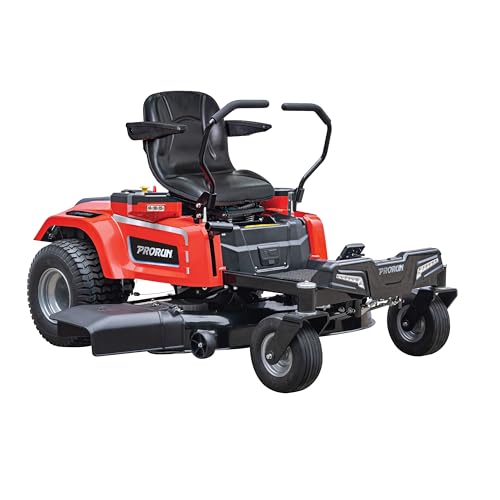
Pros
- High-efficiency brushless motors maximize power output and durability over traditional motors
- Up to 2 acres runtime with three included 10.0 Ah batteries supports substantial mowing sessions
- Zero-emission operation with gas-equivalent 20 HP power for quieter environmentally friendly use
- Six-port auto-switchover battery system provides flexible extended runtime options
- Durable 42-inch steel deck plus included mulch and towing kits add immediate functionality
Cons
- Runtime is limited to approximately 70 minutes or 2 acres which may require recharging for larger properties
- Fully battery-dependent design means performance relies on charge levels and spare battery availability
- 42-inch deck size may require more passes on expansive lawns compared to wider commercial models
The PRORUN PZT60V42 is a fully electric 60V zero-turn riding lawn mower built for residential and light commercial use. Its primary design centers on a robust 42-inch 14-gauge stamped steel twin blade deck powered by direct-drive brushless motors, giving an immediate impression of solid construction and modern battery-focused engineering. The mower arrives complete with three 10.0 Ah batteries, a charger, mulch kit, and towing kit for ready-to-work versatility.
In performance terms, four high-efficiency brushless motors deliver power equivalent to a 20 HP gas engine while producing zero emissions. The system supports up to 2.0 acres or 70 minutes of runtime, and six battery ports with auto switchover intelligently manage all PRORUN 60V battery sizes for continuous operation. A washout port on the steel deck further simplifies post-mow maintenance during real-world sessions.
Potential drawbacks include the finite 70-minute runtime window which can limit coverage on larger properties without spare batteries or recharge breaks. As a fully electric model, it also depends entirely on battery charge levels rather than continuous fuel refills, and the 42-inch deck width may demand extra passes compared with wider traditional options.
Overall the PRORUN PZT60V42 offers strong value for homeowners and small-property managers who want gas-like cutting power without emissions or noise. Those with medium-sized lawns seeking quiet efficient zero-turn performance and included accessories will benefit most from this electric mower.

Pros
- Strong 24HP FR730 engine power for demanding cutting conditions
- Wide 54-inch FAB deck reduces total mowing time
- Zero turn design delivers excellent maneuverability
- Fabricated deck supports durable everyday operation
Cons
- Sparse details beyond engine and deck leave other features unspecified
- Gas-powered FR730 engine needs regular fuel and maintenance
- Large 54-inch deck size may feel oversized on compact properties
The Husqvarna Z254F is a zero turn mower from the established Husqvarna brand in the riding lawn mowers category. It centers on a solid build that pairs a 24HP 726cc FR730 engine with a 54-inch FAB deck for straightforward residential grass care.
Performance stems directly from the listed specifications. The FR730 engine delivers the horsepower needed for steady operation across typical lawns while the wide FAB deck completes passes efficiently. Zero turn handling improves control in real yard layouts based on the model design.
Considerations arise from the limited data available. Secondary elements such as comfort features fuel capacity or extras receive no mention and the gas engine format involves routine upkeep. The large deck suits open areas better than confined spaces.
The Husqvarna Z254F provides the most value for owners of medium or large properties who want reliable engine power and a broad cutting width. Users with smaller lots or those seeking extensive accessory options should weigh the core specs carefully before purchase.
How Fast Zero-Turn Mowers Typically Travel
There is no single speed that fits every zero-turn mower, every yard, or every pass. What people call “how fast it goes” usually mixes three different things: the forward speed you can use while cutting, the higher travel speed available when the blades are off, and the much lower reverse speed used for tight work. Machine class matters as well. A compact homeowner ZTR and a large commercial unit are both zero-turns, but they are built for different duty cycles and are often listed with different ground-speed ratings.
On ordinary residential machines, published forward speeds commonly sit in a modest range. Product literature and owner’s manuals for many homeowner models list forward ground speed around a brisk walking-to-jogging pace, often in the mid-single-digit miles per hour, with a somewhat higher available speed for moving between areas. That is a manufacturer rating, not a measured result from this article and not a pace that is appropriate on every lawn.
Commercial zero-turns are often advertised with higher top speeds than homeowner machines. Spec sheets for work-oriented units frequently list forward speeds in the low double digits in miles per hour, and some large commercial models are marketed even faster. Again, those figures are capability ratings under favorable conditions. They describe what the drivetrain can do on paper, not the speed you should use around trees, beds, slopes, or children. For broader ecosystem context, read through our operational guide on jbl partybox club 120 vs sony srs xv500.
A reader should therefore expect three nested answers rather than one number: For broader ecosystem context, read through our operational guide on jbl partybox club 120 vs sony srs xv500.
- Ordinary forward travel while mowing is usually kept well below the machine’s advertised maximum so the deck can process grass and the operator can still place the machine accurately.
- Transport or travel speed, used with the deck disengaged, is often the highest forward speed the machine offers.
- Reverse is typically limited to a much lower speed than either of those forward ranges.
If two neighbors own zero-turns and report very different “top speeds,” they may both be right. One may be quoting a residential spec sheet, the other a commercial rating, and neither figure tells you how fast either machine should be moving across a wet slope or a toy-strewn backyard.
What a Zero-Turn Mower Is, and Why Speed Feels Different
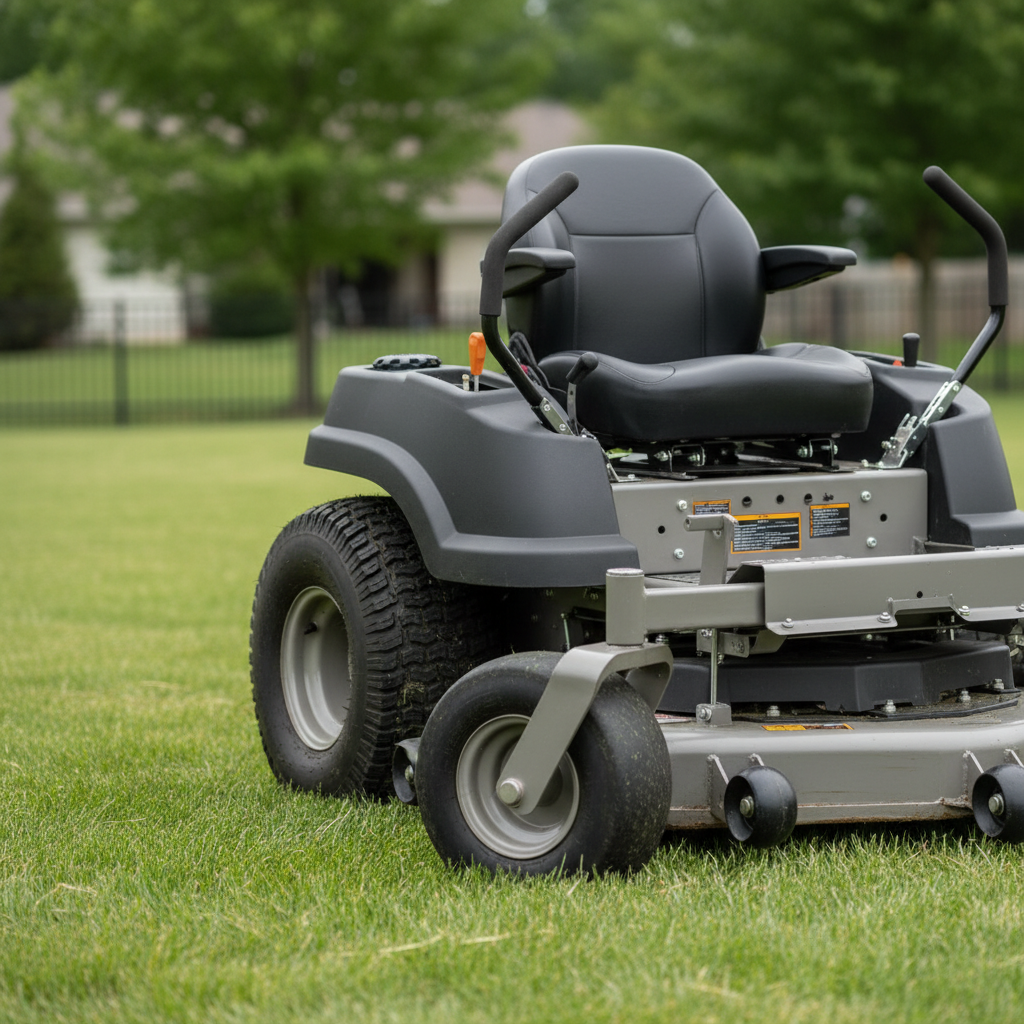
A zero-turn mower, often abbreviated ZTR, is a riding mower that steers by driving the left and right rear wheels independently. Front support usually comes from caster wheels that swivel freely instead of a steered axle. Speed and direction are controlled with dual hand levers rather than a steering wheel and a separate accelerator in the lawn-tractor sense. Push both levers forward and the machine moves ahead. Pull both back and it moves in reverse. Advance one lever farther than the other and the machine arcs. Push one lever forward and the other back and the machine can pivot in a very tight space, which is the feature behind the “zero-turn” name. For troubleshooting and reliability insights, consult our in-depth z890 vs x870e motherboard report.
Most modern zero-turns use a hydrostatic drive: each rear wheel is powered through a hydraulic pump and motor (or a closely related hydrostatic arrangement) so lever position meters oil flow and therefore wheel speed. The operator is not shifting through a set of geared ratios in the way some older garden tractors do. Ground speed is continuous and proportional to lever travel, up to whatever limit the pumps, motors, tires, and any factory speed limiter allow.
That layout is why speed feels different from a steering-wheel lawn tractor. On a tractor, the front wheels point the machine and the rear wheels mainly push. On a ZTR, a small difference in left-versus-right lever travel changes the path immediately. At walking speed that is an advantage: you can hug a bed, square a corner, and leave a clean edge. At higher ground speed the same input produces a much larger change in heading in the same fraction of a second. The caster wheels do not “hold a line” the way a steered front axle does. They follow whatever path the driven rear wheels dictate. For troubleshooting and reliability insights, consult our in-depth z890 vs x870e motherboard report.
Zero-radius turning is a control feature, not a reason to travel quickly near edges, slopes, people, or drop-offs. The machine can pivot in place; it cannot violate traction, balance, or the time you need to see and react. Understanding that distinction is the foundation for every speed claim that follows.
Mowing Speed Versus Transport Speed
Mowing speed, sometimes called cutting speed, is the ground speed you use with the blades engaged. Transport speed, also called travel speed, is the ground speed you use when the deck is disengaged and you are only moving the machine from one area to another. They are related because they share the same drivetrain, but they are not the same job. Readers comparing setup options can review our technical analysis on marshall stanmore iii vs harman kardon onyx studio 8.
When the blades are on, the mower deck has to lift, cut, and discharge (or bag or mulch) a continuous stream of grass. Forward travel and cutting performance are related but not identical. The deck needs time and power to process what it encounters. If ground speed outruns the deck, cut quality usually suffers before the engine or pumps “feel” maxed out. Typical signs that travel is too fast for the cut include ragged tips, strips of uncut grass, windrows of clippings, a washed-out or uneven stripe, and clumps that sit on the lawn instead of dispersing. On turns, a deck that is still cutting while the machine yaws quickly can scalp high spots or leave a hook-shaped miss on the inside of the arc.
That is why operators usually slow down when the blades are engaged, even if the levers can still be pushed farther forward. Many machines simply offer a wide range of forward speed, and the operator chooses a slower portion of that range for cutting. Some commercial units have a labeled transport setting, a higher available speed, or a control that makes it easier to hold a travel pace with the deck off. Not every model has a separate transport gear. Do not assume a switch or detent exists unless the operator’s manual for that machine describes one. For complementary field maintenance guidelines, examine our breakdown of dyson v8 cyclone vs bissell featherweight stick.
Going faster does not always finish a lawn sooner. Time spent recutting missed strips, clearing clumps, repairing scalped turf, or retrieving a machine that slid past a bed can erase any gain from a higher ground speed. On an open, even, lightly loaded lawn, a slightly quicker pace may be reasonable. On thick spring growth, wet turf, or a yard full of obstacles, a slower, cleaner pass is usually the faster job overall. This article cannot honestly convert those observations into acres-per-hour promises; productivity depends on deck width, overlap, layout, and how often you stop, none of which is fixed by the word “zero-turn.”
Reverse Speed and Tight Maneuvers
Reverse is typically much slower than forward. Manufacturers often limit reverse speed because backing a dual-lever machine is a poorer-visibility, higher-consequence task. The operator is working around the deck, often near a building, trailer, fence, or person, and a fast reverse combined with an uneven lever input can swing the rear of the machine or the deck in an unexpected arc. Treat reverse as a positioning speed, not a travel speed. A zero-turn is not a vehicle you should back at transport pace. To evaluate matched hardware tolerances, consult our detailed overview of bissell crosswave hydrosteam vs shark stainforce.
Exact reverse figures belong in the manual for that model. They are not universal, and quoting a single reverse miles-per-hour number as if every ZTR shared it would be misleading. What you can count on is the pattern: reverse is usually a small fraction of available forward speed.
Tight maneuvers with the deck engaged add another limit. As you pull one lever back and the other forward, the two sides of the deck travel at different speeds. The inside of the turn may nearly stop while the outside sweeps a wide path. Cut quality and turf health both suffer if that happens at a high combined speed: the outside blade path can tear rather than slice, and the deck can gouge a high spot or leave a crescent of uncut grass. Stability also changes. Weight shifts, casters flop to a new angle, and a rut or wet patch under one drive tire can make the machine rotate more than the operator intended.
Some models include a feature that stops or disengages the blades when the machine is shifted into reverse. That feature is model-dependent. It is not safe to assume every zero-turn has it, and it is not a substitute for looking behind you and slowing down. Check the operator’s manual and the control labels on your machine rather than relying on a general article.
Residential Versus Commercial Zero-Turn Classes
Price is the obvious difference people notice first, but it is not the useful one for speed. A residential zero-turn is generally built for a home lawn, intermittent use, and a mix of open grass and typical yard obstacles. A commercial zero-turn is generally built for longer hours, heavier weekly use, more robust frames and decks, and operators who spend a workday in the seat. Those differences show up in duty cycle, cooling, spindle and deck strength, suspension or isolation, and often in the hydrostatic components that determine available ground speed.
Commercial machines are often advertised with higher top speeds because contractors move between large, relatively open areas and are paid for coverage. A faster rating can help on a broad, even property when the deck is off and the path is familiar. It does not follow that a homeowner should mow faster because a commercial spec sheet lists a higher number. A small, obstacle-filled yard punishes high ground speed: more lever corrections, more near-misses with beds and toys, and more cut-quality problems in the same afternoon.
Class also changes how speed should be interpreted on a spec sheet:
- Residential ratings describe a machine that will spend much of its life below its maximum, around trees, play equipment, and irregular borders.
- Commercial ratings describe a machine that may be asked to cover more ground per hour, but still only where traction, visibility, and the deck can keep up.
- Neither rating is a recommendation to run at the limit on slopes, wet grass, or public edges.
A faster commercial rating is not “better” in the abstract, and a slower residential rating is not a defect. They are different tools. Choosing a machine on speed alone, without considering yard layout, operator experience, and how the deck handles your grass, is a poor way to shop. This article does not rank brands or models; the right comparison is whether the available speed range matches the work you actually do.
Why Advertised Top Speed Is Not a Safe Working Speed
Published top-speed numbers usually come from the manufacturer’s rating process for that model family. They are capability claims, often associated with level ground, specified tires, a maintained machine, and an operator who can hold the controls at or near full travel. They are not the same thing as a recommended cutting speed, and they are not a guarantee that your particular lawn, slope, or grass load will allow that speed to be reached or controlled.
Even when a machine can physically attain its advertised forward speed, that speed can still be a poor choice while cutting. The deck may not have enough time to process thick grass. Tracking (the tendency of the machine to pull left or right) becomes harder to correct as speed rises. Stopping distance increases. A caster that hits a hole or a drive tire that loses grip produces a larger heading error. Flying debris also carries more energy when blades are turning and the machine is moving quickly across the lawn toward a sidewalk, road, or patio.
Conditions that make a rating reachable on a brochure less relevant in the yard include tall or wet grass, dull blades, a deck packed with clippings, underinflated or mismatched tires, a machine that pulls to one side, poor visibility, fatigue, and any slope or drop-off. Operator skill matters, but skill does not rewrite traction or balance. A capable operator on a well-maintained machine still has to leave margin for a hidden hole, a child stepping out from behind a shrub, or a wet patch under one tire.
Treat the number on the spec sheet as an upper bound on what the drivetrain is designed to offer, then choose a working pace from cut quality, visibility, and the space you have to stop. Do not treat marketing speed as an operating target. Do not modify governors, remove speed limiters, or alter hydraulics to chase a higher number. Those changes can create hazards the machine was not set up to manage and can void protections you may be counting on.
What Changes Real-World Speed
The speed you can use, and the speed the machine will actually deliver, both move around with conditions. Terrain is the first limiter. On level, even turf with good grip, you can hold a steadier lever position and still place the deck. On slopes, the downhill drive tire unloads, the uphill tire works harder, and a small lever error becomes a large path error. Banks, swales, and the downhill side of a retaining wall are poor places to use anything close to top speed. Ruts, roots, and hidden depressions do the same thing on supposedly flat lawns: one caster drops, one tire bites, and the machine yaws.
Surface condition matters as much as slope angle. Wet grass reduces traction and packs the deck. Dew-heavy morning turf can make a drive tire spin or slide just when you ask for a turn. Dry, dusty, or sandy soil can also reduce bite. Uneven ground that looks minor at walking speed becomes a series of impacts at higher travel speed, which is hard on the operator and on tracking.
Grass load is the second limiter. Taller, thicker, or wetter grass asks the blades and spindles for more work per foot of travel. A wider deck processes more width at the same ground speed, which is efficient only if the engine and belt or hydraulic system can keep blade speed up. A dull blade, a bent spindle, a loose belt, or a deck packed with wet clippings increases load further. When the deck is overloaded, the usual correct response is to slow down, raise the cutting height for a first pass, or take a narrower effective cut by overlapping more—not to push the levers farther and hope the machine “pulls through.”
Machine condition and setup also change available speed and how controllable that speed feels:
- Tire type and pressure affect grip, ride, and whether the two drive tires cover the same distance per revolution. Mismatched pressure is a common reason a ZTR pulls to one side and feels “fast” in a bad way.
- Tracking that is out of adjustment makes the operator fight the levers continuously. That fight gets harder as speed rises.
- Low hydraulic fluid, worn drive belts, a tired pump, or overheating on a long climb can reduce the speed the machine will actually produce, even if the spec sheet still lists a high number.
- Deck width does not equal a specific miles-per-hour rating, but a wider, heavier deck changes how the machine behaves in turns and over bumps.
Operator factors close the loop. Fatigue, glare, low sun, tall uncut grass that hides holes, a yard you do not know well, and any bystander in the area all reduce the speed that is prudent. A machine that can go faster than you can see and stop is already past a useful working pace. Yard layout does the same: a long open run along a fence is a different task from a courtyard of island beds. The spec sheet cannot see your layout. You can.
How to Choose a Practical Mowing Pace
A practical mowing pace is the fastest speed at which you still get an even cut, still place the deck where you intend, and still have time to stop short of the next obstacle. There is no universal “correct” miles-per-hour figure for that. The cues are visual and tactile.
Slow down if you see ragged leaf tips, strips the deck skipped, windrows, clumps sitting on the turf, or a washboard look in the stripe. Slow down if the machine scalps on turns or if the inside of a zero-turn leaves a hook of uncut grass. Slow down if you are making constant large lever corrections, if one side feels as if it is running away, or if you cannot comfortably stop before a bed, mailbox, toy, or grade change. Those are not cosmetic issues only. They are evidence that ground speed has outrun either the deck or your control of the dual levers.
Beginners should start well below the machine’s available top speed and stay there until lever inputs feel small and predictable. Learn how much lever difference produces a gentle arc versus a snap turn. Practice stopping from a moderate pace on level ground before you ever ask the machine for transport speed. If the yard is new to you, walk it first for holes, wires, toys, pet waste, and drop-offs. Speed does not make those objects easier to see.
A higher transport speed is reasonable only in a narrow set of conditions: blades disengaged, path relatively open and familiar, ground reasonably level and grippy, and bystanders, pets, and traffic clear. Use it to cross a driveway or move to the next section, not to “save time” along a ditch, through a gate with poor sight lines, or across a public sidewalk. If you need to look down at the deck, check a gauge, or talk to someone, you are already going too fast for that moment.
Cut-quality cues that specifically say “slow down” include:
- Grass that looks shredded rather than cleanly sliced.
- Clippings that form ropes or piles instead of a light, even layer.
- A second pass that is required on the same strip even though overlap looked adequate.
- The engine or blades sounding loaded in grass that should be routine for that deck height.
- Any sense that a lever bump would put the deck into a bed, tree, or hard object.
If those cues appear only in thick patches, slow for those patches rather than running the whole lawn at the slowest speed. Variable pace is normal. Fixed high speed is not a virtue.
Safety Limits That Matter More Than Top Speed
High speed is riskier on a zero-turn than on many steering-wheel tractors because direction is a direct function of two independent drive wheels. A sudden lever input at speed can yaw the machine sharply. The rear of the mower and the corners of the deck swing through space that the operator may not have scanned. Casters provide little directional stability if a tire breaks loose. The same agility that makes a ZTR efficient around a flower bed makes an error at speed cover a lot of ground before you can undo it.
Slopes, banks, retaining walls, wet turf, and uneven ground call for much lower speed or a different machine. Follow the slope guidance in the operator’s manual and on the machine’s labels. Those instructions are written for that model’s weight distribution, track width, and tire package. A general article cannot invent a legal slope-angle limit or a statistic that makes a slope “safe enough.” If the manual says not to operate on a given slope, or if the ground is wet, off-camber, or ends in a drop-off, do not use speed as a way to “get it over with.” Skill does not make high-speed slope work safe. If the site is beyond what the manual and your experience support, hire a qualified professional or use a different method.
Other people share the risk. Children, pets, and bystanders are hard to see over the deck and around landscaping. A zero-turn can change heading faster than a pedestrian expects. Keep people and animals out of the area you are mowing. Never assume someone heard the engine. Along roads, sidewalks, and driveways, flying debris energy increases with blade speed and travel speed; slow down, choose a discharge direction that does not aim at people or glass, and stop the blades when someone approaches. If you must cross a public way, follow local rules, disengage the deck, and treat the crossing as a visibility problem, not a chance to use transport speed.
Other widely accepted limits:
- Do not operate a zero-turn where a rollover or slide would take you into water, a wall, a drop-off, or traffic.
- Do not carry passengers. These machines are designed for one operator.
- Do not use transport speed to compensate for a dull blade, a clogged deck, or a machine that will not hold a straight line.
- Wear sturdy footwear and eye protection, and use any other protective equipment the manual specifies for your machine and site. This article does not invent helmet or PPE laws; check the manual and local requirements.
- Shut the blades off, set the controls as the manual directs, and stop the engine before you leave the seat or try to clear the deck. Clearing a running deck is not a speed problem; it is an injury problem.
If a control feels vague, a lever sticks, tracking is badly off, or the machine behaves differently on one side, stop and have it inspected. A speed rating assumes a machine that still responds the way it did when it left the factory.
How to Confirm the Speed Rating for Your Mower
The correct source for a specific machine’s rated forward, reverse, and transport speeds is that machine’s operator’s manual, the manufacturer’s spec sheet for that model, and any dash or control labels on that serial-numbered unit. Look for terms such as ground speed, transport speed, travel speed, or forward and reverse speed. Some manuals list a range rather than a single number. Some list different figures depending on tire size. If you are comparing machines in a showroom, ask which figure is mowing capability and which is maximum transport speed, and ask whether the number assumes a particular tire. Do not let a single “up to” claim stand in for those distinctions.
Buyers who fixate on speed alone should also ask about tracking adjustment, visibility, deck discharge behavior, and how the machine is meant to be used on slopes. A slightly lower rated speed on a machine you can place accurately will usually produce a better lawn than a higher rating you cannot use. If a salesperson cannot show the rating in writing for that model, treat the spoken number as unverified.
If an existing mower feels slower than its rating, several maintenance issues are common suspects. None of them should be diagnosed from speed alone, and none of them should be “fixed” by inventing fluid types or pressure specs from an article:
- Low or degraded hydraulic fluid, or a drive system that is overheating, can reduce available wheel speed.
- Worn or glazed belts, on machines that use them in the drive or deck path, can slip under load.
- Mismatched or incorrect tire pressure changes rolling diameter and can make one side lag.
- A clogged deck, bent blade, or failing spindle loads the engine and can make the whole machine feel flat.
- Tracking that pulls to one side makes the operator hold a constant correction, which feels like lost speed even when the pumps are still capable.
- A worn or failing hydrostatic pump or wheel motor can produce a genuine loss of speed on one or both sides and needs a qualified technician.
Use the service intervals, fluid specifications, and tire pressures printed for your machine. If the mower is under warranty or the repair involves hydraulics, steering, or structural parts, a dealer or qualified technician is the right next step. Guessing at a speed problem by swapping parts or overfilling tires is a good way to create a control problem.
Once you have the rated numbers in hand, put them back in context. They answer “how fast can this zero-turn go” in the manufacturer’s sense. The useful operating answer is slower and more local: mow at the pace that keeps cut quality clean and the machine where you pointed it; reserve higher transport speed for open, familiar, reasonably level paths with the blades off; keep reverse slow; and let terrain, grass, visibility, and the people around you set a ceiling below whatever the spec sheet advertises.
Buyer FAQs: How Fast Does A Zero Turn Mower Go Solved
Is a zero-turn always faster than a lawn tractor?
Often, but not by a fixed ratio, and not in every task. Many zero-turns are advertised with higher forward speeds than typical homeowner lawn tractors, and their dual-lever steering can reduce time spent on tight turns. A tractor may still be the better tool on certain slopes or for towing, and a careful operator on a tractor can finish a small, obstacle-filled yard as quickly as someone rushing a ZTR. There is no honest universal multiplier such as “twice as fast.”
Should I mow at the highest speed the levers allow?
No. The highest lever position is a capability, not a cutting recommendation. Use a pace that leaves a clean cut and leaves you time to steer and stop. If the lawn starts to look torn, clumped, or missed, you already have the answer.
Why does my zero-turn feel slower than the number on the spec sheet?
Ratings assume a maintained machine, suitable tires, and favorable conditions. Thick grass, a packed deck, tire-pressure mismatch, tracking pull, worn belts, hydraulic issues, or simply choosing a safer pace on a tight yard can all make real travel slower than the brochure. Confirm the rating in your manual, then inspect setup and condition before assuming the machine is “wrong.”
Can I use transport speed with the blades on if the grass is short?
Short grass reduces deck load, but it does not remove obstacles, slopes, tracking error, or stopping distance. If you raise ground speed, do it only while cut quality and control remain clearly acceptable. Blades-on travel at the machine’s maximum advertised speed is rarely a good idea even on a clean, open lawn.
Where should I look first if I need an exact miles-per-hour figure?
The operator’s manual and the official spec sheet for that exact model and tire package. Those documents are the durable source. Generic internet lists, remembered showroom claims, and unofficial conversions are easy to mix across residential and commercial classes.
For more hands-on benchmarks and buying recommendations, consult our guides on heavy-duty chainsaw buyer guide, as well as high-CFM commercial leaf blower guide.
Mechanical safety standards, operational tolerances, and protective gear guidelines align with benchmark specifications established by the American National Standards Institute (ANSI).









