
Quick Answer: How To Start Yard Machine Lawn Mower?
To start a typical gasoline Yard Machine walk-behind mower, check oil and fresh fuel on level ground, clear the cutting path, and keep people away. For a cold engine, set the primer or choke as the decal or owner’s manual shows, hold the blade-control bar against the handle, then pull the recoil starter or use electric start if equipped. If…

Pros
- Large-size design named in product title
- Sharpening and balancing functions listed
- Listed as a new upgraded version

Pros
- Adjustable 15-to-45-degree range in title
- Sharpening and balancing functions listed
Pros
- Includes replacement gaskets and a 98079-55846 spark plug
- Matches Honda HRR216 and HRS216 lawn mower models
- Designed around the 16100-Z8B-901 carburetor specification
Cons
- Restricted to select Honda GCV160 mower applications
- Installation requires basic mechanical tools and skills
What this starting sequence covers
Yard Machine covers several gasoline walk-behind mowers and some riding models. Many of the walk-behind machines use familiar small-engine controls, but the layout is not identical from one deck or engine to the next. This guide is a safety-first starting sequence for a common gas-powered walk-behind mower. It is not a substitute for first-time assembly, cable routing, blade installation, long-term storage service, or a full riding-mower procedure.
A few parts of starting stay the same on most models. You still need a clear outdoor work area, the correct fuel and oil for that engine, a held operator-presence control so the machine is allowed to run, and a way to crank the engine. Other details change. Some engines use a primer bulb. Some use a choke lever. Some combine choke and throttle on one control. A few add a fuel shutoff valve or electric start. Pull-start and electric-start versions are variations of the same machine family, not different products with unrelated rules.
Cold first starts, warm restarts after a short pause, and first use after months in storage also feel different even when the hardware is the same. A cold engine usually needs richer mixture help. A warm engine often does not. A mower that sat with old gasoline may need fuel service before any starting sequence will work. Find the model and serial information on the deck or engine plate and match it to the owner’s manual for that machine before the first start of the season. The manual is the only reliable map of lever names, interlocks, and first-time setup for your exact unit.
Safety checks that come before any start
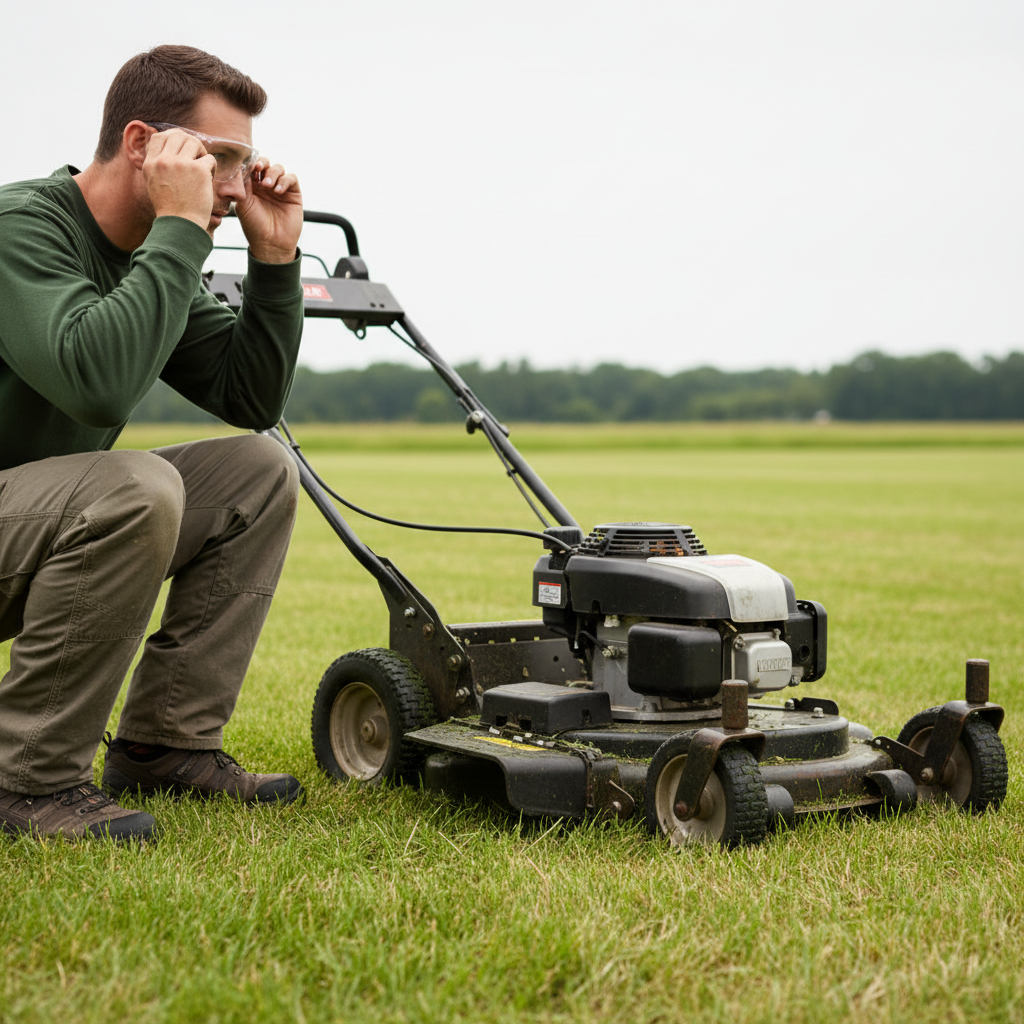
Starting a lawn mower is not only an engine task. On a walk-behind machine the blade is driven whenever the engine is allowed to run, so a successful start puts a cutting edge in motion under the deck. Contact with that blade can cause serious laceration or amputation. Stones, sticks, and loose hardware can become flying debris. The recoil rope can kick back hard enough to injure a hand, wrist, or shoulder. Gasoline can ignite. A running engine also produces carbon monoxide, which can build to dangerous levels in a closed garage, shed, or other enclosed space.
Protect yourself and everyone nearby
Wear sturdy closed-toe shoes, not sandals or bare feet. Eye protection helps against thrown material. Hearing protection is wise because small engines are loud at close range. Long, loose clothing, dangling drawstrings, and jewelry can catch on the handle or controls. Tie back long hair. Keep children, pets, and bystanders well away from the cutting path and the discharge opening before you touch the starter. Do not assume people will hear you over the engine once it fires.
Treat the deck and the fuel as hazards
Never put hands or feet under the deck to clear grass, check the blade, or retrieve an object while the engine can start or is running. If you must inspect or clear the underside, stop the engine, wait for all motion to end, and disconnect the spark-plug boot so an accidental pull or an electric-start attempt cannot fire the engine. Disconnecting that boot is an inspection step, not a starting step. Do not smoke, use an open flame, or work next to a pilot light while adding fuel. Wipe up spills and let fumes disperse before you crank the engine.
Start and run the mower outdoors only. A typical Yard Machine walk-behind mower is a gasoline machine that must be started outside, never in a closed garage or other enclosed space, because running engines produce carbon monoxide. Opening a garage door is not a reliable substitute for open air. If you fueled the mower indoors, roll it outside before you attempt to start it.
On typical walk-behind models the blade-control bar is an operator-presence control. You usually must hold it against the handle for the engine and blade to run, and releasing it is intended to stop them. That design is a safety feature, not a convenience. Do not tape, tie, or otherwise defeat the bar. Do not assume the blade stops instantly on every machine; wait until the deck is fully still before you approach it.
Fuel, oil, and the work area
An engine that is low on oil, filled with stale gasoline, or sitting on unstable ground can be hard to start and easy to damage. Do this setup with the engine off and cool, before you hold the blade-control bar or touch the recoil handle.
Check oil and fuel the way the engine is built
Most current Yard Machine walk-behind mowers are 4-stroke designs. They use unleaded gasoline in the fuel tank and separate engine oil in the crankcase. Do not treat mixed oil-and-gasoline fuel as the default. Only use a pre-mix if the owner’s manual for that specific engine requires it. Check the oil on a level surface with the engine off and cool. Read the dipstick or fill mark the way the engine decal describes, and add oil only if the level is low. Overfilling can cause smoking or other running problems. Use the oil type listed in the manual for your climate and engine; do not guess a viscosity from memory.
Use fresh gasoline appropriate to that engine rather than fuel that has sat in the tank or a can for months. Stale fuel is a common reason a mower that started last season will not start now. If the machine was stored with untreated gasoline, draining or refreshing the fuel may be necessary before any starting sequence will succeed. Follow the manual for how to add fuel, how full to fill the tank, and whether a fuel shutoff valve should be opened. Do not add gasoline while the engine is hot or running.
Set the mower on stable ground and clear the path
Start on reasonably level ground when you can. A mower that can roll, tip, or slide makes it harder to keep your stance and keep your feet clear of the deck. Set the cutting height where you intend to mow only after you have confirmed the deck is clear. Walk the lawn and remove sticks, stones, toys, hoses, wire, and hidden debris. Those objects can damage the blade, jam the deck, or become projectiles as soon as the engine starts.
Look under the discharge opening and around the deck skirt for packed grass or an object already lodged there. Clear that material only with the engine stopped and the spark-plug boot disconnected. Slope limits, if your model has them, belong in the owner’s manual; do not assume a generic angle is safe for every Yard Machine. If the ground is wet, uneven, or crowded with obstacles, wait or change the work area rather than forcing a start in a bad position.
Identify the starting controls on a typical Yard Machine
Before the first pull of the season, stand behind the handle and identify every control you will use. Names on decals vary, and not every Yard Machine has both a primer and a choke, a fuel shutoff valve, or electric start. Do not assume a color, a detent label, or a cable direction from another brand or another year.
Blade-control bar and operator presence
The blade-control bar, sometimes called a bail bar, sits on the upper handle. It is the operator-presence control. You squeeze or hold it against the handle to allow the engine to start and keep running. Releasing it is meant to stop the engine and the blade. If the bar is only partly held, many machines will not crank or will die as soon as they fire. Hold it fully and keep holding it through the start. If your hands cannot comfortably keep that grip, stop and check handle height and cable condition instead of fighting the control.
Primer, choke, throttle, and fuel shutoff
A primer bulb, when fitted, is usually a small rubber bubble on the carburetor area of the engine. Pressing it meters extra fuel for a cold start. A choke lever restricts air so the mixture is richer. Some engines have one or the other. Some have both. Some combine choke and throttle into a single lever with pictured positions such as choke, run, and stop. The engine decal and the owner’s manual show which system you have and which position is for a cold start. There is no universal primer-pump count that is correct for every Yard Machine.
Throttle, if it is a separate lever, usually needs to be in a start or fast-run position rather than idle. A fuel shutoff valve, if equipped, must be open or the carburetor will starve. If you cannot find a valve, your model may not have one. Do not force unlabeled plastic parts. If a control is stiff, broken, or disconnected, that is a repair issue, not something to solve with more starter pulls.
Recoil starter and electric start
The recoil starter is the rope handle on the engine or, on some handle layouts, a rope that reaches the upper handle. Electric start, when fitted, is typically a key or a push button and still depends on the same blade-control bar and any other interlocks. Electric start only replaces the rope as the cranking method. Many dual-start engines can still be pull-started if the manual allows it and the recoil is in good condition. Riding Yard Machine models add seat, brake, and blade or PTO interlocks that can prevent starting; those machines need that model’s interlock sequence, not the walk-behind steps below.
Step-by-step: start a cold gasoline walk-behind mower
Use this conservative sequence for a cold engine that has oil, fresh fuel, and a clear path. Confirm the primer, choke, and throttle positions on the engine decal or in the owner’s manual. Do not expect a first-pull start, and do not keep priming after the engine already smells wet with fuel.
- Confirm the mower is outdoors on reasonably level, stable ground. Recheck that bystanders are clear and that the cutting path is free of debris.
- With the engine off, verify oil level and that the tank has fresh unleaded gasoline if that is what the manual specifies. Open the fuel shutoff valve if the machine has one.
- Set the cutting-height adjusters so the deck will not scalp or catch on the first pass, but do not reach under the deck to do it.
- Set primer or choke for a cold start exactly as the decal or manual shows. If the engine has a separate throttle, move it to the start or run position the manual names. Do not invent a number of primer presses.
- Stand balanced behind the handle with both feet clear of the deck and the discharge opening. Do not lean over the engine in a way that puts your face or chest in the path of a kicking rope.
- Hold the blade-control bar fully against the handle with one hand and keep it there. The engine and blade are not meant to run unless that bar stays held.
- If you are using the recoil starter, pull the rope handle until you feel resistance, then pull smoothly and quickly in a straight line. Do not wrap the cord around your hand. Do not yank at a sharp angle that slams the handle into the engine or your body. Let the rope rewind under control.
- If the machine has electric start, keep the blade-control bar held and use the key or button instead of the rope. The choke or primer logic does not change.
- When the engine catches, move the choke or combined control toward the normal run position as the manual describes. Keep holding the blade-control bar. Give the engine a brief moment to settle before you start walking, but do not stand in one spot so long that you scalp the turf under a running blade.
- If it coughs but does not run, reset your stance and try again without adding extra primer unless the manual tells you to. Several failed attempts are a signal to stop, not to flood the carburetor.
Starter-cord kickback happens when the engine kicks backward against the rope. A balanced stance, a straight pull, and a rope that is not wrapped around your fingers reduce that risk. A frayed rope, a broken handle, or violent kickback on every pull is a reason to stop and have the starter and engine inspected rather than to pull harder.
Warm restarts and electric-start notes
A recently run engine usually needs little or no prime or choke. Extra priming after a short pause is a common way to flood the engine so it will not restart. For a warm restart, hold the blade-control bar, set the throttle to run if it is separate, leave the choke off unless the manual says otherwise, and pull or use electric start. If the engine sat long enough to cool completely, treat it as a cold start again.
Electric start still requires the blade-control bar and any other interlocks. A weak, disconnected, or uncharged battery can prevent electric cranking even when fuel and spark are fine. Do not improvise a jump-start method that the manual does not describe. If the engine also has a recoil starter and the manual allows a pull start, you can often crank it by rope while the same safety bar is held. If electric start clicks, turns slowly, or does nothing, stop and address the battery and connections instead of holding the button down.
Riding models are a different control problem. Seat switches, brake pedals, and blade or PTO levers can keep the starter from engaging even when the operator does everything that would start a walk-behind mower. Use that tractor’s interlock sequence from its own manual. Do not borrow the walk-behind order and force the key.
If the engine does not start after a few attempts
Stop after several failed attempts. Continued priming and yanking rarely fix a no-start, and they can flood the engine, wear the starter, or hide a fuel leak. Work through high-level checks with the mower still outdoors and the blade-control bar released unless a check requires you to hold it.
- Confirm the blade-control bar was held fully against the handle during each attempt. A loose grip is enough to keep many engines from running.
- Check that a fuel shutoff valve, if fitted, is open and that the tank actually contains fresh fuel.
- Recheck that there is oil in the crankcase. A neglected engine may have been stored empty or may have leaked.
- Press the spark-plug boot firmly onto the plug. A boot that looks seated can still be loose after storage or after deck work.
- Inspect the air filter. A filter packed with dust or soaked with oil can keep a cold engine from firing cleanly. Replace or clean it only as the manual describes; do not run the engine with the filter missing as a test.
- If the engine smells strongly of gasoline or you primed it repeatedly, it may be flooded. Wait, then try a start with choke off and no additional primer, following the flooded-start note in the manual if one exists.
- Look for obvious fuel leaks, a cracked fuel line, or wetness under the carburetor. Do not crank an engine that is leaking gasoline.
Old fuel and a dirty air filter are especially likely after storage. Hard kickback, a rope that will not rewind, or an engine that has been underwater needs a qualified technician. Do not bypass interlocks, disable the blade-stop system, or remove the blade-control cable to make the engine easier to start. Do not tear down the carburetor, set float levels, or chase compression numbers unless you have the service information and the skill for that work. Persistent no-starts belong with a technician and the official manual for that model.
Model variations and when to use the manual
Yard Machine controls, primer versus choke, and electric-start options vary by deck and engine. Exact lever positions, primer counts, and whether a given mower has choke, primer, a fuel valve, or electric start must be confirmed on the engine decal and in the owner’s manual for that model. The model and serial plate is usually on the deck, the rear of the machine, or the engine shroud. Match those numbers to the correct manual rather than to a generic diagram from another mower.
First assembly, unfolding a folded handle, routing cables, installing a blade, adjusting drive cables on self-propelled models, and storage fogging are not starting steps. A new mower that has never been run may still need handle hardware tightened and the engine filled with oil before the first start. A mower that sat all winter may need fresh fuel before any of the control sequence above will work. A damaged, glazed, or frayed starter cord should be replaced, not pulled until it breaks in your hand.
Stop and get help if gasoline is leaking, if the engine has been submerged, if every pull produces violent kickback, or if a safety control does not return and stop the engine as designed. Those are not problems you solve with a longer starting ritual. Used with the manual for your serial-numbered machine, the sequence in this article is enough for a routine outdoor start on a typical gasoline Yard Machine walk-behind mower: prepare the site, verify oil and fresh fuel, set the cold-start controls you actually have, hold the blade-control bar, crank once or twice with a controlled pull or electric start, then move the engine to run and mow only after it is running smoothly.