
Quick Answer: How To Use An Electric Mower?
Use an electric mower by inspecting the yard and machine, setting a safe cutting height, then starting it correctly for its power source: a dry outdoor-rated cord kept behind you, or a seated charged battery. Mow in overlapping walking-pace passes. Never cut over the cord or use a damaged blade, battery, or cable. Release the bail to stop the blade,…

Pros
- Powerful 80V brushless motor delivers 32HP gas-equivalent performance with quiet fume-free operation and no engine maintenance.
- Complete kit includes four 6.0Ah batteries and 600W charger for substantial runtime up to 1.5 acres.
- SmartCut technology and 42-inch heavy-duty steel deck ensure consistent cuts without bogging in tough conditions.
- Versatile towing up to 350 lbs and optional cargo hauling plus comfort features like high-back seat and LED lights.
- Strong 4-year limited warranty and full compatibility with the Greenworks 80V tool ecosystem.
Cons
- Rear utility cargo bed for 200 lb hauling is sold separately and not included in the kit.
- Runtime of up to 1.5 acres varies with conditions and may require recharging or battery swaps on larger properties.
- As a fully cordless model continuous operation depends on battery levels unlike gas engines with unlimited runtime.
The Greenworks 80V 42" CrossoverT Cordless Riding Lawn Tractor is a ready-to-mow zero-emission tractor designed for homeowners managing medium to large lawns. It features a reinforced 42-inch stamped steel deck of 12-gauge construction along with premium comfort elements such as a high-back padded seat with foldable armrests. The overall build emphasizes durability and user convenience right out of the box with the included battery and charger set.
Performance centers on the 80V TruBrushless motor that provides 32HP gas-equivalent power with instant torque and quiet fume-free operation. SmartCut technology senses grass conditions and automatically adjusts power to maintain a consistent cut even in tall thick or wet areas. The four 6.0Ah batteries support runtime for up to 1.5 acres depending on conditions while dual LED headlights and a 7-position deck height range from 1.5" to 4.5" add practicality. Front and rear attachments further allow towing up to 350 lbs for added yard utility.
Key considerations include that the rear utility storage bin capable of hauling 200 lbs is sold separately so full cargo functionality requires an extra purchase. Runtime remains condition-dependent and may fall short for properties significantly larger than 1.5 acres without using the 600W charger or swapping batteries. The cordless design prioritizes ease and low maintenance but trades off the continuous runtime of traditional gas models.
This tractor delivers strong value for eco-conscious owners of residential properties who want gas-like power without the emissions noise or upkeep. It suits those who already use or plan to expand into the Greenworks 80V family of tools and who appreciate the 4-year limited warranty. Users with exceptionally large or commercial-scale lawns should evaluate battery logistics carefully before purchase.

Pros
- Delivers strong 21 horsepower equivalent power comparable to gas riding mowers.
- Provides up to 1.5 acres of runtime on a full charge with the six included batteries.
- Features low-maintenance dual brushless motors without belts for greater durability.
- Offers versatile 12-position cutting height adjustment from 1.5 to 4.5 inches.
- Includes digital controls for blade settings, drive speeds, and cruise control.
Cons
- Limited to 1.5 acres of cutting per charge without purchasing additional batteries for bigger lawns.
- Requires recharging time for the six 56V batteries after each use session.
- Relies solely on battery power with no hybrid or gas backup option for extended operation.
The EGO Power+ TR4204 is a cordless electric riding lawn mower built as a modern tractor alternative for residential use. It features a robust 42-inch stamped steel deck and arrives ready to go with six 56V 6.0Ah batteries plus a charger, creating an immediate impression of convenience and solid construction free from gas engine complexity.
Performance shines through its equivalent 21 horsepower output and top speed of 6 MPH, allowing efficient coverage of up to 1.5 acres on a single charge. Dual brushless cutting motors operate without belts for added durability and less upkeep, while the digital display lets users select three blade settings, three drive speeds, and cruise control. The 12 adjustable heights ranging from 1.5 to 4.5 inches combined with anti-scalp wheels deliver precise results across varied terrain.
Drawbacks center on battery dependency, as larger properties beyond 1.5 acres require extra batteries and recharging intervals can interrupt workflow. The fully electric design eliminates fuel storage needs but demands access to power sources between sessions.
This mower suits homeowners with medium to large yards who value quiet, emission-free operation and reduced maintenance. Those seeking expandable battery capacity for bigger areas will find the EGO Power+ TR4204 a strong long-term investment in cordless lawn care.
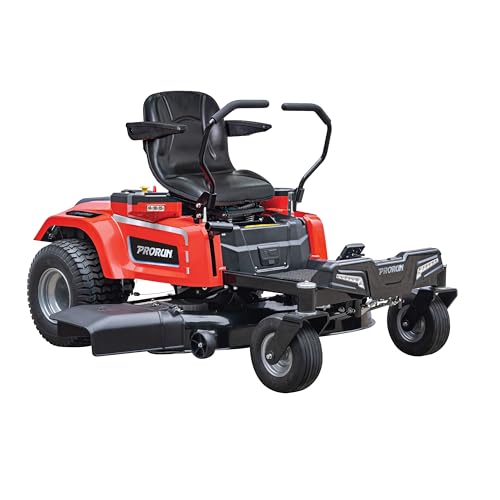
Pros
- High-efficiency brushless motors maximize power output and durability over traditional motors
- Up to 2 acres runtime with three included 10.0 Ah batteries supports substantial mowing sessions
- Zero-emission operation with gas-equivalent 20 HP power for quieter environmentally friendly use
- Six-port auto-switchover battery system provides flexible extended runtime options
- Durable 42-inch steel deck plus included mulch and towing kits add immediate functionality
Cons
- Runtime is limited to approximately 70 minutes or 2 acres which may require recharging for larger properties
- Fully battery-dependent design means performance relies on charge levels and spare battery availability
- 42-inch deck size may require more passes on expansive lawns compared to wider commercial models
The PRORUN PZT60V42 is a fully electric 60V zero-turn riding lawn mower built for residential and light commercial use. Its primary design centers on a robust 42-inch 14-gauge stamped steel twin blade deck powered by direct-drive brushless motors, giving an immediate impression of solid construction and modern battery-focused engineering. The mower arrives complete with three 10.0 Ah batteries, a charger, mulch kit, and towing kit for ready-to-work versatility.
In performance terms, four high-efficiency brushless motors deliver power equivalent to a 20 HP gas engine while producing zero emissions. The system supports up to 2.0 acres or 70 minutes of runtime, and six battery ports with auto switchover intelligently manage all PRORUN 60V battery sizes for continuous operation. A washout port on the steel deck further simplifies post-mow maintenance during real-world sessions.
Potential drawbacks include the finite 70-minute runtime window which can limit coverage on larger properties without spare batteries or recharge breaks. As a fully electric model, it also depends entirely on battery charge levels rather than continuous fuel refills, and the 42-inch deck width may demand extra passes compared with wider traditional options.
Overall the PRORUN PZT60V42 offers strong value for homeowners and small-property managers who want gas-like cutting power without emissions or noise. Those with medium-sized lawns seeking quiet efficient zero-turn performance and included accessories will benefit most from this electric mower.

Pros
- Strong 24HP FR730 engine power for demanding cutting conditions
- Wide 54-inch FAB deck reduces total mowing time
- Zero turn design delivers excellent maneuverability
- Fabricated deck supports durable everyday operation
Cons
- Sparse details beyond engine and deck leave other features unspecified
- Gas-powered FR730 engine needs regular fuel and maintenance
- Large 54-inch deck size may feel oversized on compact properties
The Husqvarna Z254F is a zero turn mower from the established Husqvarna brand in the riding lawn mowers category. It centers on a solid build that pairs a 24HP 726cc FR730 engine with a 54-inch FAB deck for straightforward residential grass care.
Performance stems directly from the listed specifications. The FR730 engine delivers the horsepower needed for steady operation across typical lawns while the wide FAB deck completes passes efficiently. Zero turn handling improves control in real yard layouts based on the model design.
Considerations arise from the limited data available. Secondary elements such as comfort features fuel capacity or extras receive no mention and the gas engine format involves routine upkeep. The large deck suits open areas better than confined spaces.
The Husqvarna Z254F provides the most value for owners of medium or large properties who want reliable engine power and a broad cutting width. Users with smaller lots or those seeking extensive accessory options should weigh the core specs carefully before purchase.
A typical use cycle is the same on most consumer walk-behind machines: clear the lawn, inspect the mower, set height and collection mode, start with the correct power source, mow in controlled passes, then stop and disconnect before cleaning or storage. Corded and cordless electric mowers share cutting technique. They differ in how they are powered, started, and stored. They avoid gasoline mixing and exhaust at the machine, but they still have a spinning blade and electrical hazards. The owner’s manual overrides generic steps for that model’s interlocks, battery family, and rated accessories.
What you need and when it is safe to mow

Treat this as a preflight, not a race to start the motor. You want dry ground, a clear cutting path, clothing that protects eyes and feet, and a power source that matches the mower in your hands. If any of those pieces is missing, wait or read the model manual instead of improvising.
Personal protection worth wearing
Eye protection and sturdy closed-toe shoes are standard yard-tool practice. A blade can throw stones, sticks, wire, and toys far enough to injure someone standing off to the side. Wraparound glasses or safety glasses reduce that projectile hazard. Closed-toe shoes with decent tread protect toes from the deck and from hidden debris; sandals and bare feet do not. Long pants reduce scrapes from the housing and from plants.
Hearing protection is a judgment call on many quieter electric models. This article does not assign a decibel rating or claim that ear protection is always required. If the machine is loud enough that conversation feels uncomfortable, ear protection is reasonable. Keep children, bystanders, and pets out of the cutting area before the blade turns. A side-discharge chute can throw debris even when you cannot see the object leave the deck.
Weather, grass, and ground conditions
Wet grass, standing water, and rain make electric mowing a bad idea. Wet turf is slippery, clippings pack under the mower deck, and water plus damaged insulation or wet plugs raises shock risk. Typical manufacturer and safety guidance is to wait for a dry surface and dry connections. That is conservative practice, not a universal legal rule stated here. Do not treat an electric mower as safe in rain or puddles.
Very tall, matted, or soaked grass can stall the motor and clog the chute. If the lawn has been left for weeks, plan a higher first pass. Soft ground after a storm can also hide holes, ruts, and objects that were easier to see when the soil was firm.
What to clear before the blade turns
Walk the lawn first. Pick up stones, toys, sticks, wire, hose fittings, sports equipment, and pet waste. Mark or avoid sprinkler heads, shallow landscape lighting cables, and hidden edging. Anything left on the surface can become a projectile or wrap the blade. If children or pets have been outside since that walk, do it again.
When a first-time user should open the manual
If this is the first use of a particular model, read that owner’s manual before following generic steps. Safety keys, button-and-bail layouts, outdoor-outlet notes, battery families, mulch plugs, and chute hardware differ by brand. Voltage, rated accessories, and any outdoor-receptacle instructions printed on the machine belong to that model. Generic advice cannot replace those labels.
Inspect the mower, cord or battery, and cutting deck
A short visual check prevents many injuries and no-start surprises. Stay with what you can see and with user-accessible latches. Do not open the motor, splice a cord, or troubleshoot live wiring.
Housing, handle, wheels, and deck
Do not use the machine if the deck is cracked or crushed, a handle will not lock, a wheel is loose, or a discharge guard or chute cover is missing. Missing guards increase projectile risk. A bent, cracked, or obviously loose blade is a reason to stop, not a reason to start. Blade service is a power-disconnected task. Replacement or sharpening belongs to a competent person or shop if you are not equipped to do it according to the manual.
Corded: mower cord, extension cord, and plugs
Inspect the mower’s own cable, the extension cord, and every plug. Look for cut, crushed, or brittle insulation, exposed conductors, melted or bent prongs, loose strain reliefs, and any taped or spliced repair. Do not operate with cut insulation or exposed wires. Do not splice a damaged cord. Replace it or have a qualified person service it. Confirm the extension cord is outdoor-rated and that connectors can stay dry while you work.
Cordless: battery pack, contacts, and charger
Inspect the battery pack, its contacts, and the charger. Look for a cracked case, swelling, leaking residue, heat damage, bent terminals, or corrosion. Do not run or charge a leaking, swollen, wet-contact, or cracked pack. Use only the battery and charger made for that mower family. A pack that almost fits is not close enough.
Why power must be off before anyone looks under the deck
The blade can keep spinning after the motor sound drops. Power must be disconnected and the blade fully stopped before anyone looks under the deck, clears a clog, changes height, or reaches toward the cutting chamber. On a corded mower that means unplugging. On a cordless mower that means removing the battery pack and any safety key the model uses. Never assume a quiet motor is a safe motor if the pack is still seated or the cord is still live.
Set cutting height and choose mulch, bag, or discharge
Configure the mower so the cut is even and the motor is not overloaded by scalping or packing wet clippings. Height and collection mode are setup choices, not afterthoughts you fix mid-pass with your hands near a spinning blade.
Where height is usually adjusted
On a consumer walk-behind mower, cutting height is usually set with levers at the wheels or with a single axle lever. The scale is model-specific. Confirm which notch is high and which is low in the manual before you assume printed numbers equal a particular height. Change height only after the blade has stopped and power is disconnected.
Why a higher first pass is often safer
A higher first pass is often safer on tall or damp grass. Cutting off too much leaf at once can stress turf and can pack the deck until the motor bogs. There is no single inch setting that fits every lawn, and a fixed fraction of blade length is not a measurement proven here for every yard. Raise the deck if the mower strains, if the cut looks scalped, or if clippings form clumps instead of a light layer.
Mulching, bagging, and side discharge
Mulching recirculates clippings under the deck so they fall back onto the lawn. Bagging collects clippings in a rear or side bag. Side discharge throws clippings out a chute. Mulching and bagging clog more easily in wet, heavy grass. Side discharge reduces packing but throws debris. Never point the discharge at people, pets, streets, or windows.
If you do not know which mulch plug, bag, or chute your model uses, stop and check the manual rather than forcing parts. Collection mode is a functional choice for clogging and cleanup, not a ranking of brands.
How to start a corded electric mower
Corded starting is mostly about dry, outdoor-rated connections and keeping the extension cord out of the blade path. Shock and trip hazards come from damaged insulation, wet plugs, and a loop of cord that slides under the deck.
What kind of extension cord belongs outdoors
Use an outdoor-rated extension cord in good condition. Indoor lamp cord is not appropriate for mowing. Gauge, length, and ampacity must match the mower label and the cord rating. Do not guess a wire size from a generic chart in this article. Check the markings on the machine and on the cord. A GFCI-protected outdoor outlet is commonly recommended as a widely advised safeguard. Whether a particular receptacle must be GFCI-protected under local electrical code is a question for a qualified electrician.
Connection order
A cautious order is:
- Confirm the mower is off and the bail handle is released.
- Connect the extension cord to the mower first, using any cord-lock or strain-relief hook on the handle so a tug hits the hook, not the plug.
- Then plug the extension cord into a dry outdoor outlet.
- Keep connectors off wet soil. If the plug or outlet is wet, do not connect.
Safety key or button and the bail bar
Most consumer electric mowers will not start unless you complete an interlock: press a button or insert a safety key, then pull and hold the bail handle against the upper handle. The blade runs only while the bail is held. Button layouts differ by brand. Describe the job as complete the interlock, then hold the bail. Never tape a bail down or defeat a lockout.
Keep the cord behind you
Keep the cord behind the operator and never mow over it. Plan rows so the cord lies in already-cut grass when you can. Avoid figure-eight paths that wrap the cord around trees. If you feel a tug, release the bail immediately and inspect the cord before you continue. A cut you did not hear still counts as damage.
Hot cords, wet connections, and tripped breakers
If the cord or plug feels hot, if a connection is wet, or if a breaker or GFCI trips, stop. Release the bail, unplug at the outlet, and do not keep resetting a tripping breaker to finish the lawn. Heat and repeated trips are abort conditions, not a reason to try a longer or thinner cord.
How to start a cordless electric mower
Cordless starting is about seating the correct pack, checking charge state, and refusing a pack that is damaged or the wrong temperature. The cutting controls feel familiar. The stored energy in the battery pack does not.
Confirm the pack is correct and fully seated
Use only the battery pack specified for that mower family. Slide it in until it latches. A pack that is not fully seated can lose contact mid-cut or fail to satisfy the interlock. Do not force a pack from another tool system that was not made for that deck.
Charger and charge indicators
Check the charger and its indicators before you mow. A pack that did not complete a normal charge, or a charger that is unusually hot, noisy, or smelling of hot plastic, should not go on the mower. Charge on a hard, dry, attended surface, as manuals typically require. Do not cover the pack with rags or charge it on a pile of leaves. This article does not assign voltages, charge times, cycle life, or storage percentages.
Keys, buttons, and the bail on battery models
Battery models usually use the same idea as corded ones: a safety key or button plus the bail handle. Insert the key if the model has one, complete the interlock, then hold the bail. If the mower has self-propelled drive, that drive is engaged separately from the blade. Learn those controls from that model’s labels so you are not surprised when the wheels pull and the blade starts, or when only one of those systems is on.
Heat, cold, swelling, odor, or damage
Do not charge or run a damaged, wet-contact, or swollen pack. Unusual heat, a case that will not sit flat, leaking residue, or a sharp chemical or burning odor means the pack should come out of service. Do not store a suspect pack in a living space or next to metal tools while you wait to see if it cools. Follow the manufacturer’s temperature guidance rather than inventing an operating range here.
Mowing technique for an even cut and a safe path
Once the blade is running, technique matters more than speed. You want an even cut, a motor that is not constantly straining, and a path that keeps people, the cord, and gravel out of the discharge stream.
Pace and overlap
A steady walking pace with a modest overlap usually produces a more even cut than rushing or scalping. Overlap enough that you do not leave a strip of uncut grass between passes. If the motor note drops and the deck starts to pack, slow down, raise the height, or take a narrower pass. Release the bail before you pull the mower backward over uncut hazards or toward a cord you cannot see.
Planning rows on a corded mower
Start near the outlet when you can and work so the cord stays in already-cut grass and behind your feet. Turn at the end of a row rather than dragging the cord across uncut turf in front of the deck. Keep enough slack that you are not fighting the cable, but not so much that a loop can wander under a wheel.
Tall grass, thick clippings, and a first spring cut
Tall grass, thick clippings, and a first spring cut often need two passes: high, then lower. Forcing a low cut through wet clumps overheats the motor and clogs the chute. Empty a bag or clear the chute when the stream of clippings thins or the mower starts to leave clumps. Do that only after you stop the blade and disconnect power.
Slopes, edges, trees, and gravel
Handle a walk-behind mower cautiously on slopes. Many walk-behind manuals prefer mowing across a slope and forbid very steep ground. There is no single degree limit or mandatory pattern that applies to every machine and every yard. If you cannot keep solid footing, or if the mower wants to slide, stop. Do not mow wet slopes. Near edges, trees, and gravel, slow down. Keep the discharge pointed away from windows, sidewalks, streets, people, and pets. Gravel is a projectile hazard.
Self-propelled drive is a control difference, not a reason to relax the same rules. Learn how that model engages and disengages drive so you are not pulled toward a drop-off or a flower bed.
When to empty a bag or clear the chute
Stop and empty a bag when it is heavy or when clippings start to fall out the back. A clogged chute is a disconnect-and-clear job: release the bail, wait for the blade to stop, unplug or remove the battery, then clear the opening with a stick or scraper. Do not reach under a connected deck with your hands.
Shut down, clean the deck, and store the mower
Close the job in the right order so residual blade motion, stored energy, and moisture do not cause injury or corrosion.
Stop sequence for corded versus cordless
The order is the same in spirit on both types:
- Release the bail handle so the blade stops.
- Wait until the motor is quiet and the blade has fully stopped.
- Disconnect power. Unplug a corded mower at the outlet and unhook the extension cord from the handle. On a cordless model, remove the battery pack and any safety key.
- Only then change height, tip the mower, clear clogs, or clean the deck.
How long to wait after the motor quiets is until the blade is visibly and audibly stopped, not a fixed number of seconds invented here. If you cannot see the blade, wait longer than you think you need.
Cleaning without soaking switches or battery bays
Remove clippings with a scraper or a stiff brush on a cooled, disconnected machine. Tip the mower only in the direction the manual allows so battery-bay seals and any gearbox oil stay where they belong. Do not hose electrical housings, switches, or battery bays. Water in those areas is a later shock and corrosion problem.
Where to store the mower, cord, battery, and charger
Store the mower dry, off soaked grass, and away from heat sources. Coil the outdoor-rated cord loosely without sharp kinks. Store the battery pack cool and dry, away from metal tools, keys, and other batteries that could short the contacts. Charge level and winter storage details belong in the manufacturer’s instructions. There is no universal storage percentage or shelf-life figure that is safe to invent. Keep the charger on a hard, dry surface. Unplug it when it is not in use if the manual says to.
When to stop and get help instead of forcing the machine
Some problems are not finish-the-lawn problems. Forcing a damaged electric mower can turn a repair into a shock, fire, or blade injury.
Stop-now smells, sounds, smoke, heat, and vibration
Shut down immediately for a shock sensation, burning smell, visible arcing, smoke, a leaking or hot battery, a cord that is cut or crushed, or a blade that will not stop when you release the bail. Unexplained heavy vibration can mean a bent blade or a loose part. Release the bail, wait for the blade to stop, disconnect power, and do not keep cutting. Do not override thermal cutouts.
Cord, plug, or battery damage beyond home use
Cut insulation, a melted plug, a cracked battery case, leaking residue, or a charger that smokes is beyond ordinary home use. Do not splice cords, open the motor or controller, or attempt lithium-pack repair. Those jobs belong to a qualified technician or, for a smoking pack, to emergency responders if fire is involved.
Clogged deck: clear it or take it to a shop
A packed chute you can reach after disconnecting power is a user-level clear with a scraper or stick. A blade that will not turn by hand after power is removed, a deck bent into the blade path, or repeated clogs after a clean deck and a higher setting are shop jobs.
Who is appropriate help
For ordinary no-starts, dull blades, and worn bags, the retailer or an outdoor-power equipment shop is appropriate. For motor, controller, or battery-pack faults, use a shop that services that brand of electric outdoor equipment. If a battery or mower is smoking, leave it outdoors away from structures if it is safe to do so, stay clear, and call local emergency services for fire or serious shock. Do not carry a smoking pack indoors.
Simple checks if it will not start or the cut looks poor
Stay with user-level checks. This is not an electrical-repair flowchart and not a list of error codes, fuse ratings, or internal board tests.
Corded mower that will not start
Confirm the outdoor outlet has power. Check that the household breaker or GFCI has not tripped. Treat a second trip as a stop, not a reset loop. Confirm the extension cord is fully seated at both ends, the cord lock is not pinching a damaged section, and the bail-and-button interlock is actually engaged. Look again for cut insulation before you assume the motor has failed.
Cordless mower that will not start
Confirm the pack is the correct one, charged, and latched. Confirm the safety key is in if the model uses one. Complete the button-and-bail sequence as labeled. If the pack or mower is hot from a previous cut, let it cool; many packs refuse to run when they overheat. Do not keep reseating a swollen pack.
It runs, but the cut is uneven, torn, or strained
Strips of uncut grass often mean too little overlap, a height that is too low for the growth, or a packed deck. Torn grass can mean a dull or damaged blade, or wet turf. Bogging down usually means the cut is too low, the grass is too heavy, or the bag and chute are full. Visibly bent, nicked, or loose blades are a power-isolated inspection item, not a technique tweak. Sharpening is not guaranteed to restore any particular cut quality. If you replace a blade, isolate power and follow the manual for orientation and fastener tightness rather than invented torque specs. If you are not equipped, take it to a shop.
Used this way, an electric mower is a straightforward yard tool: inspect and clear the yard, set height, start with the correct power source, mow in controlled passes, then stop and disconnect before you clean or store. When the machine, cord, or battery looks wrong, get qualified help instead of forcing another pass.