

Quick Answer: Is A Zero Turn Mower Good For A Small Yard?
A zero-turn mower can be a good fit for a small yard when the lawn is tight with beds, trees, fences, or corners and you have a compact residential machine plus room to store it and get it through gates. For an open, simple patch, a walk-behind or a smaller traditional rider is often enough and easier to own. Yard…

Pros
- Powerful 80V brushless motor delivers 32HP gas-equivalent performance with quiet fume-free operation and no engine maintenance.
- Complete kit includes four 6.0Ah batteries and 600W charger for substantial runtime up to 1.5 acres.
- SmartCut technology and 42-inch heavy-duty steel deck ensure consistent cuts without bogging in tough conditions.
- Versatile towing up to 350 lbs and optional cargo hauling plus comfort features like high-back seat and LED lights.
- Strong 4-year limited warranty and full compatibility with the Greenworks 80V tool ecosystem.
Cons
- Rear utility cargo bed for 200 lb hauling is sold separately and not included in the kit.
- Runtime of up to 1.5 acres varies with conditions and may require recharging or battery swaps on larger properties.
- As a fully cordless model continuous operation depends on battery levels unlike gas engines with unlimited runtime.
The Greenworks 80V 42" CrossoverT Cordless Riding Lawn Tractor is a ready-to-mow zero-emission tractor designed for homeowners managing medium to large lawns. It features a reinforced 42-inch stamped steel deck of 12-gauge construction along with premium comfort elements such as a high-back padded seat with foldable armrests. The overall build emphasizes durability and user convenience right out of the box with the included battery and charger set.
Performance centers on the 80V TruBrushless motor that provides 32HP gas-equivalent power with instant torque and quiet fume-free operation. SmartCut technology senses grass conditions and automatically adjusts power to maintain a consistent cut even in tall thick or wet areas. The four 6.0Ah batteries support runtime for up to 1.5 acres depending on conditions while dual LED headlights and a 7-position deck height range from 1.5" to 4.5" add practicality. Front and rear attachments further allow towing up to 350 lbs for added yard utility.
Key considerations include that the rear utility storage bin capable of hauling 200 lbs is sold separately so full cargo functionality requires an extra purchase. Runtime remains condition-dependent and may fall short for properties significantly larger than 1.5 acres without using the 600W charger or swapping batteries. The cordless design prioritizes ease and low maintenance but trades off the continuous runtime of traditional gas models.
This tractor delivers strong value for eco-conscious owners of residential properties who want gas-like power without the emissions noise or upkeep. It suits those who already use or plan to expand into the Greenworks 80V family of tools and who appreciate the 4-year limited warranty. Users with exceptionally large or commercial-scale lawns should evaluate battery logistics carefully before purchase.

Pros
- Delivers strong 21 horsepower equivalent power comparable to gas riding mowers.
- Provides up to 1.5 acres of runtime on a full charge with the six included batteries.
- Features low-maintenance dual brushless motors without belts for greater durability.
- Offers versatile 12-position cutting height adjustment from 1.5 to 4.5 inches.
- Includes digital controls for blade settings, drive speeds, and cruise control.
Cons
- Limited to 1.5 acres of cutting per charge without purchasing additional batteries for bigger lawns.
- Requires recharging time for the six 56V batteries after each use session.
- Relies solely on battery power with no hybrid or gas backup option for extended operation.
The EGO Power+ TR4204 is a cordless electric riding lawn mower built as a modern tractor alternative for residential use. It features a robust 42-inch stamped steel deck and arrives ready to go with six 56V 6.0Ah batteries plus a charger, creating an immediate impression of convenience and solid construction free from gas engine complexity.
Performance shines through its equivalent 21 horsepower output and top speed of 6 MPH, allowing efficient coverage of up to 1.5 acres on a single charge. Dual brushless cutting motors operate without belts for added durability and less upkeep, while the digital display lets users select three blade settings, three drive speeds, and cruise control. The 12 adjustable heights ranging from 1.5 to 4.5 inches combined with anti-scalp wheels deliver precise results across varied terrain.
Drawbacks center on battery dependency, as larger properties beyond 1.5 acres require extra batteries and recharging intervals can interrupt workflow. The fully electric design eliminates fuel storage needs but demands access to power sources between sessions.
This mower suits homeowners with medium to large yards who value quiet, emission-free operation and reduced maintenance. Those seeking expandable battery capacity for bigger areas will find the EGO Power+ TR4204 a strong long-term investment in cordless lawn care.
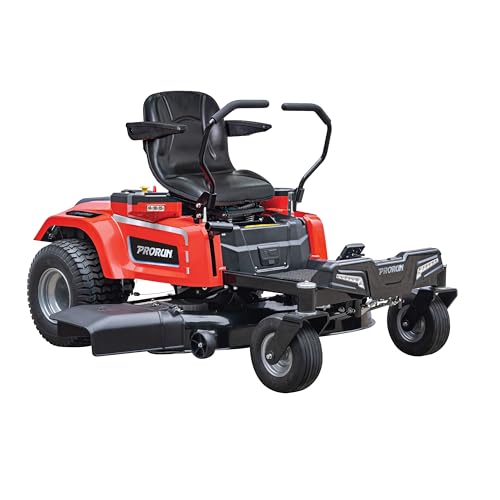
Pros
- High-efficiency brushless motors maximize power output and durability over traditional motors
- Up to 2 acres runtime with three included 10.0 Ah batteries supports substantial mowing sessions
- Zero-emission operation with gas-equivalent 20 HP power for quieter environmentally friendly use
- Six-port auto-switchover battery system provides flexible extended runtime options
- Durable 42-inch steel deck plus included mulch and towing kits add immediate functionality
Cons
- Runtime is limited to approximately 70 minutes or 2 acres which may require recharging for larger properties
- Fully battery-dependent design means performance relies on charge levels and spare battery availability
- 42-inch deck size may require more passes on expansive lawns compared to wider commercial models
The PRORUN PZT60V42 is a fully electric 60V zero-turn riding lawn mower built for residential and light commercial use. Its primary design centers on a robust 42-inch 14-gauge stamped steel twin blade deck powered by direct-drive brushless motors, giving an immediate impression of solid construction and modern battery-focused engineering. The mower arrives complete with three 10.0 Ah batteries, a charger, mulch kit, and towing kit for ready-to-work versatility.
In performance terms, four high-efficiency brushless motors deliver power equivalent to a 20 HP gas engine while producing zero emissions. The system supports up to 2.0 acres or 70 minutes of runtime, and six battery ports with auto switchover intelligently manage all PRORUN 60V battery sizes for continuous operation. A washout port on the steel deck further simplifies post-mow maintenance during real-world sessions.
Potential drawbacks include the finite 70-minute runtime window which can limit coverage on larger properties without spare batteries or recharge breaks. As a fully electric model, it also depends entirely on battery charge levels rather than continuous fuel refills, and the 42-inch deck width may demand extra passes compared with wider traditional options.
Overall the PRORUN PZT60V42 offers strong value for homeowners and small-property managers who want gas-like cutting power without emissions or noise. Those with medium-sized lawns seeking quiet efficient zero-turn performance and included accessories will benefit most from this electric mower.

Pros
- Strong 24HP FR730 engine power for demanding cutting conditions
- Wide 54-inch FAB deck reduces total mowing time
- Zero turn design delivers excellent maneuverability
- Fabricated deck supports durable everyday operation
Cons
- Sparse details beyond engine and deck leave other features unspecified
- Gas-powered FR730 engine needs regular fuel and maintenance
- Large 54-inch deck size may feel oversized on compact properties
The Husqvarna Z254F is a zero turn mower from the established Husqvarna brand in the riding lawn mowers category. It centers on a solid build that pairs a 24HP 726cc FR730 engine with a 54-inch FAB deck for straightforward residential grass care.
Performance stems directly from the listed specifications. The FR730 engine delivers the horsepower needed for steady operation across typical lawns while the wide FAB deck completes passes efficiently. Zero turn handling improves control in real yard layouts based on the model design.
Considerations arise from the limited data available. Secondary elements such as comfort features fuel capacity or extras receive no mention and the gas engine format involves routine upkeep. The large deck suits open areas better than confined spaces.
The Husqvarna Z254F provides the most value for owners of medium or large properties who want reliable engine power and a broad cutting width. Users with smaller lots or those seeking extensive accessory options should weigh the core specs carefully before purchase.
When a zero-turn helps on a compact lawn

The useful question is not whether a yard is “small enough” or “too small.” It is what you are trying to fix. Some people want less walking and pushing. Some want fewer leftover strips that need a string trimmer. Others want to finish a busy landscape without constant backing and three-point turns. A zero-turn mower only earns its keep if its near-zero turning radius solves one of those problems on your lot.
That agility pays off when the grass is broken into pockets rather than one open rectangle. Island beds, specimen trees, fence corners, play equipment, and dog-leg side yards force a conventional rider to swing wide, stop, reverse, and realign. Each extra maneuver leaves uncut crescents or forces a second pass. A machine that can pivot in place, or nearly in place, can stay closer to those obstacles and reduce the amount of grass you later chase with a trimmer. The benefit is about obstacle density and edge work, not about owning a more impressive mower.
The machine still has to fit the property. A residential compact zero-turn is a reasonable tool when the frame, deck, and turning envelope can travel the actual paths you have: through a gate, down a side yard, around a maple, and into a shed or garage. A large commercial-style zero-turn is usually the wrong answer on a home lot even if the grass would get cut. Those machines are built for long hours and wide open ground. On a compact lawn they are heavy, bulky, harder to store, and easier to scuff against fences, raised beds, and house siding.
Choose the category first, then judge the layout. If the lawn is mostly open and you mainly want to sit instead of walk, a simpler rider or a good walk-behind mower may already do the job. If the lawn is modest in area but full of things you must weave around, a compact zero-turn can be a practical fit rather than a luxury.
What people usually mean by a small yard
People use “small yard” loosely. One reader means a modest suburban lawn that takes a short walk to cross. Another means a tight urban backyard boxed in by fences, a patio, and a single gate. A third means a small front lawn plus a strip beside the driveway, with almost no storage space. Those properties can share a similar amount of grass and still need completely different tools.
Raw area is a weak starting point. Two lawns of similar size can feel nothing alike. One is a simple rectangle with a straight fence line and a wide garage door. The other has the same grass split by island beds, a play set, a narrow side gate, and a shed that barely fits a wheelbarrow. Calling both “small” does not tell you whether a riding deck will help or get in the way.
There is no single industry size that makes a zero-turn right or wrong. Manufacturers and dealers talk in general terms about compact home lots versus large properties, but they do not share one official cutoff you should treat as a rule. Shopping by a slogan such as a quarter-acre or half-acre threshold skips the details that actually decide the purchase: shape, obstacles, access, storage, and terrain.
Think in scenes, not square footage. Can you walk the whole lawn in a few minutes without feeling you have crossed a field? Is most of the work around edges rather than down the middle? Is the hard part getting equipment in and out, not covering ground? If those answers are yes, you are in the territory this article is about. The next step is to look at how a near-zero turning radius behaves in that kind of space.
How a near-zero turning radius helps and hurts
A traditional lawn tractor uses a steering wheel and a front axle that swings through an arc. You turn the way a car turns, so the rear of the machine follows a wider path than the front. In an open yard that is fine. Around a tree or a flower island, the tractor often needs extra room, a backup, or a second pass to finish the grass the deck missed on the first swing.
A zero-turn mower typically steers by changing the speed or direction of the two drive wheels, usually with dual levers or lap bars. One wheel can roll forward while the other slows, stops, or reverses. That is why these machines can typically spin in place or nearly in place. Manufacturer turning-radius claims vary and should be read as marketing language until you see the specific machine move. What matters on a home lawn is the practical difference: you can pivot close to an obstacle instead of driving a wide loop around it.
That helps in several everyday spots:
- Around trees and mailbox posts, where a wide arc leaves a ring of uncut grass.
- Along island beds and kidney-shaped borders, where you keep changing direction.
- In fence corners and against buildings, where a tractor’s tail swings out.
- On irregular edges, where the lawn pinches between a patio, a garden, and a walkway.
The same agility can work against you. Dual-lever steering is sensitive. A small extra push on one bar can put a rear tire into mulch, scrape a deck corner on a raised bed, or clip a shrub you meant to skim. Along a flower border there is less of the “slow, wide, predictable” feel many people have with a steering wheel. Near windows, parked cars, and painted siding, that quickness means less room for a late correction.
Deck width and overall bulk can cancel the benefit of a tight turn. A wide cutting deck finishes an open stretch with fewer passes, but it also has to fit between two trees, beside a fence, and through a gate. If the deck or the machine’s widest point cannot slip through the tightest gap on the lot, the famous turning radius does not help. You will still leave uncut strips wherever the deck cannot get fully around an obstacle, and you will still need a trimmer or a smaller mower for those leftovers.
Gates and path width deserve special attention. A zero-turn does not become narrow just because it can spin. The operator still needs space to line up, start moving, and recover from a crooked approach. A gate that is only barely wider than the deck can be a weekly frustration, especially if the approach is uphill, off-camber, or blocked by a trash bin or HVAC unit.
When a zero-turn is overkill
A machine can cut the grass and still be more mower than the property needs. Ownership burden matters as much as cutting ability.
A walk-behind mower is often the more practical tool when the lawn is compact, storage is tight, and access is narrow. Push and self-propelled models generally cost less than a rider, take a fraction of the floor space, and roll through gates and shed doors that would stop a deck. A self-propelled walk-behind already removes much of the physical work of covering ground. If the main complaint is tired legs rather than endless trim work around islands, stepping up to a rider may not change the weekly routine as much as you expect.
A compact lawn tractor or a smaller traditional rider can be enough when the lawn is open and turns are few. You drive down the length, make a wide U-turn at the end, and come back. There is little to weave around, so the wider turning arc is only a mild inconvenience. You also keep a steering-wheel layout that many people find easier to learn, especially if more than one person in the household will mow.
Zero-turns typically add purchase cost, weight, and mechanical complexity compared with a similar walk-behind. They need storage space, a learning period, and ongoing maintenance that is closer to a small vehicle than to a push mower. Fuel or charging needs, blade service, belt and hydrostatic care, and winter storage all scale up. Even if the machine would mow the grass beautifully, those extras are wasted if the lawn never uses the tight-turn capability.
There are also walk-behind and stand-on designs with very tight turns, including walk-behind zero-turn layouts. They exist as a category for people who want maneuverability without a full-size riding platform. They still need storage, maintenance, and a path wide enough for the deck. Mentioning them is useful so you do not assume “zero-turn” always means a large sit-down machine. It is not a reason to chase a particular model without measuring the yard.
If the lawn is a simple open patch, a simpler mower is often enough. The extra capability of a zero-turn is not free, and it does not automatically make a small, easy lawn faster or nicer to maintain.
Footprint, storage, access, and the learning curve
Before you shop, measure the path the mower must actually travel, not just the grass. Useful measurements include:
- Gate openings, including hinges, latches, and any inward swing that steals width.
- Side-yard paths between the house and the fence, plus downspouts, meters, and heat pumps.
- Shed or garage door width and height, and the clear floor space once the door is closed.
- The tightest gap between trees, beds, play equipment, or permanent posts.
- Any trailer, truck bed, or driveway turn you would use if the machine cannot live on site year-round.
Compare those numbers with the machine’s overall width with the deck installed, its length, and the extra room an operator needs to start, stop, and turn. Advertised cutting width is only the grass the blades can reach in a straight line. The turning envelope is larger than the deck. You also need space to climb on, to open a chute or bagger if you use one, and to walk around the machine for fueling, charging, or cleaning. A compact residential zero-turn exists specifically because many home lots cannot swallow a wide commercial unit. That still does not make every compact model small enough for every backyard.
Storage space is a frequent deal-breaker. Riding mowers want a dry, reasonably level floor and enough clearance that you are not squeezing past hot engines or sharp deck corners every weekend. People without a large garage often end up parking a rider outdoors under a cover, rolling it to a distant shed, or giving up a parking space. If that sounds unworkable, a walk-behind that hangs on a wall or tucks beside a trash can is the more honest match.
Transport follows the same logic. A rider that cannot stay at the property has to be loaded and unloaded. Ramps, hitch setups, and vehicle capacity are owner-specific; do not guess at weights or trailer classes from a brochure headline. If loading a heavy machine is not something you want to do regularly, either keep the mower on site or stay with equipment you can lift or roll by hand.
The learning curve is real on a small lot because there is little room for mistakes. New operators often overcorrect with lap bars or steering levers. The machine can spin faster than expected, drift a rear tire into a bed, or lurch when one lever moves farther than the other. An open practice area helps. A cramped backyard with brick edging and a glass door does not. If several people will mow, each of them needs time to get smooth. A steering-wheel rider or a walk-behind is more forgiving while that happens.
Yard features that matter more than lawn size
Layout decides the tool more reliably than a size label. Features that favor a compact zero-turn include many trees, island beds, irregular edges, and tight fence corners. In those yards the weekly job is a series of short runs and direction changes. Sitting down and pivoting can reduce both walking and leftover trim work, provided the machine can physically reach those pockets.
Features that argue against any riding mower include very narrow access, almost no storage, a lawn broken into tiny scraps of grass among hardscape, frequently wet or soft soil, and steep slopes. A riding deck is unhappy on pavers, between closely spaced raised beds, and on ground that ruts under weight. If most of the “yard” is patio, gravel, and planting beds with only ribbons of turf, you will spend more time navigating than cutting.
Everyday objects change the usefulness of a riding deck:
- Gates and fences set the maximum machine width and the approach angle.
- Raised beds and decorative edging punish wide decks and rear-wheel swing.
- Play equipment creates moving obstacles and leftover rings of grass.
- Pets mean you need a routine for getting animals inside before blades are engaged.
- Windows, parked cars, and gravel paths raise the cost of a thrown object or a misjudged turn.
Terrain sits beside layout. A small slope can be a gentle bank a walk-behind handles easily and a rider should avoid. Soft ground after rain may support a person and a walk-behind but leave ruts from a heavy zero-turn. Shade-tree roots and uneven transitions from lawn to walkway can scrape a low deck. Two yards of similar size can therefore need completely different mowers: one an open, dry, gently sloped rectangle that a basic walk-behind finishes without drama, and another a flat but busy landscape where a compact residential zero-turn finally makes the edges manageable.
How to decide before you buy or rent
Turn the layout into a weekend checklist instead of shopping from lawn size alone.
- Walk the property as if you were the mower. Follow every path from storage to the farthest corner. Note every squeeze point, reverse, and leftover strip you currently trim by hand.
- Photograph the tight spots: gates, side yards, shed doors, tree gaps, and fence corners. Photos help you remember scale when you later look at machines.
- Measure gate width, door openings, path width, and the narrowest gap between fixed obstacles. Write the numbers down. Compare them later with overall machine width, not only advertised deck width.
- Decide what problem you are solving. If it is physical effort on an open lawn, a self-propelled walk-behind or a compact traditional rider may be enough. If it is constant weaving around beds and trees, a compact zero-turn belongs on the short list.
- Compare three categories on paper: a walk-behind mower, a compact lawn tractor or rear-engine-style rider, and a compact residential zero-turn. For each, ask whether it fits the gate, the shed, the tightest gap, and the way you like to steer.
- Answer the ownership questions honestly. Who will operate it? Is there dry storage? Are you comfortable with more maintenance than a walk-behind needs? Will the machine live here year-round or need to be transported?
Renting or borrowing a compact zero-turn can be a better first step than buying when you have never steered one, when the yard is a borderline fit, or when you only need extra capacity for a short growing burst. Use a legal, owner-approved option such as a rental yard or a dealer demonstration. A short session on your own grass, or on a similar lot, tells you more than a parking-lot spin: whether the deck fits the gate, whether the levers feel controllable near beds, and whether the machine feels like relief or like too much hardware.
Do not expect renting to be automatically cheaper than buying, and do not shop on promised time savings or resale stories. The point of a trial is fit and comfort. If the rental feels clumsy in your side yard, a purchased machine of the same class will not magically shrink.
Safety, slopes, and other limits size does not fix
A smaller lawn does not make a riding mower safer. Tight spaces, drop-offs, and slopes are still serious. Read the operator manual and the on-machine labels for the specific model, and treat those instructions as the rule set for that machine. The notes below are general cautions, not a substitute for the manual and not a slope rating.
Riding mowers, including zero-turns, are a poor match for steep slopes, retaining-wall edges, creek banks, porch drop-offs, and wet or unstable ground. Weight that is helpful on flat turf becomes a rollover or slide risk on a bank. Many operators find zero-turn steering less confidence-inspiring on side slopes than a steering-wheel rider, because the machine turns by changing wheel speed and because traction on one drive wheel can change suddenly. If one wheel loses grip on wet grass, the mower may not go where the levers suggest. When the ground is slick, rutted, or pitched, choose a walk-behind or wait for better conditions rather than forcing a rider through.
Basic habits reduce injury risk on any property:
- Keep children, bystanders, and pets indoors or well away before the blades are engaged.
- Never carry passengers. A zero-turn is not a bench seat for a helper or a child.
- Disengage the blade, wait for it to stop, set the controls in a safe state, and stop the engine before leaving the seat.
- Watch for gravel, toys, wire, and stones that a deck can throw toward windows, cars, and people.
- Go slowly near structures, fences, and beds. Tight-space operation leaves little room to recover.
- Do not defeat safety interlocks or remove guards. If a switch or shield is damaged, have it repaired before use.
Fuel, batteries, and storage have their own hazards. Gasoline belongs in approved containers, away from ignition sources, and never in a closed living space. Batteries and chargers need the ventilation, dryness, and clearances the manufacturer specifies. A crowded shed with a hot engine, a gas can, and a pile of cardboard is a bad combination on a small lot just as it is on a large one. Follow the manual for fueling, charging, and seasonal storage. If electrical, fuel-system, or structural repairs are beyond a simple owner task, use a qualified technician.
Choose a walk-behind for control when the lot is cramped, sloped, or broken into scraps of turf. A rider that barely fits is not a clever use of space; it is a weekly chance to hit something or lose traction. Size does not fix a bad match between machine and ground. If the honest walk-through says the zero-turn will spend its life squeezing, scraping, and climbing banks it is not meant for, the practical answer is a simpler mower, not a more agile one.
A conditions-based answer, not a size rule
A zero-turn mower is neither automatically right nor automatically wrong for a small yard. It is a good choice when a compact residential machine can reach a busy, obstacle-filled lawn, pass the gates, and live in the storage you actually have. It is overkill when the grass is an open, simple patch, when access or storage is too tight, or when slopes and soft ground make any rider a poor idea. Measure the path, judge the obstacles, and pick the least complicated tool that solves the real weekly problem.









