

Quick Answer: Is 300 Hours A Lot On A Lawn Mower?
Three hundred hours is not automatically a lot or a little on a lawn mower. An hour meter usually records engine run time, not calendar age, and the same number can look light, typical, or concerning depending on whether the machine is a walk-behind or a rider, how hard those hours were worked, the conditions it faced, and whether it…

Pros
- Powerful 80V brushless motor delivers 32HP gas-equivalent performance with quiet fume-free operation and no engine maintenance.
- Complete kit includes four 6.0Ah batteries and 600W charger for substantial runtime up to 1.5 acres.
- SmartCut technology and 42-inch heavy-duty steel deck ensure consistent cuts without bogging in tough conditions.
- Versatile towing up to 350 lbs and optional cargo hauling plus comfort features like high-back seat and LED lights.
- Strong 4-year limited warranty and full compatibility with the Greenworks 80V tool ecosystem.
Cons
- Rear utility cargo bed for 200 lb hauling is sold separately and not included in the kit.
- Runtime of up to 1.5 acres varies with conditions and may require recharging or battery swaps on larger properties.
- As a fully cordless model continuous operation depends on battery levels unlike gas engines with unlimited runtime.
The Greenworks 80V 42" CrossoverT Cordless Riding Lawn Tractor is a ready-to-mow zero-emission tractor designed for homeowners managing medium to large lawns. It features a reinforced 42-inch stamped steel deck of 12-gauge construction along with premium comfort elements such as a high-back padded seat with foldable armrests. The overall build emphasizes durability and user convenience right out of the box with the included battery and charger set.
Performance centers on the 80V TruBrushless motor that provides 32HP gas-equivalent power with instant torque and quiet fume-free operation. SmartCut technology senses grass conditions and automatically adjusts power to maintain a consistent cut even in tall thick or wet areas. The four 6.0Ah batteries support runtime for up to 1.5 acres depending on conditions while dual LED headlights and a 7-position deck height range from 1.5" to 4.5" add practicality. Front and rear attachments further allow towing up to 350 lbs for added yard utility.
Key considerations include that the rear utility storage bin capable of hauling 200 lbs is sold separately so full cargo functionality requires an extra purchase. Runtime remains condition-dependent and may fall short for properties significantly larger than 1.5 acres without using the 600W charger or swapping batteries. The cordless design prioritizes ease and low maintenance but trades off the continuous runtime of traditional gas models.
This tractor delivers strong value for eco-conscious owners of residential properties who want gas-like power without the emissions noise or upkeep. It suits those who already use or plan to expand into the Greenworks 80V family of tools and who appreciate the 4-year limited warranty. Users with exceptionally large or commercial-scale lawns should evaluate battery logistics carefully before purchase.

Pros
- Delivers strong 21 horsepower equivalent power comparable to gas riding mowers.
- Provides up to 1.5 acres of runtime on a full charge with the six included batteries.
- Features low-maintenance dual brushless motors without belts for greater durability.
- Offers versatile 12-position cutting height adjustment from 1.5 to 4.5 inches.
- Includes digital controls for blade settings, drive speeds, and cruise control.
Cons
- Limited to 1.5 acres of cutting per charge without purchasing additional batteries for bigger lawns.
- Requires recharging time for the six 56V batteries after each use session.
- Relies solely on battery power with no hybrid or gas backup option for extended operation.
The EGO Power+ TR4204 is a cordless electric riding lawn mower built as a modern tractor alternative for residential use. It features a robust 42-inch stamped steel deck and arrives ready to go with six 56V 6.0Ah batteries plus a charger, creating an immediate impression of convenience and solid construction free from gas engine complexity.
Performance shines through its equivalent 21 horsepower output and top speed of 6 MPH, allowing efficient coverage of up to 1.5 acres on a single charge. Dual brushless cutting motors operate without belts for added durability and less upkeep, while the digital display lets users select three blade settings, three drive speeds, and cruise control. The 12 adjustable heights ranging from 1.5 to 4.5 inches combined with anti-scalp wheels deliver precise results across varied terrain.
Drawbacks center on battery dependency, as larger properties beyond 1.5 acres require extra batteries and recharging intervals can interrupt workflow. The fully electric design eliminates fuel storage needs but demands access to power sources between sessions.
This mower suits homeowners with medium to large yards who value quiet, emission-free operation and reduced maintenance. Those seeking expandable battery capacity for bigger areas will find the EGO Power+ TR4204 a strong long-term investment in cordless lawn care.
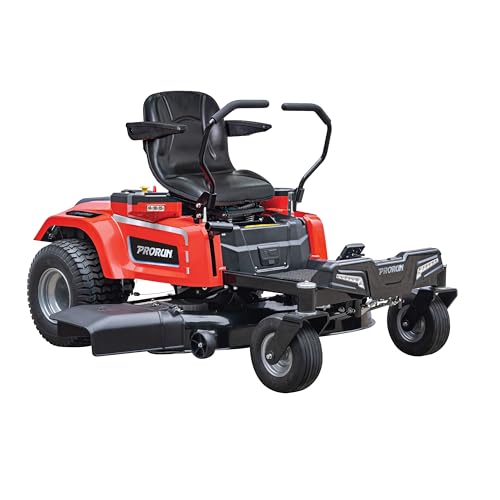
Pros
- High-efficiency brushless motors maximize power output and durability over traditional motors
- Up to 2 acres runtime with three included 10.0 Ah batteries supports substantial mowing sessions
- Zero-emission operation with gas-equivalent 20 HP power for quieter environmentally friendly use
- Six-port auto-switchover battery system provides flexible extended runtime options
- Durable 42-inch steel deck plus included mulch and towing kits add immediate functionality
Cons
- Runtime is limited to approximately 70 minutes or 2 acres which may require recharging for larger properties
- Fully battery-dependent design means performance relies on charge levels and spare battery availability
- 42-inch deck size may require more passes on expansive lawns compared to wider commercial models
The PRORUN PZT60V42 is a fully electric 60V zero-turn riding lawn mower built for residential and light commercial use. Its primary design centers on a robust 42-inch 14-gauge stamped steel twin blade deck powered by direct-drive brushless motors, giving an immediate impression of solid construction and modern battery-focused engineering. The mower arrives complete with three 10.0 Ah batteries, a charger, mulch kit, and towing kit for ready-to-work versatility.
In performance terms, four high-efficiency brushless motors deliver power equivalent to a 20 HP gas engine while producing zero emissions. The system supports up to 2.0 acres or 70 minutes of runtime, and six battery ports with auto switchover intelligently manage all PRORUN 60V battery sizes for continuous operation. A washout port on the steel deck further simplifies post-mow maintenance during real-world sessions.
Potential drawbacks include the finite 70-minute runtime window which can limit coverage on larger properties without spare batteries or recharge breaks. As a fully electric model, it also depends entirely on battery charge levels rather than continuous fuel refills, and the 42-inch deck width may demand extra passes compared with wider traditional options.
Overall the PRORUN PZT60V42 offers strong value for homeowners and small-property managers who want gas-like cutting power without emissions or noise. Those with medium-sized lawns seeking quiet efficient zero-turn performance and included accessories will benefit most from this electric mower.

Pros
- Strong 24HP FR730 engine power for demanding cutting conditions
- Wide 54-inch FAB deck reduces total mowing time
- Zero turn design delivers excellent maneuverability
- Fabricated deck supports durable everyday operation
Cons
- Sparse details beyond engine and deck leave other features unspecified
- Gas-powered FR730 engine needs regular fuel and maintenance
- Large 54-inch deck size may feel oversized on compact properties
The Husqvarna Z254F is a zero turn mower from the established Husqvarna brand in the riding lawn mowers category. It centers on a solid build that pairs a 24HP 726cc FR730 engine with a 54-inch FAB deck for straightforward residential grass care.
Performance stems directly from the listed specifications. The FR730 engine delivers the horsepower needed for steady operation across typical lawns while the wide FAB deck completes passes efficiently. Zero turn handling improves control in real yard layouts based on the model design.
Considerations arise from the limited data available. Secondary elements such as comfort features fuel capacity or extras receive no mention and the gas engine format involves routine upkeep. The large deck suits open areas better than confined spaces.
The Husqvarna Z254F provides the most value for owners of medium or large properties who want reliable engine power and a broad cutting width. Users with smaller lots or those seeking extensive accessory options should weigh the core specs carefully before purchase.
What an hour meter usually measures

On many riding mowers, and on some walk-behind machines, an hour meter is a run-time counter. In everyday terms, it usually tracks how long the engine has been on. That is not the same thing as how long the mower has been owned, how many summers it has sat in a shed, or even how many of those minutes were spent actually cutting grass. Idle time in the driveway, transport across a property, and pauses with the engine still running can all add to engine hours.
Calendar age and engine hours answer different questions. A five-year-old mower that is started only a few times a season can have a low hour reading and still have old fuel, dry-rotted tires, or a rusty deck. A much newer machine used on a large property can reach 300 engine hours sooner and still look mechanically fresh if it was serviced and stored well. The meter does not know whether those hours were gentle residential cutting or hard, dusty work.
Not every lawn mower has a trustworthy hour meter. Plenty of homeowner walk-behind mowers have none at all. Others have a display that failed, a meter that was never watched, or only a seller’s estimate. Some listings copy a previous owner’s number, guess from “a couple of seasons,” or treat key-on time and cutting time as if they were the same. Meter design also varies by machine, so you should not assume every display counts in exactly the same way, or that a reading cannot be incomplete, inaccurate, or tampered with.
When hours are missing, treat the number as unknown rather than zero. Ask how the figure was recorded, whether it is engine run time, and whether anyone has reason to think the meter was replaced, disconnected, or reset. If the answer is vague, lean harder on physical condition and a used mower inspection instead of the dashboard.
Why 300 hours cannot be judged by itself
Three hundred hours is not a pass-or-fail lifespan score. It is a moderate-looking data point only after you know the machine class, the load those hours carried, the environment, and the maintenance that did or did not happen. The same reading can describe a lightly used residential rider, a walk-behind that has already seen a lot of work for its size, or a neglected machine whose real wear is elsewhere.
Hours do not measure the things that actually decide whether a mower still cuts well. Blade sharpness and balance, deck rust, belt cracking, spindle play, cable stretch, tire dry rot, and skipped oil or air-filter service all sit outside the meter. Two mowers can show 300 engine hours and be in very different condition because one cut short, dry turf and received regular care, while the other bagged wet clippings, climbed slopes, sat with old fuel, or was stored dirty.
That is why you should resist converting 300 hours into “half used,” “almost new,” or “near the end.” Those phrases imply a known total life, and a single hour count cannot supply one. Remaining service life is a judgment about the whole machine: how it starts and runs, what the deck and drivetrain look like, what work it did, and whether anyone can show a coherent service story.
How mower type changes the meaning of 300 hours
Walk-behind mowers, riding mowers, and zero-turn mowers should not be compared as if the same hour count means the same amount of remaining life. They are built for different sessions, different loads, and different ways of accumulating engine run time.
Walk-behind mowers
A typical homeowner walk-behind often works in shorter bursts. The operator walks, the session ends when the yard is done, and many of these machines never get a reliable hour meter. Because hours tend to accumulate more slowly, 300 recorded hours on a walk-behind can be more notable if the number is genuine. It may simply mean the mower was used a lot, used on a large lot, or used in a setting closer to heavy residential or light commercial work than a small suburban lawn.
It can also mean the reading is an estimate. If a push mower listing claims 300 hours with no meter in sight, ask what that figure is based on. Without a working counter, “hours” are a story, not a measurement.
Riding mowers and zero-turn mowers
Riding mowers and zero-turn mowers are designed for longer sitting-and-mowing sessions. The engine stays on while the operator covers more ground, turns, empties a bagger, or moves between areas. For that reason, 300 hours is more commonly seen on riders than on homeowner walk-behinds, and it is still incomplete without duty-cycle context. A compact lawn tractor used on a modest yard is not the same working life as a wide zero-turn that spent those hours on thick turf, slopes, or property-maintenance work.
Compare similar machine classes. A buyer looking at a used rider should weigh 300 hours against other riders of roughly the same size and intended use, not against a push mower. A walk-behind should be judged against other walk-behinds. Crossing those categories turns the hour meter into a false common language.
Duty cycle, load, and operating conditions
How the hours were used can matter as much as how many hours exist. A light hour is not a formal rating; it is a plain-language way to describe easy work. Light residential cutting usually means reasonably maintained turf, modest height, fairly level ground, and an engine that is not constantly laboring. A hard hour is continuous cutting of thick, wet, or overgrown grass, work on slopes, sandy or dusty conditions, bagging under load, or using a rider like a small tractor to tow or push more than it was clearly set up to do.
Tall grass and wet clippings make the deck, belts, and engine work harder. Hills add load to the drivetrain and can increase heat. Dust and sand chew at air filters, cooling fins, spindles, and painted surfaces. Moisture and packed clippings hold debris against the deck and hardware. Heat and poor airflow are hard on engines even when the hour meter is only ticking slowly. Impact with hidden roots, rocks, stumps, or curbs can bend a blade, damage a spindle, or, after a severe strike, raise concern about the crankshaft. None of that is captured as a separate line on the meter.
The pattern of use matters too. Short, frequent starts expose the engine to more warm-up and cool-down cycles, more choke use, and more chances for stale fuel to cause trouble between outings. Long, steady mowing builds hours faster but can be gentler if the machine is up to temperature, the air filter stays clean, and the operator is not constantly overloading the deck. Neither pattern is automatically “better.” They simply wear different parts in different ways.
Residential versus heavy use is a spectrum, not a label on the hour display. A homeowner with several acres, a bagger, and a habit of cutting infrequently can put commercial-style stress on a residential machine. A lightly used rider on a small, flat lawn can look almost unused at the same 300-hour mark. Ask what the mower cut, how often it ran, whether it bagged or towed, and what the ground was like.
Maintenance history often matters more than the hour count
A well-maintained higher-hour mower can be in better shape than a neglected machine with fewer hours. The meter only says the engine ran. Maintenance says whether anyone protected the engine, cutting system, and chassis during that run time.
For a homeowner machine, the service themes that most often change the meaning of 300 hours are straightforward:
- Engine oil and, when the engine uses one, the oil filter
- Air filter cleanliness and timely replacement
- Fresh fuel and basic fuel-system care, including what happens during storage
- Spark plug condition
- Blade sharpness, balance, and the absence of severe bends
- Deck cleaning so clippings and moisture are not left packed against metal
- Belt condition and tracking
- Tire condition, including cracking or dry rot
- Storage practices: dry, reasonably clean, and not left with a neglected fuel system
Those are themes, not a substitute for the specific model’s manual. Service intervals, capacities, and procedures belong in that manual when you have it. This article will not invent hour- or month-based schedules, because those vary by engine, climate, and manufacturer guidance.
Records help, but physical clues matter even when paperwork is thin. Clean cooling fins, a deck that has been scraped or washed rather than left caked, recent-looking filters, oil that does not look neglected on the dipstick, and a seller who can describe oil changes, blade work, and winter storage in ordinary detail all suggest care. A grimy engine, a mouse nest in the cowling, a sour fuel smell, a deck packed with composted clippings, or a shrug when you ask about oil are warning signs that modest hours may still hide extra wear.
Neglected oil, a clogged air filter, old fuel, a packed deck, or a mower stored wet and dirty can make 300 hours look worse than a higher-hour machine that was kept on a simple routine. If you are buying, ask what was done and when, in plain language. If you already own the mower, the hour reading is a reminder to check the manual and catch up on overdue basics before you decide the machine is “used up.”
What else besides hours indicates remaining life
A used mower inspection should start with your eyes, ears, and nose, then move to how the machine actually runs. Hours do not measure blade condition, deck rust, belt wear, spindle play, or impact damage. Those show up on the machine itself.
Starting and running
Watch a cold start if you can, then listen again after the engine is warm. Note whether it starts without an unusual struggle, whether it stays running, and whether idle and throttle response sound even. Smoke, a raw fuel smell, a burning-oil smell, or exhaust that seems clearly abnormal are more important than the number on the meter. Do not treat a single glance at idle as a complete diagnosis. If something sounds knocking, grinding, screaming, or otherwise unlike a normal small engine under load, have a mechanic interpret the noise rather than guessing from an article.
Leaks, belts, and the cutting system
Look under and around the engine and transaxle or hydrostatic unit for wet stains that suggest fuel, oil, or other fluid leaks. Check belts for cracking, glazing, fraying, or a history of rubbing the wrong surfaces. On the deck, look for rust scale, holes, bent baffles, cracked welds or stampings, and missing or damaged discharge hardware. Spindles should not show obvious looseness or grinding when you inspect them carefully with the engine off and the spark-plug lead disconnected so the blade cannot start. Bent or heavily battered blades, missing blade hardware, or an uneven cut on a test strip all point to problems the hour meter never counted.
Chassis, controls, and storage damage
On a riding mower or zero-turn, check steering or lap-bar play, deck-lift play, and whether the machine tracks in a reasonably straight, controllable way at low speed in a safe open area. Tires that are cracked, flat-spotted, or dry-rotted speak to age and storage more than to engine hours. Corroded cables, seized adjusters, brittle wiring, and rusted fasteners are independent of the meter. Impact marks on the front, a crumpled chute, or a deck that looks as if it has been used as a bumper are clues to hidden damage.
Some problems should outweigh the hour reading immediately. Rust-through on a structurally important part of the deck, a machine that will not start or stay running, obvious fluid leaks, seized or sloppy spindles, or a serious impact that makes you suspect the crankshaft or chassis has been bent are decision-level issues. None of those can be cleared by saying “it only has 300 hours.”
If you are not sure what you are seeing, get a knowledgeable in-person look or take the mower to a qualified small-engine shop. Hours alone cannot certify that a used mower is safe or reliable, and an uncertain noise, leak, or impact history is exactly the kind of issue a shop is better equipped to evaluate.
When 300 hours may look modest versus more concerning
These are judgment cues, not guarantees. They help you apply the earlier factors instead of hunting for a universal rule that 300 hours is “low” or “high.”
Three hundred hours is usually not alarming by itself when the machine is in a similar class to what you need, the use story sounds residential and coherent, there is some evidence of service, the deck and engine area are reasonably clean, the mower starts and runs strongly, and you do not find major structural damage or leaks. In that setting, the hour meter is simply confirming that the engine has been used, not that it is worn out.
The same 300 hours should raise more caution when use is unknown or sounds like heavy, continuous, commercial-style work; when nobody can describe maintenance; when the mower smokes, starts hard, or makes knocking or grinding sounds; when fluids are leaking; when the deck is badly rusted or cracked; when spindles are seized or sloppy; or when the meter does not match the wear you can see. A shiny console and a tired, sandblasted deck are a mismatch. So is a very low-looking machine paired with a high-confidence hour claim and no meter you can verify.
When you talk with a seller, keep the conversation specific. Ask whether the number is from a working hour meter, what the mower actually cut, whether it bagged, whether it towed, where it was stored, and what service was done. You are not trying to catch someone in a trick question. You are testing whether the hour figure sits inside a believable story that matches the machine in front of you.
Using hours when buying or keeping a mower
For a listing, treat 300 hours as a conversation starter, not the headline reason to buy or walk away. Useful questions include:
- How were the hours recorded, and can you see the meter working?
- What size and type of area did it cut, and how often?
- Did it bag clippings, mulch, or side-discharge most of the time?
- Was it used to tow, plow, or do other non-mowing work?
- Where was it stored in the off-season, and how was fuel handled?
- What maintenance was done, and are there receipts, notes, or at least a clear verbal list?
- Has it hit anything serious, and has the deck, spindle, or blade been repaired?
Put hours beside the rest of the package: machine type, visible wear, repairs you can already see coming, parts availability for that model, and whether you are comfortable doing basic service or paying a shop. Cost talk should stay qualitative. A used mower can need inspection time, fresh fluids, blades, belts, filters, and possibly a shop diagnosis even when it runs. Those are normal wear and upkeep items after years of use. They are not a hidden price list, and they are not a forecast of “hours left.”
If you already own a 300-hour mower and it starts, runs, and cuts, the practical question is whether continued maintenance still makes sense relative to the machine’s condition, not whether the meter has crossed an imaginary line. Repairing a known machine can be sensible when the chassis and deck are sound, parts are obtainable, the engine is fundamentally healthy, and the needed work is ordinary wear. Replacing it becomes more attractive when rust, impact damage, or an engine and drivetrain that already run poorly would stack several uncertain repairs on top of each other. That is a condition decision, not an hour-threshold decision.
If you cannot verify condition, get a professional inspection rather than buying on the hour number. A shop will not turn 300 hours into a remaining-life certificate either, but it can tell you whether the engine, deck, and safety-related parts look serviceable before you take the machine home.
Limits, safety, and what this number cannot tell you
An hour meter can miss or misrepresent a lot. It may not exist. It may have failed. It may have been replaced with the machine already used. It may count in a way the seller does not fully understand. It does not record overload, impact, rust, mice in the wiring, water in the fuel, or a blade that was run over a hidden hazard last season. Listings may guess hours, copy a previous owner’s number, or omit the hard use that actually defines the machine.
Hours also do not prove the mower is safe to operate, free of hidden damage, or compliant with any current standard. Fuel, a spinning blade, belts, and other moving parts are hazards on any mower, new or used. Inspect before use, keep guards and deflectors in place, and do not run a machine with unknown mechanical problems just because the meter looks acceptable. If a safety interlock, brake, blade-stop behavior, or guard is missing or questionable, that is a reason to stop and get qualified help, not a reason to keep shopping by hour count.
Ignore listing language that treats 300 hours as a certified remaining life, a factory hour-life rating, or proof the mower is “barely used” without evidence. Manufacturer life claims, commercial-versus-residential hour limits, and model-specific service intervals only mean something when they come from the actual manual or a sourced specification. This article does not invent those figures, and a sales sentence should not invent them either.
The useful conclusion is simple. Three hundred hours on a lawn mower is information, not a verdict. Read the hour meter as engine run time, place it in the context of walk-behind versus riding or zero-turn use, ask how hard those hours were, look at maintenance, and then decide from a real inspection. That is how 300 hours becomes a clue you can use instead of a number that uses you.









