

Quick Answer: What Does Zero Turn Mean?
Zero turn means a zero turning radius: the machine is designed to pivot around its own center instead of swinging through a wide steered arc. In everyday use the phrase almost always refers to a zero-turn lawn mower, also called a ZTR. Those machines change heading by driving the two sides independently, so they can tighten a turn or reverse…

Pros
- Powerful 80V brushless motor delivers 32HP gas-equivalent performance with quiet fume-free operation and no engine maintenance.
- Complete kit includes four 6.0Ah batteries and 600W charger for substantial runtime up to 1.5 acres.
- SmartCut technology and 42-inch heavy-duty steel deck ensure consistent cuts without bogging in tough conditions.
- Versatile towing up to 350 lbs and optional cargo hauling plus comfort features like high-back seat and LED lights.
- Strong 4-year limited warranty and full compatibility with the Greenworks 80V tool ecosystem.
Cons
- Rear utility cargo bed for 200 lb hauling is sold separately and not included in the kit.
- Runtime of up to 1.5 acres varies with conditions and may require recharging or battery swaps on larger properties.
- As a fully cordless model continuous operation depends on battery levels unlike gas engines with unlimited runtime.
The Greenworks 80V 42" CrossoverT Cordless Riding Lawn Tractor is a ready-to-mow zero-emission tractor designed for homeowners managing medium to large lawns. It features a reinforced 42-inch stamped steel deck of 12-gauge construction along with premium comfort elements such as a high-back padded seat with foldable armrests. The overall build emphasizes durability and user convenience right out of the box with the included battery and charger set.
Performance centers on the 80V TruBrushless motor that provides 32HP gas-equivalent power with instant torque and quiet fume-free operation. SmartCut technology senses grass conditions and automatically adjusts power to maintain a consistent cut even in tall thick or wet areas. The four 6.0Ah batteries support runtime for up to 1.5 acres depending on conditions while dual LED headlights and a 7-position deck height range from 1.5" to 4.5" add practicality. Front and rear attachments further allow towing up to 350 lbs for added yard utility.
Key considerations include that the rear utility storage bin capable of hauling 200 lbs is sold separately so full cargo functionality requires an extra purchase. Runtime remains condition-dependent and may fall short for properties significantly larger than 1.5 acres without using the 600W charger or swapping batteries. The cordless design prioritizes ease and low maintenance but trades off the continuous runtime of traditional gas models.
This tractor delivers strong value for eco-conscious owners of residential properties who want gas-like power without the emissions noise or upkeep. It suits those who already use or plan to expand into the Greenworks 80V family of tools and who appreciate the 4-year limited warranty. Users with exceptionally large or commercial-scale lawns should evaluate battery logistics carefully before purchase.

Pros
- Delivers strong 21 horsepower equivalent power comparable to gas riding mowers.
- Provides up to 1.5 acres of runtime on a full charge with the six included batteries.
- Features low-maintenance dual brushless motors without belts for greater durability.
- Offers versatile 12-position cutting height adjustment from 1.5 to 4.5 inches.
- Includes digital controls for blade settings, drive speeds, and cruise control.
Cons
- Limited to 1.5 acres of cutting per charge without purchasing additional batteries for bigger lawns.
- Requires recharging time for the six 56V batteries after each use session.
- Relies solely on battery power with no hybrid or gas backup option for extended operation.
The EGO Power+ TR4204 is a cordless electric riding lawn mower built as a modern tractor alternative for residential use. It features a robust 42-inch stamped steel deck and arrives ready to go with six 56V 6.0Ah batteries plus a charger, creating an immediate impression of convenience and solid construction free from gas engine complexity.
Performance shines through its equivalent 21 horsepower output and top speed of 6 MPH, allowing efficient coverage of up to 1.5 acres on a single charge. Dual brushless cutting motors operate without belts for added durability and less upkeep, while the digital display lets users select three blade settings, three drive speeds, and cruise control. The 12 adjustable heights ranging from 1.5 to 4.5 inches combined with anti-scalp wheels deliver precise results across varied terrain.
Drawbacks center on battery dependency, as larger properties beyond 1.5 acres require extra batteries and recharging intervals can interrupt workflow. The fully electric design eliminates fuel storage needs but demands access to power sources between sessions.
This mower suits homeowners with medium to large yards who value quiet, emission-free operation and reduced maintenance. Those seeking expandable battery capacity for bigger areas will find the EGO Power+ TR4204 a strong long-term investment in cordless lawn care.
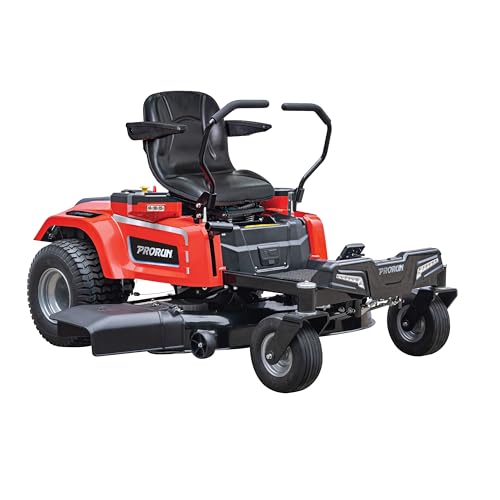
Pros
- High-efficiency brushless motors maximize power output and durability over traditional motors
- Up to 2 acres runtime with three included 10.0 Ah batteries supports substantial mowing sessions
- Zero-emission operation with gas-equivalent 20 HP power for quieter environmentally friendly use
- Six-port auto-switchover battery system provides flexible extended runtime options
- Durable 42-inch steel deck plus included mulch and towing kits add immediate functionality
Cons
- Runtime is limited to approximately 70 minutes or 2 acres which may require recharging for larger properties
- Fully battery-dependent design means performance relies on charge levels and spare battery availability
- 42-inch deck size may require more passes on expansive lawns compared to wider commercial models
The PRORUN PZT60V42 is a fully electric 60V zero-turn riding lawn mower built for residential and light commercial use. Its primary design centers on a robust 42-inch 14-gauge stamped steel twin blade deck powered by direct-drive brushless motors, giving an immediate impression of solid construction and modern battery-focused engineering. The mower arrives complete with three 10.0 Ah batteries, a charger, mulch kit, and towing kit for ready-to-work versatility.
In performance terms, four high-efficiency brushless motors deliver power equivalent to a 20 HP gas engine while producing zero emissions. The system supports up to 2.0 acres or 70 minutes of runtime, and six battery ports with auto switchover intelligently manage all PRORUN 60V battery sizes for continuous operation. A washout port on the steel deck further simplifies post-mow maintenance during real-world sessions.
Potential drawbacks include the finite 70-minute runtime window which can limit coverage on larger properties without spare batteries or recharge breaks. As a fully electric model, it also depends entirely on battery charge levels rather than continuous fuel refills, and the 42-inch deck width may demand extra passes compared with wider traditional options.
Overall the PRORUN PZT60V42 offers strong value for homeowners and small-property managers who want gas-like cutting power without emissions or noise. Those with medium-sized lawns seeking quiet efficient zero-turn performance and included accessories will benefit most from this electric mower.

Pros
- Strong 24HP FR730 engine power for demanding cutting conditions
- Wide 54-inch FAB deck reduces total mowing time
- Zero turn design delivers excellent maneuverability
- Fabricated deck supports durable everyday operation
Cons
- Sparse details beyond engine and deck leave other features unspecified
- Gas-powered FR730 engine needs regular fuel and maintenance
- Large 54-inch deck size may feel oversized on compact properties
The Husqvarna Z254F is a zero turn mower from the established Husqvarna brand in the riding lawn mowers category. It centers on a solid build that pairs a 24HP 726cc FR730 engine with a 54-inch FAB deck for straightforward residential grass care.
Performance stems directly from the listed specifications. The FR730 engine delivers the horsepower needed for steady operation across typical lawns while the wide FAB deck completes passes efficiently. Zero turn handling improves control in real yard layouts based on the model design.
Considerations arise from the limited data available. Secondary elements such as comfort features fuel capacity or extras receive no mention and the gas engine format involves routine upkeep. The large deck suits open areas better than confined spaces.
The Husqvarna Z254F provides the most value for owners of medium or large properties who want reliable engine power and a broad cutting width. Users with smaller lots or those seeking extensive accessory options should weigh the core specs carefully before purchase.
What “Zero Turn” Means
The phrase is shorthand. A turning radius is the space a vehicle needs to complete a change of direction. When a car, a truck, or a typical lawn tractor turns, the steered wheels point left or right and the whole machine follows a curve. The tighter that curve, the smaller the turning radius. Even a very small radius still describes an arc. Zero turn names a different idea: the intended path is not a curve at all, but a rotation around a point at or near the machine’s own center.
People say “zero turn,” “zero turning radius,” and “zero-turn radius” for the same concept. The extra words are often dropped because the meaning has become familiar in lawn care. The word zero is geometric language, not a laboratory measurement. It means the design is meant to pivot in place, or so close to in place that the extra sweep of a steered arc is no longer the point of the machine.
What a turning radius is in ordinary language
The usual way to talk about turning is to imagine a circle. Picture a vehicle driving a constant curve until it has changed direction. The radius of that circle is the distance from the center of the turn to the path the vehicle follows. A large radius is a gentle, roomy sweep. A small radius is a tight hook that still needs some open ground beside the machine. Drivers already use this picture when they ask whether a car can make a U-turn on a given street. The same picture is borrowed for mowers and other small machines.
If the vehicle can spin around a point that sits inside its own footprint, that circle collapses. The heading changes while the machine stays roughly where it already is. That is the contrast the name is trying to capture. “Zero” is there because the imagined circle no longer has a useful radius. The machine is not supposed to need a wide patch of empty grass just to face a new direction.
Why the geometry is conceptual
Real tires have width. Real ground has slip. Real machines have length, a cutting deck, and supporting wheels that trail. So zero should be read as “designed to rotate about its center” rather than “guaranteed to occupy a mathematical point.” Two machines can share the label and still leave slightly different marks on the turf. The definition itself stays simple: zero turn is everyday language for a zero turning radius, and a zero turning radius is an in-place or near-center pivot instead of a wide steered curve.
The Usual Meaning: Zero-Turn Lawn Mowers
When someone says “zero turn” without extra context, they are almost always talking about lawn equipment. The usual machine is a riding mower built around that pivot: a zero-turn mower, sometimes called a zero-turn rider. ZTR is a common abbreviation for the same category. It is not a single brand, a model line, or a certification. It is an informal type name, the way people say “lawn tractor” for a different kind of rider.
You will hear the phrase in residential yards and on commercial properties. In both settings it describes the same idea: a mower whose drive system can change heading without needing a long, looping approach. Residential use and commercial use are only the places the words appear. They are not two different definitions, and they are not a buying split. A homeowner and a grounds crew can point at the same turning concept even if their machines look different.
A type of machine, not a brand
Zero turn is a feature of the machine’s layout, not a badge that belongs to one company. Listings and conversations treat zero-turn mower, zero-turn rider, and ZTR as labels for the same category idea. The words tell you how the machine is meant to change direction. They do not, by themselves, tell you the size of the deck, the power of the engine, or who built it.
Because the everyday meaning is so strong, it is the safest assumption if you only have the two words. A neighbor who bought a “zero turn,” a classified ad that says “ZTR,” or a conversation about trimming around beds is almost certainly about this class of riding mower. Other machines can share the geometry. Those uses exist, and they are covered later. They are the exception, not the default.
A zero-turn mower is still a riding mower. It still has a cutting deck, an operator seat, and a body that takes up space. What sets the category apart is how it steers—or, more accurately, how it does not steer in the car-like sense. The next section explains the pivot. The section after that contrasts the result with a conventional lawn tractor.
How a Zero-Turn Machine Pivots
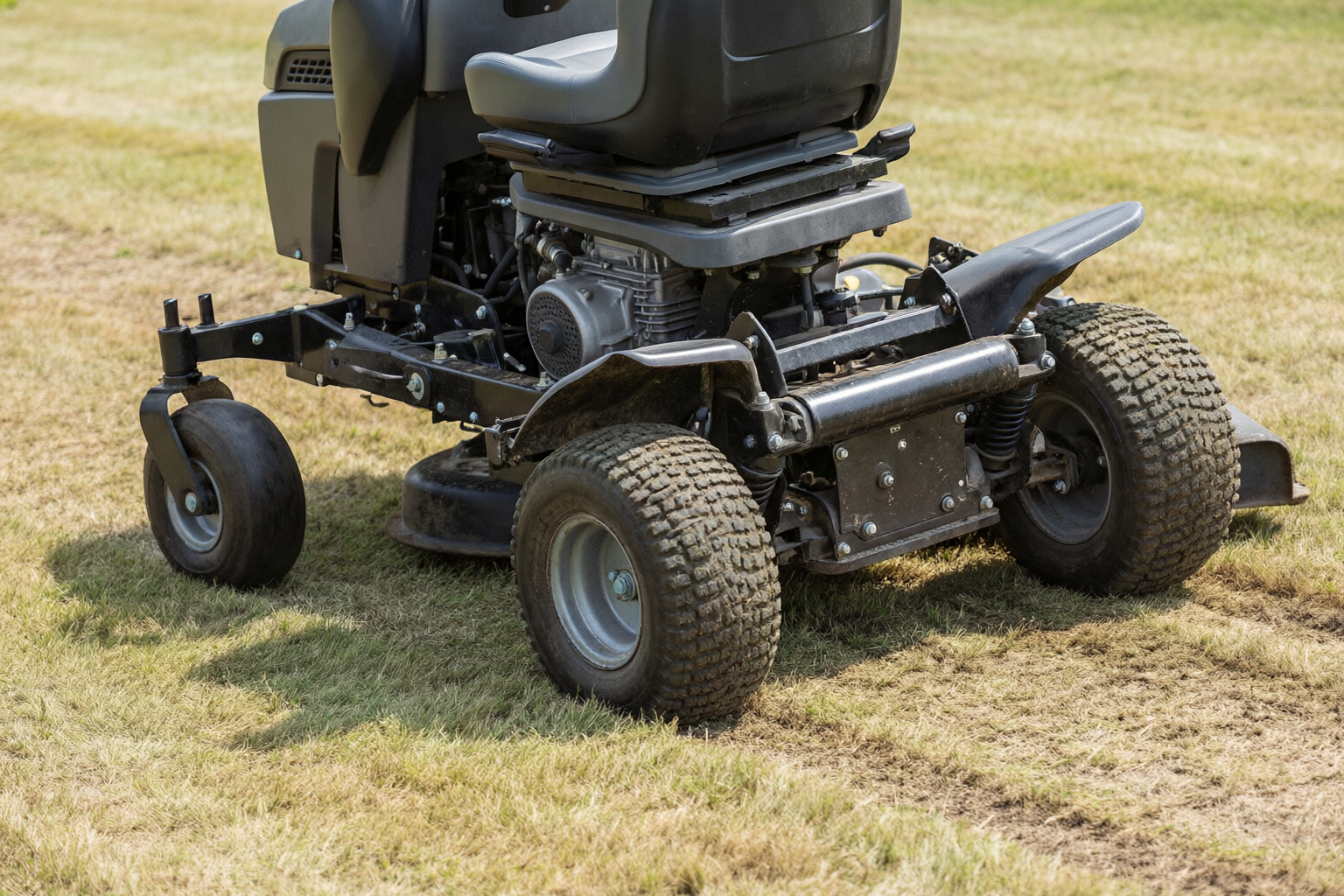
A conventional vehicle changes direction by pointing steered wheels. A typical zero-turn layout changes direction by treating the two sides of the machine as separate drives. Two independently controlled drive wheels—often at the rear—can run at different speeds. They can also run in opposite directions. The other end of the machine is usually supported by casters or similar free-following wheels that are not aimed by a steering wheel in the operator’s hands. Those casters trail whatever path the driven end creates.
What has to happen at the drive wheels
If both drive wheels turn forward at the same speed, the machine travels straight. If one wheel slows while the other keeps moving, the machine yaws toward the slower side and the path tightens. If one wheel stops and the other continues, the turn becomes still tighter. If the two wheels drive in opposite directions, the machine can rotate around a point between them and change heading while staying nearly in place. That last case is the picture people have in mind when they say the mower can pivot in place.
The reason one side can move differently from the other is that the two drives are commanded separately. There is no single axle that forces both wheels to share one steering angle. Each side is a source of motion. Matching commands produce a straight line. Mismatched commands produce a yaw. Opposite commands produce a rotation about the machine’s own center. That independence is the mechanical heart of the name.
What the operator is usually holding
The operator is usually not using a car-style steering wheel. Control is often a pair of hand levers or similar split controls, one for each side. Moving both controls the same way sends both sides the same command. Moving them differently creates the speed or direction difference that turns the machine. Layouts vary. Some machines use other split-hand arrangements. It is not accurate to treat one lever shape, one wheel placement, or one kind of transmission as universal. Hydrostatic drive is common language in this category, but it is not a safe claim that every labeled machine uses the same hardware.
What the category shares is the idea: independently driven wheels, not a single steered axle that forces the whole machine through an arc. Nothing in that description is a lesson in how to spin a rider. It is only the reason the name exists. The same independence that allows a tight heading change also means small control differences produce large changes in direction. That is useful near an obstacle. It is also why a first ride can feel abrupt compared with a steering-wheel tractor.
How This Differs From Conventional Steering
A typical riding mower or lawn tractor uses conventional steering. The operator turns a steering wheel. The front wheels angle left or right. The machine then travels through an arc whose size depends on the wheelbase, how far the wheels can steer, and how the operator times the turn. To reverse a heading or to line up for the next pass, the operator often needs room to complete that curve. Tight corners, island beds, and trees force extra back-and-forth or a wide looping approach.
The steered design is familiar because it matches cars and many other vehicles. The front of the machine leads the change of direction. The rear follows. The body sweeps a path wider than the machine’s own width. That extra sweep is exactly what a turning radius describes. It is not a defect. It is the ordinary geometry of pointing wheels and driving through the resulting circle.
A dual-drive path around an obstacle
A zero-turn machine does not rely on that steered front path as its primary way to change heading. Because the two drive wheels can be given different commands, the operator can tighten one side, stop one side, or reverse one side. The path can shrink from a curve into a pivot. Around a post, a bed edge, or the corner of a building, the machine can change its nose direction without first swinging the whole body through a large circle.
Imagine finishing a strip of grass beside a tree. A conventional rider may need to roll past the trunk, steer through an arc, and come back on the next line, leaving a teardrop of uncut or already-traveled ground. A dual-drive layout can reach the end of the strip, rotate its heading, and start the return with much less of that loop. The tree is the same. The difference is the shape of the path the machine is allowed to take.
The contrast is qualitative, not a scorecard. A steered tractor is not unable to turn. It simply needs more space to complete the same change of heading. A zero-turn layout is not able to disappear. It can point a new direction in a much smaller patch of ground. Which layout fits a property depends on the yard, the operator, and many other choices this article does not rank. The definitional point is the path: an arc from steered front wheels versus a dual-drive pivot that can stay at or near the machine’s center.
It also helps to separate steering feel from cutting width. A lawn tractor with a wide deck still turns by steering. A zero-turn mower with a similar deck still turns by independent drive. Deck size and turning concept are different facts. People sometimes mix them because both affect how the machine fits a space. Only one of them is what “zero turn” names.
Other Uses of the Same Idea
Zero or near-zero turning radius is a geometry, not a lawn-care trademark. Any machine with independently driven sides can, in principle, rotate about a point between those drives. That is why the same language sometimes appears on other equipment.
Skid-steer machines and some compact loaders are the closest everyday cousins. They also command the two sides separately and can turn in a very small area, often by skidding or counter-rotating. Service robots, certain indoor utility platforms, and some mobility devices use related dual-drive ideas so they can negotiate corridors, docks, or rooms without a long turning circle. The shared concept is the same: do not steer a single pair of wheels through an arc if you can drive the left and right sides as two sources of motion.
Those uses are real, but they are not what most English speakers mean by “zero turn” in casual speech. Equipment catalogs may say “zero turning radius” as a specification. A robotics description may call a differential-drive platform the same thing. If your conversation is about mowing, landscaping, or a rider in a shed, the lawn-mower meaning is still the safest assumption. If someone is clearly talking about a loader, a robot, or a wheelchair-style platform, they are borrowing the geometry, not renaming a ZTR.
This article does not treat any named product as a true or false zero-turn machine. The phrase is a description of intended turning geometry. Different industries apply it with different precision. For a reader who only asked what the words mean, the takeaway is simple: the idea can travel, and the default destination is still the mower.
What the Name Implies in Real Use
People care about a pivot because yards are full of things that do not move. Trees, mailbox posts, flower beds, fences, play equipment, and the corners of a house all force a mower to change heading. With a wide steered arc, each of those objects costs extra travel: swing out, come back, straighten, try again. With an in-place or near-center turn, the operator can finish a pass, rotate, and start the next pass without leaving as large a loop on the ground.
Cluttered spaces make the difference easiest to see. A yard broken into small lawns by beds and walkways asks for frequent heading changes. A property with many trees asks for the same thing at every trunk. A commercial lot with light poles, islands, and building corners repeats the problem at larger scale. In each case the useful implication is the same: the machine is built so that changing direction does not require as much open room.
That is a statement about path shape, not about time, fuel, or cut quality. A tighter heading change can reduce wasted travel in cluttered spaces. It does not automatically make a property faster to finish, and it does not make the cut better. Those outcomes depend on the operator, the turf, the deck, and the job. The definition only implies this much: fewer wide loops are needed to point the machine where the next strip of grass is.
The machine still occupies space
Zero turning radius does not mean the whole machine occupies no extra space while turning. The phrase describes the intended center of rotation. The mower deck still has width. The body still has length. Casters still swing. Grass still has to be cleared around the outside of that rotating rectangle. If you stand next to a tree, the deck can still strike the trunk even though the drive wheels are pivoting. Zero is about the turning circle, not about making the machine smaller than it is.
The same point applies to gates, trailer ramps, and storage sheds. A machine that can pivot in a yard may still be long, tall, or wide when you try to park it. Turning geometry and overall size answer different questions. If you only needed the meaning of the phrase, remember both halves: the heading can change in a small patch of ground, and the physical object still takes up the space of its own frame.
Limits of the Phrase “Zero Turn”
Zero is a design concept and a convenient label. It is not a promise that every labeled machine will spin cleanly on one spot in every condition. Two mowers can both be sold as zero-turn machines and still feel different. Control response, wheelbase, tire type, weight distribution, and the way the casters are built all change how tight a real turn becomes. Manufacturers use the same words for a family of layouts, not for one identical behavior.
It is also unsafe to claim that every machine called a zero-turn mower can rotate a full circle in place on demand. The intended geometry points that way. Traction, slope, and how the controls are used decide what actually happens on the ground. Treating the label as a guaranteed 360-degree spin overstates what the words can carry.
When the real path is wider than the name
Surfaces matter. On firm, level turf with good traction, opposite-wheel commands can produce a compact rotation. On wet grass, loose soil, slopes, or slick patches, a drive wheel can slip. The intended pivot becomes a small arc, a shove, or a pause while the tires search for grip. Worn tires, low pressure, or an attachment that changes weight on the driven wheels can do the same. The name does not override physics.
Operator input matters as well. A gentle difference between the two controls traces a curve. A larger difference tightens it. Reversing one side is a stronger command than slowing one side. A person who has never used split hand controls may overshoot, correct, and overshoot again, so the path on the ground is wider than the brochure idea of a point turn. None of that means the phrase is meaningless. It means the word zero describes intended geometry, not a certified spin in all weather.
This article does not assign invention dates, first models, or brand-by-brand verdicts. Those claims need sources that were not part of the question. For a definition, it is enough to know that the label is shared, that real tightness varies, and that a small arc instead of a perfect pivot is still consistent with the same design idea.
Safety and Control Caveats
A machine that can change heading in place can also change heading suddenly. Independent-drive controls do not have the same gradual, self-centering feel as many steering wheels. A new operator who treats the levers like a car’s wheel, or who makes a large correction while moving, can rotate the machine faster than bystanders expect. People and pets who would have been outside a wide steered arc can find themselves in the path of the deck or the rear of the rider.
Sudden pivots can throw debris. A rotating deck still cuts, and a rotating body still has momentum. The same independence that is useful next to a bed is unforgiving next to a sidewalk group, a closed gate, or a drop-off. Slopes, edges, and loose ground change traction and stability. A wheel that slips on an embankment does not follow the neat geometry in the definition. Understanding the phrase does not make a person qualified to operate a rider.
General cautions are enough here, because specific techniques belong in training and in the machine’s own documents.
- Read and follow the operator’s manual for that exact machine, including the sections on controls, slopes, passengers, and attachments.
- Keep bystanders, children, and animals well away from the area being mowed.
- Treat edges, retaining walls, water, and steep grades as traction and stability problems, not as places to demonstrate a tight turn.
- Do not use high-speed spins or stunt-style pivots as a way to learn the machine.
- Look for local safety guidance from the manufacturer and from recognized outdoor-power-equipment sources when you need operating rules rather than a definition.
If the task is teaching someone to mow, fitting a machine to a slope-heavy property, or diagnosing a control problem, that is work for the manual and, when appropriate, a qualified dealer or trainer. A definition article cannot substitute for that. Machine-specific operating rules live with the machine, not with the dictionary meaning of zero turn.
Related Terms People Mix Up
Ads and conversations borrow nearby language, and it helps to keep the pieces separate.
A tight-turning or short-turn tractor is not automatically a zero-turn machine. Those phrases usually mean a conventional steered rider with a smaller-than-usual turning circle. The front wheels still steer. The path is still an arc. The radius is reduced, not designed to collapse to a center pivot. If a description never mentions independent drive, dual levers, or a zero turning radius, do not assume ZTR behavior from the word “tight” alone.
Turning radius is also not the same thing as the width of the mower. Width is how much space the deck and body occupy from side to side when the machine is sitting still or traveling straight. Turning radius is about the space needed to change heading. A narrow machine with conventional steering can still need a large loop. A wide zero-turn mower can still pivot its heading in a small patch while its deck remains wide. Wheelbase and overall length are separate again: they affect both how the machine stores and how any real turn feels, but they are not synonyms for zero turn.
Listings may say zero turn, ZTR, or zero-turn radius interchangeably. In ordinary use those labels point at the same category idea. They are not a ranking of honesty, and they are not a substitute for reading how that particular machine is controlled. If you only needed the definition, look for three signals in any description: a claim of zero or near-zero turning radius, independently driven sides or split hand controls, and contrast with a steering-wheel lawn tractor. Those signals describe the concept. They do not tell you which machine to buy.
A last distinction is worth repeating because it closes the loop on the original question. Zero turn is not a brand. It is not a promise of a perfect point spin. It is not a measurement of deck size. It is shorthand for a zero turning radius: a machine, most often a lawn mower, designed to pivot around its own center instead of completing a wide steered arc.









