

Quick Answer: Choosing the Best Commercial Mower
There is no single best commercial mower. The right machine is the one that matches your acreage, terrain, weekly hours, preferred platform—walk-behind, stand-on, or ride-on/zero-turn—plus durability, local service access, and total cost of ownership. “Best” is a matching problem, not a brand ranking. Landscaping crews and owners of large private properties need different answers, and those answers change with gates,…

Pros
- Brushless motor system delivers gas-equivalent power without emissions or excessive noise
- High-capacity battery kit enables cutting coverage of up to 4.4 acres per charge set
- Durable 10-gauge steel deck and constant high blade tip speed handle dense grass effectively
- Premium seating and lighting features support comfortable extended operation
- 4-year warranty provides strong protection for the investment
Cons
- Runtime tops out around 4.4 acres depending on conditions, requiring recharges for bigger properties
- Electric design depends on charging infrastructure and battery management rather than simple refueling
- Height adjustment is noted only basically without extensive position details in available specs
The Greenworks 60V MaximusZ Zero Turn Riding Lawn Mower is a commercial-grade electric machine built for large lawns. Its primary construction centers on a heavy-duty 60-inch 10-gauge fabricated steel deck that prioritizes durability and airflow, paired with premium comfort elements including an adjustable suspension seat with lumbar support and foldable armrests for a solid first impression of quality and user focus.
Performance shines through an intelligent brushless motor system offering power equivalent to a 31HP gas engine with zero emissions. Three high-torque brushless hub motors sustain a constant 17,900 FPM blade speed, while SmartCut Technology auto-adapts to prevent bogging in thick or wet grass. The complete kit supplies (2) 20.0Ah suitcase batteries plus (4) 8.0Ah batteries and a 1.5kW fast charger for up to 4.4 acres of cutting. Additional capabilities include a 4-in-1 deck for mulching, bagging, rear and side discharge, 300 lb towing capacity with front/rear hitch, dual LED headlights, and an LCD display.
Drawbacks and considerations include the practical need to recharge the battery set after maximum runtime, which can interrupt work on properties exceeding 4.4 acres. Being fully electric means reliance on power sources for recharging instead of fuel, and height adjustment is referenced only in basic terms without more granular position data in the specifications.
In verdict, the Greenworks 60V MaximusZ delivers the most value to homeowners and professionals managing medium-to-large properties who want quiet, emission-free commercial power, versatile cutting options, and the security of a 4-year warranty in a comfortable zero-turn package.

Pros
- Strong stated cutting capacity for large properties, with up to 4 acres per charge.
- Zero-turn design supports fast, precise mowing around obstacles.
- Uses battery power instead of gas, reducing maintenance-related chores and emissions.
- Includes six high-capacity batteries and a charger, so it is ready for use out of the box.
Cons
- Heavy at 720 pounds, which may make transport, storage, or maneuvering by hand difficult.
- Large dimensions require substantial garage or shed space.
- The high upfront cost may put it out of reach for buyers with smaller lawns or limited budgets.
Overview & Design: The EGO Power+ ZT5207L is a 52-inch electric riding lawn mower with a zero-turn radius, built for users who need efficient coverage on larger properties. Its black finish, substantial frame, and 720-pound weight reflect a serious, full-size riding mower designed for demanding residential mowing.
Performance & Key Features: EGO says Peak Power+ technology combines up to six 56V ARC Lithium batteries, and the mower is rated at a 25 HP-equivalent output. The 52-inch deck and zero-turn steering should help reduce mowing time and improve control around landscaping, while the included six 56V 12.0Ah batteries are stated to support up to 4 acres per charge.
Drawbacks & Considerations: This model is large and heavy, so it will not suit every storage space or every user. Its premium positioning also means buyers should be confident they need this much capacity, since smaller yards may not justify the size, weight, or cost.
Verdict: The ZT5207L is best for homeowners with expansive lawns who want battery-powered convenience and zero-turn efficiency in one machine. It is a compelling option if you value gas-like performance, broad deck coverage, and compatibility with EGO's 56V battery ecosystem.
What people mean by the “best” commercial mower
When someone asks for the best commercial mower, they are rarely asking for a trophy model. They want a machine that will finish paid work or a large property on schedule, survive a real duty cycle, and not sit in a shop when the grass is growing. That can mean a landscaping-business unit that runs many days a week, or a heavy-duty mower for a large private property that is simply too much for a typical homeowner riding mower. Those two buyers overlap in hardware, but they do not share the same downtime cost, trailer setup, or crew size.
A single model ranking is the wrong answer because commercial mowing is not one job. A gated campus with tight beds is a different problem from open sports turf. A hilly estate is a different problem from a flat industrial park. Wet spring grass, sandy soil, heavy clippings, and frequent on-and-off trimming all change what “best” looks like. Typical use also varies by region and business mix: some operations live on residential routes with many stops; others mow a few large sites all day.
Before any machine can honestly be called the right one, you need job details that a spec sheet cannot invent for you:
- How the work is split across properties: many small lots versus a few large ones.
- Access limits: gate width, trailer space, storage, and whether the machine must roll through beds or around playgrounds.
- Terrain: relatively open and flat turf versus slopes, ditches, roots, or wet ground. Slope limits come from the operator manual for that machine, not from a generic article.
- Weekly engine hours and season length, not a one-time impression of a “big yard.”
- Who will operate and service it, and how quickly parts and a technician are available nearby.
- Whether you need one platform or a mix (for example, a ride-on for open ground and a walk-behind for detail work).
Until those facts are on the table, “best commercial mower” is only a category, not a purchase decision.
Commercial mowers versus homeowner mowers
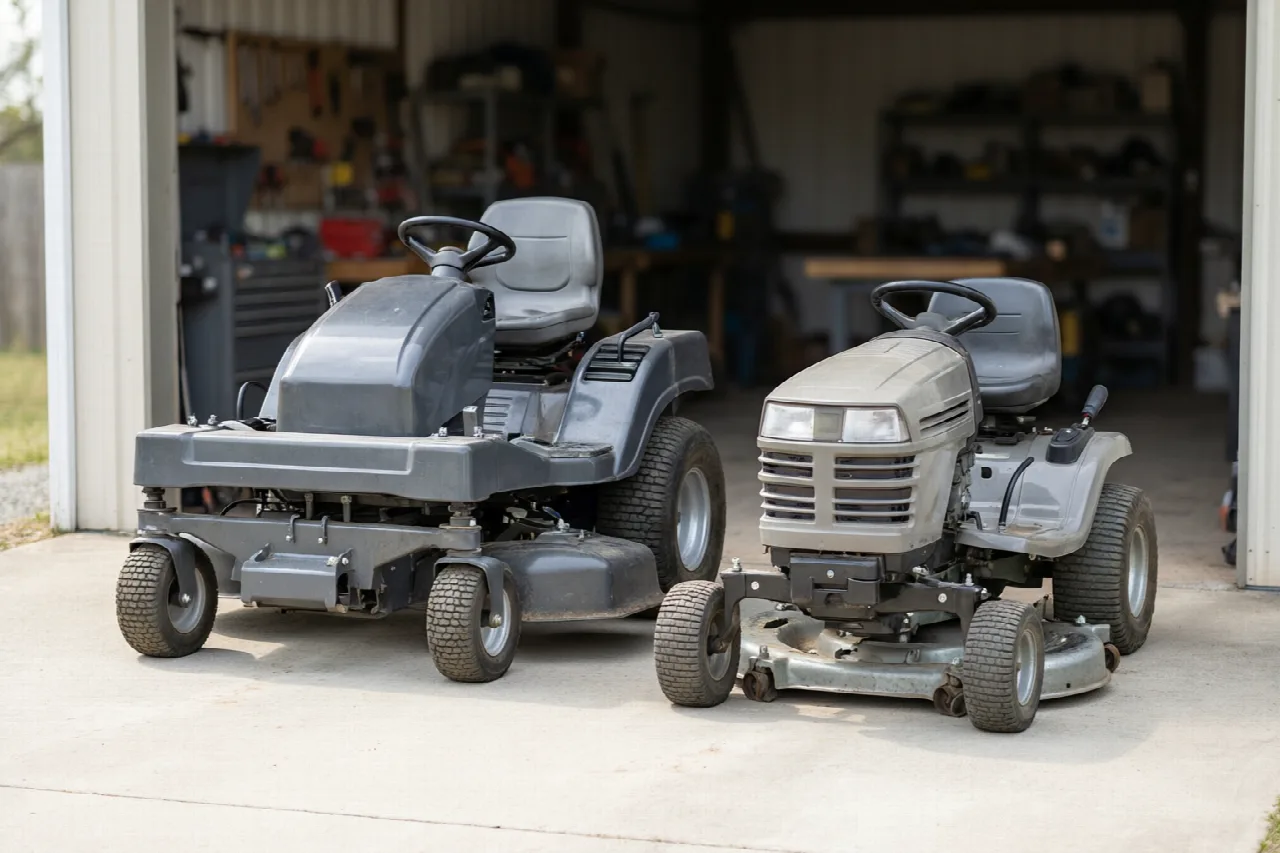
A commercial mower is built for paid or large-scale work: longer daily use, faster field service, and a frame and cutting deck meant to take more abuse than a typical residential mower. A homeowner walk-behind or riding mower is generally designed around occasional weekend use, lighter structures, and dealer visits that can wait. The commercial side of the market usually emphasizes thicker decks, stronger frames, more accessible service points, and higher expected engine hours. That is a design intent, not a regulated grade. The word “commercial” on a spec sheet is a manufacturer label. It is not a single legal standard, and it does not by itself prove the machine will survive your route.
Build and duty cycle show up in how the machine is meant to be used and repaired. Commercial units often put filters, belts, spindles, and blades where a technician or owner-operator can reach them without tearing the machine apart. Decks are commonly designed to take impacts and to be flipped or opened for cleaning. Controls and hydrostatic drives are built for repeated all-day use. Residential machines can still cut well; they are simply less often designed around hours of continuous work, curb drops, trailer ramps, and same-day parts turnaround.
Marketing language blurs the line. Features that are often sold as “commercial” but do not by themselves make a machine ready for paid daily work include a large deck number, a powerful-sounding engine description, a fabricated look, or a “pro” badge. A wide cutting deck on a light frame can still flex. A high horsepower claim does not help if the spindles, belts, or operator cannot use that power. Comfort seats, LED lights, and striping kits may be useful, but they do not replace serviceability or a frame that can take real hours.
A heavy-duty residential or “prosumer” mower can still be enough when the property is large but the weekly hours are modest, the terrain is gentle, the operator is not racing a commercial clock, and downtime is an inconvenience rather than lost revenue. That is common on some private estates, HOA common areas with infrequent mowing, or a small side job. If the machine will run many hours a week through a long growing season, or if a breakdown cancels a crew’s day, the commercial category is usually the more honest starting point—even then, you still have to match the platform and the dealer, not just the label.
The main commercial mower formats and what each is for
Most commercial-grade machines fall into a few platforms: walk-behind mowers, stand-on mowers, seated zero-turn mowers, and other ride-on types. Operations often mix them. The useful question is not which format is “best,” but which one matches the hardest regular job you actually have.
| Format | Typical job fit | Strengths | Trade-offs |
|---|---|---|---|
| Commercial walk-behind | Tighter turf, detailed properties, sites where a large ride-on is clumsy or cannot fit | Often lower purchase cost, strong maneuverability around beds and obstacles, useful as a second machine | More operator walking and fatigue on large open acres; slower coverage of wide, empty turf |
| Stand-on | Mid-size properties, frequent on/off work, routes with many obstacles or trailer stops | Quick mount and dismount, compact footprint relative to many seated units, good visibility for trim work | Less seated comfort on long open runs; still a ride-on class machine for slope and transport decisions |
| Seated zero-turn or other ride-on | Large, relatively open, relatively flat turf and higher daily acreage | Less walking fatigue, wide-deck coverage on open ground, a natural fit for long continuous runs | Harder in tight gates and highly landscaped yards; larger trailer and storage needs |
Commercial walk-behind mowers
A commercial walk-behind mower is typically best suited for tighter or more detailed turf: gated yards, dense landscaping, cemeteries, schools with lots of fixtures, and any site where a wide seated deck spends more time reversing than cutting. Hydrostatic walk-behinds with sulkies exist in some fleets; the core idea is still a compact, agile deck the operator stays close to. Purchase cost is often lower than a comparable ride-on, which makes a walk-behind a common second machine even in a zero-turn shop. The trade-off is operator fatigue and time on large, empty lawns. Deck width still matters: a wider walk-behind covers more open ground but can lose the very tightness that made the format attractive.
Stand-on mowers
A stand-on mower makes more sense than a walk-behind when the operator is covering more ground than they want to walk, and more sense than a seated zero-turn when the day is full of hopping off to move a hose, blow a walk, lift a gate, or trim a bed. Mid-size properties and residential routes with many stops are the usual fit. The operator stands on a platform, which can improve visibility for close work and speed up on/off cycles. That is a workflow advantage, not a safety ranking. A stand-on is not automatically safer or less safe than a seated unit; rollover, thrown-object, and blade hazards still apply, and the operator manual for that machine governs slope use, ROPS (if equipped), and passenger rules (there should be no extra riders).
Zero-turn and other ride-on mowers
Jobs that favor a zero-turn mower or another ride-on are those with large, relatively open, relatively flat turf and higher daily acreage: campuses, parks, wide HOA commons, and similar sites where the deck can stay in a long pass. Zero-turn steering (independent drive wheels) is built for tight turns at the end of a pass. Other riding mowers—including some front-mount or more traditional steering designs—still appear in commercial fleets when the buyer wants a different weight balance, implement options, or a feel closer to a small tractor. The shared idea is seated endurance and a wide cutting deck on ground that can accept it.
Deck width, transport, and fatigue change across formats. Wider decks can cover more ground on open, relatively flat turf. They can also be harder to trailer, store, and thread through gates. A deck that is too wide for the site spends its time lifting, reversing, and missing strips. Operator fatigue is not only about sitting versus walking: vibration, heat, noise, and how often the operator must dismount all add up. A seated machine that cannot fit the property will fatigue a crew in a different way—by forcing extra trim work with a string trimmer.
Format fit also fails in predictable ways. A large seated zero-turn is generally a poor match for highly landscaped yards, narrow gates, or cluttered courtyards. Any ride-on or stand-on can be a poor fit on slopes beyond what that specific machine’s manual allows; walk-behinds are not automatically “better on hills,” and no article should invent a safe angle. Steep ground, drop-offs, and wet slopes are residual hazards for every platform. Follow the operator manual and local workplace rules, and do not treat marketing photos of hillside work as a rating.
Criteria that should drive the purchase
Treat the buying decision as a checklist, not a scoring formula with made-up weights. The machine that wins on paper can still lose on your route if it cannot fit a gate, cannot be serviced locally, or costs more in downtime than it saves in cut time.
Lot size, obstacles, turf, and slope
Map the actual pattern of work, not the largest single lawn you have ever seen. Many small obstructed lots favor maneuverability, frequent dismounts, and a deck that can finish without a second trim pass around every tree. A few large open sites favor a wider deck and a seated or stand-on platform that can stay in a long run. Turf type matters in a practical way: thick, wet grass and leaf-heavy seasons ask more of deck discharge, engine cooling, and cleaning access. Sandy or gritty sites punish blades, belts, and spindles. Slope changes the shortlist more than almost any brochure feature. Stay inside the limits and procedures in the operator manual for that machine. If the regular job includes slopes the manual does not support, change the job plan or the machine class; do not “make it work” with speed or a different platform based on internet advice.
Weekly engine hours and season length
Engine hours and how those hours are clustered matter more than a one-time “big yard” impression. A property that looks huge but is mowed lightly may be within a stout residential or light commercial machine. A modest route that runs many hours every week through a long growing season is a commercial duty cycle. Hours are also how you should think about used machines later: they are one signal among many, not a magic cutoff. High hours with documented maintenance can be healthier than low hours with a neglected deck. Season length changes wear on blades, belts, spindles, and operators. A short intense spring and a long green season are different budgeting problems even at the same acreage.
Cutting decks, spindles, frames, and controls
The cutting deck is the tool. Look at how it is built to be cleaned, sharpened, and repaired: belt access, spindle replacement, baffle design, and whether discharge, mulching, and bagging are realistic options for your sites—not universal must-haves. Mulching and bagging change airflow and power demand; they help on some properties and slow you down or clog on others. Spindles take the shock of blades hitting hidden debris; play, heat, and leaking grease are inspection themes, not numbers to invent here. Frames and welds should look consistent with curb drops and trailer ramps. Operator controls should be something your actual crew can use all day: steering levers or bars, deck lift, parking systems, and visibility over the front of the deck. More power is not automatically better. Extra engine capacity only helps if the deck, terrain, and operator can turn it into a clean cut without tearing turf or throwing belts.
Fuel type, noise, and local service
Fuel type (gasoline, diesel, propane, or battery-electric where offered) is a local and operational choice, not a universal winner. Availability, refill or charge logistics, cold-weather behavior, and shop familiarity all matter more than a generic claim that one fuel is always cheaper, greener, or more reliable. Those comparisons depend on your electricity or fuel prices, duty cycle, and how the machine is actually used—none of which this article can measure for you. Noise and exhaust matter around schools, hospitals, HOAs, and early-morning routes. Emissions and workplace noise rules are time- and region-specific; check current local rules and the manufacturer’s documentation rather than relying on remembered “tier” numbers from an article. Service access often dominates fitness for a business. A machine that cannot be serviced quickly locally is a poor fit even if it looks strong on paper. Ask who stocks belts, blades, spindles, and hydro parts, and how a mid-season failure is handled.
Total cost of ownership
Sticker price is only one line in total cost of ownership. Separate the categories even if you cannot yet fill in dollar amounts:
- Capital cost of the mower, trailer space, and any required accessories.
- Fuel or energy, plus blades, belts, spindles, filters, and fluids.
- Labor: cut time, trim time the deck cannot reach, and time spent washing and loading.
- Transport and storage: trailer capacity, ramps, shop space, and whether a wider deck forces a different truck.
- Downtime and lost revenue when the machine is waiting on parts.
- Training time for operators and the cost of preventable damage.
Warranty language, if it influences you, must be read on the current manufacturer documents for that serial-number class. Do not treat a remembered year-count or hour-count as a market fact. For a business, parts access and turnaround often dwarf a small difference in purchase price.
How to shortlist a machine without picking a “winner”
Turn the criteria into a process you can finish with your own job data, a dealer, and the manuals—not with a ranked internet list.
Gather job data before you shop
Write down the hardest regular job, not the easiest sales demo: tightest gate, steepest slope you are actually allowed to mow with a given class of machine, wettest turf you cannot reschedule, longest continuous run, and the worst debris or sand. Add crew size, who will maintain the machine, weekly engine-hour estimates, and how properties are sequenced in a day. Measure access widths and trailer capacity. Note fuel preference only as a constraint (what you can store, refill, or charge), not as a brand identity. This packet is what a good dealer should see before they point at a deck width.
Choose a platform, then a few comparable machines
Pick the format that fits the hardest regular job. If that job is split—open acres plus tight courtyards—plan a fleet mix instead of forcing one hero machine. Then compare a small number of machines in that format on fit and serviceability: deck width versus gates, discharge versus your turf, how spindles and belts are serviced, how the deck is cleaned, and whether the local shop will own the product after the sale. Demo on ground that resembles your work, including a loaded trailer cycle if you trailer daily. A parking-lot figure-eight does not test wet grass, curb drops, or operator fatigue.
Questions for parts, service, training, and attachments
Ask what fails in the first seasons of similar use, how quickly common wear parts arrive, and whether a loaner or priority shop time exists in peak season. Ask who trains new operators on that specific machine’s controls, blade-stop behavior, and any ROPS or seat-belt procedures if equipped. Attachments—baggers, mulch kits, striping kits, snow blades or brooms where the chassis is rated for them—are job-dependent options. A bagger is not a virtue if you never haul clippings; a snow kit is not a reason to buy a mower that is wrong in July. Only consider attachments the manufacturer documents for that model, and treat “certified” claims as something to verify on current manufacturer literature, not as a rumor.
Used commercial mowers
A used commercial mower is a reasonable path when the maintenance history is credible, the platform still matches the job, and you can inspect it as a working tool rather than a bargain. Hours are one signal among many. Look at deck condition (rust-through, bent baffles, stretched or cracked belts), spindle play and grease condition, frame cracks or bent axle areas, leaks around hydros and filters, control feel and tracking, tire and caster wear, and whether safety devices (guards, chute, switches) are present and functional. Compression stories and “it was a one-owner estate machine” are not substitutes for that inspection. There is no honest universal “good hours” cutoff in an article, because duty cycle, maintenance, and storage dominate the number. Do not shop by mythical best model years or promised resale values; those figures are market- and condition-specific and go stale quickly.
Safety, workplace, and buying caveats
Commercial mowers can cause severe injury regardless of platform. Residual hazards include rotating blades, thrown objects (rocks, wire, toys), rollovers and tip-overs on slopes or near drop-offs, burns from engines and exhaust, fuel fires and spills, carbon monoxide in enclosed spaces, noise, and vibration. Guards, discharge chutes, and blade-stop systems exist for a reason. Keep bystanders, pets, and debris clear. Do not carry passengers. Use required guards and, where the machine is equipped with a ROPS, use the ROPS and seat belt as the operator manual specifies for that situation. Folding a ROPS for a tree limb and then treating the machine as if it were still protected is a common and dangerous shortcut.
Slope ratings, maximum operating angles, ROPS use, and blade-safety practices must come from the machine’s operator manual and from your employer’s rules—not from a generic article, a video, or a salesperson’s hillside story. This article will not invent degree limits, “safe on hills” claims, or hearing-protection decibel thresholds. A stand-on is not automatically safer than a seated zero-turn; a walk-behind is not automatically the hillside solution. Wet grass, hidden holes, and towed sulkies change behavior. If the work is for a business, follow applicable workplace rules and training your employer requires; those rules vary and are not something an article should declare as a legal conclusion.
Fuel handling, exhaust, and noise also stay on the checklist. Refuel when the engine is cool and outdoors, store fuel as local fire rules require, and never run a mower in a closed garage. Workplace hearing and vibration programs, if they apply to your crew, are local and occupational questions for a qualified safety professional—not a medical claim this article can settle. Emissions and local noise ordinances change; verify current rules where you mow before you assume a gasoline, diesel, propane, or battery machine is allowed at the hours you work.
Before you buy or deploy a machine, you still need facts only you and a supporting dealer can supply: typical weekly hours, terrain and the steepest slope you will actually ask the machine to take under its manual, access width, trailer capacity, budget range, fuel or charging preference, attachment needs, and a shop that will stock parts when the grass is growing. The best commercial mower is the one that survives that list. It is not a brand name waiting at the top of a ranking.
Buyer FAQs: Best Commercial Mower Solved
Is a commercial mower only for landscaping companies?
No. The same platforms are used for paid routes and for large private properties that outgrow a residential mower. The difference is usually hours, downtime cost, and how hard a missed week of cutting will hit you—not a ban on private owners using commercial-grade equipment.
Does a wider deck always mean a better commercial mower?
No. A wider cutting deck can raise coverage on open, relatively flat turf and can lower coverage or raise difficulty on tight, gated, or obstructed sites. Match deck width to gates, trailer space, and the shape of the turf, not to the largest number on a brochure.
Should I decide by engine hours on the spec sheet?
Use expected weekly hours and season length to choose a duty class, then treat published hour claims—if you see them—as manufacturer statements to verify, not as a guaranteed life. For used machines, hours are only one inspection signal beside deck, spindles, frame, leaks, and service history.
Can I rely on the “commercial” label alone?
No. It is not a single regulated grade. Judge build, serviceability, dealer support, and fit for your terrain and hours. A badge does not replace a demo or a parts counter you can actually reach.









