

Quick Answer: What Is The Best Robot Lawn Mower?
There is no universal best robot lawn mower. The right robotic lawn mower is the one that matches your lawn’s size, slope, layout, and obstacles, plus the boundary or navigation system you are willing to install. Cut quality, weather use, noise, safety around children and pets, theft risk, and how much upkeep you will actually do all change the answer….

Pros
- Powerful 80V brushless motor delivers 32HP gas-equivalent performance with quiet fume-free operation and no engine maintenance.
- Complete kit includes four 6.0Ah batteries and 600W charger for substantial runtime up to 1.5 acres.
- SmartCut technology and 42-inch heavy-duty steel deck ensure consistent cuts without bogging in tough conditions.
- Versatile towing up to 350 lbs and optional cargo hauling plus comfort features like high-back seat and LED lights.
- Strong 4-year limited warranty and full compatibility with the Greenworks 80V tool ecosystem.
Cons
- Rear utility cargo bed for 200 lb hauling is sold separately and not included in the kit.
- Runtime of up to 1.5 acres varies with conditions and may require recharging or battery swaps on larger properties.
- As a fully cordless model continuous operation depends on battery levels unlike gas engines with unlimited runtime.
The Greenworks 80V 42" CrossoverT Cordless Riding Lawn Tractor is a ready-to-mow zero-emission tractor designed for homeowners managing medium to large lawns. It features a reinforced 42-inch stamped steel deck of 12-gauge construction along with premium comfort elements such as a high-back padded seat with foldable armrests. The overall build emphasizes durability and user convenience right out of the box with the included battery and charger set.
Performance centers on the 80V TruBrushless motor that provides 32HP gas-equivalent power with instant torque and quiet fume-free operation. SmartCut technology senses grass conditions and automatically adjusts power to maintain a consistent cut even in tall thick or wet areas. The four 6.0Ah batteries support runtime for up to 1.5 acres depending on conditions while dual LED headlights and a 7-position deck height range from 1.5" to 4.5" add practicality. Front and rear attachments further allow towing up to 350 lbs for added yard utility.
Key considerations include that the rear utility storage bin capable of hauling 200 lbs is sold separately so full cargo functionality requires an extra purchase. Runtime remains condition-dependent and may fall short for properties significantly larger than 1.5 acres without using the 600W charger or swapping batteries. The cordless design prioritizes ease and low maintenance but trades off the continuous runtime of traditional gas models.
This tractor delivers strong value for eco-conscious owners of residential properties who want gas-like power without the emissions noise or upkeep. It suits those who already use or plan to expand into the Greenworks 80V family of tools and who appreciate the 4-year limited warranty. Users with exceptionally large or commercial-scale lawns should evaluate battery logistics carefully before purchase.

Pros
- Delivers strong 21 horsepower equivalent power comparable to gas riding mowers.
- Provides up to 1.5 acres of runtime on a full charge with the six included batteries.
- Features low-maintenance dual brushless motors without belts for greater durability.
- Offers versatile 12-position cutting height adjustment from 1.5 to 4.5 inches.
- Includes digital controls for blade settings, drive speeds, and cruise control.
Cons
- Limited to 1.5 acres of cutting per charge without purchasing additional batteries for bigger lawns.
- Requires recharging time for the six 56V batteries after each use session.
- Relies solely on battery power with no hybrid or gas backup option for extended operation.
The EGO Power+ TR4204 is a cordless electric riding lawn mower built as a modern tractor alternative for residential use. It features a robust 42-inch stamped steel deck and arrives ready to go with six 56V 6.0Ah batteries plus a charger, creating an immediate impression of convenience and solid construction free from gas engine complexity.
Performance shines through its equivalent 21 horsepower output and top speed of 6 MPH, allowing efficient coverage of up to 1.5 acres on a single charge. Dual brushless cutting motors operate without belts for added durability and less upkeep, while the digital display lets users select three blade settings, three drive speeds, and cruise control. The 12 adjustable heights ranging from 1.5 to 4.5 inches combined with anti-scalp wheels deliver precise results across varied terrain.
Drawbacks center on battery dependency, as larger properties beyond 1.5 acres require extra batteries and recharging intervals can interrupt workflow. The fully electric design eliminates fuel storage needs but demands access to power sources between sessions.
This mower suits homeowners with medium to large yards who value quiet, emission-free operation and reduced maintenance. Those seeking expandable battery capacity for bigger areas will find the EGO Power+ TR4204 a strong long-term investment in cordless lawn care.
Pros
- High-efficiency brushless motors maximize power output and durability over traditional motors
- Up to 2 acres runtime with three included 10.0 Ah batteries supports substantial mowing sessions
- Zero-emission operation with gas-equivalent 20 HP power for quieter environmentally friendly use
- Six-port auto-switchover battery system provides flexible extended runtime options
- Durable 42-inch steel deck plus included mulch and towing kits add immediate functionality
Cons
- Runtime is limited to approximately 70 minutes or 2 acres which may require recharging for larger properties
- Fully battery-dependent design means performance relies on charge levels and spare battery availability
- 42-inch deck size may require more passes on expansive lawns compared to wider commercial models
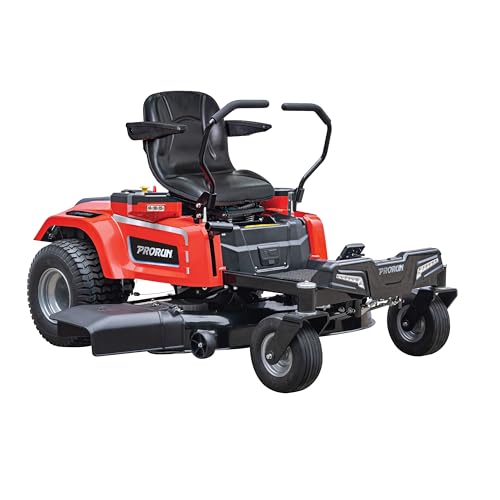
The PRORUN PZT60V42 is a fully electric 60V zero-turn riding lawn mower built for residential and light commercial use. Its primary design centers on a robust 42-inch 14-gauge stamped steel twin blade deck powered by direct-drive brushless motors, giving an immediate impression of solid construction and modern battery-focused engineering. The mower arrives complete with three 10.0 Ah batteries, a charger, mulch kit, and towing kit for ready-to-work versatility.
In performance terms, four high-efficiency brushless motors deliver power equivalent to a 20 HP gas engine while producing zero emissions. The system supports up to 2.0 acres or 70 minutes of runtime, and six battery ports with auto switchover intelligently manage all PRORUN 60V battery sizes for continuous operation. A washout port on the steel deck further simplifies post-mow maintenance during real-world sessions.
Potential drawbacks include the finite 70-minute runtime window which can limit coverage on larger properties without spare batteries or recharge breaks. As a fully electric model, it also depends entirely on battery charge levels rather than continuous fuel refills, and the 42-inch deck width may demand extra passes compared with wider traditional options.
Overall the PRORUN PZT60V42 offers strong value for homeowners and small-property managers who want gas-like cutting power without emissions or noise. Those with medium-sized lawns seeking quiet efficient zero-turn performance and included accessories will benefit most from this electric mower.

Pros
- Strong 24HP FR730 engine power for demanding cutting conditions
- Wide 54-inch FAB deck reduces total mowing time
- Zero turn design delivers excellent maneuverability
- Fabricated deck supports durable everyday operation
Cons
- Sparse details beyond engine and deck leave other features unspecified
- Gas-powered FR730 engine needs regular fuel and maintenance
- Large 54-inch deck size may feel oversized on compact properties
The Husqvarna Z254F is a zero turn mower from the established Husqvarna brand in the riding lawn mowers category. It centers on a solid build that pairs a 24HP 726cc FR730 engine with a 54-inch FAB deck for straightforward residential grass care.
Performance stems directly from the listed specifications. The FR730 engine delivers the horsepower needed for steady operation across typical lawns while the wide FAB deck completes passes efficiently. Zero turn handling improves control in real yard layouts based on the model design.
Considerations arise from the limited data available. Secondary elements such as comfort features fuel capacity or extras receive no mention and the gas engine format involves routine upkeep. The large deck suits open areas better than confined spaces.
The Husqvarna Z254F provides the most value for owners of medium or large properties who want reliable engine power and a broad cutting width. Users with smaller lots or those seeking extensive accessory options should weigh the core specs carefully before purchase.
There is no single best robot lawn mower
“Best robot lawn mower” lists disagree because they are answering different questions. One reviewer may prize a quiet machine on a small, open backyard. Another may care about covering a large, divided garden with less perimeter work. A third may weight app scheduling, security, or how the mower behaves around trees. None of those priorities is wrong. They simply do not produce one winner that fits every home lawn.
For a typical household, “best” means a machine that stays inside a defined area, covers the grass often enough to keep it even, returns to its charging station on its own, and does that without creating new problems: missed corridors, chewed flower beds, a schedule that runs during every barbecue, or a setup you will not maintain. Finish quality matters, but so do noise, safety, and whether you can live with the remaining trim work.
A universal pick is impossible because the important facts are usually unknown until you walk your own yard. Lawn size, shape, and lawn slope vary. So do trees, ponds, play equipment, and how often people actually use the grass. Some owners will bury a boundary wire without complaint. Others want GPS or wireless navigation and will accept mapping and signal limits in return. Budget, smart-home habits, grass type, climate, and theft risk differ too. Until those conditions are on the table, a named champion is marketing, not a decision.
Contrast two ordinary gardens. A small, flat rectangle with one tree and a clear path back to a garage wall is a different job from a large, sloped property with several lawn zones and islands, a pond, a narrow side passage, and weekend football. The first lawn may thrive with a simpler robot and a modest schedule. The second needs more capable coverage, stronger traction and containment, and more careful placement of the charging station. Chasing a generic “best” label skips that difference.
What a robot lawn mower is meant to do
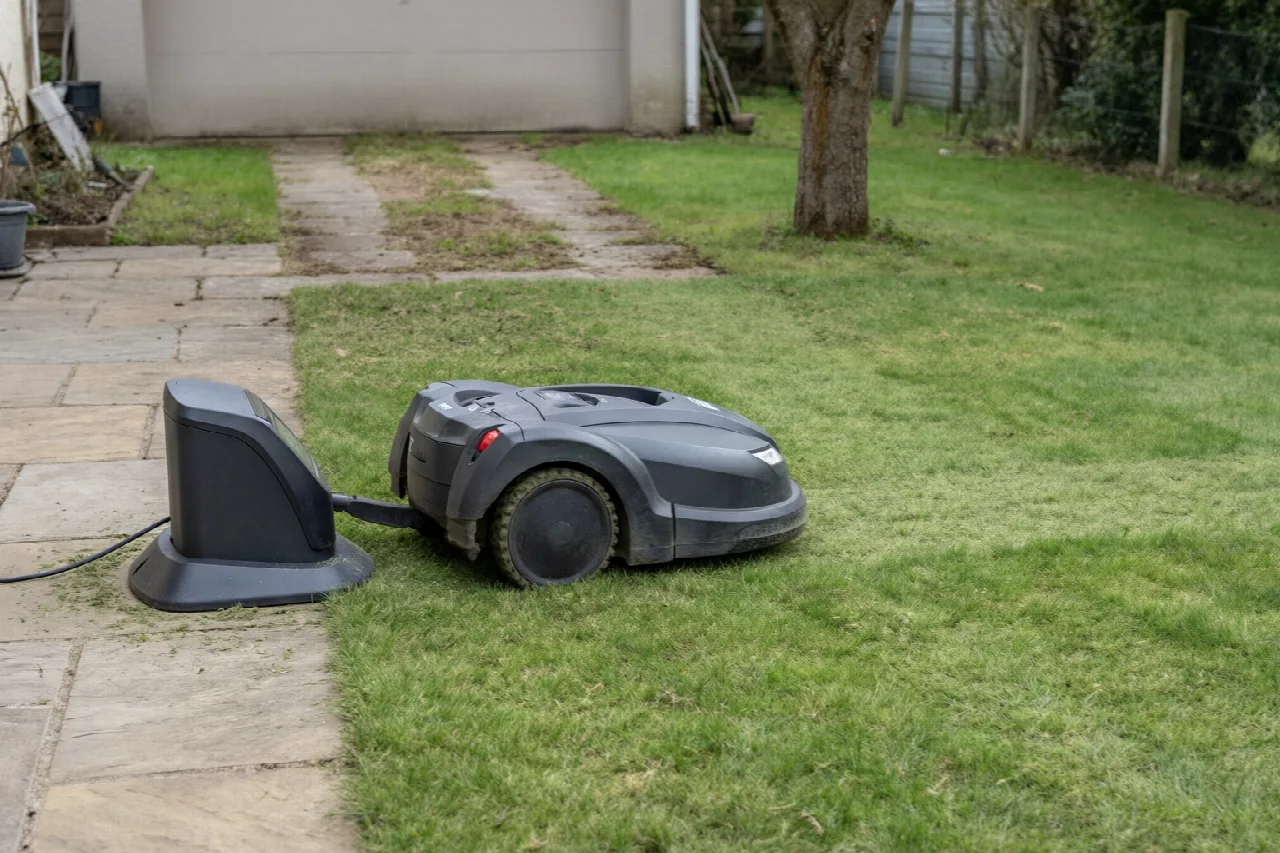
A robot lawn mower is a battery-powered machine meant to cut grass unattended and return to a charging station. Most consumer models work on a mowing schedule: they leave the dock, cut for a stretch, go back to recharge, and repeat through the growing season. The usual job is not a once-a-week scalping. It is frequent, light cutting so the lawn never gets long enough to look ragged.
That pattern is the main difference from a push, reel, or riding mower. A conventional mower is a tool you take out, often on a weekend, and put away. You choose the path, empty a bag or dump a chute, and finish edges by hand or with a trimmer. A robotic lawn mower is closer to a small, repeating groundskeeper. It typically has a narrower cutting path, works in shorter sessions, and is designed to stay inside a defined area rather than to be steered by a person the whole time. You still decide where it is allowed to go and when it may run. You do not stand behind it for every pass.
Mulching, not bagging
Most consumer robot mowers mulch. The blades chop clippings finely and leave them on the turf instead of collecting them. When the machine runs often enough, those clippings stay short and can feed the lawn as they break down. That is why a robot that looks “always busy” can still leave a tidy surface: it is never cutting a week of growth in one pass. If you stop the schedule for a long stretch, the next cuts can leave more obvious debris, and the robot may struggle in grass that has grown past what it was designed to handle.
Mulching is not a complete lawn-care program. It does not replace edging, dethatching, leaf cleanup, overseeding, or fertilizer. It also does not magically tidy every corner. Many robots leave a strip along fences, walls, and beds, or miss awkward pockets that still need a trimmer or a manual pass.
Charging station, schedule, and boundary
Three pieces make the unattended pattern work. The charging station is home base: a dock, usually on a firm, relatively level pad, where the mower replenishes the battery and often waits between jobs. The mowing schedule tells it when it is allowed to work so you can keep it off the lawn during play, entertaining, or the quietest hours. The boundary—whether a physical wire or a mapped or wireless perimeter—tells it where grass ends and flower beds, sidewalks, ponds, and the neighbor’s yard begin.
Not every model uses the same navigation or containment method. Some follow or stay inside a perimeter they can sense. Others build a map and use satellite, radio, cameras, or a mix of sensors to cover the space. All of them still need a defined working area and a reliable way home. “Set and forget forever” is the wrong expectation. You set the area and the rules; you still check the result.
The conditions that decide a good fit
Shop features after you have walked the lawn. The household already knows, or can measure roughly, the facts that matter more than a headline award. Start with how the grass is laid out, not with a shopping-tab comparison.
Walk the open lawn, then the tight passages. Note trees, roots, raised beds, gravel paths, steps, retaining walls, ponds or pools, and anything that creates a drop-off. Mark play equipment, washing lines, and furniture that moves. Check whether the mower would have a clear, safe route from a charging station to every zone, including a side yard that pinches between house and fence. Look at street access and how visible an outdoor robot would be from the road. Feel the ground after rain: spongy banks and ruts are as important as the pretty dry-day slope.
How the lawn is used changes the brief as much as geometry. Children and pets mean unattended blades, toys, bowls, and sudden traffic. Entertaining means you may want the machine docked during evenings and weekends. Wildlife, bird feeders, and hedgehog or rabbit activity raise the bar for when the mower should run and how much you trust collision sensing. A decorative lawn that is mostly viewed from the patio has different finish expectations than a pitch that is kicked every afternoon.
A robot mower is often a poor fit when the site fights the job. Very steep or unstable banks, constantly reconfigured play areas, formal gardens that demand crisp hand-cut edges as the main look, lawns buried in toys or tools, or grass that is routinely left long for weeks will frustrate both the machine and the owner. If you need to clear a meadow after months of neglect, a conventional mower or a professional cut is the right first step. If most of the “lawn” is tiny fragments separated by steps and gravel, the docking and transit time can outweigh the benefit.
Lawn size, shape, and how the mower covers ground
Manufacturers rate models for a claimed working area. Treat that figure as a starting point, not a promise. Real capacity shrinks when the mower must weave around obstacles, climb, recut the same corridors, or wait while people use the yard. Grass that grows fast in a wet, warm spell needs more cutting time than the same square footage in a slow month. If the household only allows daytime weekday hours, the machine has fewer hours to finish the job than a rating written for a more generous schedule.
Two lawns of similar size can need different machines because shape and fragmentation matter as much as square footage. A single open rectangle is efficient to cover. The same area split into front, back, and a narrow side strip, with islands of shrubs in the middle, forces extra travel, more boundary work, and more chances to miss a pocket. Pinch points—gates, paths between beds, gaps beside a shed—can become bottlenecks. If the mower cannot pass reliably, or spends half its time shuttling, the “maximum lawn size” on the box is irrelevant.
Lawn zones and islands are not edge cases; they are common. A zone may be a separate front lawn the mower can only reach through a corridor or with a second docking arrangement, depending on the system. An island is a bed, tree, pond, or trampoline the mower must go around. Each island is another place for a wire loop, a mapped keep-out, or a sensing failure. Multiple zones also affect charging-station placement: the dock has to be a practical home, not just a pretty corner of the patio.
Frequent light cutting is how coverage and charging fit together. The mower is not trying to finish the entire property in one heroic charge. It cuts a portion, docks, and returns. That works when growth stays modest and the schedule has enough windows. It fails when you expect one short daily run to tame a large, complex, fast-growing lawn. Leave headroom. If a model is advertised at the outer edge of your area, complexity, slope, and a few rainy weeks can push it past a reliable everyday fit.
Slope, surface, and obstacles
Lawn slope and surface decide whether the robot can stay planted and keep a consistent cut. Steep, wet, or unstable ground can exceed traction and stability. The mower may slip, scalp, leave uncut patches, struggle to return to the charging station, or in the worst case tip or slide toward a hazard. There is no universal maximum grade that applies to every robot. Buyers should check the maker’s stated slope limit for the actual model and install it only within that limit, on ground that is firm enough to support the machine. A number written for dry turf does not automatically apply to a slick clay bank after rain.
Uneven surfaces create their own problems. Roots, molehills, ruts, and hidden holes can lift a deck, stall a wheel, or produce a washboard finish. Loose soil, fresh seed, and soggy spots can rut under repeated passes. Gravel and decorative stone can be thrown or can damage blades. Steps and retaining walls are drop-offs, not “obstacles to bump.” If the mower can approach an edge, containment has to be trustworthy before the first unattended run.
Some obstacles are best handled with a physical boundary. Ponds, pools, streams, steep drops, public sidewalks, and vegetable beds usually need a hard keep-out, not optimism about onboard sensing. Trees and large fixed objects may be left as islands the mower circumnavigates. Light furniture, hoses, and toys should be cleared; they are not a fair test of a bumper. Lift or collision sensing can reduce some bumps and stop the blades if the chassis is raised, but no sensor suite is foolproof around wildlife, trailing cables, sleeping pets, or a child who treats the robot as a toy.
Water is a special risk because it combines slip, electrical equipment, and a place the mower must never enter. Loose soil is a special risk because the machine can dig in and then fail to dock. Drop-offs are a special risk because gravity does not wait for a second detection. If those features exist, design the working area around them first, then choose a mower that can respect that design.
Boundary wire versus GPS or wireless navigation
The main setup choice is how the mower knows the edge of the job. A common method is a boundary wire: a conductor laid around the working area, often pegged to the surface at first and sometimes buried later. The mower stays inside that loop, and extra loops can mark islands or guide corridors. Installing a boundary wire means walking the entire perimeter, keeping a consistent offset from beds and hard edges, crossing paths in a way the system accepts, and connecting the loop back to the charging station or its associated hardware. The work is tedious more than mysterious. Typical failure modes later are cuts from edging tools, animal damage, broken connectors, and a loop that was laid too tight against a wall or too loose around a play area you later change.
GPS or wireless navigation, and related mapping or camera systems, aim to reduce or skip that perimeter wire. The appeal is obvious on a large or frequently redesigned garden: less trenching, easier changes, sometimes a map you can edit in an app. The trade-off is that these systems have their own setup and signal limits. Tree canopy, tall buildings, dense hedges, and the space between house walls can weaken satellite or radio references. Mapping quality depends on a careful first tour and on the garden not changing every week. Some setups still need reference hardware in the yard. None of this is automatically more accurate or “maintenance-free.” A wire break is obvious once you know what to look for. A confused map can be subtler: repeated misses, drifting toward a neighbor, or a mower that will not leave the dock after a software or signal hiccup.
Charging-station placement sits in the middle of both approaches. The dock needs a stable, relatively level base, space for the mower to approach, power within a safe, weather-appropriate run, and a location that does not block a gate or invite theft. On a wire system, the station is part of the loop. On a wireless system, it is still the place the mower must find at the end of a battery. A beautiful but shaded, cramped, or signal-poor corner can undo an otherwise sensible purchase.
Before you commit to a method, ask how that specific system handles islands, neighboring lawns, and signal or wire loss. Ask what happens if a child opens a gate onto the street, if you add a new bed mid-season, or if the mower loses its reference halfway down the side passage. The honest answer is part of the product, not a footnote.
Cut quality, height, and how the lawn is used
The finish people see is a mix of cutting height, blade sharpness, how often the robot runs, and how much traffic the grass takes. Most robot mowers look their best when they mulch often enough that each pass removes only a little. That pattern can look smoother than a weekly weekend cut, but it looks different: fewer long windrows, more of a continuously short carpet, and usually no decorative stripes. It will not hide bare patches, dog damage, or a lawn that was never level.
Look for a cutting-height range you can actually use through the season, and for an adjustment you will not dread. Cool-season and warm-season grasses, shade, and summer stress all argue for different heights, and those needs change with weather. Treat any millimeter chart as a typical range that varies by species and climate, not as a prescription. If the lowest setting is still too high for a formal look you care about, or the highest setting is too low for a rough utility lawn, the machine is the wrong tool. If height is locked behind a fiddly under-deck knob you will never touch, you will leave it wrong for months.
Sports use, pets, and ornamental edges change expectations. A kickabout lawn needs enough height and recovery time that a daily robot pass does not grind thin spots to dirt. Pets add urine spots and digging; a mower cannot fertilize those away, and it should not run while animals are unsupervised on the same grass. Ornamental edges still usually need a trimmer. Many robots leave a border along hard edges and struggle with tight corners, steps, and the last strip under a low-hanging shrub. If your standard of “done” is a hand-finished perimeter every Saturday, budget that time even after the robot is running well.
Blade condition is part of cut quality. Dull blades shred rather than slice, brown the tips, and make mulching look messy. Blade replacement is routine ownership, not a failure. How often depends on sand, grit, hidden stones, and hours of use—there is no honest single interval for every model and every yard. Plan to inspect, clean, and replace rather than to ignore the underside until the lawn looks torn.
Safety, weather, batteries, and theft
Rotating blades and pinch points can injure children, pets, and wildlife even when sensors are present. Lift or collision sensing and emergency stops reduce some risks. They do not make unattended use automatically safe. Treat the machine as a small mower that happens to drive itself, not as a toy or a harmless gadget. Keep people and animals off the lawn while it runs if you cannot supervise. Store or disable it when very young children treat the garden as a playroom. Clear toys, cables, and low ornaments. Follow the model manual for stopping, lifting, and working on the underside—blades can still be sharp when the unit is off.
Weather and charging habits matter because this is a lithium-ion, outdoor appliance. Follow the manufacturer’s rules on rain, wet grass, and charging-station placement. Wet slopes are more slippery. Soaked turf ruts more easily. Some owners park the mower in rain; others pause the schedule. That choice belongs to the manual and the site, not to a generic internet rule. Keep the dock and connections dry in the sense the maker intends. Do not improvise electrical work. If the supply, outdoor socket, or routing is not already suitable, use a qualified professional. Lithium-ion packs need appropriate charging and should not be treated as indestructible, stored soaked, or repaired as a home electronics project.
Theft is a real outdoor risk. A robot left in an open front garden is attractive and portable. PIN lock or alarm features, disabling the mower so it will not run for someone else, and anchoring or placing the charging station where it is harder to grab all reduce risk. They do not eliminate it. Sight lines from the street, gates, and whether you bring the unit in at night or in the off-season still matter. Check local rules for unattended equipment if that is a concern where you live. Do not assume a PIN or an app notification is insurance.
Noise belongs in the same household conversation even though it is not a blade hazard. Robots are often quieter than a weekend petrol mower, but “often quieter” is not the same as silent, and a machine that starts at dawn under a bedroom window will not feel neighborly. Schedule is a safety and courtesy control as much as a coverage control.
How to match features to your lawn
Turn the criteria into a short process you can finish at home before you talk to a retailer or installer. Compare only models that clearly cover the measured conditions with margin. The manufacturer’s manual—and a competent installer, if you use one—is the authority for slope and area limits on a given model.
- Sketch the lawn from above. Mark buildings, fences, beds, trees, water, steps, and play equipment. Note every pinch point and every separate zone.
- Estimate open area versus complicated area. You do not need a surveyor; you do need honesty about fragments and corridors.
- Walk the slopes on a dry day and after rain. Flag any bank you would not want a wheeled machine to climb unsupervised.
- Decide how much perimeter work you will tolerate. If you will not lay or maintain a boundary wire, a wireless or GPS-assisted system has to be credible on your site, including tree cover and neighboring lawns.
- List must-haves: cutting-height range, schedule control (app, panel, or both), security (PIN lock or alarm, dock placement), and whether you need to pause easily for pets and guests.
- Plan the charging station: power, approach, level pad, weather, and theft exposure.
- Ask about local service, spare blades, and what happens if a wire breaks or a map fails. Consumables and support are part of fit.
- Reject anything that only works if every optimistic assumption is true—perfect weather, no islands, unlimited run hours, children who never leave toys out.
Walk away from a robot mower entirely when the lawn is steeper or less stable than reputable models are specified for, when water and drop-offs cannot be contained reliably, when the grass is a maze of tiny patches, or when the household will not accept remaining edge work and routine cleaning. A conventional mower is not a failure in those cases. It is the tool that still matches the job.
If you do go ahead, compare a short list that already passed the site filter. Do not widen the list to include machines that miss slope, containment, or height needs because they look impressive in a photo. Installation quality matters as much as the box. A well-chosen robot with a sloppy boundary or a dock in a hollow will behave like a bad robot.
Limits and trade-offs to expect
Even a well-matched robot lawn mower does not replace a human mower plus a landscaper. Edge finishing, very long grass after a long pause, leaf piles, molehills, fallen twigs, and toys left on the lawn still need human attention. Tight corners, fence lines, and the strip around islands often stay on the trimmer list. After a holiday, you may need to raise the cutting height gradually or cut once by hand before the robot can resume its light, frequent pattern.
Some gardens stay difficult even with a capable model. Complex formal layouts, very steep banks, constantly moved play equipment, and properties that mix lawn with open water or public paths ask more of containment and judgment than a consumer robot can guarantee. Shade-thin turf and heavy clay that stays wet can look worse under frequent wheels. If the “lawn” is really a collection of display beds with grass as filler, you may spend more time managing keep-out zones than you save on mowing.
Owners should plan a maintenance cadence: cleaning the deck and wheels, checking blades, clearing the charging station, inspecting a boundary wire or refreshing a map, and winter storage or reduced use in harsh climates. None of that is exotic. All of it is easy to skip until the cut turns ragged or the mower gets lost. Do not expect zero maintenance, a stated decade of service life, or silence below a number you saw in an ad. Expect a machine that works hard in the growing season and still needs the same common sense you would give any outdoor power tool.
The best robot lawn mower is the one whose limits match the lawn you actually have. Size, slope, layout, obstacles, boundary or navigation method, cut quality, weather, noise, safety, security, and upkeep are the decision—not a trophy label. When those conditions and the machine’s capabilities line up, “best” stops being a ranking and becomes a yard that stays even while you do something else.
Everything You Need to Know: Best Robot Lawn Mower FAQ
Will a robot lawn mower replace my trimmer?
Usually not. Many robots leave edges, fence lines, and tight corners. Plan to keep a trimmer or to accept a slightly softer perimeter. Islands and walls are the usual leftovers.
Can I leave it running around children and pets?
You should not treat unattended blades as automatically safe. Sensors and PIN codes reduce some risks; they do not remove rotating cutters or pinch points. Keep kids and pets off the lawn while it works unless you are supervising and following the manual.
Does wireless navigation mean no installation?
It usually means less perimeter wire, not zero setup. You still place a charging station, teach or map the lawn, and deal with signal, canopy, and keep-out areas. Check how the system behaves if the reference is lost.
What should I do before the first unattended run?
Confirm the working area is inside the maker’s slope and use limits, contain water and drop-offs, clear debris, and watch a full outing including the return to the charging station. Fix misses and weak edges before you leave the garden.









