

Mechanical safety standards, operational tolerances, and protective gear guidelines align with benchmark specifications established by the American National Standards Institute (ANSI).
Quick Answer: What Size Lawn Mower Do I Need?
Lawn-mower “size” usually means cutting-deck width plus machine class—walk-behind, riding, or zero-turn—not engine horsepower or battery marketing. Match those to the grass you actually maintain, along with shape, obstacles, slope, storage, and how often you cut. Small or broken-up yards generally fit a narrower walk-behind. Larger, more open turf can support a wider deck or a rider. Treat any acre-to-deck…

Pros
- Powerful 80V brushless motor delivers 32HP gas-equivalent performance with quiet fume-free operation and no engine maintenance.
- Complete kit includes four 6.0Ah batteries and 600W charger for substantial runtime up to 1.5 acres.
- SmartCut technology and 42-inch heavy-duty steel deck ensure consistent cuts without bogging in tough conditions.
- Versatile towing up to 350 lbs and optional cargo hauling plus comfort features like high-back seat and LED lights.
- Strong 4-year limited warranty and full compatibility with the Greenworks 80V tool ecosystem.
Cons
- Rear utility cargo bed for 200 lb hauling is sold separately and not included in the kit.
- Runtime of up to 1.5 acres varies with conditions and may require recharging or battery swaps on larger properties.
- As a fully cordless model continuous operation depends on battery levels unlike gas engines with unlimited runtime.
The Greenworks 80V 42" CrossoverT Cordless Riding Lawn Tractor is a ready-to-mow zero-emission tractor designed for homeowners managing medium to large lawns. It features a reinforced 42-inch stamped steel deck of 12-gauge construction along with premium comfort elements such as a high-back padded seat with foldable armrests. The overall build emphasizes durability and user convenience right out of the box with the included battery and charger set.
Performance centers on the 80V TruBrushless motor that provides 32HP gas-equivalent power with instant torque and quiet fume-free operation. SmartCut technology senses grass conditions and automatically adjusts power to maintain a consistent cut even in tall thick or wet areas. The four 6.0Ah batteries support runtime for up to 1.5 acres depending on conditions while dual LED headlights and a 7-position deck height range from 1.5" to 4.5" add practicality. Front and rear attachments further allow towing up to 350 lbs for added yard utility.
Key considerations include that the rear utility storage bin capable of hauling 200 lbs is sold separately so full cargo functionality requires an extra purchase. Runtime remains condition-dependent and may fall short for properties significantly larger than 1.5 acres without using the 600W charger or swapping batteries. The cordless design prioritizes ease and low maintenance but trades off the continuous runtime of traditional gas models.
This tractor delivers strong value for eco-conscious owners of residential properties who want gas-like power without the emissions noise or upkeep. It suits those who already use or plan to expand into the Greenworks 80V family of tools and who appreciate the 4-year limited warranty. Users with exceptionally large or commercial-scale lawns should evaluate battery logistics carefully before purchase.

Pros
- Delivers strong 21 horsepower equivalent power comparable to gas riding mowers.
- Provides up to 1.5 acres of runtime on a full charge with the six included batteries.
- Features low-maintenance dual brushless motors without belts for greater durability.
- Offers versatile 12-position cutting height adjustment from 1.5 to 4.5 inches.
- Includes digital controls for blade settings, drive speeds, and cruise control.
Cons
- Limited to 1.5 acres of cutting per charge without purchasing additional batteries for bigger lawns.
- Requires recharging time for the six 56V batteries after each use session.
- Relies solely on battery power with no hybrid or gas backup option for extended operation.
The EGO Power+ TR4204 is a cordless electric riding lawn mower built as a modern tractor alternative for residential use. It features a robust 42-inch stamped steel deck and arrives ready to go with six 56V 6.0Ah batteries plus a charger, creating an immediate impression of convenience and solid construction free from gas engine complexity.
Performance shines through its equivalent 21 horsepower output and top speed of 6 MPH, allowing efficient coverage of up to 1.5 acres on a single charge. Dual brushless cutting motors operate without belts for added durability and less upkeep, while the digital display lets users select three blade settings, three drive speeds, and cruise control. The 12 adjustable heights ranging from 1.5 to 4.5 inches combined with anti-scalp wheels deliver precise results across varied terrain.
Drawbacks center on battery dependency, as larger properties beyond 1.5 acres require extra batteries and recharging intervals can interrupt workflow. The fully electric design eliminates fuel storage needs but demands access to power sources between sessions.
This mower suits homeowners with medium to large yards who value quiet, emission-free operation and reduced maintenance. Those seeking expandable battery capacity for bigger areas will find the EGO Power+ TR4204 a strong long-term investment in cordless lawn care.
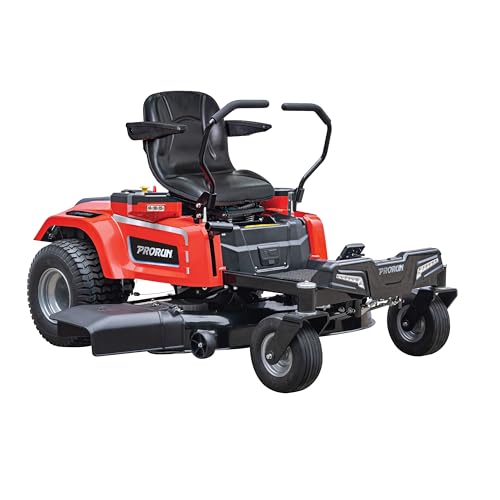
Pros
- High-efficiency brushless motors maximize power output and durability over traditional motors
- Up to 2 acres runtime with three included 10.0 Ah batteries supports substantial mowing sessions
- Zero-emission operation with gas-equivalent 20 HP power for quieter environmentally friendly use
- Six-port auto-switchover battery system provides flexible extended runtime options
- Durable 42-inch steel deck plus included mulch and towing kits add immediate functionality
Cons
- Runtime is limited to approximately 70 minutes or 2 acres which may require recharging for larger properties
- Fully battery-dependent design means performance relies on charge levels and spare battery availability
- 42-inch deck size may require more passes on expansive lawns compared to wider commercial models
The PRORUN PZT60V42 is a fully electric 60V zero-turn riding lawn mower built for residential and light commercial use. Its primary design centers on a robust 42-inch 14-gauge stamped steel twin blade deck powered by direct-drive brushless motors, giving an immediate impression of solid construction and modern battery-focused engineering. The mower arrives complete with three 10.0 Ah batteries, a charger, mulch kit, and towing kit for ready-to-work versatility.
In performance terms, four high-efficiency brushless motors deliver power equivalent to a 20 HP gas engine while producing zero emissions. The system supports up to 2.0 acres or 70 minutes of runtime, and six battery ports with auto switchover intelligently manage all PRORUN 60V battery sizes for continuous operation. A washout port on the steel deck further simplifies post-mow maintenance during real-world sessions.
Potential drawbacks include the finite 70-minute runtime window which can limit coverage on larger properties without spare batteries or recharge breaks. As a fully electric model, it also depends entirely on battery charge levels rather than continuous fuel refills, and the 42-inch deck width may demand extra passes compared with wider traditional options.
Overall the PRORUN PZT60V42 offers strong value for homeowners and small-property managers who want gas-like cutting power without emissions or noise. Those with medium-sized lawns seeking quiet efficient zero-turn performance and included accessories will benefit most from this electric mower.

Pros
- Strong 24HP FR730 engine power for demanding cutting conditions
- Wide 54-inch FAB deck reduces total mowing time
- Zero turn design delivers excellent maneuverability
- Fabricated deck supports durable everyday operation
Cons
- Sparse details beyond engine and deck leave other features unspecified
- Gas-powered FR730 engine needs regular fuel and maintenance
- Large 54-inch deck size may feel oversized on compact properties
The Husqvarna Z254F is a zero turn mower from the established Husqvarna brand in the riding lawn mowers category. It centers on a solid build that pairs a 24HP 726cc FR730 engine with a 54-inch FAB deck for straightforward residential grass care.
Performance stems directly from the listed specifications. The FR730 engine delivers the horsepower needed for steady operation across typical lawns while the wide FAB deck completes passes efficiently. Zero turn handling improves control in real yard layouts based on the model design.
Considerations arise from the limited data available. Secondary elements such as comfort features fuel capacity or extras receive no mention and the gas engine format involves routine upkeep. The large deck suits open areas better than confined spaces.
The Husqvarna Z254F provides the most value for owners of medium or large properties who want reliable engine power and a broad cutting width. Users with smaller lots or those seeking extensive accessory options should weigh the core specs carefully before purchase.
What lawn-mower size actually means
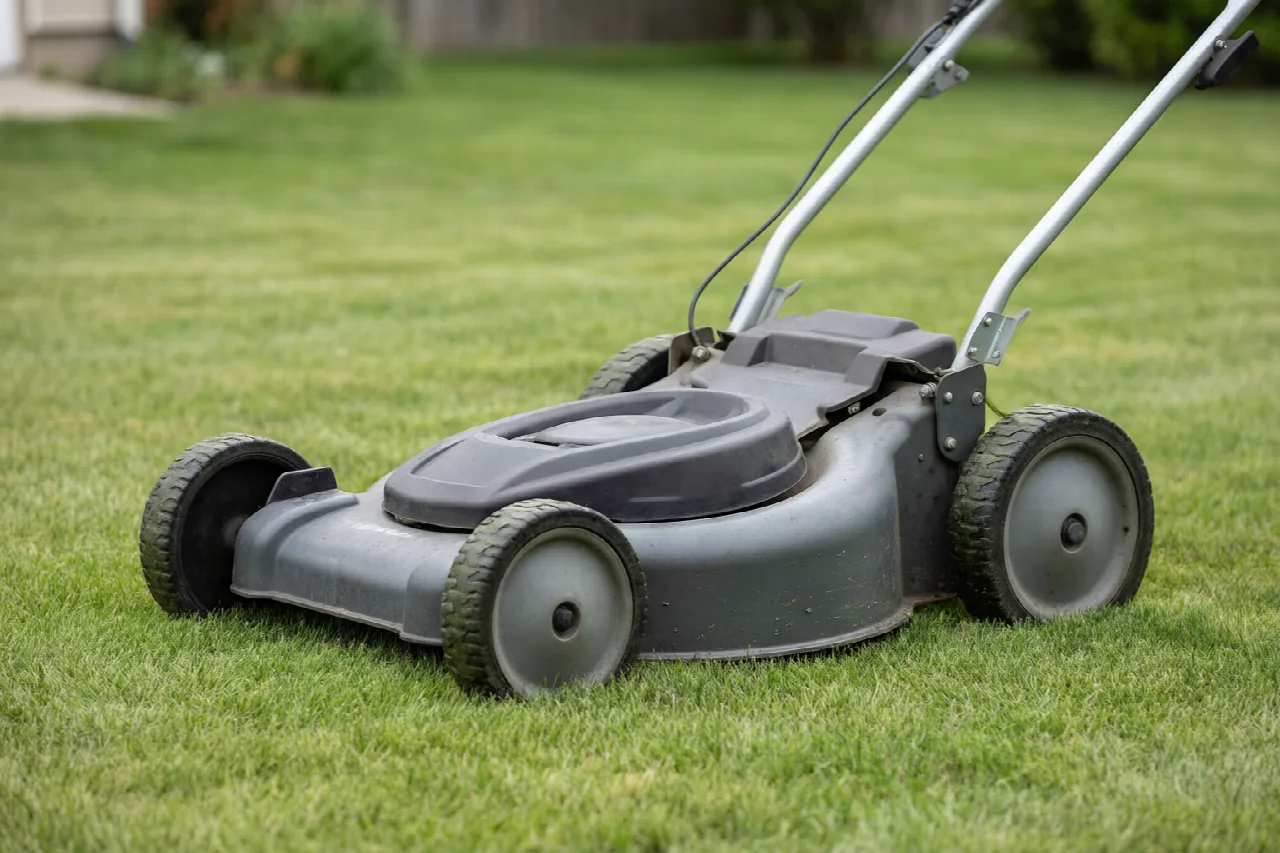
When shoppers ask what size lawn mower they need, they are rarely asking about the marketing number on the engine or battery. They want a machine that will finish the yard in a reasonable time without being clumsy, unsafe, or impossible to store. In everyday language, that “size” is two things working together: how wide the cutting deck is, and what class of machine carries that deck.
The cutting deck is the housing that holds the blade or blades. Deck width is the advertised cutting swath in one pass. A wider deck can cover more grass per trip down an open stretch. It also makes the whole machine longer or wider, harder to thread between beds, and more demanding of shed doors and turning space. The printed deck number is a cutting width, not the full footprint of the mower and not the room you need to turn around at the end of a row.
Machine class is the other half of sizing. A walk-behind mower—push or self-propelled—puts the operator on foot behind a relatively compact deck. A riding mower, including many lawn-tractor styles, puts the operator on a seat and usually pairs that with a wider deck. A zero-turn mower is also a rider in everyday terms, but it steers differently and typically turns in less space than many traditional lawn tractors. Choosing class is part of choosing size because a 21-inch walk-behind and a mid-size rider are not interchangeable even if someone later talks about “horsepower.”
Power source is not size. Gas displacement, advertised horsepower, torque slogans, and battery voltage describe how the machine is powered, not how much lawn it is suited to. A high-voltage walk-behind can still be the right tool for a small, fenced yard. A modest rider can still be too large for a gate. Treat engine and battery claims as separate from deck width and class, and compare them only after the job itself is clear.
Residential deck widths overlap across classes. Walk-behinds tend to be narrower; riders and zero-turns tend to be wider. Those bands are approximate, they overlap, and they are not a standard that maps one acreage to one inch measurement. Two machines with the same advertised deck can still feel different because of wheelbase, bagger, side discharge, and how much extra metal sits outside the blades.
Measure the lawn you will actually mow
Lot size is a poor stand-in for mowing area. A half-acre listing can include the house, driveway, patio, woods, a steep bank you never cut, or a side lot a landscaper already handles. The number that matters is usable turf: the grass you personally keep short, on the schedule you actually keep.
You do not need a survey. Pace the main rectangles, use a property sketch or tax-map outline if you have one, or add the lengths and widths of the front, back, and side lawns and subtract obvious hardscape. A rough estimate is enough to decide whether you are looking at a compact walking job, a long walking job, or a job that starts to argue for sitting down. Do not chase false precision. What you need is order of magnitude plus a mental picture of how that grass is arranged.
Arrangement matters as much as the total. One open expanse is a different job from three disconnected patches that add up to the same area. Multiple small lawns mean more starts and stops, more gates, more edges, and more time turning than cutting. A highly landscaped yard with beds, trees, and play equipment behaves like several small lawns even when it looks like one backyard on a map.
How often you mow should nudge the range, not replace it. If you cut frequently during peak growth, a slightly smaller, more agile machine can still keep up because each visit removes less height and you are not trying to reclaim a meadow. If you routinely let the grass get long, or you only have one window a week, extra walking time becomes more noticeable and a wider deck on open ground starts to earn its keep. Frequency is a comfort and time factor. It is not a formula that converts square footage into a required deck.
Write down three facts before you shop: a rough usable-turf estimate, whether that turf is one open field or many fragments, and how many times a month you realistically mow in high season. Those three facts prevent the most common error, which is buying for the lot listing instead of the grass. For troubleshooting and reliability insights, consult our in-depth marshall stanmore iii vs harman kardon onyx studio 8 report.
How shape, obstacles, and access change the right width
Two yards with the same area can need different decks. Shape, obstacles, and the path in and out of storage decide whether a wide swath saves time or creates extra work.
A wider deck reduces passes on open, regular ground. Around trees, swing sets, fences, raised beds, and tight corners, that same width can force you to leave uncut crescents, back up more often, or spend the time you “saved” with a trimmer. Leftover strips along beds and trunks are normal with any mower; a deck that cannot slip between obstacles simply leaves more of them. If most of the lawn is a slalom, a slightly narrower deck often finishes the whole job sooner because you spend less time correcting and less time on follow-up trimming.
Access is a hard limit, not a preference. Measure gates, fence openings, side yards, and the door or bay where the mower will live. Include handles, bags, chutes, and the fact that you need room to spare, not a paint-scraping fit. A machine that matches the grass on paper is the wrong size if it cannot roll from the shed to the lawn without being tipped, disassembled, or left outdoors. Readers comparing setup options can review our technical analysis on dyson v8 cyclone vs bissell featherweight stick.
Check the path, not only the opening. Stairs, a sharp turn at the garage, a narrow walk between house and fence, a trailer ramp, or a low lintel can rule out a rider that would otherwise suit an open back lawn. If you ever need to load the mower for service, the same path and opening still have to work.
Think in leftover geometry. After you imagine the first pass along a fence, what remains beside the tree ring? After you turn at the end of a row, does the machine need a wide apron of lawn that you do not have? Advertised deck width never includes that turning apron. Tight property lines, retaining walls, and playground borders shrink the space you can actually use at the end of each row. For complementary field maintenance guidelines, examine our breakdown of bissell crosswave hydrosteam vs shark stainforce.
Slopes between levels belong in this layout check. A yard that looks large from the street may be several terraces connected by steps or a steep path. That is not one riding surface. It is several walking surfaces plus a storage and transport problem. Size the machine to the largest continuous area you can actually drive or walk without fighting grade changes the machine was not meant to handle.
Walk-behind, self-propelled, riding, and zero-turn
Class is how the industry groups residential machines, and it is the cleanest way to turn lawn layout into a short list. These are typical patterns, not rules, and they stay inside homeowner use—not commercial or agricultural equipment.
When a walk-behind is usually the better fit
A walk-behind mower is generally the better fit when the usable turf is modest, broken into patches, or wrapped around beds and trees. You can store it in a smaller footprint, roll it through ordinary gates, and cut close enough that a string trimmer is a finishing tool rather than a second mower. Push mowers ask you to supply the forward force. That is simplest on small, flat lawns and for people who want the lightest, least complicated machine.
What self-propelled changes
A self-propelled walk-behind still requires you to walk the entire lawn. What it changes is effort. Drive wheels help on larger walking jobs, mild slopes, thick grass, and days when heat or fatigue would otherwise rush the work. You still steer, still turn around obstacles, and still need a deck width that matches the layout. Self-propelled is a comfort and control upgrade inside the walk-behind class, not a substitute for a rider.
When a riding mower starts to make sense
A riding mower, including many lawn-tractor styles, starts to make sense when there is enough open, reasonably regular turf that walking the whole job would take a long time, and when you have storage, a path, and turning room for a larger machine. Riders trade agility for seated time and, often, a wider deck. They are a poor match for a large total area that is actually a maze of small rooms. If most of the grass is fragmented, a mid-size walk-behind plus a trimmer usually fits the work better than a lawn tractor bought for the sum of the patches.
How a zero-turn differs for sizing and layout
A zero-turn mower typically turns in less space than many traditional lawn tractors, which can help on open lawns with some trees if you have practiced the controls. That tighter turn does not erase the need for room to operate and store the machine. It also does not make a zero-turn the default on slopes or rough ground. Steering with independent drive wheels is a different skill than a steering wheel, and the learning curve is part of the size decision: a machine you cannot place confidently will leave a ragged edge and invite mistakes near fences and drop-offs.
Expect tradeoffs in space and terrain no matter which seated class you consider. Riders need a larger storage footprint and a wider path. They are less forgiving of ruts, hidden roots, and soft spots. Zero-turns can be quicker on open, relatively even turf and still be the wrong tool for a hillside, a cluttered lot, or a shed that barely fits a walk-behind. None of these classes eliminates edging or trimming. Buying a rider because you hope never to use a trimmer is a sizing mistake, not a time-saver.
How cutting-deck width trades speed for control
Deck width is a coverage-versus-agility choice. On a wide, unobstructed rectangle, a wider deck means fewer parallel passes. On a complex yard, each extra inch can be an extra inch you cannot fit between a maple and a fence.
Operators usually overlap passes slightly so they do not leave a strip of tall grass. Usable coverage is therefore less than the advertised deck number. Edges along beds, fences, and sidewalks also eat width: you cannot hang the whole deck over a boundary, so the last pass is often a partial pass. A chart that pretends the full advertised width is productive every foot of the lawn overstates the benefit of going wider.
A slightly narrower deck can finish a complex yard faster because you spend more time cutting and less time jockeying. You can take a cleaner line along a bed, you leave smaller uncut pockets, and you may need fewer cleanup passes. The time that matters is total job time—mowing plus trimming plus putting the machine away—not theoretical acres per hour on an empty field.
Turning space is larger than printed deck width. At the end of a row you need room for the wheels, the deck overhang, and the arc of the turn. A walk-behind needs a smaller apron than a rider; a zero-turn often needs less apron than a lawn tractor of similar deck width, but it still needs more than the blade housing alone. If your lawn ends in a wall, a pond edge, or a neighbor’s garden, that apron does not exist. Size the deck to the space you can actually turn in, not to the widest number on a showroom tag.
Buying the widest deck you can find is not automatically efficient. Oversizing can add cost, weight, storage problems, and trimming time. It can also tempt you onto terrain or through openings the machine does not fit. Choose the narrowest deck that still makes the open parts of the lawn reasonable, then stop. That conservative habit prevents most over-buying.
Slope, terrain, storage, and who will mow
Square footage misses the conditions that actually decide whether a class is workable.
Steep, uneven, or soft ground can make a larger or riding machine a poor or unsafe fit even on a big property. Ruts, hidden holes, wet swales, and side hills change traction and stability. A walk-behind you can refuse to push across a bad patch is often more controllable than a rider you have already committed to a line. This is a caution, not a homemade slope rule. Never treat a blog’s advice as a substitute for the operator manual. Manufacturers publish limits for a specific machine; those limits, not a general article, govern where that machine may be used. If the yard is steep enough that you are unsure, get local advice and stay with a smaller, more controllable machine until you have a clear answer.
Storage is a hard constraint. Measure the shed or garage opening, the depth of the bay, and whether you can walk around the machine to add fuel or charge a battery. Stairs, tight sheds, and shared garage space often rule out a rider that would otherwise match the grass. If the only storage is a balcony, a basement, or a closet-sized locker, you are in walk-behind territory regardless of lot size.
The person who actually mows should be able to start, steer, stop, and store the machine comfortably. Physical effort, balance, hearing comfort, and whether more than one person shares the job all affect class. A self-propelled walk-behind can be the difference between a sustainable routine and a machine that sits unused. A rider can reduce walking for someone who has the space and a relatively open lawn, and it can be a burden for someone who cannot comfortably mount it or who dreads backing it through a narrow door. Size the tool to the operator, not to an idealized weekend.
Local checks belong here only as reminders to look, not as universal rules. Some neighborhoods care about noise hours; some properties have awkward fuel or charging locations. Those are site facts you verify at home. They are not a reason to invent ordinance numbers or to treat one power source as always quieter or always better.
Site conditions that should push you toward a smaller, more controllable machine include: broken turf, many obstacles, narrow access, limited storage, uncertain slopes, rough or wet ground, and an operator who wants maximum control more than minimum walking. A large open lawn with a wide path and a real storage bay is the situation that most often supports stepping up in class.
A practical way to choose a size range
A short decision order keeps you from buying too much or too little machine.
- Estimate usable turf and how fragmented it is. Ignore lot listings and house square footage.
- Walk the access path and measure storage and gate openings with room to spare.
- Choose machine class from that layout and from who will mow: walk-behind (push or self-propelled) for smaller or broken-up yards; rider or zero-turn only when open turf, storage, and terrain support a seated machine.
- Pick a conservative deck-width range inside that class. Favor the width that still leaves you agile around beds and fences. Treat published acre-to-deck charts as unofficial, overlapping starting points, not engineering rules.
Common marketing charts that pair acres with deck widths are rough bands. They overlap on purpose, they assume relatively open ground, and they ignore your shed door. Use them only to confirm you are in the right neighborhood—compact walk-behind, larger walk-behind, or seated machine—then let layout and storage decide. There is no single formula that converts acres into the only correct deck width.
Stay one step smaller when the yard is landscaped, the openings are tight, the ground is uneven, or you mow often enough that each session is short. Accepting a bit more walking or a few more passes is usually cheaper than owning a machine you cannot store, cannot turn, or cannot use on half the property. Oversizing adds cost, storage problems, and extra trimming without reliably shortening the job.
Two tools often beat one oversized machine. A mid-size walk-behind plus a trimmer covers most residential yards that look “almost big enough” for a rider. A modest rider for the open back lawn plus a small walk-behind for the gated side yard can be saner than forcing one huge deck through every opening. A zero-turn does not replace a trimmer. Plan the finishing tools as part of the size decision, not as an afterthought.
If you are between two ranges, write down the limiting factor: time on open grass, a 36-inch gate, a hillside, or a one-car garage. The limiting factor is the answer. Buy to that constraint, then use class and deck width to fill in the rest.
Mistakes, safety limits, and when to get local advice
The expensive mistakes are predictable. Sizing from the lot listing instead of usable turf buys a rider for a house, driveway, and woods. Ignoring the shed door or the side-yard gate buys a machine that lives in the driveway. Assuming a wide deck or a zero-turn eliminates edging leaves you with the same trimmer work and a harder machine to park. Choosing class from engine art or battery voltage skips the job entirely.
Some choices have safety implications you should not guess about. Slope and rollover risk, blade-handling, fuel storage, and battery charging all come with rules in the operator manual and with conditions only you can see on site. Do not invent a slope percentage, do not assume a class is safe if you go slowly, and do not treat general comfort on a hill as approval. If a machine’s manual limits use on slopes, or if the ground is steep, broken, or slick, follow the manual or ask a qualified local dealer or equipment shop to help you match a machine to that terrain. When the task is choosing a machine for a hillside, local eyes and the manufacturer’s limits matter more than any size chart.
Measure before you buy. Take a tape to the storage opening, the gate, and the tightest turn on the path to the lawn. Walk that path as if you were already pushing or driving the machine. If you cannot describe those clearances, you are not ready to choose a rider or a wide deck.
Ask for local help when the lawn is sloped or irregular, when you are unsure whether a seated mower will fit the property, or when two classes seem equally plausible. A shop that can look at photos of the yard, the gate, and the shed is more useful than a chart. Read the operator manual for any machine you seriously consider: that is the place to check slope, weight, and operation limits for that specific model. A sizing article can only give criteria. The manual and the site give the limits.
If you remember only one sequence, use this: count the grass you cut, respect the openings and the ground, choose the smallest class that makes the open areas reasonable, then pick a deck you can turn and store. That is what size means on a residential lawn, and it is enough to choose a range without treating any product as a winner.









