Quick Answer: Which Weed Wacker Is the Best?
There is no single best weed wacker. The right string trimmer is the one that matches your lot size, how thick the growth is, whether you need edging, and whether gas, corded electric, or battery power fits how you work, store, and maintain equipment. Start with the job and the power source, then compare weight, shaft style, line feed, and cutting width. Brand lists fail when they ignore those conditions.
There Is No One Best Weed Wacker
People search for the best weed wacker because they want a short answer. Yards are not short answers. A tool that feels light and quiet on a small urban lot can bog down in wet weeds along a rural fence. A gas trimmer that keeps going on a long property line can be a poor fit beside a patio, a shared wall, or a shed with no room for fuel. “Best” only means best for a defined job.

Pros
- Includes both battery and charger for immediate setup.
- Compatible with RYOBI 18V ONE+ batteries for broader system flexibility.
- Lightweight design improves portability and reduces fatigue during regular yard work.
- Supports both .065 and .080 trimmer line for added line compatibility.
Cons
- 13-inch maximum cutting width is more suited to small and medium yards than large properties.
- No runtime, noise level, or weight spec is provided in the manufacturer listing.
- The product details do not specify advanced features such as brushless motor technology or telescoping shaft adjustment.
Overview: The RYOBI ONE+ 18V 13 in. Cordless Battery String Trimmer/Edger is a lightweight, battery-powered lawn tool designed for basic trimming and edging tasks. Its 2-in-1 setup makes it a practical option for homeowners who want one tool for routine yard cleanup.
Performance: A pivoting head helps the tool transition into edging mode, while the variable-speed trigger gives the user more control over light trimming and tougher spots. The adjustable 11 in. to 13 in. cutting width adds flexibility, and compatibility with .065 and .080 line makes replacement easier.
Drawbacks: This model is best matched to smaller or medium-size yards because its 13-inch cutting width is modest. The manufacturer listing does not list runtime, total weight, or advanced motor details, so buyers should avoid assuming high-end performance beyond the stated features.
Verdict: For homeowners already using the RYOBI ONE+ platform, this trimmer/edger offers convenient cordless operation and broad battery compatibility. It is a sensible pick for straightforward lawn maintenance, especially when included battery and charger value matters.

Pros
- Highly versatile multi-head system with support for a wide range of EGO attachments.
- Brushless motor and carbon fiber shaft are built for durability and reduced vibration.
- Edger attachment offers adjustable depth control for more precise curb and driveway edging.
- Works with EGO 56V ARC Lithium batteries, which is convenient for current EGO users.
Cons
- Battery and charger are not listed in the kit details, so they may need to be purchased separately.
- As a multi-head system, it may not be the simplest choice if you only need a basic standalone edger.
- The product data does not provide weight or runtime, making it harder to compare with other cordless edging options.
EGO Power+ ME0820 is a cordless multi-head edging kit that pairs the PH1420 power head with the EA0820 8-inch edger attachment. It is designed for homeowners who want one power unit that can support multiple yard-care tasks over time.
The standout feature is flexibility. The power head works with EGO's Multi-Head System attachments, while the edger itself offers up to 3 inches of depth adjustment for crisp lawn borders. A brushless motor, digital two-speed control, and IPX4 weather-resistant construction add practical value for regular outdoor use.
There are a few limitations to consider. The kit details do not include a battery or charger, so some buyers may need to add those separately. It is also best suited to users already invested in the EGO 56V platform, since the system's value is strongest when paired with other compatible attachments.
Overall, this is a strong option for EGO owners who want a durable, expandable edging system rather than a single-purpose tool. It should appeal most to users who value modularity, cleaner edging control, and compatibility with a larger cordless yard-care lineup.

Pros
- True 2-in-1 design that converts quickly between trimmer and edger modes
- Command feed spool with free spools for life program for ongoing convenience
- Two 20V batteries and charger included for extended use out of the box
- Tilting head plus rubberized wheels improve control on varied terrain
- Full Power Share compatibility with other WORX 20V and 40V tools
Cons
- 12-inch cutting diameter may require extra passes on larger lawns
- 0.065-inch line diameter best suited to light and medium grass rather than heavy brush
- Battery-powered design means runtime depends on charge levels without specified duration
The WORX WG163 is a cordless 20V string trimmer and lawn edger built for residential use. Weighing just 5.5 lbs with a compact design, it features rubberized wheels and an adjustable spacer guard that create a solid first impression of a user-friendly outdoor power tool focused on precision and ease.
In performance the 7600 rpm motor and 12 inch cutting diameter handle standard grass trimming effectively. The innovative command feed allows instant line deployment with a push button while the head tilts up to 90 degrees for slopes and tight spaces. Conversion from trimmer to edger takes only seconds and the two included Power Share batteries support the broader WORX ecosystem for ongoing convenience.
Potential drawbacks include the 12 inch path that can slow progress on expansive lawns and the 0.065 inch line suited mainly to lighter tasks. Battery runtime is not detailed in specs so users may need to plan around recharges for prolonged sessions.
Overall the WORX WG163 delivers strong value for homeowners managing small to medium yards who want a convertible cordless tool with ecosystem compatibility and straightforward operation.
Most ranking articles fail for the same reason: they treat power type, cutting width, and brand as if those choices were universal. They are not. Lot size, terrain, thickness of growth, outlet access, noise limits, storage, and how often you will use the tool change the answer. So does whether you mainly tidy grass along fences or you regularly cut coarse weeds that a light nylon line struggles to finish.
Decide the job first, then the power source, then the feature set. Brand comes last. If you reverse that order, you compare marketing claims instead of matching a tool to the work. Before you look at models, settle the ambiguities that actually change the purchase:
- How large is the area you will walk with the trimmer, and how often?
- Is the growth light grass, thick weeds, wet clumps, or woody stems?
- Do you need clean edging along walks and beds, or only trimming?
- Do you have a safe outdoor outlet and a cord path, or only indoor charging space?
- Are neighbors, local noise rules, or fuel storage a constraint?
- How much weight, starting effort, and seasonal upkeep will you accept?
No power type wins every one of those questions. The rest of this guide is a criteria path so you can choose a class of tool without treating any model as the winner for every yard.
Weed Wacker, String Trimmer, and Brush Cutter: What People Usually Mean
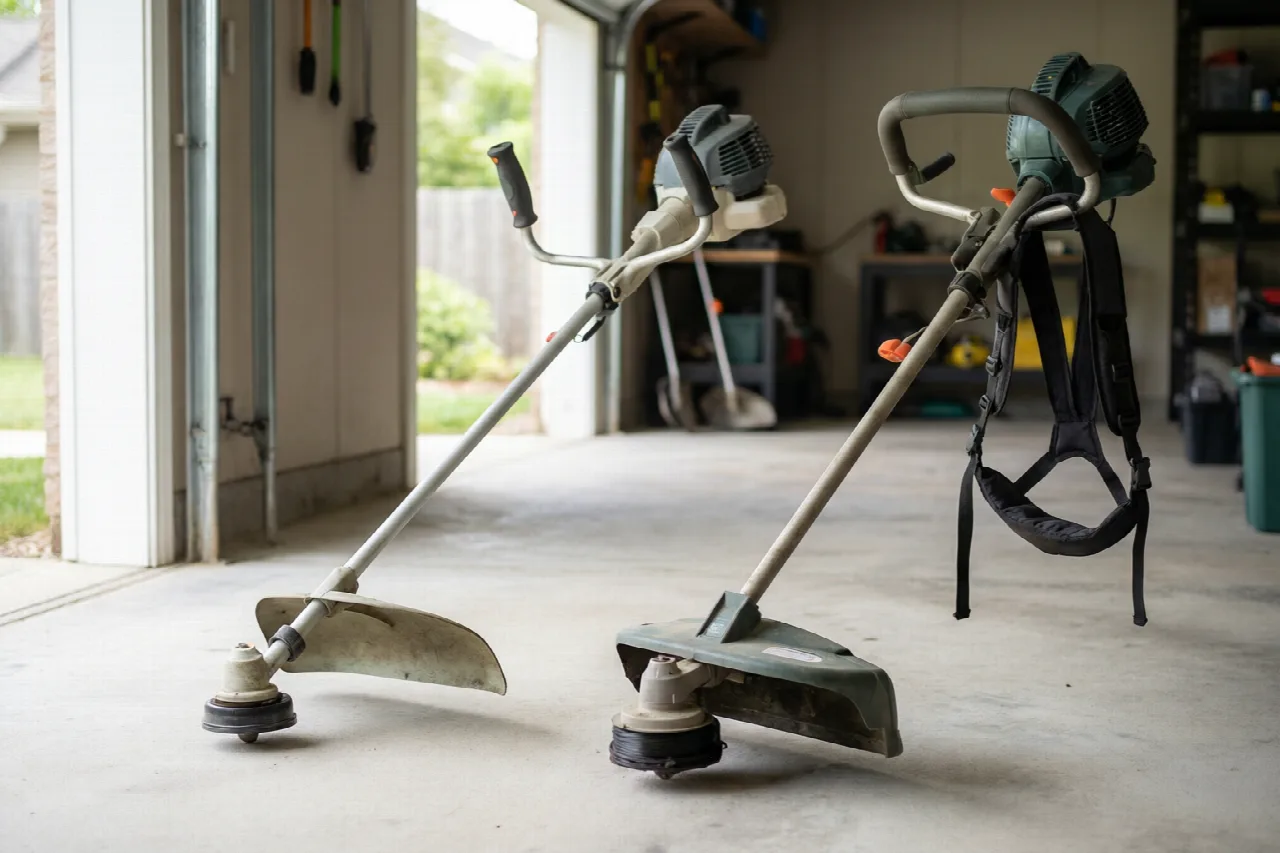
In everyday speech, weed wacker and string trimmer usually mean the same class of residential tool: a handheld machine that spins nylon cutting line to trim grass and light weeds where a mower cannot reach. Retailers and manufacturers may prefer “string trimmer,” “line trimmer,” or a brand-specific name. Regional slang varies. Unless a listing is clearly describing a heavier brush cutter or a blade-only machine, those common names point at the same job.
A brush cutter is a heavier class. It is aimed at thicker vegetation and is sometimes fitted with a metal blade instead of, or in addition to, line. The shaft, harness, and cutting head are built for more resistance. That extra capability comes with more weight, more vibration, and a different injury profile. Names still vary by brand and region, so read the cutting head and intended use, not only the product title.
Spinning nylon cutting line is enough when you are finishing edges after mowing, clearing grass from fences, posts, and beds, and knocking down ordinary weeds. Line flexes when it hits a hard object, which is why it is the usual choice around rocks, foundations, and landscaping. It is the wrong first choice when the work is woody brush, dense brambles, or stems that repeatedly stall a light head. In those cases a dedicated brush cutter, a different landscape tool, or a professional crew is more appropriate than forcing a residential string trimmer to act like a clearing saw. When planning workspace deployment, consider the engineering criteria outlined in our z890 vs x870e motherboard guide.
Do not assume a trimmer can replace a lawn mower on a large open lawn, or that a blade attachment turns a light consumer tool into a safe brush machine. Class of tool, cutting medium, and the job have to match. If a listing is vague about whether it is a line trimmer or a brush cutter, treat that as a reason to keep reading the description rather than a reason to guess.
Gas, Corded Electric, and Battery Power Compared
Residential weed wackers are almost always gas, corded electric, or battery powered. Each type can cut grass and light weeds. They differ in mobility, noise, starting effort, upkeep, and how they fail when the vegetation gets thick or the session gets long.
Gas trimmers
A gas trimmer is typically the most mobile option and the one people reach for when the lot is large, the growth is coarse, or there is no convenient outdoor outlet. There is no cord to plan around and no pack that needs a charger between sessions. That freedom is the main reason gas still makes sense for some properties. For additional operational safety benchmarks, see our published testing notes on marshall stanmore iii vs harman kardon onyx studio 8.
The tradeoffs are practical, not theoretical. Gas tools are usually louder and heavier. They need fuel on hand, seasonal storage habits, and more routine upkeep than electric machines. Starting can take more effort, especially after the tool has sat. Exhaust and fuel handling matter if you work near doors, play areas, or a tightly packed neighborhood. Local noise, fuel-storage, and emissions rules can also make a gas tool less practical even when it has the power you want. Check current local rules rather than assuming a gas model is allowed everywhere you might use it.
Two-stroke and four-stroke engines show up in this category. Treat that difference as a maintenance and exhaust distinction, not a ranking. Two-stroke designs generally involve mixing fuel and oil according to the specific engine’s instructions. Four-stroke designs typically keep oil in a crankcase and use unmixed gasoline, with their own service needs. Neither type is universally “better.” Both still require fuel handling, spark and air-filter attention over time, and storage that follows the owner’s manual.
A gas trimmer is a poor fit if you have a tiny yard, little storage, noise-sensitive neighbors, or no interest in fuel and seasonal service. It can be a strong fit if you regularly walk a long perimeter, cut thicker weeds, and already maintain other gasoline equipment.
Corded electric trimmers
A corded electric trimmer can run as long as it is plugged in. There is no tank to fill and no battery pack to wait on. For a small or medium lot with a safe outdoor outlet and a clear path around beds and walks, that continuous power is the main advantage. The tool is often lighter than a comparable gas unit and simpler to start.
The limits are the cord. Reach is only as good as a properly rated outdoor extension cord and a route that does not cross the cutting path, stairs, water, or traffic. Extension-cord hazards are real: trip risk, a cut cord, wet-ground shock risk, and the temptation to use an indoor cord outdoors. You also spend attention managing the cord instead of only watching the cutting head. If the outlet is far from the work, or if you trim around many obstacles, the cord becomes the job.
A corded model is a poor fit when there is no outdoor receptacle you can use safely, when the yard is large, or when you would have to drape a cord across wet grass, driveways, or children’s play space. It can be a good fit for a compact lot where you already mow with a corded tool and can keep the cord behind you.
Battery trimmers
A battery trimmer uses a rechargeable pack and a charger. These tools are usually quieter and easier to start than gas models. There is no mixing of fuel at the machine and no cord to plan around while you cut. For many homeowners that combination of convenience and lower noise is the reason to choose battery power.
Runtime is not a fixed number you can trust from a headline. How long a pack lasts in a session depends on the pack itself, how thick and wet the vegetation is, how wide the cutting path is, heat, and how aggressively you feed line. A second pack can extend a session if you already own a compatible platform, but that is a planning choice, not a guarantee. Chargers and packs also need dry, manufacturer-directed storage. Overheating, damaged packs, and improvised charging setups are hazards, not minor inconveniences.
A battery trimmer is a poor fit if you routinely clear thick brush for a long stretch without a place to swap or recharge packs, or if you expect one small pack to behave like an unlimited gas tank. It can be a strong fit for regular grass trimming, moderate weeds, and users who already keep batteries for other outdoor tools, provided you treat platform compatibility as a convenience, not as a reason to ignore weight and cutting needs.
| Power type | Usually does well | Usual limits | Often a poor fit when |
|---|---|---|---|
| Gas trimmer | Mobility on large or remote areas; thicker weeds | Noise, weight, fuel, more upkeep, exhaust | Tiny lots, tight storage, strict noise or fuel constraints |
| Corded electric trimmer | Continuous run time near a safe outlet; simpler starting | Cord reach, trip and cut-cord risk, outlet access | No outdoor outlet, large or obstacle-heavy yards |
| Battery trimmer | Quiet start-and-go trimming; no fuel, no work cord | Session length depends on pack and vegetation | Long, heavy clearing with no spare pack or charge time |
These are qualitative patterns, not test scores. A well-matched lighter tool in the right class will beat a “more powerful” tool you cannot control or will not maintain.
Match the Tool to the Yard and the Vegetation
Job factors matter more than brand. Walk the property the way you will work, not the way a product photo is staged.
Growth type, not just “weeds”
Light grass along fences, beds, and mower strips is the core string-trimmer job. Nylon line is built for that. Thick weeds, wet clumps, and lodged growth ask more of the motor or engine and of the line. You may need to take a thinner bite, let the head get back up to speed, and accept that a light consumer tool will slow down. Woody stems and saplings are a different problem. A residential line trimmer is not a safe or reliable way to cut them. Move to a heavier cutter class, another tool, or a pro rather than forcing the head.
Wet growth is a common surprise. Damp grass wraps, packs in the guard, and loads the drive. That can make any power type feel weak. The fix is usually technique and timing, cut less at once, clear the guard, wait for drier conditions when you can, not buying a tool based on an invented thickness rating.
Area, frequency, and terrain
A small urban lot you tidy weekly is a different machine problem than a long rural edge you hit a few times a season. Frequent light use favors something you will actually start: often a lighter electric or battery tool you can grab without a fuel ritual. Infrequent heavy use on a large perimeter can favor gas mobility, or it can favor renting a heavier machine on the days you need it.
Treat size examples as illustrations, not hard cutoffs. A compact courtyard with raised beds is not the same job as a wide suburban lot, and neither is the same as acreage with ditches. Slopes change the equation because weight and balance become safety issues. Obstacles, trees, play equipment, fences, stone, mean you will twist, reach, and stop often. A tool that is miserable to hold for twenty minutes of fence work is the wrong tool even if it is “strong.”
Edging, storage, and how you live with the tool
Edging along walks and beds is a control job. You want a head you can hold steady at a consistent height or rotate into an edging position if the design allows it. Shaft style and balance matter more here than a wide cutting path. If you only knock down grass the mower missed, a simpler trimmer may be enough.
Storage is part of the match. Apartment closets, HOA sheds, and garages without fuel cabinets constrain gas tools. Battery packs and chargers need the dry, ventilated space the manufacturer specifies. Corded tools need a place for the cord where it will not be crushed. If you will not store the machine correctly, you will not like owning it.
Also be honest about whether a weed wacker is even the weekly tool. If most of the property is open lawn, the mower does the bulk of the work. The trimmer is a finishing tool. Buying an oversized clearing machine for a few fence posts wastes money and adds fatigue.
What to Compare Besides Brand
Once the power type fits the yard, compare how the tool will feel and feed line. Marketing power language is a weak guide. Fatigue, control, and line management decide whether you finish the job cleanly.
Weight, balance, and shaft shape
Heavier, poorly balanced tools cause fatigue faster and can reduce control. Hold the idea of the machine at arm’s length in your mind: the cutting head is a lever. A head-heavy tool that looks compact on a shelf can still twist your wrists after a row of beds. Shoulder straps or dual handles on heavier units exist because the load is real. If you have shoulder, back, or grip limits, weight and balance outrank a wider swath.
Straight shaft and curved shaft designs are a reach, edging, and balance tradeoff, not a universal winner. A straight shaft often gives more reach under benches and along the far side of a fence and can feel more natural for some edging motions. A curved shaft can feel more compact and may place the head in a comfortable spot for people of certain heights on simple grass work. Try the stance in a store if you can, or at least picture the motion on your actual fences and walks. Shaft length and handle position matter as much as the curve.
Cutting width and dual line
Cutting width is the path the spinning line can clear in one pass. A wider path can cover more ground along a long fence. It can also add weight, demand more from a battery pack or a small motor, and make the tool harder to thread between delicate plants. Treat width claims as conditions-dependent. Wet, thick growth effectively narrows what you can take in one pass no matter what the guard suggests.
Dual line (two pieces of nylon cutting line) can cut more aggressively than a single strand in the same class of head. It can also use line faster and load the drive more. That is a qualitative tradeoff. It is not a promise that dual line never wraps or never breaks on rocks.
How the line feeds
Line wears down and breaks. The feed system decides how interrupting that is.
- Bump feed. You tap the head on the ground while it is spinning so more line releases. It is common and understandable. It asks you to bump on a firm surface and to load the spool the way the head is designed. Loaded wrong, it short-feeds or dumps line.
- Automatic line feed. The head meters line as it wears, which can reduce bumping. It can also surprise you by releasing more line than you wanted or by failing to feed if the spool is tangled. It is a convenience feature, not a no-maintenance feature.
- Fixed-length or pre-cut line. You insert measured pieces. Feeding is predictable and the head is often simple. You stop more often to reload, which some people prefer to fighting a jammed spool.
No consumer feed system “never jams.” Rocks, old fused line, overfilling the spool, and wet debris all cause problems. Compare how easy the head is to open and reload, and whether replacement line of the specified type is easy for you to buy. Follow the tool’s labeled line size and shape; improvising thicker line can overload the drive or the head.
Platforms, guards, and claims to treat carefully
If you already own a battery platform, a compatible trimmer can save you a second charger ecosystem. That is logistics, not proof the trimmer is the right size or weight. Do not buy a weak match just to stay on a platform, and do not treat compatibility as advice to choose a specific brand if you are starting from zero.
Look at the debris guard, the ease of changing the spool, and whether the handles suit one- or two-handed use. Ignore invented certainty around runtime, voltage slogans, and cutting-width headlines. Those figures, when manufacturers publish them, are measured under conditions that may not match wet weeds on a slope. Use them only as rough class signals, and prefer current documentation over memory of an old spec sheet.
How to Choose a Type in Practice
Turn the criteria into a short sequence before you shop. Do this on paper or in a notes app while you can still see the yard.
- Define the vegetation and the frequency. Grass finish work after mowing is not the same as seasonal clearing of coarse weeds. Write down both what you cut and how often.
- Map access and storage. Note outdoor outlets, where a cord would run, where fuel or a charger would live, and whether the tool must hang in a closet.
- Pick a power type. Use the tradeoffs above. If two types still seem plausible, keep both on a short list rather than forcing a tie-breaker from advertising.
- Set a feature set. Decide shaft preference, how much weight you will carry, line-feed style, and whether you need a head that can edge neatly. Only then open listings.
- Compare current listings inside that box. Read the intended-use language, the line-head type, and the manual if it is available. Confirm replacement line and, for battery tools, pack compatibility you already understand.
Rent, borrow, or hire instead of buying when the job is rare, heavier than a residential line trimmer, or larger than you want to store. A once-a-year brush pile is a classic rental or crew job. A shared household tool can also be enough if the yard is small and the schedule is flexible.
Before you commit, read the current owner’s manual for the specific tool and check local rules on noise, fuel storage, emissions, and battery disposal. Those rules change by place and over time. A model that is legal and practical on one street may be a nuisance or a storage problem on another.
Safety, Noise, and Upkeep by Type
Every trimmer throws flying debris: stones, wire bits, sticks, and line fragments. Eye and face protection are basic precautions, not optional accessories for “careful” users. Sturdy footwear, long pants, and keeping bystanders and pets well away from the cutting radius matter on every power type. Ear protection is worth taking seriously on louder machines, especially gas models and any extended session. Do not treat a type as “safe.” Treat every running head as something that can cut skin and throw objects.
Never operate a damaged line head, a cracked guard, or a frayed cord. Stop if the tool vibrates in a new way, smokes, leaks fuel, or the pack is hot, swollen, or damaged. For exact start-up, shutdown, and storage steps, use the manufacturer’s current manual and labels. The notes below are hazard awareness, not a repair guide or a substitute for that document.
Hazards that change with power type
Gas models add fuel storage, spills, fire risk, and exhaust. Store fuel in approved containers, away from living spaces and ignition sources, as the fuel maker and tool maker direct. Do not refuel a hot machine. Do not run a gas trimmer in an enclosed space. If fuel or emissions rules apply where you live, follow those rules rather than informal neighborhood habit.
Corded electric models add extension-cord hazards. Use a cord rated for outdoor power equipment, keep connections out of standing water, and keep the cord behind the operator and away from the line. Do not operate electric tools in wet conditions unless the product is specifically designed and labeled for that use. A cut cord is an electrical emergency, not a “tape it and finish” moment. Damaged cords belong out of service.
Battery packs and chargers add electrical and thermal risk. Charge on the supplied or specified charger, on a hard, dry surface, and stop using a pack that is damaged or overheating. Do not store packs in a hot vehicle or in a damp shed contrary to the maker’s instructions. Dispose of or recycle packs through proper channels; they are not ordinary household trash in many places.
Line versus metal blades
Nylon line can still cut skin and pull in loose clothing, but a metal blade is a different injury and kickback problem. Kickback is a sudden bounce or twist when a rigid cutter snags. Blades raise the risk of deep lacerations and loss of control. A brush cutter with a blade is not “the same tool with a better accessory.” It needs the right guard, the right harness if the design uses one, and the discipline to keep the blade away from hidden objects, feet, and bystanders. If you are not prepared for that class of tool, stay with line or hire the clearing work. Carefulness does not make a blade safe.
Upkeep you should expect
Gas tools need fuel that is fresh enough for the engine design, attention to air filters and spark components over time, and storage steps in the manual (including how the maker wants the carburetor and tank left for the off-season). Two-stroke and four-stroke service differ; use the procedure written for that engine, not a generic mix or oil habit copied from another machine.
Electric and battery tools need clean vents, intact cords or contacts, and line heads that are not packed with debris. Packs need the charge and storage conditions the maker specifies. All types need the correct replacement line and a guard that is still in place. Optional user checks when line will not feed or the tool bogs in wet grass: confirm the spool is loaded in the direction the head shows, that line is not welded together from old heat, and that you are taking a smaller bite. Those are operating checks, not permission to disassemble a motor or bypass a safety interlock.
For anything beyond basic cleaning, line replacement, and the maintenance the manual assigns to the owner, use a qualified service technician. That includes fuel-system work you do not understand, electrical repairs, and battery packs that have been dropped or wet.
When a Weed Wacker Is the Wrong Tool
A string trimmer is a finishing and light-clearing tool. It is the wrong primary machine for a large open lawn (use a mower), for shaping hedges (use a hedge tool designed for that), and for dense woody brush or heavy brambles (use a dedicated brush cutter or a professional). Forcing nylon line through work it cannot do well wastes time and invites kickback-style snags if someone then bolts on a blade the tool was not meant to run.
Common buying mistakes follow from skipping the criteria:
- Choosing a small battery setup for regular thick, wet weeds and then blaming the brand when the pack fades mid-job.
- Buying a gas trimmer for a tiny patio because it sounds more “serious,” then resenting the noise, weight, and fuel can.
- Ignoring weight and balance because a listing emphasizes cutting width.
- Assuming a corded tool will reach the back fence without a safe cord plan.
- Treating a brush-cutter blade as an upgrade for a light residential shaft.
- Shopping brand first and discovering after the return window that the shaft style makes edging miserable.
If the growth is beyond a line trimmer, or if slopes, hidden debris, and long sessions make control doubtful, hiring help or renting the right class of machine is the better decision. The best weed wacker in that situation is the one you do not force to do another tool’s job.
Choose by lot, vegetation, edging need, and the power source you will actually maintain. Compare weight, shaft, line feed, and cutting width inside that box. Read the manual you will have to live with. That process is more reliable than any claim that one weed wacker is the best.
Technical Standards and Compliance
Mechanical safety standards, operational tolerances, and protective gear guidelines align with benchmark specifications established by the American National Standards Institute (ANSI).