Sometimes. In a 4-stroke lawn mower, automotive motor oil is often acceptable if it matches the viscosity and quality rating on the owner’s manual or engine label. In a 2-stroke mower, do not pour car motor oil in as the lubricant—those engines need 2-cycle oil mixed with fuel or supplied by oil injection. The bottle saying “motor oil” matters less than whether it meets the manufacturer’s specification.
The short answer: it depends on the engine and the spec
You can pour car motor oil into a lawn mower only when two facts line up. First, the engine must be designed to hold oil in a separate crankcase, which is the usual layout on a 4-stroke walk-behind or riding mower. Second, the oil in your hand must match the type, viscosity grade, and any quality or service rating the manufacturer lists for that engine. If both are true, automotive motor oil is often a normal choice, not a last-resort substitute you should feel guilty about using.
If either fact is missing, the answer changes. A 2-stroke mower is not lubricated by filling a car-style oil pan with automotive motor oil. Those engines need 2-cycle oil mixed into the gasoline or metered by an oil-injection system. Using crankcase oil in that role is the wrong oil family, even if the bottle also says “motor oil.”
The marketing name on the bottle is a weak guide. Small-engine oil, lawn-and-garden oil, and automotive motor oil can look interchangeable on a store shelf. The engine does not read the aisle sign. It responds to how thick the oil is when cold and hot, whether the oil is meant to stay in a crankcase or burn with fuel, and whether it meets any rating printed in the owner’s manual or on the engine label. Match that specification and you are on solid ground. Guess from the word “motor” and you are not.
This article stays with general walk-behind and riding lawn mowers and the oil question itself. It does not rank products, invent a universal grade, or replace the chart in your manual. Climate, load, storage, and the exact leftover oil you have all matter, but they matter through that published spec—not as internet rules of thumb.
Four-stroke vs. two-stroke: the difference that changes everything
Most confusion about motor oil in a lawn mower comes from treating every mower as the same machine. A typical 4-stroke engine and a typical consumer 2-stroke engine do not store or use oil the same way. Four-stroke motor oil and 2-cycle oil are not interchangeable.
How to tell which engine you have
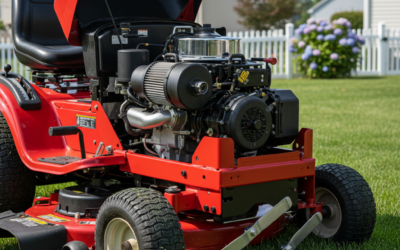
Look at the hardware before you open a bottle. A typical 4-stroke lawn mower has a separate crankcase oil supply. You will usually find an oil-fill opening, often with a cap, and a dipstick or a fill mark used to set the level. Gasoline goes in the fuel tank. Oil goes in the crankcase. You do not mix them. Many shrouds, decals, or manuals also say 4-cycle or 4-stroke.
A typical consumer 2-stroke is lubricated by 2-cycle oil that travels with the fuel, or by 2-cycle oil stored in a small tank and metered by an oil-injection system. Clues include a stated fuel-oil mix on the tank or shroud, the words 2-cycle or 2-stroke, the absence of a conventional oil fill and dipstick, or a dedicated oil reservoir that is clearly not a car-style crankcase. Not every 2-stroke is premix-only. Some meter oil automatically. If you see an oil tank plus a fuel tank, treat that as a 2-stroke lubrication system and read the manual for that design. Do not assume it takes automotive motor oil just because there is a place to pour oil.
If the machine is unlabeled and you cannot find a manual, stop and identify the engine from the model information on the housing before you add anything. Guessing the stroke type is how people put the wrong oil family in the wrong place.
Where the oil actually goes
In a 4-stroke, oil lives in the crankcase. It coats bearings, the cylinder wall, and valve-train parts, then returns to the sump. You check it with the engine off, usually on a level surface, following the dipstick or fill-plug procedure in the manual. You change it as a liquid you drain from the engine, not as something you burn on purpose.
In a 2-stroke, lubrication is tied to the fuel system. Premix engines need the correct 2-cycle oil blended with gasoline at the ratio the manufacturer specifies for that engine. Injected engines still use 2-cycle oil, just stored separately and delivered by the injection system. In both cases the oil is meant to lubricate as the fuel mixture moves through the engine, then leave with the exhaust. That is a different job from sitting in a 4-stroke crankcase for hours of mowing.
What happens if you put automotive motor oil in a 2-stroke
Automotive motor oil is blended to stay in a crankcase, resist oxidation there, and work with a 4-stroke’s oil control rings and, in cars, a catalytic converter and emissions system. It is not formulated to replace 2-cycle oil in a fuel mix or injection tank. If you pour it into 2-stroke gasoline or use it instead of 2-cycle oil, the engine may not get the film it needs, may smoke or foul, and can suffer scoring or seizure if you run it. Do not start the engine to “see if it is fine.” Correct the fuel and lubricant first, using the mix or injection instructions in the manual—not a ratio remembered from another tool.
Why lawn mower oil guidance often differs from car oil
If both products are called motor oil, it is fair to ask why a lawn mower manual sometimes points you toward small-engine oil instead of whatever is already in the garage. The short reason is that the engines and the duty cycle are not identical. That does not prove every automotive oil will damage a mower, and it does not prove every bottle labeled for small engines is automatically superior. It explains why a specification exists and why you should match it.
Many lawn mower engines are air-cooled, compact, and mounted in a deck that throws dust, grass, and heat around the cooling fins. They often work in short, high-load bursts: thick grass, slopes, bagging, or a rider climbing and turning. They sit for days or months, then start cold and go straight to work. Passenger-car engines are typically liquid-cooled and designed around a different operating cycle, with a thermostat, a much larger sump, and highway or commuting patterns that are not the same as yard work.
Small-engine oils are marketed for those mower conditions: frequent starts, airborne debris, and air-cooled heat. Automotive motor oils are marketed for cars and light trucks. Overlap is common enough that many 4-stroke mowers accept an automotive oil that meets the listed viscosity and quality rating. Difference is common enough that you should not treat “I use this in the car” as proof it is correct for the mower.
What you should not do is invent a chemistry argument. Additive packages, detergents, friction modifiers, and synthetic versus conventional base stocks all change how an oil behaves, but there is no safe universal rule that synthetics always help a mower, always harm a mower, or that a car oil’s detergent level will always wash away a film a small engine needs. Those claims need the manufacturer’s guidance or a test you do not have in the driveway. The practical stance is simpler: recommendations exist because the hardware and the work are not the same as a car’s. Use the published spec as the tie-breaker, not a forum debate about which bottle is “stronger.”
Air cooling is worth taking seriously even when the oil is correct. Fins packed with clippings, a clogged air filter, or a missing blower housing can raise engine temperature and stress any oil. Wrong oil is one contributor to heat and wear, not a guaranteed meltdown by itself. Clean airflow and the right oil work together.
How to confirm the oil type and viscosity your mower needs
The official oil specification is not on the automotive bottle’s front label and not in a generic “use 30 weight” tip. Start with the owner’s manual. If that is missing, read the engine housing sticker or model label—the same plate that identifies the engine brand and model—and then the engine or mower maker’s official guidance for that model. Dealer literature for the exact engine is more reliable than a neighbor’s grade or the oil you happen to have left over.
What viscosity grades mean in practice
A viscosity grade, often written in SAE terms, describes how thick the oil is when it is cold and how it holds together when it is hot. A single-grade oil is described one way; a multi-grade oil describes cold-flow and high-temperature behavior in one designation. Thicker is not automatically better. Oil that is too thick when cold can starve parts at startup. Oil that is too thin when hot may not keep a reliable film under load. The correct grade can depend on climate and on the manufacturer’s viscosity chart for that engine. Because those charts vary by model and are not universal, this article will not name a default grade for all lawn mowers or all seasons.
If the manual lists a quality or service rating—API or another designation—treat that as part of the spec when you compare bottles. If it lists more than one acceptable grade by temperature range, use the range that matches how and where you mow, not the leftover jug that is merely “close.” If it allows either a small-engine product or an automotive product that meets the same viscosity and rating, either path is a match. The match is the point.
When leftover car oil is reasonable—and when it is not
If you have automotive motor oil already opened, read the viscosity grade and any service rating on the bottle against the 4-stroke mower’s listed requirement. If they match and the oil is clean, within a normal service life, and not a different fluid (diesel-only specialty oil you cannot confirm, gear oil, hydraulic fluid, or anything that is not crankcase motor oil), it is commonly acceptable to use in that 4-stroke. You do not need a different brand just because the first bottle came from the automotive aisle.
Do not use the leftover oil if the grade or rating does not match, if you cannot read the label, if the oil has been sitting open and contaminated, or if the mower is a 2-stroke. Do not stretch “close enough” across oil families. Do not top up a 4-stroke with 2-cycle oil, and do not treat cooking oil, transmission fluid, or gear lube as motor oil. If the only unknown is whether last year’s partial bottle is still appropriate, buying a sealed product that clearly meets the spec is cheaper than an engine repair.
Capacity is not something to guess from a similar-looking mower. Fill to the dipstick or fill-mark procedure in the manual. Overfilling can be as harmful as running low: excess oil can foam, smoke, leak past seals, or cause erratic lubrication. Underfilling leaves bearings and the cylinder without a full supply, especially on slopes.
Walk-behind, riding, and other small-engine mowers
A riding mower does not automatically “take car oil” more readily than a push mower. Chassis type—walk-behind versus rider—does not decide oil compatibility. Engine type and the manufacturer’s oil specification still govern. A large rider with a 4-stroke engine may look more like a car, but many of those engines are still air-cooled small engines with their own chart. A compact walk-behind 4-stroke may list an automotive viscosity that you already own. Read the engine, not the deck size.
Many mowers wear an engine brand on a sticker that is not the same as the mower brand on the deck. That is normal. Oil guidance usually follows the engine model. Use the engine serial and model information when you search official documents or talk to a dealer. The deck maker may still publish a combined manual; if the two sources ever seem to disagree, do not invent a compromise grade. Use the engine maker’s stated oil type and viscosity for that engine, or ask a dealer to reconcile the documents.
Riders add a second trap: extra fluids. Some have a hydrostatic transmission or hydraulic system that uses a fluid that is not engine motor oil. Those reservoirs can sit near the engine and invite a well-meaning top-up with the wrong bottle. Engine oil, transmission fluid, and hydraulic fluid are not interchangeable. If a cap is not clearly the engine oil fill, leave it alone until the manual identifies it.
Other yard machines—generators, tillers, snow throwers, string trimmers—sometimes share an engine family with mowers and sometimes do not. A 4-stroke generator is not permission to copy its oil into the mower, or the reverse, without checking each manual. Two-stroke trimmers are a frequent source of leftover 2-cycle oil, which still does not belong in a 4-stroke crankcase. One cautious line covers the rest of the shed: check that machine’s manual.
Risks of using the wrong oil
Incorrect viscosity, the wrong oil family (2-cycle versus 4-stroke), a low oil level, or overfilling can reduce lubrication quality. Practical results include extra heat, varnish or deposits, smoking, hard starting, accelerated wear, and, in severe cases, engine damage or a sudden stop while the blade is turning. A stoppage during a pass is not only a repair problem. Loss of power on a slope or near a road, people, or pets is an operating hazard. If the engine knocks, seizes, smokes heavily, or you find the oil missing, milky, or thinned with fuel, shut it down. Let it cool before you inspect the dipstick, look for leaks, or remove a fill cap. Do not keep mowing to finish the yard.
Air-cooled mower engines can run hot in tall grass, on a trailer deck with blocked fins, or in high ambient heat. Wrong oil can contribute to that heat by failing to control friction or by foaming and failing to pick up at the pickup screen. It is still only one contributor. A dirty cooling system or overloaded cutting deck can overheat an engine that has the correct oil. Fix the oil problem and the airflow problem together.
Warranty coverage may be affected if you use oil outside the stated specification. That is not the same as a legal rule that off-spec oil always voids a warranty in every case. Warranties are controlled by the written terms and by what the warrantor can show about cause. Keep receipts and follow the manual if the machine is still covered. If a claim is in play, a dealer or the warrantor—not a guess on a forum—should interpret the policy.
There is no honest way to assign a failure percentage or a remaining-hour promise to a single wrong-oil event. A brief use of a matching automotive oil in a 4-stroke is not the same as running a 2-stroke on straight gasoline or running any engine with no oil. Severity depends on what was used, how long it ran, load, and whether the level was correct. Treat unknown or clearly wrong oil as a reason to stop and correct, not as a reason to panic or to keep going.
If you already put automotive oil in the mower
Stay calm and identify the engine and what you poured. The next step is different for a matching 4-stroke fill, an off-spec 4-stroke fill, and any 2-stroke fuel or injection mistake.
Four-stroke, and the oil appears to match
If the engine is a 4-stroke, the automotive oil matches the manual’s viscosity and quality rating, and the level is correct on the dipstick after the procedure the manual describes, it is reasonable to leave it in. Use the mower normally and change the oil at the interval the manual already gives, or sooner if the oil becomes milky, fuel-smelling, or gritty. You do not need an emergency drain solely because the bottle came from a car aisle.
Four-stroke, but the grade is unknown or clearly off-spec
If you cannot confirm the grade or you know it is outside the listed options, plan an oil change rather than “running it a little more.” Drain and refill when the engine is warm enough for the oil to flow but not so hot that you risk burns from the muffler, oil, or deck. Follow the manual’s drain method—plug location, filter if the engine has one, and refill marks. Do not invent a chemical flush or a second mystery oil “to clean it out.” Do not overfill to compensate. Dispose of used oil through a local household-hazardous-waste or recycling route; do not dump it.
If you already ran the engine and it now knocks, will not turn freely, smokes heavily, or shows fuel in the oil or coolant-like milkiness (on designs where that can appear), stop troubleshooting with more oil changes and take it to a dealer or a qualified small-engine shop. A locked engine or a no-oil run is not a driveway experiment.
Two-stroke fuel, injection tank, or a mixed-up bottle
If automotive motor oil went into 2-stroke gasoline, or you used car oil instead of 2-cycle oil in an injection tank, do not run the engine. Drain the fuel system or the oil tank as the manual allows, and dispose of the mixture under local rules. Refill with the correct fuel and the 2-cycle oil the manufacturer specifies. If you are not sure you can drain the carburetor or injection lines without leaving contaminated mix behind, a small-engine shop should do it. Do not add a bottled “fix,” do not try to burn the mistake out, and do not run the engine dry to empty it.
If 2-cycle oil was poured into a 4-stroke crankcase, treat that as off-spec oil: drain it, refill with the listed 4-stroke oil, and do not start the engine until the crankcase has the correct lubricant at the correct level.
Good habits that matter as much as the oil brand
Matching the specified oil is necessary. It is not sufficient if the level is wrong, the oil is neglected, or the engine cannot shed heat. Famous automotive brands do not outrank an unglamorous bottle that meets the spec and is changed on time. Cleanliness and level usually matter more than the aisle you shopped.
Check 4-stroke oil before use, with the engine off, on a level surface. Wipe the dipstick and read it the way the manual describes—some want the cap screwed in, some want it rested. Add slowly. Recheck. Do not overfill because the mower will sit on a hill later; mow slopes with the correct level already set, and be aware that oil can uncover the pickup if you operate at extreme angles the manual warns against.
Change oil on the schedule in the manual, and change it earlier if it looks milky, smells like gasoline, or feels gritty. Fuel-thinned oil cannot carry load. Grit is abrasives from a neglected air filter or a worn engine. Dirty oil left in an unused engine is a common reason manuals call for a change before storage: acids and contaminants sit on parts all winter. This article will not invent a month count or a winterization chemical list. If you store the mower, follow that machine’s storage section, and do not leave the crankcase low or sludged on purpose.
Keep cooling fins, the flywheel screen, and the air filter clean. An air-cooled engine that cannot breathe air or dump heat will punish the oil film even when the viscosity is correct. Replace a damaged blower housing rather than running without it. Use fresh fuel appropriate for the machine; stale gasoline and ethanol-related varnish are separate from oil, but they show up as hard starting and gum that people sometimes blame on the lubricant.
Before the next mowing season, confirm you still have the manual or a saved copy of the engine model and oil spec, a sealed container of oil that matches, a way to check the level, and a plan for used-oil disposal. Look at belts, blades, and safety devices while the machine is off and cool. None of that requires a premium automotive brand. It requires the right oil family, the right viscosity and rating, the right level, and an engine that is not asked to run hot and dirty.
If you remember only one decision rule, use this: identify 4-stroke versus 2-stroke, then match the owner’s manual or engine label. Automotive motor oil can be the correct fill for many 4-stroke lawn mowers. It is the wrong lubricant for a 2-stroke. Everything else—small-engine labeling, leftover garage jugs, rider versus walk-behind—is secondary to those two facts.