

Quick Answer: Who Sells Lawn Mowers?
Lawn mowers are sold across three primary retail channels: national home improvement centers (The Home Depot and Lowe’s), farm and ranch supply stores (Tractor Supply Co. and Rural King), and independent authorized outdoor power equipment dealerships. Big-box retailers specialize in high-volume residential walk-behind and entry-level riding mowers, while independent servicing dealers carry professional-grade brands (Scag, Stihl, commercial Toro, and premium John Deere) with on-site warranty support.
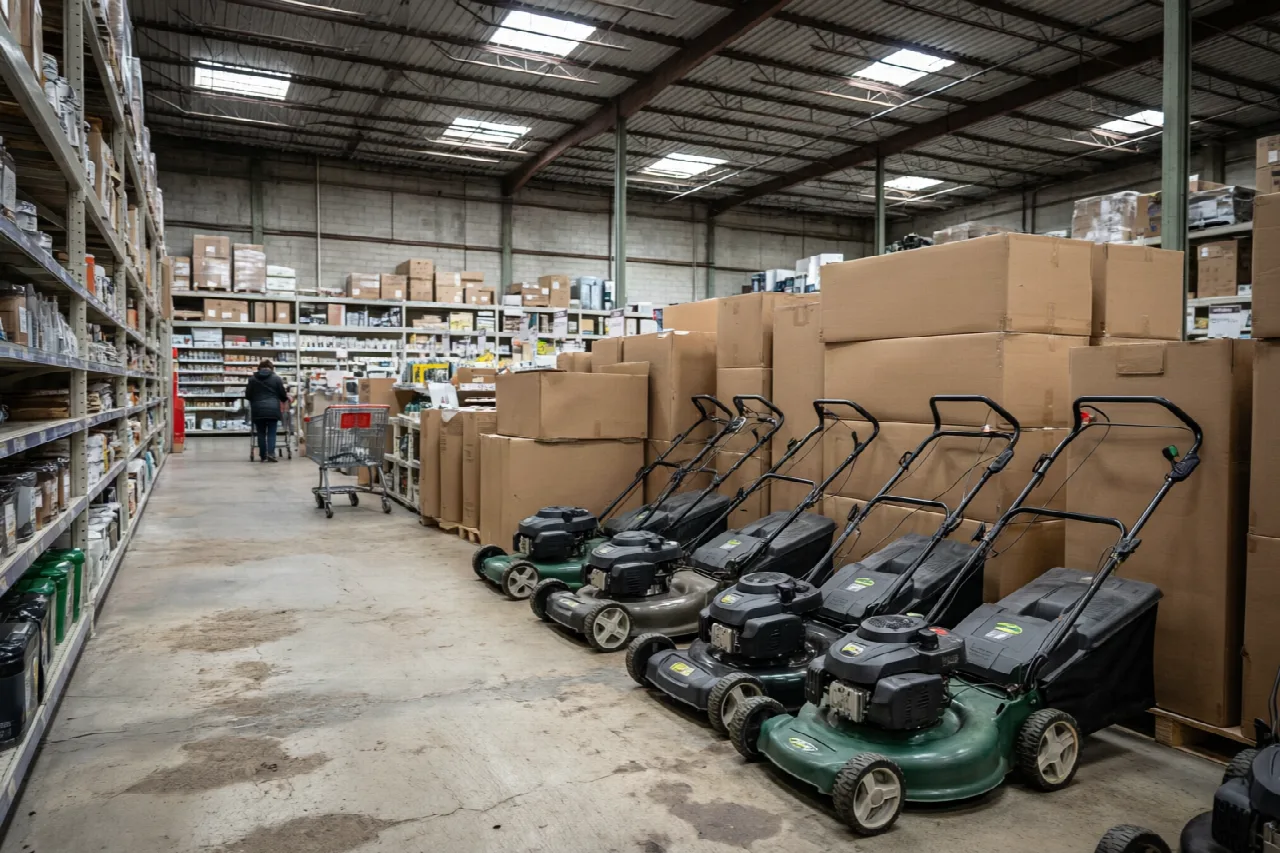
Primary Retail Channels for Purchasing Lawn Mowers
Choosing where to purchase a new lawn mower depends heavily on the type of machine required, your budget, and the level of post-purchase mechanical support you expect. Retail outlets fall into distinct categories, each tailored to different buyer profiles ranging from suburban homeowners needing basic cordless push mowers to commercial landscapers seeking heavy equipment.
The lawn equipment retail landscape breaks down into three core retail sectors:
- National Home Improvement Centers: The Home Depot and Lowe’s dominate residential lawn mower sales across the United States. Home Depot carries exclusive retail agreements with brands like Toro, Honda (stock clearance), Ryobi, and Cub Cadet, while Lowe’s retails John Deere 100-Series, Craftsman, EGO Power+, and Husqvarna products.
- Farm & Rural Supply Retailers: Chains such as Tractor Supply Company, Northern Tool, and Rural King cater to large acreage owners. They retail mid-tier to heavy-duty lawn tractors, tow-behind trail mowers, and commercial-residential hybrid zero-turns from manufacturers including Bad Boy, Cub Cadet, and Swisher.
- Independent Outdoor Power Equipment Dealerships: Local specialty dealers represent the gold standard for commercial operators and discerning property owners. They carry exclusive dealer-tier models from Scag, Exmark, Stihl, Hustler, Ferris, and commercial Honda lines.
Prospective buyers researching specific machine configurations can examine our comparative analysis of gas riding lawn mowers to determine whether a riding tractor or zero-turn fits their yard dimensions.
Big-Box Retailers vs. Independent Servicing Dealers
Understanding the operational contrast between big-box department retailers and independent dealerships is crucial for a smooth ownership experience. While big-box stores offer convenient locations, retail credit financing, and competitive entry prices, their sales associates rarely provide ongoing mechanical service.
When purchasing from a big-box retailer, riding mowers are delivered in crated freight form and assembled by third-party assembly contractors. If a warranty issue arises or a carburetor requires tuning, home centers generally instruct customers to transport the unit to an independent authorized service center. In contrast, local power equipment dealerships assemble, inspect, service, and test-run every machine before delivery, providing dedicated in-house warranty repair departments and extensive OEM spare parts inventories.
Furthermore, major manufacturers frequently engineer separate model tiers for different retail channels. For example, John Deere manufactures entry-level 100-Series tractors for distribution through big-box stores, while reserving heavier X300 and X500 Select Series tractors with serviceable transmissions exclusively for certified dealerships. Buyers interested in brand-specific dealership networks can explore our overview of Toro riding lawn mowers to locate certified regional distributors.
Online Retailers and Direct-to-Consumer Marketplaces
Online retail platforms have transformed how consumers buy outdoor power tools, particularly battery-electric and compact walk-behind push mowers. Amazon, manufacturer direct web stores, and specialized online equipment retailers (such as Mowers at Jacks and Power Equipment Direct) ship thousands of units annually direct to residential doorsteps.
Online purchasing offers unparalleled convenience for cordless electric platforms from brands like Greenworks, EGO Power+, and WORX, where assembly consists simply of unfolding handle brackets and snapping in a lithium battery pack. However, ordering large gas-powered lawn tractors or heavy zero-turns online requires careful freight logistics. Deliveries typically arrive via semi-truck with liftgate curbside delivery, requiring the customer to uncrate the machine, dispose of shipping pallets, and complete initial engine oil fueling independently. Homeowners maintaining smaller urban plots can compare compact alternatives like walk-behind Craftsman lawn mowers designed for easy garage storage.
Where to Buy Used and Reconditioned Mowers
For property owners operating on tight budgets, secondary markets offer significant value. Certified outdoor power dealerships frequently accept trade-in equipment, refurbishing commercial zero-turns and garden tractors for resale with short-term dealer warranties. Online marketplaces such as Facebook Marketplace, Craigslist, and regional farm consignment auctions also provide abundant options, though buyers must carefully inspect engine compression, spindle bearing play, and hydrostatic drive response prior to purchase.
Recommended Gear
Protect and maintain your newly purchased lawn mower with these top-rated all-weather equipment covers, maintenance tools, and fuel management gear.

Pros
- Premium Select Cut multi-blade system that provides cutting performance exceeding traditional gas mowers
- Intuitive Touch Drive self-propulsion with adjustable speeds for reduced user effort
- Includes 56V 7.5Ah battery and rapid charger delivering 60-minute runtime and matching charge time
- Versatile 3-in-1 mulching, bagging, and side discharge options plus 7 cutting heights
- High-efficiency brushless motor with convenient push-button start and LED headlights
Cons
- 60-minute runtime may require recharging or a spare battery for very large properties
- Charge time of 60 minutes can interrupt extended mowing sessions without an extra battery
- Relies solely on the included battery system, so users without spare packs face limited continuous use
The EGO Power+ LM2135SP is a self-propelled cordless electric lawn mower that stands out as a modern gas alternative. Its build centers on a high-efficiency brushless motor and robust Select Cut multi-blade setup, creating an immediate impression of quality engineering focused on superior cutting results and user-friendly operation.
In real-world scenarios the Touch Drive self-propelled system allows palm-based speed adjustments between 0.9 and 3.1 MPH while the included 56V 7.5Ah ARC Lithium battery supports 60 minutes of runtime. Seven-position height settings from 1.5 to 4 inches along with 3-in-1 mulching, bagging, and side discharge functions plus push-button start and LED headlights make the mower highly adaptable for everyday lawn maintenance.
Honest considerations include the 60-minute runtime limit which may fall short for oversized yards without a second battery. The matching 60-minute charge time with the rapid charger also means planning ahead is essential for longer jobs, and the cordless design inherently requires ready access to power for recharging.
Overall the EGO Power+ LM2135SP delivers the most value to homeowners with medium-sized yards who prioritize quiet emission-free mowing and cut quality that exceeds gas models. Those managing larger properties will maximize benefits by adding an extra battery for seamless coverage.

Pros
- Includes two 4.0Ah batteries and a rapid charger
- Self-propelled rear-wheel drive assists on slopes
- 4-in-1 system: mulch, bag, side discharge, and leaf pickup
- Comes with an extra mower blade
Cons
- Coverage up to 3/4 acre varies by terrain and technique
- Requires 60V platform compatibility for spare batteries

Pros
- Powerful 60V brushless motor provides efficient gas-comparable cutting force
- Self-propelled rear-wheel drive simplifies work on uneven terrain and dense grass
- Comes complete with two 4.0Ah batteries, rapid charger, and grass bag ready for use
- 4-in-1 cutting modes and LED lights add all-day versatility
- Quiet zero-emission design with IPX4 water resistance for outdoor durability
Cons
- Runtime is limited to about 3/4 acre per charge and varies by terrain and technique
- Requires battery charging cycles unlike unlimited-run gas or corded mowers
- Exact weight and dimensions are not detailed in available specifications
The Greenworks 60V 21" Brushless Self-Propelled Cordless Lawn Mower stands out as a robust battery-powered walk-behind unit built for homeowners managing medium to large lawns. Its design focuses on cordless convenience with a durable frame, rear-wheel drive system, and IPX4 weather resistance, creating an immediate impression of modern reliability without the mess of gas engines.
Performance & Key Features center on the 60V brushless motor paired with two 4.0Ah batteries that deliver gas-like power for up to 3/4 acre per charge. Self-propelled traction handles slopes and thick grass with adjustable speed, while the 4-in-1 system supports mulching, bagging, side discharge, and turbo leaf pickup. Ultra-bright LED lights extend usable hours, and the quiet operation runs 3x quieter than gas mowers with zero emissions and instant starts. The included rapid charger and compatibility with 75+ Greenworks 60V tools further enhance daily efficiency.
Drawbacks & Considerations include the fact that runtime varies based on terrain and technique, so larger or denser areas may require careful battery management. Unlike gas models, it depends on charging cycles, and detailed weight or dimensional data is not provided in the specifications, which could influence handling preferences for some users.
Verdict: This mower delivers excellent value for eco-conscious homeowners seeking powerful, low-maintenance cordless performance on yards up to 3/4 acre. Those already in the Greenworks 60V ecosystem or wanting quiet, emission-free mowing will gain the most, especially with the dual batteries, rapid charger, and strong warranties included.

Pros
- Brushless motor delivers more torque, quieter operation, and longer motor life than brushed alternatives
- Self-propelled design with variable speed reduces operator fatigue on larger or sloped lawns
- 21-inch steel deck and SmartCut auto-adapting power provide efficient, high-quality cuts across different grass types
- Maintenance-free cordless convenience eliminates gas mixing, oil changes, and emissions
- Includes 4.0Ah battery and rapid charger for immediate use and quick recharges
Cons
- Runtime limited to up to 45 minutes per charge depending on grass conditions and technique, which may require recharging for very large properties
- Only one 4.0Ah battery included, so extra batteries may be needed for continuous extended mowing sessions
- As a self-propelled steel-deck model it prioritizes power and durability over the lightest possible weight for users seeking ultra-portable push mowers
The Greenworks 80V 21" Brushless Cordless Self-Propelled Lawn Mower is a robust walk-behind electric mower built for homeowners who want reliable cordless power. Its durable 21-inch steel deck and compact vertical storage design create a strong first impression of quality construction and space-saving practicality, while the overall unit feels ready for serious residential yard work without the hassle of gas engines.
In real-world performance the brushless motor delivers strong torque and quiet operation with up to 45 minutes of runtime on the included 4.0Ah battery. Rear-wheel self-propulsion with variable speed control improves traction and reduces fatigue, while SmartCut technology automatically adjusts power based on grass density for even results. The single-lever 7-position height adjustment and true 3-in-1 functionality (mulch, rear bag, or side discharge) add flexibility across different lawn conditions and seasons.
Potential drawbacks include the finite 45-minute runtime that can vary with thick grass or aggressive techniques, plus the need for additional batteries if mowing large areas without interruption. The rapid charger helps by restoring power in about 60 minutes, yet users with expansive properties should plan accordingly. The steel deck prioritizes durability and cutting capacity, so it may feel less featherweight than some pure plastic-deck cordless options.
Overall this Greenworks 80V self-propelled mower is an excellent choice for homeowners seeking gas-like cutting power, low maintenance, and eco-friendly operation on medium to large yards. Those already invested in the Greenworks 80V ecosystem of 75+ tools will gain the most value from the shared battery platform and included rapid charger.

Pros
- Electric start technology simplifies operation by eliminating pull-cord starting.
- 6-speed CVT offers superior speed variability for comfortable self-propelled mowing.
- Integrated blower with 150 CFM and 130 MPH airflow adds multi-season utility.
- High-wheel RWD configuration enhances stability and control on varied terrain.
- Automatic choke system supports easy cold starts without extra steps.
Cons
- Gas-powered engine requires regular fueling, oil changes, and routine maintenance.
- High-wheel design may require more storage space than compact low-wheel models.
- Available data lacks specifics on weight, cutting height range, and bag capacity.
The YARDMAX 24 in. 201cc Electric Start Select PACE 6 Speed CVT High Wheel RWD 3-in-1 Gas Walk Behind Self Propelled Lawn Mower w/Blower is a feature-focused walk-behind mower aimed at residential users who want convenience and versatility. Its high-wheel self-propelled layout and rear-wheel drive give an immediate impression of stability and ease of use for medium to large yards.
Performance centers on the electric start and automatic choke for push-button, no-prime ignition, while the exclusive Select PACE CVT with 6-speed lever lets operators fine-tune speed to match their walking pace. The self-propelled RWD high wheels improve traction on uneven ground, and the advanced airflow blower delivers 150 CFM and up to 130 MPH for effective leaf and debris clearing alongside the 3-in-1 cutting system powered by the 201cc engine.
Considerations include the ongoing need for gasoline fuel and standard gas-engine maintenance such as oil and filter changes. The high-wheel configuration, while helpful for terrain, can make the unit bulkier to store or transport in tighter spaces. Specifics such as exact weight, cutting-height range, and bag capacity are not detailed in available information.
This YARDMAX model delivers the most value to homeowners who prioritize easy starting, variable self-propelled speeds, and multi-function capability including leaf blowing, especially those maintaining medium to large lawns who prefer gas power over battery alternatives.
Frequently Asked Questions
Can you buy lawn mowers directly from manufacturers?
Yes, many prominent brands including Toro, EGO, Cub Cadet, and Greenworks allow direct online ordering through their official websites, fulfilling orders either via direct freight shipping or through local affiliated dealer pickup.
Is it better to buy a riding mower from Home Depot or a dealer?
Independent dealers are generally better for long-term support because they provide professional pre-delivery inspection, personalized setup, factory warranty servicing, and stocked replacement parts that home centers do not offer.
Does Lowe’s sell John Deere lawn tractors?
Yes, Lowe’s sells John Deere 100-Series residential lawn tractors, while John Deere larger X-Series, commercial zero-turns, and sub-compact tractors are sold exclusively through certified John Deere ag and turf dealerships.
What is the best time of year to buy a lawn mower on sale?
The best retail sales occur during early spring promotional events (Memorial Day weekend) and late autumn inventory clearances (Labor Day through October), when retailers discount floor models to make room for snow equipment.
Where can I find replacement parts for older lawn mowers?
Replacement parts are readily available through local servicing dealers, dedicated online parts portals (such as Sears PartsDirect, Jack’s Small Engines, and RepairClinic), and automotive or farm supply retailers.
Technical Standards and Compliance
For more hands-on benchmarks and buying recommendations, consult our guides on heavy-duty chainsaw buyer guide.
For practical maintenance advice and setup requirements, check our guide on how to sharpen a chainsaw correctly.
Mechanical safety standards, operational tolerances, and protective gear guidelines align with benchmark specifications established by the American National Standards Institute (ANSI).









