

Quick Answer: Can A Lawn Mower Get Rained On?
\nYes. A typical unused lawn mower can get rained on, and a short shower usually will not ruin it. Water can still rust metal, soak air filters and electrical parts, and create shock or starting problems if the machine sits wet, is used while soaked, or stays outdoors through repeated storms. Risk depends on whether the mower is gas, battery,…
\n\n

Pros
- Powerful 80V brushless motor delivers 32HP gas-equivalent performance with quiet fume-free operation and no engine maintenance.
- Complete kit includes four 6.0Ah batteries and 600W charger for substantial runtime up to 1.5 acres.
- SmartCut technology and 42-inch heavy-duty steel deck ensure consistent cuts without bogging in tough conditions.
- Versatile towing up to 350 lbs and optional cargo hauling plus comfort features like high-back seat and LED lights.
- Strong 4-year limited warranty and full compatibility with the Greenworks 80V tool ecosystem.
Cons
- Rear utility cargo bed for 200 lb hauling is sold separately and not included in the kit.
- Runtime of up to 1.5 acres varies with conditions and may require recharging or battery swaps on larger properties.
- As a fully cordless model continuous operation depends on battery levels unlike gas engines with unlimited runtime.
The Greenworks 80V 42" CrossoverT Cordless Riding Lawn Tractor is a ready-to-mow zero-emission tractor designed for homeowners managing medium to large lawns. It features a reinforced 42-inch stamped steel deck of 12-gauge construction along with premium comfort elements such as a high-back padded seat with foldable armrests. The overall build emphasizes durability and user convenience right out of the box with the included battery and charger set.
Performance centers on the 80V TruBrushless motor that provides 32HP gas-equivalent power with instant torque and quiet fume-free operation. SmartCut technology senses grass conditions and automatically adjusts power to maintain a consistent cut even in tall thick or wet areas. The four 6.0Ah batteries support runtime for up to 1.5 acres depending on conditions while dual LED headlights and a 7-position deck height range from 1.5" to 4.5" add practicality. Front and rear attachments further allow towing up to 350 lbs for added yard utility.
Key considerations include that the rear utility storage bin capable of hauling 200 lbs is sold separately so full cargo functionality requires an extra purchase. Runtime remains condition-dependent and may fall short for properties significantly larger than 1.5 acres without using the 600W charger or swapping batteries. The cordless design prioritizes ease and low maintenance but trades off the continuous runtime of traditional gas models.
This tractor delivers strong value for eco-conscious owners of residential properties who want gas-like power without the emissions noise or upkeep. It suits those who already use or plan to expand into the Greenworks 80V family of tools and who appreciate the 4-year limited warranty. Users with exceptionally large or commercial-scale lawns should evaluate battery logistics carefully before purchase.

Pros
- Delivers strong 21 horsepower equivalent power comparable to gas riding mowers.
- Provides up to 1.5 acres of runtime on a full charge with the six included batteries.
- Features low-maintenance dual brushless motors without belts for greater durability.
- Offers versatile 12-position cutting height adjustment from 1.5 to 4.5 inches.
- Includes digital controls for blade settings, drive speeds, and cruise control.
Cons
- Limited to 1.5 acres of cutting per charge without purchasing additional batteries for bigger lawns.
- Requires recharging time for the six 56V batteries after each use session.
- Relies solely on battery power with no hybrid or gas backup option for extended operation.
The EGO Power+ TR4204 is a cordless electric riding lawn mower built as a modern tractor alternative for residential use. It features a robust 42-inch stamped steel deck and arrives ready to go with six 56V 6.0Ah batteries plus a charger, creating an immediate impression of convenience and solid construction free from gas engine complexity.
Performance shines through its equivalent 21 horsepower output and top speed of 6 MPH, allowing efficient coverage of up to 1.5 acres on a single charge. Dual brushless cutting motors operate without belts for added durability and less upkeep, while the digital display lets users select three blade settings, three drive speeds, and cruise control. The 12 adjustable heights ranging from 1.5 to 4.5 inches combined with anti-scalp wheels deliver precise results across varied terrain.
Drawbacks center on battery dependency, as larger properties beyond 1.5 acres require extra batteries and recharging intervals can interrupt workflow. The fully electric design eliminates fuel storage needs but demands access to power sources between sessions.
This mower suits homeowners with medium to large yards who value quiet, emission-free operation and reduced maintenance. Those seeking expandable battery capacity for bigger areas will find the EGO Power+ TR4204 a strong long-term investment in cordless lawn care.
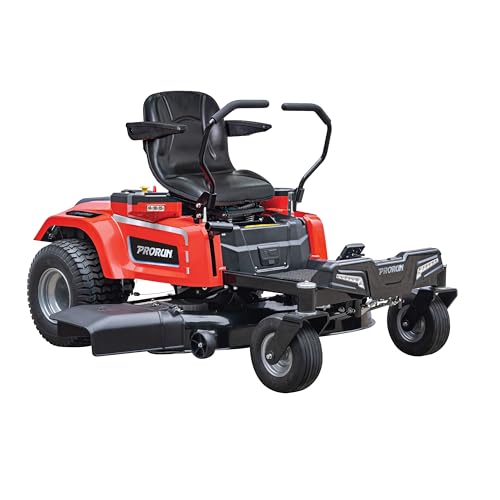
Pros
- High-efficiency brushless motors maximize power output and durability over traditional motors
- Up to 2 acres runtime with three included 10.0 Ah batteries supports substantial mowing sessions
- Zero-emission operation with gas-equivalent 20 HP power for quieter environmentally friendly use
- Six-port auto-switchover battery system provides flexible extended runtime options
- Durable 42-inch steel deck plus included mulch and towing kits add immediate functionality
Cons
- Runtime is limited to approximately 70 minutes or 2 acres which may require recharging for larger properties
- Fully battery-dependent design means performance relies on charge levels and spare battery availability
- 42-inch deck size may require more passes on expansive lawns compared to wider commercial models
The PRORUN PZT60V42 is a fully electric 60V zero-turn riding lawn mower built for residential and light commercial use. Its primary design centers on a robust 42-inch 14-gauge stamped steel twin blade deck powered by direct-drive brushless motors, giving an immediate impression of solid construction and modern battery-focused engineering. The mower arrives complete with three 10.0 Ah batteries, a charger, mulch kit, and towing kit for ready-to-work versatility.
In performance terms, four high-efficiency brushless motors deliver power equivalent to a 20 HP gas engine while producing zero emissions. The system supports up to 2.0 acres or 70 minutes of runtime, and six battery ports with auto switchover intelligently manage all PRORUN 60V battery sizes for continuous operation. A washout port on the steel deck further simplifies post-mow maintenance during real-world sessions.
Potential drawbacks include the finite 70-minute runtime window which can limit coverage on larger properties without spare batteries or recharge breaks. As a fully electric model, it also depends entirely on battery charge levels rather than continuous fuel refills, and the 42-inch deck width may demand extra passes compared with wider traditional options.
Overall the PRORUN PZT60V42 offers strong value for homeowners and small-property managers who want gas-like cutting power without emissions or noise. Those with medium-sized lawns seeking quiet efficient zero-turn performance and included accessories will benefit most from this electric mower.

Pros
- Strong 24HP FR730 engine power for demanding cutting conditions
- Wide 54-inch FAB deck reduces total mowing time
- Zero turn design delivers excellent maneuverability
- Fabricated deck supports durable everyday operation
Cons
- Sparse details beyond engine and deck leave other features unspecified
- Gas-powered FR730 engine needs regular fuel and maintenance
- Large 54-inch deck size may feel oversized on compact properties
The Husqvarna Z254F is a zero turn mower from the established Husqvarna brand in the riding lawn mowers category. It centers on a solid build that pairs a 24HP 726cc FR730 engine with a 54-inch FAB deck for straightforward residential grass care.
Performance stems directly from the listed specifications. The FR730 engine delivers the horsepower needed for steady operation across typical lawns while the wide FAB deck completes passes efficiently. Zero turn handling improves control in real yard layouts based on the model design.
Considerations arise from the limited data available. Secondary elements such as comfort features fuel capacity or extras receive no mention and the gas engine format involves routine upkeep. The large deck suits open areas better than confined spaces.
The Husqvarna Z254F provides the most value for owners of medium or large properties who want reliable engine power and a broad cutting width. Users with smaller lots or those seeking extensive accessory options should weigh the core specs carefully before purchase.
Can rain ruin a lawn mower?
\nRain on a parked consumer mower is common, and a brief unused shower is often not immediately catastrophic. That is not the same as calling any lawn mower waterproof. Housings, decks, vents, and battery bays are built for yard work, not for standing in puddles or riding out storm after storm with no cover.
\nA stored or unused machine that gets wet once and then dries with airflow usually survives. The picture changes when water sits in recesses, when grass clippings stay plastered to the underside, or when you try to start, plug in, or install a battery while parts are still soaked. Repeated outdoor exposure is harder on the same mower than one passing shower, even if no single storm looks dramatic.
\nMower type matters. A gas walk-behind can be hard to start if the air filter or ignition parts get wet, and leftover moisture can encourage rust on the deck, blade, wheels, and fasteners. A battery or corded-electric mower adds shock and short-circuit risk that a gas engine does not share. An unpowered reel mower has little electrical exposure, but its cutting cylinder, bedknife, and hardware still rust. In every class, the owner’s manual should override generic advice if the two conflict.
\nRain on a parked mower is also not the same problem as cutting wet grass. A shower that hits a machine sitting still mainly wets the top, handles, openings, and whatever water can run or splash underneath. Mowing soaked turf loads the deck with wet clippings, hides the blade, clogs discharge paths, and makes slips and thrown debris more likely. You can have one without the other. A mower that sat through a storm still needs drying before use. A dry machine pushed into wet grass still faces clogging and footing hazards.
\n- \n
- A light unused shower is usually less harmful than days of sitting wet. \n
- Gas, battery, corded-electric, and reel mowers share rust risk but not the same electrical or starting risk. \n
- Do not treat a consumer mower as weatherproof, even if one storm did little visible harm. \n
- Parked-in-rain care is about drying and corrosion. Wet-grass mowing is about traction, clogs, and cutting quality. \n
How water reaches engines, electrics, batteries, and the deck
\n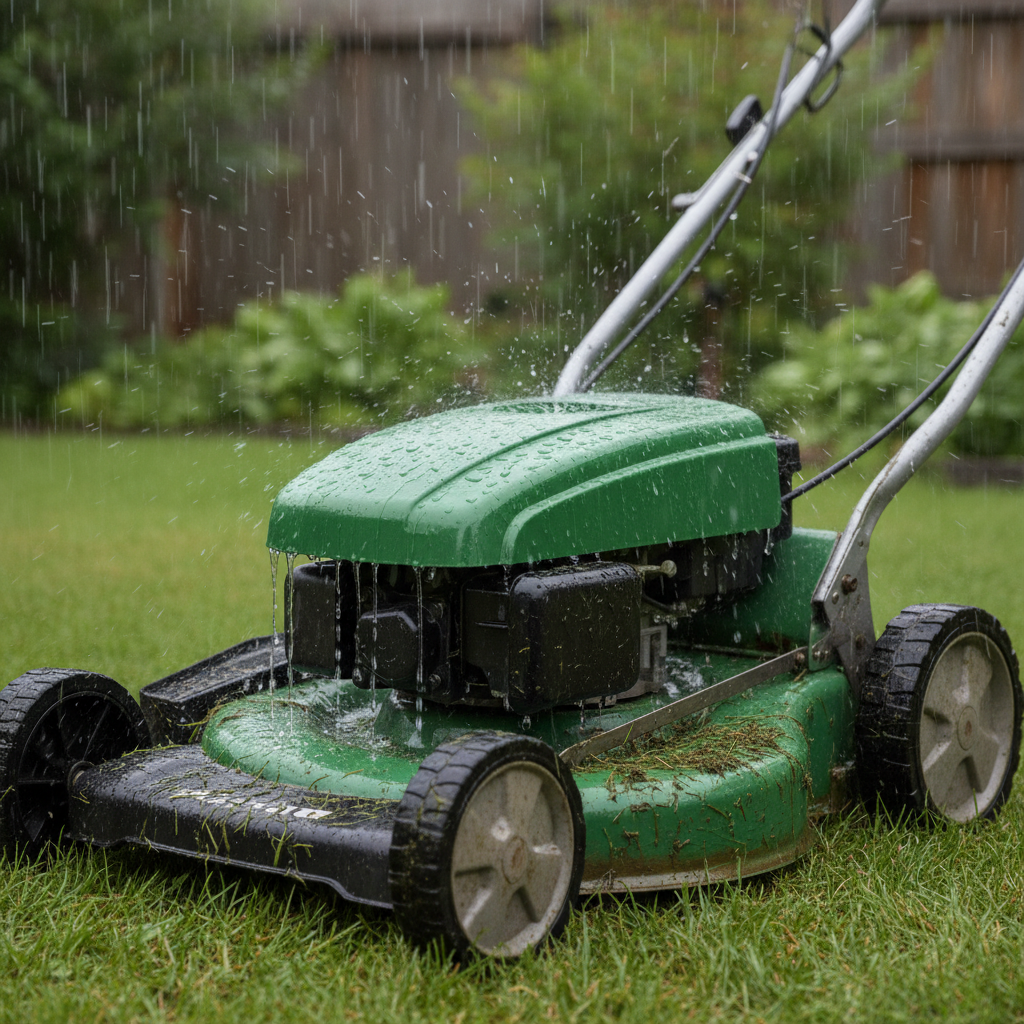
Most home walk-behind mowers are open underneath. The mower deck is a shell over the blade, with discharge or bagging openings, wheel wells, and plenty of horizontal ledges. Rain hits the painted top and runs toward handles, cable housings, the engine or motor cover, and the edges of the deck. Splash from the ground and runoff from the hood find the same gaps. After the shower ends, the shiny top may look almost dry while the underside, blade, and fasteners stay wet.
\nWater collects where geometry works against you. Recesses around the blade adapter, the lip of the deck, wheel axles, and fastener heads hold droplets. Wet clippings and soil act like a sponge against bare steel. Shade, still air, and a machine left over damp ground slow evaporation. That is why a cover or even a shed can still leave underside moisture: the top stays drier, but trapped grass and poor airflow under the deck keep metal wet long after the sky clears.
\nOn a gas mower, rain does not have to “flood the tank” to cause trouble. Air intakes, filter housings, and cooling fins are meant to move air. If those openings face upward or sit under a gap in a cover, water can reach the air filter. A soaked filter restricts airflow and can carry moisture toward the carburetor area. Ignition parts, including the spark plug boot and nearby wiring, can collect water in the same way. None of those parts is guaranteed to fail after one rain, but they are plausible paths when the machine sits unused in a downpour.
\nBattery mowers add a different set of openings. Battery bays, latch areas, charge ports, and control switches are designed to keep debris out during normal use, not to shrug off standing water. If rain pools in the bay or runs along the handle into a switch housing, contacts can stay wet after the rest of the machine looks fine. Corded-electric mowers concentrate risk at the cord, strain relief, switch, and any connection you handle with wet hands. A reel mower skips those electrical paths, but water still sits on the reel, bedknife, rollers, and every untreated fastener.
\nHandles and cables matter more than they look. Water runs along tubes and control cables into pivot points and switch boxes. If you store the mower with the handle folded or the deck tipped the wrong way, that runoff can sit against a battery door or an air-filter cover instead of draining off. Placement after the storm is as important as how hard it rained. Readers comparing setup options can review our technical analysis on marshall stanmore iii vs harman kardon onyx studio 8.
\n\nWhat moisture does to each mower type
\nMoisture does not treat every consumer mower the same. The metal deck, blade, and hardware rust across types. Engines, batteries, and cords do not.
\n\nGas mowers
\nA gas engine can be difficult or impossible to start if the air filter is soaked or if water is sitting on ignition parts. A wet filter starves the engine of air. Water on the spark plug boot or in obvious recesses around the engine can prevent a clean spark until those surfaces dry. Leftover moisture plus ordinary fuel-system humidity can contribute to later running problems, especially if the machine is stored wet and unused. That is a possible outcome, not a guaranteed failure after every shower. For complementary field maintenance guidelines, examine our breakdown of dyson v8 cyclone vs bissell featherweight stick.
\nThe deck and blade still take the long-term beating. Standing water and wet clippings promote rust on the cutting edge, the underside of the deck, wheel rims, and fasteners. Surface rust after one storm is common and not automatically a death sentence. Pitting, seized bolts, and a blade that no longer holds an edge show up more often when the same parts stay damp through many wet-dry cycles.
\nDo not pull the starter while the machine is obviously waterlogged. A sudden start, a hydrolocked cylinder if water has entered the engine in an unusual way, or a kickback at the handle are reasons to wait, inspect, and follow the manual. Disconnect the spark-plug lead before you put your hands near the blade or dump water out of the deck. To evaluate matched hardware tolerances, consult our detailed overview of bissell crosswave hydrosteam vs shark stainforce.
\n\nBattery mowers
\nTreat a wet battery mower as electrical equipment, not as a slightly damp gas machine. Water on battery contacts, in the bay, or inside a switch can short the circuit, corrode terminals, or create a shock hazard. Leave the battery out, do not charge it on a wet mower, and do not install it until housings and contacts are fully dry. Corrosion on contacts may look like dull film, green or white crust, or pitting. Do not scrape aggressively or soak the pack; dry what you can see and stop if the pack, charger, or wiring looks damaged or smells burnt.
\nThe deck still rusts. Plastic body panels do not make the blade or fasteners immune. If the design allows, store the battery indoors even when the mower itself lives outside under a cover.
\n\nCorded-electric mowers
\nA corded mower should stay unplugged until the cord, strain relief, switch, and housing are dry. Wet hands on a live cord or a soaked switch are a shock and short-circuit concern. Inspect the cord for cuts or crushed insulation before the next use; rain does not create those injuries, but wet damaged insulation is more dangerous than dry damaged insulation. Do not use a hair dryer on high heat, a heat gun, or an oven to speed things along. Air-dry, then plug in only when everything you can see and handle is dry.
\n\nReel mowers
\nAn unpowered reel mower avoids engine and battery problems. Rain still wets the reel, bedknife, rollers, and fasteners. Those parts rust, lose a keen edge, and can seize at the adjustment hardware if they sit wet. Wipe accessible metal, let the reel spin freely in dry air, and keep the machine off bare mud. The safety story is rust and slips, not shock, unless you add a powered dethatcher or similar accessory that is not part of a simple reel mower.
\n\nWhen it is unsafe to power up
\nDo not insert a battery, plug in a cord, or pull a starter if water is visible in a battery bay, on contacts, in a switch, on the air filter, or pooled on ignition parts. Wait for a full air-dry, or have the machine serviced if water may have reached internals you cannot see. Follow the machine’s manual when it gives a drying or inspection sequence that differs from this general guidance.
\n\nShort rain versus days of sitting wet
\nAfter a brief unused shower, you will often see beads on the deck, dark wet clippings underneath, and damp handles. If you move the mower under shelter, clear the wet grass, and let air move through the deck, many machines return to ordinary use once dry. A short exposure is not a lab-clean event, and it is not automatically a write-off either.
\nSitting wet for days is a different exposure. Water that never drains from the underside keeps oxygen and moisture on bare steel. Fasteners rust at the threads. Blade edges pit. Wheel bearings and axle hardware stay damp. Electrical contacts that were only wet for an hour can corrode if a film of water and dirt remains. None of that arrives on a fixed timetable. Shade, poor airflow, thick clippings, and a machine parked in a puddle keep parts wet longer than sun and breeze on a raised pad.
\nRepeated wet-dry cycling is harder on metal than one soak that is then dried thoroughly. Each cycle can leave a little more oxide on steel and a little more film on contacts. Outdoor storage without a cover makes that cycling routine. One storm may do little visible harm, and the next dozen still add rust you notice months later when a bolt rounds off or a blade looks scalloped with corrosion.
\nStanding water changes the outlook again. A battery bay with a puddle, a deck sitting in a depression, or an engine cover that collected a pool is not “a little rain.” Drain what you can in the orientation the manual allows, dry the recess, and treat electrical standing water as a reason to wait longer and inspect more carefully. Do not assume a drying window of any particular length prevents all damage. Airflow, temperature, and how much debris is trapping moisture matter more than a clock.
\n\nWhat to do after a mower gets wet
\nStart with power isolation, not with a starter rope or a wall outlet. On a gas mower, disconnect the spark-plug lead and keep it away from the plug so the engine cannot start while you work. On a battery mower, remove the battery if the design allows and take it somewhere dry. On a corded mower, unplug it and keep the plug off wet ground. Do not start, plug in, or install a battery while the machine is still wet.
\n\nMove, drain, and clear
\nIf it is safe to roll the mower, get it off standing water and under a porch, carport, shed, or even a temporary cover that lets air move. Tip the deck only in the orientation the manual allows. Many walk-behind gas mowers have a preferred side so fuel and oil do not run into the air filter or exhaust. Guessing the wrong way can turn a rain problem into a fuel-in-the-filter problem.
\nClear wet clippings from the underside with a scraper or stick, not your hands, and only after the spark-plug lead is off or the battery is out. Wet grass hides the blade and packs into the discharge path. Removing that pack does more for drying than wiping the painted hood. Wipe accessible surfaces, including the top of the deck, handle, and around openings, with a dry cloth. Leave the deck open to airflow. Do not seal a wet machine under a tight plastic sheet.
\n\nWhat not to use
\nDo not pressure-wash the engine, battery bay, switches, or control panel. A hard jet drives water into the same openings you are trying to dry. A garden hose on a dirty deck is a separate choice you can make later on a dry day, aimed away from intakes and electrics, and only if your manual allows it. Do not use a heat gun, space heater aimed at plastics, or a household oven. Gentle room-temperature airflow is enough. A fan in a dry space helps; concentrated heat can warp housings and damage batteries.
\n\nType-specific checks before the next use
\nOn a gas mower, confirm the air filter is dry before you try to start. A paper filter that is soaked should be dry or replaced according to the manual; do not run the engine on a dripping filter. Look for water in obvious recesses around the engine and spark-plug boot. Reconnect the plug lead only when you are ready to start and the area is clear. If the engine was submerged or you can hear water slosh, do not keep pulling the rope. That is a service job.
\nOn battery and corded machines, wait until housings, contacts, cords, and switches are fully dry. Seat a dry battery firmly. Check that safety levers and interlocks move normally. If you see corrosion, burnt smell, cracked battery casing, or a cord with damaged insulation, do not power the mower. Repeated start attempts on a wet electric machine are more likely to create a short than to “clear” the moisture.
\nWait, service, or skip use when water may have entered the engine, when electrical parts still look wet or corroded, or when you cannot isolate power safely. Flag the risks of shock, fire, and kickback if someone forces a start. There is no reliable household recipe of starter fluid, additives, or oven time that makes a soaked machine safe.
\n\nWays to keep a mower drier without a garage
\nYou do not need a finished garage to reduce rain on the machine. You also will not match a dry indoor space with any outdoor setup. The goal is less standing water, less trapped grass, and less direct spray on openings.
\nPark on a dry pad, boards, or pavers rather than bare soil. Mud holds water against the wheels and deck edge. After rain, a depression under the mower becomes a shallow bath. Point the deck so water can drain from the discharge opening instead of pooling against a wall. Leave space around the machine so air can move under the deck.
\nA breathable outdoor cover sheds rain while letting some moisture escape. A simple shed or lean-to does the same job with more headroom. If you only have a plastic tarp, drape it so water runs off and so the cover is not sealed tight against a wet deck and wet grass. A tarp wrapped like a bag traps condensation. That trapped humidity rusts the underside even when the tarp kept the latest storm off the hood.
\nA cover should protect the top, engine or motor housing, battery bay, and handle controls. It should not create a sealed wet tent. Leave enough edge gap or use a cover that vents. Check after storms: if the underside is steaming under plastic, open it up and dry the machine.
\nWhen the design allows, take batteries indoors. A dry closet or shelf is a better home for a pack than a covered but humid yard. Store fuel containers separately and legally; rain care is not a reason to leave extra gasoline in a hot shed without following ordinary fuel-storage rules.
\nWinter and humid weather still matter. A mower that goes into the off-season with wet clippings under the deck will rust in storage whether or not it rains again. Clean the underside on a dry day, let it air out, and cover it only after it is dry. In humid climates, the same breathable cover and raised parking reduce overnight condensation. None of these habits makes the mower waterproof. They only shorten the time metal and contacts stay wet.
\n- \n
- Raise the mower off mud and out of puddles. \n
- Use a breathable cover or a simple roof; avoid sealing a wet machine in plastic. \n
- Let the deck drain and keep clippings from packing the underside. \n
- Bring removable batteries inside. \n
- Treat outdoor storage as moisture reduction, not as indoor dryness. \n
Safety caveats around a wet mower and wet grass
\nA wet battery or corded-electric mower is a shock and short-circuit concern. Water on contacts and switches can complete a circuit you did not intend. Keep the machine unpowered until it is dry. If someone receives a shock, stop use and get appropriate medical help rather than troubleshooting the mower first.
\nForcing a water-affected gas engine can damage it or produce a sudden start when a wet ignition path finally fires. Keep hands and feet away from the deck, keep the spark-plug lead disconnected during cleaning, and do not brace yourself over the handle in a way that invites kickback if the engine catches unexpectedly.
\nWet decks, wet shoes, slopes, and wet grass change footing. A walk-behind mower can slide. A rider or zero-turn on soaked turf is outside this article’s consumer walk-behind focus, but the same idea applies: traction drops and stopping distances grow. Wet cutting also packs the deck and can throw clumps or hidden debris in less predictable ways than dry grass. If you must mow after rain, wait until the turf is only damp, the ground is firm, and the deck is clean enough to discharge normally. That is a wet-grass decision, separate from whether the parked mower got rained on.
\nHidden rust later matters for fasteners and fuel fittings. A bolt that looks intact can be seized or weakened. Corrosion around a fuel fitting can contribute to seepage. You will not diagnose a specific failure from rust stains alone, and there is no injury-rate figure that belongs here. Inspect hardware you rely on, and have a qualified shop look at fuel leaks, damaged electrical parts, or structural rust you cannot judge yourself.
\n\nIf the mower will not start or looks damaged after rain
\nBegin with obvious, non-invasive checks. Confirm the machine is dry enough to handle. Confirm safety controls are in the normal position: handle bail held if required, battery fully seated, cord fully plugged at both ends when you are ready to test a corded unit, and the spark-plug lead connected only when you intend to start a gas engine. Look at the air filter on a gas mower; a soaked filter is a first-line reason for a no-start. Look at battery contacts and the cord for moisture, corrosion, or damage.
\nIf a gas mower cranks poorly after rain, stop after a few reasonable attempts. More pulling on a waterlogged engine is not a diagnostic method. Recheck that the filter is dry, that you have fresh enough fuel for ordinary running, and that the plug boot is seated on a dry plug area. Do not disassemble the carburetor, bypass interlocks, or mix household chemicals into the tank as a rain remedy. If you suspect water in the fuel, internal water, or a flooded engine that will not clear, a qualified repair shop is the safer next step.
\nIf a battery mower shows no power, remove the pack and inspect contacts. Dry what is visible. Try a known-dry pack only if you have one that fits and the bay itself is dry. Corroded contacts, a pack that will not charge, a burnt smell, or heat from the switch or wiring are reasons to stop. The same rule applies to a corded mower that trips a breaker, smells burnt, or has a wet or damaged cord.
\nSymptoms that argue for more drying rather than more starting include visible water in a bay or engine recess, a dripping air filter, beads on electrical contacts, and a machine that sat in standing water. Symptoms that argue for professional service include suspected fuel contamination, water that may have entered the engine, electrical faults, melted or cracked battery parts, and any leak you cannot explain. Do not treat interlocks as optional, and do not improvise wiring repairs to “just get it to start.”
\nA typical unused consumer mower can get rained on without being immediately ruined. A short shower is usually less harmful than a prolonged soak or a season of uncovered storms. Water still promotes rust, can soak filters and ignition parts, and can make battery or corded equipment unsafe until dry. Clear the clippings, isolate power, give the deck airflow, cover the machine in a way that does not trap steam, and let the manual win when it is more specific than general yard advice.
\n\nRelated Maintenance and Operating Guides
To keep your equipment running at peak operating efficiency, explore our related technical walkthroughs and maintenance tutorials:
- Consult our detailed breakdown on heavy-duty chainsaw buyer guide.
Technical Standards and Compliance
\nMechanical safety standards, operational tolerances, and protective gear guidelines align with benchmark specifications established by the American National Standards Institute (ANSI).









