

Quick Answer: Choosing the Best Jump Start Lawn Mower With Car
Yes, you can jump-start a lawn mower with a car only when the mower has a conventional 12-volt starter battery and you can confirm polarity. A typical passenger car is also a 12-volt system, so the voltages can match. Do not jump cordless lithium packs, unlabeled batteries, or recoil-only machines with nothing to jump. Keep the car from hard-charging the…

Pros
- Large-size design named in product title
- Sharpening and balancing functions listed
- Listed as a new upgraded version

Pros
- Adjustable 15-to-45-degree range in title
- Sharpening and balancing functions listed
Pros
- Includes replacement gaskets and a 98079-55846 spark plug
- Matches Honda HRR216 and HRS216 lawn mower models
- Designed around the 16100-Z8B-901 carburetor specification
Cons
- Restricted to select Honda GCV160 mower applications
- Installation requires basic mechanical tools and skills
When a Car Jump Is Appropriate
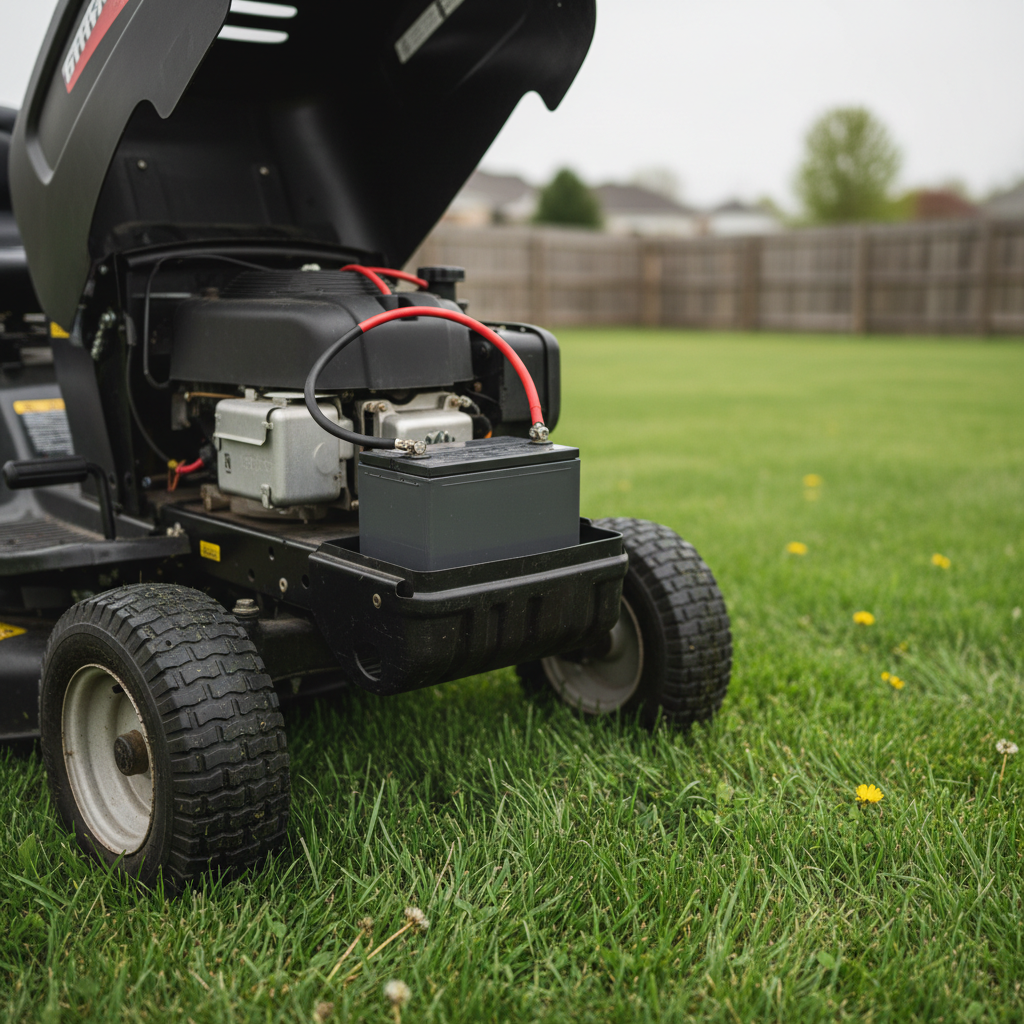
A jump-start only works if there is a starter battery to accept current. Many gas riding mowers and some electric-start walk-behind mowers use a small 12-volt starter battery, usually a lead-acid or AGM battery, to turn the starter motor. That is the setup a car can sometimes help. Recoil-start walk-behind mowers often have no starter battery at all. Pulling the cord is how they start, so jumper cables have nowhere useful to go. Cordless electric mowers use lithium-ion packs at various voltages. Those packs are not designed to be jump-started from a car, and connecting a vehicle to them is unsafe.
Do not guess voltage from the mower’s size or brand. Read the battery label and the owner’s manual. A 12-volt starter battery is usually marked 12V on the case, along with polarity marks at the posts. If the label is missing, unreadable, or shows a voltage that is not 12 volts, do not use the car as a donor. If the machine is a battery-only mower with a removable lithium-ion pack, treat it as incompatible no matter how convenient the car looks.
Skip a car jump entirely when any of the following is true:
- The mower has no starter battery, or you cannot find clearly marked 12-volt posts.
- The battery is a lithium-ion pack, or the system voltage is unknown.
- The battery is cracked, leaking, swollen, frozen, missing caps, or heavily corroded.
- The cables, clamps, or terminals are frayed, melted, or too short to keep the vehicles apart.
- The owner’s manual for the mower or the car forbids jumping or names a different procedure.
- You smell fuel, see a spark hazard near vents, or cannot work outdoors or in strong ventilation.
If the goal is only to “wake up” a neglected rider after winter, a car jump may still be the wrong first tool. A small 12-volt charger or maintainer matched to lead-acid or AGM chemistry is usually the calmer option. Use a car only when you have confirmed a 12-volt starter battery, the battery looks intact, and you need a brief assist to crank, not a charging session.
Why Voltage Match Matters, and Why a Car Can Still Cause Harm
A typical passenger car electrical system is 12 volts nominal. A 12-volt mower starter battery is nominally compatible with that system. Matching voltage is the first filter: same nominal voltage can allow current to flow in a useful direction; a mismatch can overheat a pack, blow fuses, or damage electronics. Compatibility of the number on the label is not the same as compatibility of size, chemistry, or charging behavior.
A car battery and alternator are built for a much larger load than a typical mower battery. The car’s job is to start a heavy engine and then replenish a large battery while running accessories. A lawn mower starter battery is a small reservoir meant to spin a compact starter for a few seconds. If you treat the car like a charger, especially with the engine running hard, the small battery can be forced to accept more energy than it is built to handle. The jump should transfer just enough energy to crank. It should not become a charging session.
That is why a running or revved car is risky. With the donor engine off, you are mostly using the car battery as a parallel source. With the engine idling, the alternator is already adding charge. Revving the engine increases charging output and is a poor idea for a small mower battery. Extra output does not make the procedure “more successful.” It mainly raises heat, gassing, and surge risk on the smaller pack and on any nearby electronics.
Reverse polarity is a separate and more immediate hazard. Connecting positive to negative can create a hard short, a shower of sparks, melted clamps, and damage to wiring. On a mower, a surge or reverse polarity can harm more than the battery. Possible victims include the starter solenoid, fuses, lights, hour meters, and, on some machines, fuel-injection or other modules. Those failures are a reason for caution, not a guarantee that every reverse hookup destroys every board. The safe assumption is that a polarity mistake can be expensive and dangerous, so you prevent it instead of hoping it is recoverable.
AGM batteries still need correct polarity and a gentle assist. They are a sealed lead-acid style used on some riders, not a license to treat the car as a high-output charger. Lithium-ion packs on cordless electric mowers are a different chemistry and often a different voltage family. Do not treat “battery-powered” as “12-volt jump candidate.” For troubleshooting and reliability insights, consult our in-depth marshall stanmore iii vs harman kardon onyx studio 8 report.
Safety Checks Before You Touch the Cables
Lead-acid batteries can release flammable hydrogen gas and contain corrosive electrolyte. A spark at the vent or post can ignite that gas. Acid can burn skin and eyes. Those are established hazards of jumping any lead-acid battery, including the small one on a riding mower. Work outdoors or in strong ventilation. Keep flames, cigarettes, and loose sparks away from both batteries and from fuel caps, vents, and spilled gasoline.
Inspect both batteries before the cables come out. Look for cracks, leaks, a bulging case, missing vent caps, white or green crust that suggests a failing connection, and any sign the battery is frozen. A cracked, leaking, frozen, or unlabeled battery should not be jumped. Replacement is safer than forcing current into a damaged cell. If electrolyte has already leaked, keep people and pets away, avoid spreading the residue, rinse skin or eyes with water if contact occurs, and seek medical care. Do not invent a home “neutralizer” ritual or keep working around an open leak. Readers comparing setup options can review our technical analysis on dyson v8 cyclone vs bissell featherweight stick.
Park both machines on stable ground, out of gear, with parking brakes set if they have them. Disengage the blades and the PTO. Remove the mower key if that is how the machine is disabled, and keep bystanders, especially children, well away from decks, belts, and the space between the vehicles. The mower must not be able to roll into the car or into you when it fires. Wear eye protection and gloves. Loose jewelry and dangling clothing do not belong near posts, fans, or belts.
Read both owner’s manuals when you have them. The mower and vehicle owner’s manuals override generic jump-start steps when they conflict. Some makers name a specific chassis ground, forbid jumping, or want you to use a charger instead. If the manual and a generic article disagree, follow the manual or take the battery to a shop. For complementary field maintenance guidelines, examine our breakdown of bissell crosswave hydrosteam vs shark stainforce.
Replacement is the better choice when the battery will not hold a charge, the case is damaged, the machine sits unused for long stretches without a maintainer, or previous jumps only produced a brief click. Repeated boosting of a failing pack wastes time and keeps hydrogen, acid, and spark risk in play.
How to Jump a 12-Volt Lawn Mower From a Car
Confirm again that both systems are 12-volt and that the mower battery is a conventional starter battery, not a lithium-ion pack. Inspect jumper cables for cracked insulation, exposed wire, and clamps that close firmly. Do not use damaged cables. Position the car close enough for the leads to reach without stretching, but do not let the vehicles touch. Touching metal bodywork can create an unintended ground path.
Identify polarity on both batteries. The positive post is usually marked “+” and often has a red cover or cable. The negative post is marked “−” and is often black. If marks are gone, stop. Clean heavy corrosion off the mower terminals only if you can do it without grinding metal into your eyes or shorting a tool across the posts. A poor connection can look like a dead battery.
Prefer the car engine off so the alternator does not dump charge into the small battery. Shut the mower off as well. If the mower still will not crank after a correct hookup with the car off, a brief idle of the donor car is sometimes used, but keep that interval short and never rev the engine. Some manufacturers forbid jumping altogether or specify a ground point; those instructions win.
Use this clamp order, which is the standard jumper sequence for reducing spark at the dead battery:
- Connect a red clamp to the donor car’s positive battery post.
- Connect the other red clamp to the mower’s positive battery post.
- Connect a black clamp to the donor car’s negative battery post.
- Connect the remaining black clamp to a clean, unpainted metal chassis ground on the mower, away from the battery, fuel tank, carburetor, vents, and moving parts.
Making the last connection to a chassis ground away from the battery reduces spark risk at the battery vents, where hydrogen gas can collect. Do not attach that last negative clamp to the dead battery’s negative post if a suitable chassis ground is available and recommended. Keep every clamp from touching another clamp, painted bodywork you did not choose as a ground, or rotating parts. Do not let the red and black leads drape across a hot exhaust or a blade deck you may later start.
After the cables are secure, try to start the mower using its normal sequence: operator in the seat if a seat interlock is present, brake or clutch held as the machine requires, PTO off, blades disengaged. If it cranks and runs, let it idle only long enough to confirm it stays running, then shut it down before you remove cables if that is safer around moving parts. If you must disconnect with the engine running, stay clear of belts and blades.
Remove the cables in reverse order: black clamp off the mower ground first, then black off the car, then red off the mower, then red off the car. Lift each clamp clear so it cannot spring back onto a post. Do not let the clamps touch each other while any end is still connected. There is no reliable “wait this many minutes and it will start” window. If the starter turns weakly and then dies, stop and move to diagnosis rather than repeating long hookups.
What Not to Do
- Do not jump a lithium-ion pack or any cordless electric mower from a car.
- Do not jump an unlabeled battery, a non-12-volt system, or a machine with no starter battery.
- Do not use the car as a charger. A car charging system is built for a much larger battery than a typical mower battery.
- Do not rev the donor car, and do not leave a running car connected longer than a brief, cautious assist.
- Do not reverse polarity. Reverse polarity can spark and damage electrical parts, including the starter solenoid and other circuits.
- Do not connect the last negative clamp to the dead battery post when a clean chassis ground is available and recommended.
- Do not jump a frozen, leaking, cracked, or smoking battery, and do not continue if cables get hot or you smell burning insulation.
- Do not use frayed jumper cables or clamps that will not stay on the posts.
- Do not leave a rider in gear with the PTO or blades engaged. A sudden start can throw the machine or the operator into the deck.
- Do not defeat seat, brake, blade, or PTO safety interlocks to force a start.
- Do not work indoors over a fuel spill, or with bystanders leaning over the battery.
These are hard stops, not style preferences. A polarity error or a lithium-pack hookup is not a learning moment. Disconnect immediately if you see the wrong color on the wrong post, hear a pop, or see smoke, then reassess whether the battery should be replaced by a shop instead of jumped again.
If It Still Will Not Start
A careful jump that still fails usually means the battery is not the only problem, or is no longer able to hold a charge. Repeated failed jumps often mean a battery that will not hold a charge or a problem that is not the battery. Stop recycling the car as a donor and look at the clues.
A single click with no crank often points to a weak battery, a poor ground, a failing starter solenoid, or a safety interlock that is open. Lights or a dash display that stay completely dead after a correct hookup can mean a broken cable, a blown fuse, or corrosion so heavy that current never arrives. A starter that spins freely while the engine never fires is not a jump-start problem. That pattern points toward fuel, spark, or an engine that is not ready to run.
On a riding mower, walk through the operator interlocks before you blame the battery again. Many riders will not crank unless the seat is occupied, the brake is down, and the PTO is off. A walk-behind electric-start machine may refuse to crank unless the blade control is in the required position. Check that the ground strap to the chassis is tight and that both battery cables are clean at the posts, the solenoid, and the starter. A green crusty terminal can drop enough voltage to mimic a dead battery even while the car is connected.
If terminals are clean, polarity was correct, and the engine still will not crank, switch to a charger made for small 12-volt lead-acid or AGM batteries, or replace the battery, rather than lining up more car jumps. A charger designed for that chemistry can recover a sulfated but intact battery more gently than a vehicle alternator. If the case is old, the battery dies again overnight, or you are not sure of the chemistry, replacement or a shop inspection is the safer path. A new battery will not fix a failed starter, a dead solenoid, a clogged fuel system, or a safety switch that is open.
Safer Options Than Borrowing a Car
A charger matched to the battery chemistry, clean tight terminals, and off-season maintenance are generally safer than a car jump. After the mowing season, or any time the machine will sit, a maintainer or trickle charger designed for 12-volt lead-acid or AGM batteries can keep the small pack from going flat. That avoids both the no-start and the temptation to drag a running vehicle next to a fuel tank.
A portable 12-volt jump pack with polarity protection is often more controllable than a running vehicle. You still confirm 12 volts and lead-acid or AGM chemistry, and you still use a chassis ground for the last connection when that is the recommended method. The advantage is scale: you are not pairing the mower with an alternator built for a car. Choose a pack only if its documentation covers small 12-volt starter batteries. Do not use a lithium vehicle pack as an excuse to jump a cordless mower’s lithium-ion pack.
Some manuals allow a pull-start on certain riders when the battery is down. Many do not. Do not invent a rope-start bypass, and do not disable interlocks to make a pull-start possible. If the manual describes a procedure, follow it exactly. If it does not, treat the electric start as the only approved method and service the battery properly.
Take the battery to a shop when you cannot confirm voltage or chemistry, the case is damaged, acid has leaked, the mower has electronics you do not want to risk, or you are not comfortable working around hydrogen gas and fuel. A technician can load-test a small starter battery, check the charging circuit on the mower, and replace cables or a solenoid without improvising around a car bumper.
The short version of the decision is simple. Jump-start a lawn mower with a car only for a clearly labeled 12-volt starter battery on a gas riding mower or an electric-start walk-behind, with correct polarity, a chassis ground for the last clamp, and the donor engine kept from hard-charging the small pack. For cordless electric mowers, unlabeled systems, damaged batteries, and anything the manual forbids, leave the jumper cables in the trunk.
Technical Standards and Compliance
Mechanical safety standards, operational tolerances, and protective gear guidelines align with benchmark specifications established by the American National Standards Institute (ANSI).









