
Quick Answer: How Fast Does A Lawn Mower Go?
A lawn mower’s travel (ground) speed is not a single value. How fast a lawn mower goes depends on mower type—push, self-propelled, riding or zero-turn, or robotic—and on how that machine is designed to move across the lawn. When manufacturers publish a figure, lawn mower travel speed is usually given in miles per hour (mph) or kilometers per hour (km/h)….

Pros
- Powerful 80V brushless motor delivers 32HP gas-equivalent performance with quiet fume-free operation and no engine maintenance.
- Complete kit includes four 6.0Ah batteries and 600W charger for substantial runtime up to 1.5 acres.
- SmartCut technology and 42-inch heavy-duty steel deck ensure consistent cuts without bogging in tough conditions.
- Versatile towing up to 350 lbs and optional cargo hauling plus comfort features like high-back seat and LED lights.
- Strong 4-year limited warranty and full compatibility with the Greenworks 80V tool ecosystem.
Cons
- Rear utility cargo bed for 200 lb hauling is sold separately and not included in the kit.
- Runtime of up to 1.5 acres varies with conditions and may require recharging or battery swaps on larger properties.
- As a fully cordless model continuous operation depends on battery levels unlike gas engines with unlimited runtime.
The Greenworks 80V 42" CrossoverT Cordless Riding Lawn Tractor is a ready-to-mow zero-emission tractor designed for homeowners managing medium to large lawns. It features a reinforced 42-inch stamped steel deck of 12-gauge construction along with premium comfort elements such as a high-back padded seat with foldable armrests. The overall build emphasizes durability and user convenience right out of the box with the included battery and charger set.
Performance centers on the 80V TruBrushless motor that provides 32HP gas-equivalent power with instant torque and quiet fume-free operation. SmartCut technology senses grass conditions and automatically adjusts power to maintain a consistent cut even in tall thick or wet areas. The four 6.0Ah batteries support runtime for up to 1.5 acres depending on conditions while dual LED headlights and a 7-position deck height range from 1.5" to 4.5" add practicality. Front and rear attachments further allow towing up to 350 lbs for added yard utility.
Key considerations include that the rear utility storage bin capable of hauling 200 lbs is sold separately so full cargo functionality requires an extra purchase. Runtime remains condition-dependent and may fall short for properties significantly larger than 1.5 acres without using the 600W charger or swapping batteries. The cordless design prioritizes ease and low maintenance but trades off the continuous runtime of traditional gas models.
This tractor delivers strong value for eco-conscious owners of residential properties who want gas-like power without the emissions noise or upkeep. It suits those who already use or plan to expand into the Greenworks 80V family of tools and who appreciate the 4-year limited warranty. Users with exceptionally large or commercial-scale lawns should evaluate battery logistics carefully before purchase.

Pros
- Delivers strong 21 horsepower equivalent power comparable to gas riding mowers.
- Provides up to 1.5 acres of runtime on a full charge with the six included batteries.
- Features low-maintenance dual brushless motors without belts for greater durability.
- Offers versatile 12-position cutting height adjustment from 1.5 to 4.5 inches.
- Includes digital controls for blade settings, drive speeds, and cruise control.
Cons
- Limited to 1.5 acres of cutting per charge without purchasing additional batteries for bigger lawns.
- Requires recharging time for the six 56V batteries after each use session.
- Relies solely on battery power with no hybrid or gas backup option for extended operation.
The EGO Power+ TR4204 is a cordless electric riding lawn mower built as a modern tractor alternative for residential use. It features a robust 42-inch stamped steel deck and arrives ready to go with six 56V 6.0Ah batteries plus a charger, creating an immediate impression of convenience and solid construction free from gas engine complexity.
Performance shines through its equivalent 21 horsepower output and top speed of 6 MPH, allowing efficient coverage of up to 1.5 acres on a single charge. Dual brushless cutting motors operate without belts for added durability and less upkeep, while the digital display lets users select three blade settings, three drive speeds, and cruise control. The 12 adjustable heights ranging from 1.5 to 4.5 inches combined with anti-scalp wheels deliver precise results across varied terrain.
Drawbacks center on battery dependency, as larger properties beyond 1.5 acres require extra batteries and recharging intervals can interrupt workflow. The fully electric design eliminates fuel storage needs but demands access to power sources between sessions.
This mower suits homeowners with medium to large yards who value quiet, emission-free operation and reduced maintenance. Those seeking expandable battery capacity for bigger areas will find the EGO Power+ TR4204 a strong long-term investment in cordless lawn care.
Pros
- High-efficiency brushless motors maximize power output and durability over traditional motors
- Up to 2 acres runtime with three included 10.0 Ah batteries supports substantial mowing sessions
- Zero-emission operation with gas-equivalent 20 HP power for quieter environmentally friendly use
- Six-port auto-switchover battery system provides flexible extended runtime options
- Durable 42-inch steel deck plus included mulch and towing kits add immediate functionality
Cons
- Runtime is limited to approximately 70 minutes or 2 acres which may require recharging for larger properties
- Fully battery-dependent design means performance relies on charge levels and spare battery availability
- 42-inch deck size may require more passes on expansive lawns compared to wider commercial models
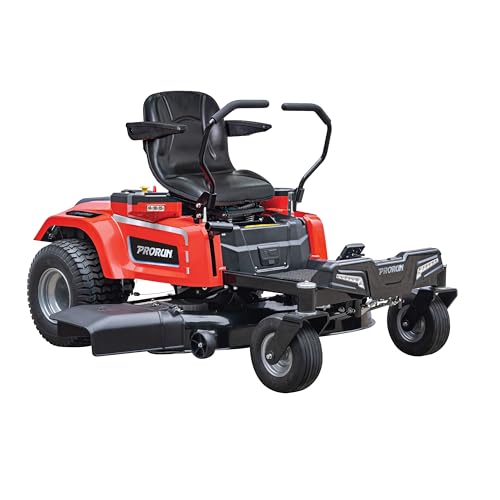
The PRORUN PZT60V42 is a fully electric 60V zero-turn riding lawn mower built for residential and light commercial use. Its primary design centers on a robust 42-inch 14-gauge stamped steel twin blade deck powered by direct-drive brushless motors, giving an immediate impression of solid construction and modern battery-focused engineering. The mower arrives complete with three 10.0 Ah batteries, a charger, mulch kit, and towing kit for ready-to-work versatility.
In performance terms, four high-efficiency brushless motors deliver power equivalent to a 20 HP gas engine while producing zero emissions. The system supports up to 2.0 acres or 70 minutes of runtime, and six battery ports with auto switchover intelligently manage all PRORUN 60V battery sizes for continuous operation. A washout port on the steel deck further simplifies post-mow maintenance during real-world sessions.
Potential drawbacks include the finite 70-minute runtime window which can limit coverage on larger properties without spare batteries or recharge breaks. As a fully electric model, it also depends entirely on battery charge levels rather than continuous fuel refills, and the 42-inch deck width may demand extra passes compared with wider traditional options.
Overall the PRORUN PZT60V42 offers strong value for homeowners and small-property managers who want gas-like cutting power without emissions or noise. Those with medium-sized lawns seeking quiet efficient zero-turn performance and included accessories will benefit most from this electric mower.

Pros
- Strong 24HP FR730 engine power for demanding cutting conditions
- Wide 54-inch FAB deck reduces total mowing time
- Zero turn design delivers excellent maneuverability
- Fabricated deck supports durable everyday operation
Cons
- Sparse details beyond engine and deck leave other features unspecified
- Gas-powered FR730 engine needs regular fuel and maintenance
- Large 54-inch deck size may feel oversized on compact properties
The Husqvarna Z254F is a zero turn mower from the established Husqvarna brand in the riding lawn mowers category. It centers on a solid build that pairs a 24HP 726cc FR730 engine with a 54-inch FAB deck for straightforward residential grass care.
Performance stems directly from the listed specifications. The FR730 engine delivers the horsepower needed for steady operation across typical lawns while the wide FAB deck completes passes efficiently. Zero turn handling improves control in real yard layouts based on the model design.
Considerations arise from the limited data available. Secondary elements such as comfort features fuel capacity or extras receive no mention and the gas engine format involves routine upkeep. The large deck suits open areas better than confined spaces.
The Husqvarna Z254F provides the most value for owners of medium or large properties who want reliable engine power and a broad cutting width. Users with smaller lots or those seeking extensive accessory options should weigh the core specs carefully before purchase.
How Fast Do Walk-Behind Lawn Mowers Go?
Walk-behind lawn mowers include unpowered push mowers and self-propelled mowers. In both cases, “how fast the mower goes” means ground speed: how quickly the machine and operator move over the grass. That is different from how fast the blade spins. For this class of mower, travel speed is closely tied to the person walking behind the handle, not to a highway-style top speed. Manufacturers often describe the experience as matching a walking pace rather than advertising a single mph or km/h rating for every walk-behind model.
What is typical travel speed for a push mower?
A push mower does not drive itself. The operator supplies the force that moves the mower forward. Typical travel speed is therefore the operator’s walking and pushing pace under the conditions of that lawn. Wet or tall grass, slopes, uneven ground, and a full bag all change how quickly a person can push the machine. Two operators can move the same push mower at different speeds. Because locomotion comes from the user, many push-mower documents never list a factory ground speed in mph or km/h. The honest typical value is “whatever walking pace the operator can sustain while still cutting evenly,” not a published maximum. Users looking for related component recommendations can explore our jbl partybox club 120 vs sony srs xv500 breakdown.
That does not mean push-mower speed is meaningless. It means the measurement lives with the person, not with a transmission. If you need a number for planning how long a job might take, time a representative strip of your own lawn at a comfortable pace and scale from that observation. Do not treat informal claims about “average push-mower speed” as a substitute for that check, and do not assume every push mower moves at the same rate. Deck width, grass condition, and operator effort all change how much ground you cover in a given time even when the walking pace feels similar. Users looking for related component recommendations can explore our jbl partybox club 120 vs sony srs xv500 breakdown.
Does a self-propelled mower go faster than walking speed?
A self-propelled mower uses driven wheels to help move the machine so the operator does not have to push the full weight. Drive may be front-wheel, rear-wheel, or all-wheel, and many models include a variable-speed control on the handle. That control lets the operator match ground speed to a comfortable walk, to thicker grass, or to a slope. Self-propelled assistance does not automatically mean the mower is meant to outrun a walking person. In normal mowing, operators still walk behind the handle. Using a drive that feels faster than a stable walking pace can reduce control, leave an uneven cut, or make turns harder, depending on the lawn and the machine.
Whether a given self-propelled mower can exceed walking pace is a model-specific question. Some drives have a range of settings; some are simpler. The operator’s manual is the place to see how the manufacturer describes forward speed, variable drive, and any caution about operating speed. If the manual does not publish mph or km/h, treat the speed control as a way to match your walk, not as proof of a hidden top speed. Reverse, if offered, is usually for maneuvering and is not a second “travel speed” in the same sense as forward mowing. Before finalizing equipment decisions, refer to our comprehensive z890 vs x870e motherboard comparison.
Is walk-behind speed usually listed in mph or only felt as walking pace?
Walk-behind travel speed is often felt as walking pace rather than listed as a single mph or km/h figure. Specification sheets for push and self-propelled mowers commonly emphasize cutting width, engine or motor description, drive type, and bagging or mulching features. Ground speed may appear as “variable,” as a drive description, or not at all. When a numeric travel speed is published, it will be in the technical data or operator’s manual for that model, in mph, km/h, or both. Absence of a number does not mean the mower has no speed; it means the manufacturer treated operator pace and the drive control as the practical answer.
If you are comparing how fast walk-behind lawn mowers go, read each model’s documents instead of assuming a shared numeric range. Terrain, grass length, and whether the drive is engaged change real ground speed even when two machines look similar. For planning, walking pace plus deck width is more useful than an invented average. For safety, keep the pace at which you can stop, turn, and watch the discharge area. Walk-behind lawn mower travel speed is therefore best understood as operator-matched ground speed, documented when the maker chooses to publish it, and otherwise experienced as a controlled walk.
How Fast Do Riding and Zero-Turn Lawn Mowers Go?
Riding lawn mowers and zero-turn mowers put the operator on the machine. Ground speed is then a property of the transmission, tires, and controls, not of a person pushing a handle. This is the category in which manufacturers most often publish travel speed in mph or km/h. Even here there is no single lawn mower speed. A riding mower and a zero-turn mower can be specified differently. The same machine may have a mowing speed used with the deck engaged and a higher transport speed used when moving between areas without cutting. Always read the figures that belong to the exact model, and treat “typical” language as a pointer to those documents rather than as a substitute for them. Before finalizing equipment decisions, refer to our comprehensive z890 vs x870e motherboard comparison.
What travel speeds do riding lawn mowers typically have?
Riding lawn mowers typically have a published forward travel speed, a reverse speed, or a speed range, when the manufacturer includes that data. Those values are model-specific. They can differ between gear-drive and hydrostatic machines, and they can differ between mowing and transport. A spec labeled only as maximum speed is not the same as the speed the maker expects you to use while cutting. Actual speed on your lawn also depends on slope, grass load, tire condition, and whether the cutting deck is engaged. Because numeric ranges vary by model and because this article does not reproduce manufacturer test sheets, the accurate “typical” answer is: look up that riding mower’s travel-speed specification rather than applying one number to every ride-on machine.
If a listing mentions speed without units, check whether the writer meant ground speed or blade speed. Ground speed for a riding mower should be in mph or km/h. If you only find engine RPM, that is not travel speed. When both mowing speed and transport speed appear, use mowing speed for cutting and transport speed only as the manual allows for moving the machine. Do not assume a neighbor’s rider, a different deck size, or a different year of the same nameplate shares the same ground speed. For broader ecosystem context, read through our operational guide on marshall stanmore iii vs harman kardon onyx studio 8.
How is zero-turn mower ground speed described?
Zero-turn mower ground speed is usually described as forward travel speed, sometimes with a separate reverse figure, in the same mph or km/h units used for other ride-on machines. Control is typically through dual levers or a comparable steering system that varies drive to each side. That design is about turning radius and maneuvering, not a promise that every zero-turn mower is faster than every tractor-style rider. Some specification sheets highlight a maximum forward speed; others list a range. Marketing language about agility is not a speed rating. The technical data and operator’s manual are the descriptions that matter.
On a zero-turn mower, the speed you feel in a straight line and the speed you should use in a tight turn are not the same operating problem. Lever position, turf condition, and slope change how the machine responds. Follow the manufacturer’s instructions for travel speed, slope limits, and moving with the deck on or off. If a document lists only a maximum, that is a ceiling for that model under the stated conditions, not a target for every pass. Ground speed remains how fast the mower travels across the lawn, independent of how fast the blades spin. For troubleshooting and reliability insights, consult our in-depth dyson v8 cyclone vs bissell featherweight stick report.
Where is maximum or operating speed stated for a ride-on mower?
Maximum or operating speed for a ride-on mower is stated in the operator’s manual, on the official specification sheet, and sometimes on a product technical page that repeats those figures. Look for labels such as ground speed, travel speed, forward speed, transport speed, or mowing speed. Check units so you do not confuse mph with km/h. A decal on the machine may repeat a warning or a limit; it does not always repeat the full speed table. If the serial plate identifies a model but the public page is vague, use the model and serial information to request the correct manual from the manufacturer.
Operating speed in real use can be lower than a published maximum. Grass height, wet turf, hills, and attachments affect how fast it is appropriate to travel. The manual’s safety section may limit speed on slopes or when the bagger is installed. Those limits are part of the answer to how fast that lawn mower should go, not extras. Ride-on travel speed is therefore a documented, type-specific range or maximum plus the operating conditions in the same documents—not a universal mph figure for every riding or zero-turn mower. Readers comparing setup options can review our technical analysis on bissell crosswave hydrosteam vs shark stainforce.
How Fast Do Robotic Lawn Mowers Go?
Robotic lawn mowers are autonomous walk-over machines. They travel without a person walking behind or sitting on them. Ground speed is still the right meaning of “how fast the mower goes,” and it is still separate from blade RPM. Robotic mowers typically move more slowly than walk-behind or riding mowers. The point of the design is unattended coverage over many hours, not matching a rider’s transport speed. When a maker publishes travel speed, it appears in the same kinds of documents as other mowers: the user manual and the technical specifications, in mph, km/h, or sometimes in meters per second. Many consumer listings emphasize area capacity, boundary setup, and cutting height rather than a headline top speed.
What is typical robotic mower travel speed?
Typical robotic mower travel speed is a controlled, relatively low ground speed set by the manufacturer and, on some models, adjustable in the app or onboard menu. There is no single number that applies to every robot. Boundary wire or wireless mapping, obstacle sensors, rain behavior, and zone settings all influence how the mower moves, including how often it slows, turns, or stops. A specification may list a nominal working speed. That figure, if present, is the evidence-based answer for that model. If no mph or km/h value is published, do not invent one from the mower’s size or from another brand. Observe the machine on your lawn and use the official manual to see whether speed is a user setting or a fixed parameter.
Coverage time is a poor substitute for travel speed. A robot that runs for many hours can finish a lawn while moving slowly. Area rating, if the manufacturer provides one, describes a capacity claim under stated conditions; it is not a conversion into ground speed. When you need to know how fast a robotic lawn mower goes, look for ground speed or working speed in the spec sheet. If you only find blade or disc speed, that is not travel speed.
Why do robotic mowers often move more slowly than walk-behind or riding mowers?
Robotic mowers often move more slowly because they navigate, sense obstacles, and cut without an operator on site. Lower, controlled ground speed gives sensors and software more time to detect people, pets, toys, and boundary limits. It also suits a small cutting disc or blade system that works by frequent overlap rather than by a wide deck at walking or riding pace. Battery use, traction on wet grass, and the need to return to a charging station all favor a modest travel speed over a high one. Slower movement is a design choice for unattended operation, not a defect relative to a rider.
That difference in role is why this article does not rank robotic mowers as slower “winners” or “losers” against other types. Walk-behind speed is tied to a walking operator. Riding and zero-turn speed is tied to a seated operator and a larger transmission. Robotic speed is tied to autonomy and safety logic. If a manufacturer states that a robot’s working speed is limited in certain modes—night, rain, or narrow passages—those modes are part of how fast that mower goes in practice. Read those notes in the manual instead of assuming the robot always travels at one constant pace.
Ground Speed Versus Blade Speed
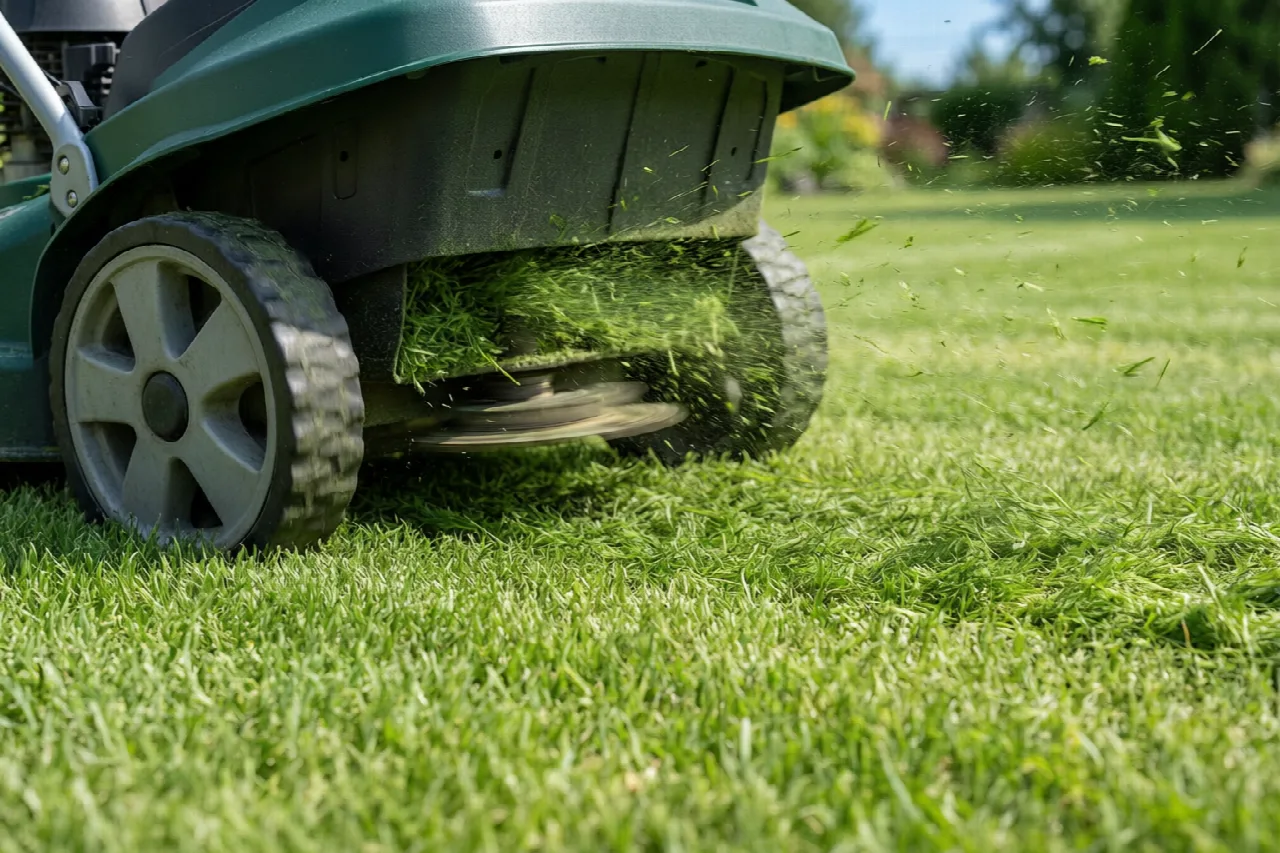
The question “how fast does a lawn mower go?” asks about travel. Ground speed is how fast the mower moves across the lawn. Blade speed is how fast the cutting blade or disc rotates. People mix them up because both appear in mower documents and both can be described with the word “speed.” They are not interchangeable. You can have a machine that travels at a walking pace with a blade spinning at a high RPM, or a robot that creeps across the yard while its cutting disc rotates quickly. Answering with blade RPM alone does not tell you how fast the mower goes from one end of the lawn to the other.
Is “how fast a lawn mower goes” the same as blade RPM?
No. “How fast a lawn mower goes” is ground speed, not blade RPM. RPM means revolutions per minute: how many times the blade assembly turns in one minute. That measurement describes cutting-system rotation. It does not describe miles or kilometers of travel. Engine or motor RPM, where listed, is also not ground speed; it describes the power unit, and the blade may be driven at a related but not identical rate depending on the machine. If a product page boasts a large RPM number and is silent on mph or km/h, it has not answered the travel-speed question.
Confusing the two can distort expectations. A high blade RPM does not mean the mower will finish a property faster. Finish time depends on ground speed, cutting width, overlap, and how much of the lawn you can actually cover in a session. A low ground speed with an appropriate blade speed can still cut well. Conversely, traveling too fast for the grass conditions can leave uncut strips even if the blade RPM specification looks impressive. Treat blade RPM as a cutting-system specification and travel speed as the locomotion specification.
What units are used for travel speed versus blade speed?
Travel speed, or ground speed, uses miles per hour (mph) or kilometers per hour (km/h). Some technical documents may use meters per second for slow autonomous machines. Blade speed uses revolutions per minute (RPM). Occasionally a manufacturer also discusses blade tip speed in distance-per-time units; that is still a property of the spinning blade, not of how fast the mower chassis travels. If units are missing, do not guess. A three-digit number is more likely to be RPM than mph. A small number with mph or km/h is more likely to be ground speed. Convert only when the source gives a clear unit; do not convert RPM into mph.
Keeping the units straight is the simplest way to read a spec sheet. Scan for “ground speed,” “travel speed,” “forward speed,” or “transport speed” next to mph or km/h. Scan for “blade speed,” “cutting speed,” or “blade RPM” next to RPM. For walk-behind mowers, you may find RPM and no travel figure because walking pace is the ground speed. For riding, zero-turn, and some robotic mowers, you may find both. Both can be valid specifications. Only the mph or km/h ground-speed figure answers how fast the lawn mower goes across the grass.
How to Find the Speed of a Specific Lawn Mower
Because lawn mower travel speed is model-specific, the reliable method is to look up the machine you actually have or are considering—not to apply a generic average. Manufacturer documents are the primary source. Retail descriptions sometimes copy those figures and sometimes omit them or mix them with blade RPM. If two sources disagree, prefer the operator’s manual that matches the model and revision of the mower. Record the model number from the mower’s identification plate so you do not download the wrong PDF. The goal is the published ground speed, or a clear statement that speed is variable and operator-paced, not a number borrowed from a different type of mower.
Where do manufacturers list lawn mower travel speed?
Manufacturers list lawn mower travel speed in the operator’s manual, in a specification or technical data table, and sometimes on an official product page that repeats the manual. Search the PDF for “speed,” “ground speed,” “travel,” “transport,” “forward,” and the unit abbreviations mph and km/h. For self-propelled walk-behind mowers, also search for “variable speed” or drive-system descriptions; those phrases may replace a numeric rating. For riding and zero-turn mowers, expect forward and reverse rows in a table. For robotic mowers, look for working speed, maximum speed, or a setting in the software manual. Keep blade RPM rows separate from travel-speed rows when you take notes.
If you use a printed manual, check both the specifications chapter and the operating chapter. Maximum speed, recommended mowing speed, and slope-related speed limits may not sit in the same paragraph. Safety sections can qualify the spec table. Accessory manuals (baggers, trailers, sulkies) may add further limits. Those qualifications are part of how fast that mower is supposed to go in use. Do not rely on a forum estimate or an unlabeled video as a substitute for the manufacturer’s units and conditions.
Mechanical safety standards, operational tolerances, and protective gear guidelines align with benchmark specifications established by the American National Standards Institute (ANSI).
What should I check if my model does not publish a mph or km/h figure?
If your model does not publish a mph or km/h figure, first confirm you have the correct manual. Then check whether speed is described qualitatively: variable drive, walking pace, or adjustable in an app. For a push mower, the absence of a number is common; your walking pace while cutting evenly is the travel speed. For a self-propelled mower, use the speed control as instructed and time a pass on your own lawn if you need a planning estimate. For a rider, zero-turn, or robot, contact the manufacturer with the model and serial number and ask specifically for ground speed, not blade RPM. If they cannot provide a number, do not invent one.
You can still work without a factory mph rating. Decide what you needed the number for. If the goal was job time, measure how long you take to mow a known area at a controlled pace and scale up. If the goal was comparing types, remember the qualitative pattern: walk-behind generally matches walking pace, ride-on machines travel faster, robotic mowers typically move more slowly, and none of those statements replaces a spec sheet. If the goal was safety, follow the manual’s instructions on slopes, stopping, and bystanders regardless of whether a top speed is printed. Lawn mower travel speed is documented when the maker publishes it in mph or km/h; when the maker does not, the honest answer is the operating description in the manual plus the pace you can actually control on your lawn.
In short, how fast a lawn mower goes is a ground-speed question with a type-specific answer. Use mph or km/h figures from the manufacturer when they exist. Do not confuse them with blade RPM. Match walk-behind machines to a walking pace, read ride-on travel and transport ratings from the correct model documents, and expect robotic mowers to use a lower, controlled working speed. That is the complete, evidence-based way to answer the speed question without treating every lawn mower as if it shared one number.