Quick Answer: RX 7900 XT vs RX 9070 XT — Which Should You Buy in 2026?
Buy the RX 9070 XT at equal prices: it is typically 5–7% faster in current raster averages, substantially faster in ray tracing, and adds official FSR 4/Redstone support plus a stronger media engine. Choose the RX 7900 XT instead when it is at least $100–150 cheaper, because its 20GB VRAM buffer remains valuable. At approximately $600, the RX 7900 XT is the better bargain; at its usual $700–750 price, the newer RX 9070 XT is the safer new purchase. Standard operational and maintenance protocols can be consulted via ENERGY STAR official efficiency certification benchmarks.
Winner by Category
| Category | Winner | Margin / Evidence |
|---|---|---|
| 1080p | RX 9070 XT | Approximately 194 FPS versus 184 FPS, or about 5.4% faster in one native Ultra average. |
| 1440p | RX 9070 XT | Approximately 152 FPS versus 142 FPS, giving the newer card a roughly 7.0% lead in the cited average. |
| 4K | RX 9070 XT, narrowly | Approximately 88 FPS versus 84 FPS, or about 4.8% faster. The RX 7900 XT can still win individual games. |
| Ray tracing | RX 9070 XT | RDNA 4 delivers approximately 20–30% higher average RT performance, with a cited Cyberpunk 2077 lead of about 51%. |
| Upscaling | RX 9070 XT | Supports FSR 3.1 and officially supported ML-based FSR 4/Redstone on compatible RDNA 4 games; the RX 7900 XT supports FSR 2/3 and RSR. |
| VRAM | RX 7900 XT | 20GB versus 16GB, a 25% larger capacity that can help with large textures, scenes and AI models. |
| Power | RX 7900 XT, narrowly | Approximately 300–315W TBP versus 304W. Actual RX 7900 XT board specifications vary. |
| Value | Depends on price | RX 7900 XT wins near $600; RX 9070 XT is preferable at equal pricing, but its typical $700–750 street price weakens its value advantage. |
Pros
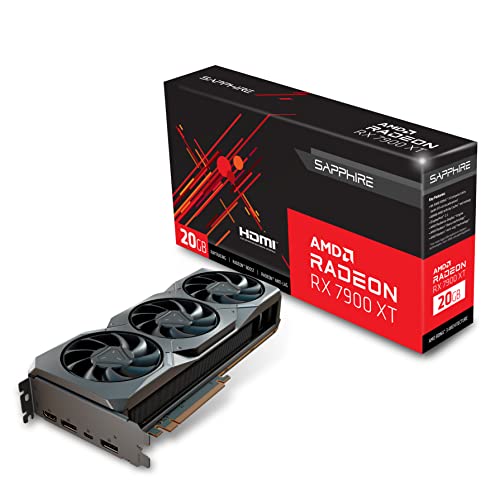
- Large 20GB memory capacity suited for 4K gaming and demanding tasks
- Multiple modern display outputs including USB-C
- PCI-Express 4.0 for solid bandwidth
Cons
- Large 3-slot design requires a spacious case
- Not suitable for compact or small-form-factor systems

Pros
- Large 20GB memory buffer suits high-res textures and multitasking
- Multiple modern display outputs (HDMI 2.1 and DisplayPort 2.1)
- Renewed option may offer a more budget-friendly path to high-end performance
Cons
- Bulky dimensions require ample case clearance and support
- Renewed condition means potential variability in wear and performance
- Heavy weight may need reinforcement in some builds
Pros
- Large 16GB VRAM buffer is well suited to demanding games and visual settings.
- Advanced WINDFORCE cooling design offers multiple thermal management features.
- Dual BIOS provides useful flexibility between performance and lower-noise operation.
- Reinforced build quality adds confidence for long-term desktop installation.
Cons
- The 2.7-slot design may be too bulky for smaller cases or tightly spaced builds.
- Full AMD platform benefits are best realized with compatible Ryzen 9000 and AM5 hardware.
- RGB customization depends on GIGABYTE CONTROL CENTER, which adds software overhead.
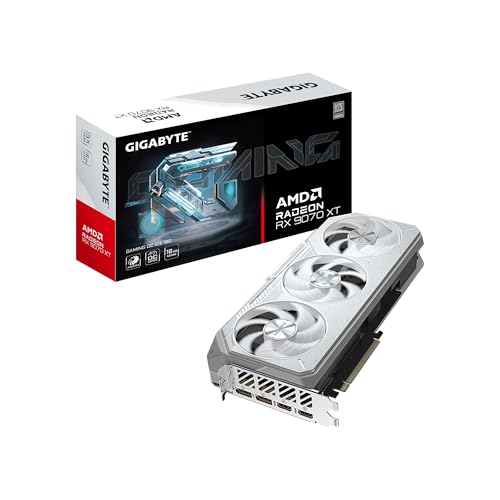
Overview: The GIGABYTE Radeon RX 9070 XT Gaming OC ICE 16G is a premium graphics card built around AMD Radeon RX 9070 XT graphics and 16GB of GDDR6 memory. Its reinforced metal backplate, 2.7-slot design, and ICE styling give it a sturdy, high-end look and feel right out of the box.
Performance: This card is positioned for demanding gaming setups, with PCIe 5.0 support, DisplayPort 2.1, and AMD Smart Access Memory compatibility for modern AM5 systems. GIGABYTE's WINDFORCE cooling combines server-grade thermal conductive gel, Hawk fans, copper heat pipes, a copper plate, and 3D active fans to support sustained gaming loads.
Considerations: The larger cooler may be a challenge in compact cases, and users will get the most from its AMD-specific features when paired with compatible Ryzen 9000 and AM5 hardware. RGB lighting and mode switching are useful, but they also add a layer of software and system management.
Verdict: This is a strong option for gamers who want a well-cooled, feature-rich Radeon card with modern display support and 16GB of memory. It is best suited to builders who have enough case space and plan to use it in a modern AMD-based gaming PC.

Pros
- 16GB of GDDR6 memory is well suited for modern game assets and multitasking.
- Includes WINDFORCE Cooling System for thermal management under load.
- PCIe 5.0 interface supports newer desktop platforms.
- RGB lighting provides a customizable aesthetic for themed builds.
Cons
- No detailed dimensions or case-clearance information is provided in the listing.
- The product page does not include full specification details beyond the main features.
- Customer feedback is limited in the provided data, so real-world owner insight is scarce.
Overview: The GIGABYTE Radeon RX 9070 XT Gaming OC 16G is a desktop graphics card built around AMD Radeon RX 9070 XT graphics. It combines 16GB GDDR6 memory with GIGABYTE's Gaming OC line styling, making it a practical choice for users assembling a modern gaming PC.
Performance and Features: This model highlights WINDFORCE cooling, a Hawk Fan design, and server-grade thermal conductive gel, all of which suggest a focus on heat control during extended gaming or GPU-heavy use. PCIe 5.0 support and RGB lighting add platform compatibility and visual appeal for users who want both function and style.
Drawbacks and Considerations: The listing does not provide detailed dimensions, power requirements, or bundled accessories, so compatibility planning may require additional research. There is also limited customer feedback in the provided data, which makes long-term user experience harder to judge from this page alone.
Verdict: This graphics card is best suited to buyers who want a Radeon RX 9070 XT-based option with 16GB memory and a cooling-focused design. It is a strong fit for gaming-focused desktop builds, especially when visual customization and thermal management are important.
Specifications Side-by-Side
The RX 7900 XT and RX 9070 XT use different generations of AMD’s Radeon architecture. The older card has more stream processors, a wider memory bus and 4GB more VRAM, while the newer card uses RDNA 4 improvements, higher stated clocks and a more advanced ray-tracing and media design.
| Specification | Radeon RX 7900 XT | Radeon RX 9070 XT |
|---|---|---|
| Architecture | RDNA 3, Navi 31 | RDNA 4, Navi 48 |
| CUDA / streaming cores | No CUDA cores; 5,376 stream processors | No CUDA cores; 4,096 stream processors |
| VRAM | 20GB GDDR6 | 16GB GDDR6 |
| Memory bus | 320-bit | 256-bit |
| Memory bandwidth | 800GB/s; approximately 2,900GB/s effective with Infinity Cache | 640GB/s; approximately 3,000GB/s effective with Infinity Cache |
| Base clock | Approximately 1,387MHz | Approximately 1,660MHz |
| Game clock | Approximately 2,025MHz | Approximately 2,400MHz |
| Boost clock | Up to approximately 2,394MHz | Up to approximately 2,970MHz |
| Total board power | Approximately 300–315W, depending on board model | 304W |
| Launch MSRP | $899; later reduced to $749 | $599 |
| Typical U.S. street price in 2026 | Approximately $600–650 new; about $575 used | Approximately $700–750 new; premium models can reach $800–900 |
Gaming Performance
1080p
At 1080p Ultra in the cited native-resolution comparison, the RX 9070 XT averaged approximately 194 FPS, compared with 184 FPS for the RX 7900 XT. That is a roughly 5.4% advantage for the newer card. At this resolution, both GPUs have substantial performance headroom in the tested average, so the difference is better viewed as a modest lead rather than a transformation. Results can change with the game, driver and test suite, and the RX 7900 XT wins some individual titles. Readers comparing setup options can review our technical analysis on how to clean gpu dust.
1440p
1440p is a strong target for both cards. The RX 9070 XT reached approximately 152 FPS in the cited Ultra average, while the RX 7900 XT produced approximately 142 FPS. That makes the RX 9070 XT about 7.0% faster in that test suite. Game-specific variation remains important: newer titles such as Cyberpunk 2077 and Star Wars Outlaws can favor the RX 9070 XT more clearly, while other workloads may reduce or reverse the gap. Readers comparing setup options can review our technical analysis on how to clean gpu dust.
4K
At 4K Ultra, the average lead is narrower but still favors the RX 9070 XT: approximately 88 FPS versus 84 FPS, or about 4.8%. The RX 7900 XT’s 20GB of VRAM and 320-bit bus can be useful in memory-heavy situations, so average FPS alone does not settle every 4K decision. If a particular game or texture workload benefits from the extra capacity, the older card can remain competitive despite the newer GPU’s aggregate lead.
Ray Tracing & Upscaling
Ray tracing is the largest performance reason to choose the RX 9070 XT. Its RDNA 4 ray accelerators provide approximately 20–30% higher average RT performance in the cited testing, with much larger game-specific gains. In Cyberpunk 2077 at 1440p with ray tracing and upscaling, it was approximately 51% faster than the RX 7900 XT; in Metro Exodus Enhanced, the cited advantage was approximately 34%. The RX 9070 XT also supports FSR 3.1 and official FSR 4/Redstone support on compatible RDNA 4 games. For complementary field maintenance guidelines, examine our breakdown of vertical gpu mount airflow.
Features & Ecosystem
FSR and DLSS: Neither card supports NVIDIA DLSS, so a DLSS version is not applicable. The RX 7900 XT supports FSR 2/3, FSR 3 frame generation and AMD Radeon Super Resolution. The RX 9070 XT supports FSR 3.1, frame generation and officially supported ML-based FSR 4/Redstone on selected RDNA 4 games. Community workarounds may bring newer features to RDNA 3, but those are not equivalent to supported retail functionality.
The RX 9070 XT’s newer AI acceleration and official FSR 4 path give it the stronger forward-looking upscaling feature set. However, FSR 4 game support is narrower than the mature NVIDIA DLSS ecosystem, and support should be checked for the games you actually play. The RX 7900 XT’s FSR 3 and RSR options remain broadly usable, but future feature development is more likely to prioritize RDNA 4. To evaluate matched hardware tolerances, consult our detailed overview of weak psu cause gpu stutter.
Streaming and recording: Both cards support hardware AV1, H.264 and HEVC encoding and decoding. The RX 9070 XT has a redesigned media engine with improved AV1 quality, AV1 B-frame encoding and higher stated throughput. That makes it the stronger choice for streaming and recording, particularly if modern AV1 workflows matter more than maximum VRAM capacity.
Drivers and compute: The RX 9070 XT benefits from newer RDNA 4 optimizations and continuing driver development. The RX 7900 XT has mature RDNA 3 drivers and remains supported, but future feature development is more likely to focus on the newer generation. Neither card has CUDA. AMD’s HIP/ROCm alternative supports both GPUs in current ROCm 7.2 Linux and Windows support matrices, with applications including PyTorch, Ollama, llama.cpp and some Blender and DaVinci workflows. CUDA retains the broader software, plug-in, tutorial and precompiled-binary ecosystem. When planning workspace deployment, consider the engineering criteria outlined in our black screen gpu drivers guide.
Power, Thermals & Build Compatibility
Power consumption is effectively a draw. The RX 7900 XT is listed at approximately 300–315W TBP, depending on the specification and board model, while the RX 9070 XT is rated at 304W TBP. Neither is a low-power mainstream card, so the practical build decision should include the specific board design, case airflow and power-supply capacity rather than relying only on the GPU name.
- Check the exact board model: RX 7900 XT power figures vary by specification source and board model.
- Plan around roughly 300W of GPU power: Both cards sit in a similar total-board-power class.
- Prioritize airflow: A high-power GPU benefits from a case with effective intake and exhaust circulation.
- Match the PSU to the complete system: Consider the processor and the rest of the build, not only the graphics card’s TBP.
- Think about VRAM usage: The RX 7900 XT’s 20GB can provide more room for large textures, scenes and AI models.
Price & Value Analysis
The RX 7900 XT is the older and discontinued option, so availability is inconsistent. In 2026, typical U.S. pricing is approximately $600–650 new and around $575 used. A well-priced used card with a warranty can be particularly attractive, but buyers should account for the condition and remaining support of the individual product. For additional operational safety benchmarks, see our published testing notes on daisy chain pcie cables.
The RX 9070 XT launched at a $599 MSRP, but typical 2026 street pricing is approximately $700–750 new. Roughly $700 is a realistic low-end price, while premium models can reach approximately $800–900. This means its newer architecture and feature advantages do not automatically make it the value winner at every current price.
At equal prices, the RX 9070 XT is the better overall purchase because it is modestly faster in aggregate raster testing, markedly stronger in ray tracing, and offers official FSR 4/Redstone support plus the improved encoder. If the RX 7900 XT is genuinely available near $600, however, its extra 4GB of VRAM and broadly similar raster performance make it the better price-performance choice. A $100–150 or larger discount is the clearest reason to select it over the newer card.
Which Should You Buy?
Choose RX 9070 XT if…
- You are buying new and the price gap is small or the cards cost the same.
- You play modern ray-traced games and want approximately 20–30% higher average RT performance.
- You want the newer RDNA 4 architecture and its continuing feature development.
- You plan to use officially supported FSR 4/Redstone features on compatible games.
- You stream or record and value the redesigned media engine, improved AV1 quality and AV1 B-frame encoding.
- You prefer the newer card despite its usual 2026 street price of approximately $700–750.
Choose RX 7900 XT if…
- You can find it at least $100–150 cheaper than the RX 9070 XT.
- You locate a reliable new or used model near $600, or around $575 used with suitable warranty coverage.
- You prioritize native raster performance and are comfortable with a roughly 5–7% aggregate disadvantage in the cited averages.
- You need 20GB of VRAM for larger textures, scenes or AI models.
- You expect memory capacity to matter more than the RX 9070 XT’s newer encoder and FSR 4 support.
- You find a specific RX 7900 XT board with better availability or a more suitable price than current RX 9070 XT models.
Consider a different card if…
Consider an NVIDIA GPU instead if your work depends on CUDA-only applications, CUDA-specific rendering or scientific software, or if you need the broader CUDA plug-in, tutorial and precompiled-binary ecosystem. Also consider a different option if neither card fits your power, software or budget requirements; the right alternative depends on whether your priority is CUDA compatibility, ray tracing, VRAM or lower power use.
Common Questions on Rx 7900 Xt Vs Rx 9070 Xt Answered
Is the RX 9070 XT faster than the RX 7900 XT?
Usually, but the lead is modest in native rasterized gaming. The cited averages show the RX 9070 XT ahead by approximately 5.4% at 1080p, 7.0% at 1440p and 4.8% at 4K. Individual games can produce different results, and the RX 7900 XT wins some titles. The RX 9070 XT’s advantage is much clearer when ray tracing is enabled.
Is 16GB of VRAM enough, or should I buy the RX 7900 XT’s 20GB?
Both capacities have a place. The RX 9070 XT’s 16GB is the newer card’s available capacity, while the RX 7900 XT provides 20GB, or 4GB more. That additional memory can help with larger scenes, ultra-high texture workloads and AI models. Choose the RX 7900 XT when VRAM headroom is a higher priority than FSR 4, ray tracing performance and the newer media engine.
Which card is better for ray tracing?
The RX 9070 XT is the clear winner. RDNA 4 provides approximately 20–30% higher average ray-tracing performance in the cited testing. The difference can be considerably larger in specific games: the RX 9070 XT was approximately 51% faster in Cyberpunk 2077 at 1440p RT with upscaling and approximately 34% faster in Metro Exodus Enhanced.
Do either of these cards support DLSS or CUDA?
No. Neither Radeon card supports NVIDIA DLSS, and neither has CUDA cores. AMD provides FSR and RSR for upscaling, while HIP/ROCm is the alternative software route for supported compute workloads. Current ROCm 7.2 support matrices list both GPUs, but CUDA remains the safer choice for applications that specifically require NVIDIA’s ecosystem.
Mechanical safety standards, operational tolerances, and protective gear guidelines align with benchmark specifications established by the American National Standards Institute (ANSI).
Related Posts
- Rtx 5070 Ti Vs Rx 9070 Xt
- Rx 7600 Xt 16Gb Vs Arc B580
- Rtx 4080 Super Vs Rx 7900 Xtx
For more hands-on benchmarks and buying recommendations, consult our guides on cordless stick vacuum buyer guide.