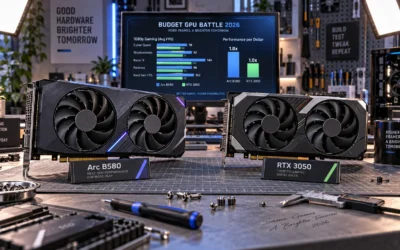
Quick Answer: Intel Arc B580 vs RX 9060 XT 8GB — Which Should You Buy in 2026?
Buy the Radeon RX 9060 XT 8GB if you want the faster average gaming card, stronger typical ray-tracing performance, lower power draw and more predictable compatibility. Choose the Intel Arc B580 if it is at least $20–30 cheaper, because its 12GB VRAM buffer and 192-bit memory bus are better suited to demanding 1440p textures. At similar prices, AMD wins on speed; at roughly $249–270, Intel is the stronger value.
Winner by Category
| Category | Winner | Margin / Evidence |
|---|---|---|
| 1080p | Radeon RX 9060 XT 8GB | Approximately 5–15% faster in broad modern-game comparisons; older DX11 titles can produce a larger AMD lead. |
| 1440p | Radeon RX 9060 XT 8GB, narrowly | Usually 0–10% faster. One comparison measured approximately 410 FPS versus 404 FPS, which is effectively a tie. |
| 4K | Radeon RX 9060 XT 8GB | Approximately 5–20% faster where both remain playable; another aggregate comparison put AMD approximately 23% ahead. |
| Ray tracing | Radeon RX 9060 XT 8GB | Usually 0–25% faster, although the gap varies by game and occasional near-ties or Intel wins are possible. |
| Upscaling | Draw, with different strengths | Arc offers XeSS 2 with Super Resolution and Frame Generation; Radeon offers FSR 4 and AMD frame-generation features in supported games. |
| VRAM | Intel Arc B580 | 12GB versus 8GB, giving Intel 50% more capacity and more room for high-resolution textures. |
| Power | Radeon RX 9060 XT 8GB | 150W reference TBP versus 190W for the B580; some partner Radeon cards are approximately 160W. |
| Value | Intel Arc B580 at the right price | Typical 2026 pricing is approximately $240–300 for Intel versus $288–360 for AMD. The Radeon becomes more compelling when it is within roughly $20–30. |

Pros
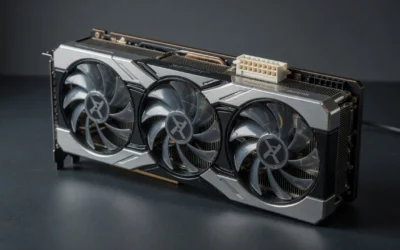
- 16GB GDDR6 provides ample memory for modern games and apps
- Triple-fan cooling targets better thermal headroom during load
- 3320MHz boost clock offers overclocked performance out of the box
- HDMI plus dual DisplayPort outputs support multi-monitor setups
Cons
- 11.4-inch card length requires adequate chassis clearance
- Triple-fan design may be noisier than dual-fan alternatives at full load
- Desktop PC compatibility means you must verify system fit and PSU support

Pros
- Large 16GB frame buffer suits modern game textures and creative applications
- RDNA 4 brings ray tracing and AI accelerators for next-gen features
- 0dB silent mode keeps the card quiet during light loads
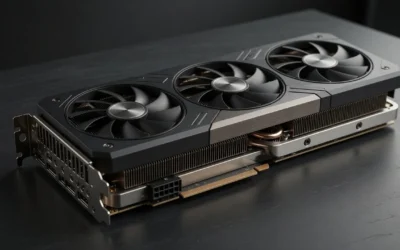
- Compact 2-slot footprint and single 8-pin power simplify installation
Cons
- 128-bit memory bus may limit bandwidth compared to wider-bus cards
- Requires a recommended 550W power supply, adding to system cost
- Check chassis clearance—card measures 249mm long and 41mm tall

Pros
- Factory overclocked for immediate out-of-box performance.
- Quiet operation at idle thanks to 0dB Silent Cooling.
- Modern display connectivity with three DisplayPort 2.0 outputs.
- Reinforced build quality with a metal backplate and Super Alloy parts.
Cons
- Requires two 8-pin PCIe power connectors and a recommended 650W power supply.
- The 2.4-slot, 271 mm length may be difficult to fit in smaller cases.
- 8GB of VRAM may be limiting for some heavy 4K or pro-level workloads.
Overview: The ASRock Intel Arc A580 Challenger 8GB OC is a factory-overclocked graphics card based on Intel Xe HPG architecture. It uses a dual-fan cooler, a metal backplate, and ASRock Super Alloy components, giving it a solid and practical design for mainstream gaming PCs.
Performance & Features: With 8GB of GDDR6 memory, a 256-bit interface, and a 2000 MHz engine clock, this card is aimed at 1440p gaming and everyday creative workloads. It also supports Intel XeSS, DirectX 12 Ultimate, PCIe 4.0, and up to four displays through three DisplayPort 2.0 outputs and one HDMI 2.0b port.
Drawbacks & Considerations: This model is not the best fit for compact systems because it needs a 2.4-slot layout, two 8-pin PCIe power connectors, and a recommended 650W power supply. Users planning heavier high-resolution workloads should also consider that 8GB of VRAM can be a practical limit in some demanding scenarios.
Verdict: The ASRock Intel Arc A580 Challenger 8GB OC is a good option for buyers who want modern Intel graphics features, quiet idle operation, and strong display support at a midrange level. It is best suited to PC builders who have enough case space and adequate power delivery.
Specifications Side-by-Side
The two cards target the same general market, but they make different trade-offs. Intel gives the Arc B580 more memory capacity and bandwidth, while AMD emphasizes gaming speed, ray-tracing throughput and lower board power. The specifications below apply to the GPUs described in the comparison, rather than to every individual board-partner cooler or factory-overclocked model.
| Specification | Intel Arc B580 | Radeon RX 9060 XT 8GB |
|---|---|---|
| Architecture | Xe2-HPG / Battlemage | RDNA 4 / Navi 44 |
| Core configuration | 20 Xe-cores; 2,560 shaders | 32 Compute Units; 2,048 Stream Processors |
| Ray-tracing hardware | 20 second-generation ray-tracing units | 32 ray accelerators |
| VRAM | 12GB GDDR6 | 8GB GDDR6 |
| Memory bus | 192-bit | 128-bit |
| Memory bandwidth | 456GB/s | Approximately 320–322GB/s, supported by 32MB Infinity Cache |
| Clock speeds | 2,670MHz base; up to 2,850MHz boost | Approximately 1,700MHz base; 2,530MHz game clock; up to 3,130MHz boost |
| Total board power | 190W | 150W reference; approximately 160W on some partner cards |
| Launch MSRP | $249 | $299 |
| Typical 2026 street price | Approximately $240–300 | Approximately $288–360 |
Gaming Performance
1080p
The RX 9060 XT 8GB is generally the quicker card at 1080p, with broad modern-game comparisons putting its advantage at approximately 5–15%. The result is not universal: game engine, graphics API and driver behavior matter, and older DX11 games can show a larger AMD advantage. The Radeon is therefore the safer choice for a straightforward high-refresh 1080p build, while the Arc B580 remains competitive when its lower purchase price matters more than a modest frame-rate lead. Readers comparing setup options can review our technical analysis on how to clean gpu dust. For complementary hardware performance, examine our breakdown on external gpu.
1440p
At 1440p, the contest is much closer. The Radeon is approximately 0–10% faster on average, but some test suites show virtually no meaningful separation. One 2026 comparison recorded roughly 410 FPS for the RX 9060 XT 8GB and 404 FPS for the B580 across its selected games. Individual results also swing in both directions: Cyberpunk 2077 at 1440p measured approximately 109 FPS on AMD versus 104 FPS on Intel, while Dying Light: The Beast at 1440p High measured approximately 48 FPS on AMD versus 52 FPS on Intel. Readers comparing setup options can review our technical analysis on how to clean gpu dust.
4K
The RX 9060 XT 8GB usually leads at 4K, by approximately 5–20% in tests where both cards remain playable. A separate aggregate comparison reported an approximately 23% AMD advantage, showing how much game selection and test methodology can affect the headline result. Neither GPU is an ideal native 4K Ultra card, and the Radeon’s 8GB frame buffer becomes an important limitation as texture demand rises. For occasional 4K output with upscaling, AMD has the performance edge; for longer-term texture headroom, Intel is less restrictive. For complementary field maintenance guidelines, examine our breakdown of vertical gpu mount airflow.
Ray Tracing & Upscaling
Ray tracing generally favors the RX 9060 XT 8GB, with an expected advantage of approximately 0–25% depending on the title. Resident Evil Requiem at 1440p Ultra with ray tracing provides a clear example: approximately 38 FPS on the Radeon versus 30 FPS on the B580, or about a 27% AMD lead in that test. Both cards are better suited to 1080p or 1440p ray tracing with upscaling than native 4K ray tracing.
Features & Ecosystem
Intel and AMD both provide modern upscaling and frame-generation options, but neither card supports NVIDIA DLSS. DLSS is exclusive to GeForce RTX GPUs, so buyers choosing either of these cards should check which vendor-neutral or vendor-specific options each game supports. To evaluate matched hardware tolerances, consult our detailed overview of weak psu cause gpu stutter.
The Arc B580 supports XeSS 2, including XeSS Super Resolution, XeSS Frame Generation and Xe Low Latency. Its best image-quality and performance results generally occur on Arc hardware, where the XMX engines can be used. Intel also provides 160 XMX AI engines, OpenVINO, oneAPI and Level Zero tools. XeSS adoption is smaller than FSR adoption, but supported games can deliver very good results. For complementary field maintenance guidelines, examine our breakdown of vertical gpu mount airflow.
The Radeon RX 9060 XT 8GB supports AMD’s FSR 4 machine-learning upscaler, along with Radeon Super Resolution, HYPR-RX and AFMF through AMD’s software stack. FSR is broadly available, while FSR 4 features are primarily tied to newer Radeon hardware and supported games. As with XeSS Frame Generation, game support is an important part of the buying decision rather than a guarantee across every title.
For recording and content creation, both cards provide hardware AV1, H.264 and HEVC encode and decode. Intel adds two media engines and HEVC 4:2:2 decode support, which can be useful for some camera footage and video-editing workflows. AMD improved low-bitrate H.264 quality and supports AV1 B-frames, offering a more conventional creator experience through Adrenalin. Application-specific driver behavior still matters: Arc content-creation performance can vary, while some creative applications have shown driver or hardware-acceleration issues. To evaluate matched hardware tolerances, consult our detailed overview of weak psu cause gpu stutter.
Driver maturity is another meaningful difference. Battlemage drivers are substantially more mature than Intel’s first-generation Alchemist drivers, particularly in DX12 and Vulkan, but older DX9 and DX11 games can still be more variable. Radeon drivers and compatibility are generally more predictable across older games. Resizable BAR should be enabled for proper Arc performance.
Power, Thermals & Build Compatibility
The Radeon has the lower reference power target: 150W compared with 190W for the Arc B580. Some partner RX 9060 XT 8GB cards are approximately 160W, so the exact board design can modestly change the comparison. Lower board power can make AMD easier to cool and more attractive in a compact or efficiency-focused system, although cooler design and case airflow also affect real-world temperatures and noise. When planning workspace deployment, consider the engineering criteria outlined in our black screen gpu drivers guide.
The B580’s 190W TBP is not excessive for a modern gaming PC, but it gives the Radeon a practical efficiency advantage. Do not select a power supply solely from the GPU number: account for the complete system, the chosen partner card and the manufacturer’s requirements. Confirm that the case has sufficient clearance and airflow, and check the specific board’s power connectors before ordering.
- Enable Resizable BAR when installing the Arc B580.
- Check the exact partner-card power specification rather than assuming every RX 9060 XT uses 150W.
- Match the power supply to the complete PC and the specific graphics card.
- Verify case clearance, cooling space and airflow for the chosen model.
- For a small-form-factor build, give extra weight to the Radeon’s lower reference TBP and the physical design of the selected card.
Price & Value Analysis
Intel launched the Arc B580 at $249, and its typical 2026 street price is approximately $240–300. Some listings are considerably higher, so the model and seller deserve careful attention. AMD’s RX 9060 XT 8GB launched at $299 and typically sells for approximately $288–360, depending on availability and the specific board-partner design. For additional operational safety benchmarks, see our published testing notes on daisy chain pcie cables.
The B580 is the value winner when it is available near $249–270. It can deliver similar 1440p results while providing 12GB of VRAM, a 192-bit bus and 456GB/s of bandwidth. That 12GB buffer is 50% larger than the Radeon’s 8GB and can help avoid stutter or texture compromises in VRAM-limited games.
The RX 9060 XT 8GB is easier to justify when it is within roughly $20–30 of the B580. Its average gaming performance is higher, its ray tracing is typically faster, its drivers are generally more predictable in older games and its 150W reference TBP is lower. The central value problem is long-term memory capacity: an 8GB card can be the faster purchase today but the less flexible choice for a new 1440p system.
Which Should You Buy?
Choose Intel Arc B580 if…
- You can find it near the $249 launch MSRP or in the approximately $240–270 value range.
- You want 12GB of GDDR6 rather than an 8GB frame buffer.
- You play modern DX12 or Vulkan games and are comfortable enabling Resizable BAR.
- You want the widest memory configuration for high-resolution textures and longer-term 1440p use.
- You value AV1 and HEVC media flexibility, two media engines and HEVC 4:2:2 decode support.
- You can accept more variable results in some older DX9 or DX11 games and creative applications.
Choose Radeon RX 9060 XT 8GB if…
- You want the highest average gaming performance between these two cards.
- You primarily play at 1080p and want the more predictable plug-and-play option.
- You want generally stronger ray-tracing performance, with typical gains ranging from 0–25% depending on the game.
- You prefer the lower 150W reference TBP, or approximately 160W on some partner cards.
- You want access to AMD’s FSR 4, HYPR-RX, Radeon Super Resolution and AFMF features where supported.
- The Radeon is priced within roughly $20–30 of the B580.
Consider a different card if…
Consider a GeForce RTX model if your work depends on CUDA, NVIDIA-specific OptiX or NVENC workflows, or if DLSS support is a priority. Consider a graphics card with more than 8GB of VRAM if your main goal is a new 1440p build with high-resolution textures and long-term flexibility. The research provided does not identify a specific alternative model or price, so the right replacement depends on your budget and software requirements.
Mechanical safety standards, operational tolerances, and protective gear guidelines align with benchmark specifications established by the American National Standards Institute (ANSI).
Do either of these graphics cards support DLSS?
No. NVIDIA DLSS is exclusive to GeForce RTX GPUs. The Arc B580 uses Intel XeSS 2, including Super Resolution and Frame Generation, while the RX 9060 XT 8GB uses AMD FSR 4 and related Radeon features where games support them. Check each game individually because upscaling and frame-generation availability is not identical across titles.