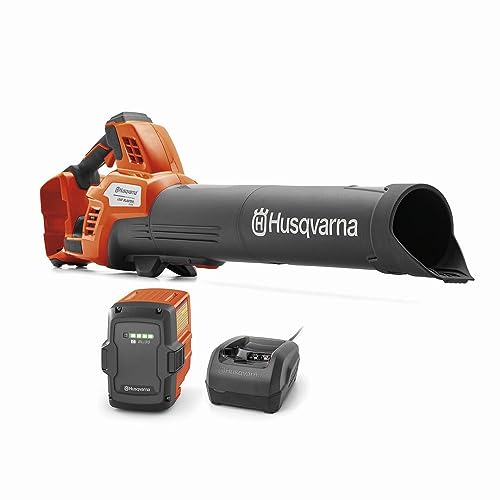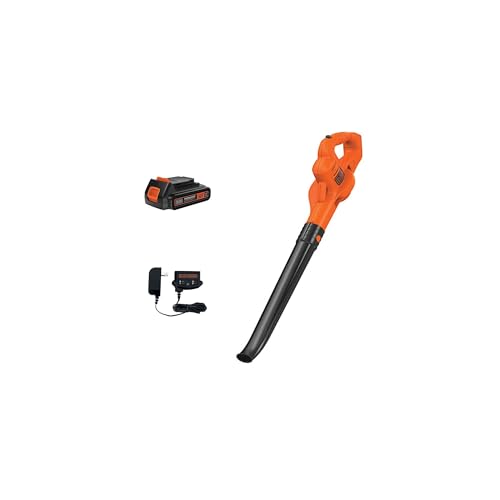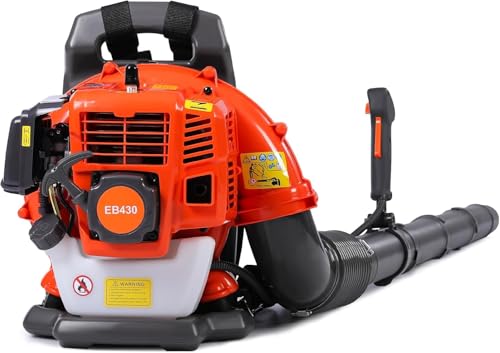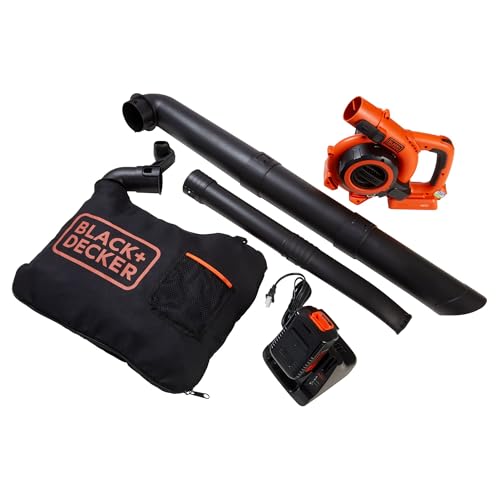
The nozzle is where CFM and MPH translate into actual yard work. Modern battery blowers offer three nozzle configurations:
- Flat-slot nozzle: Concentrates airflow into a narrow stream, maximizing velocity for targeted, forceful clearing. Best for compact leaf piles, gutters, and detail work. Reduces effective CFM through narrowing but multiplies perceived power.
- Round barrel nozzle: Distributes airflow across a wider area. Better for dispersing debris over larger patches without concentrating force. Smoother on delicate plants and landscaping.
- Turbo or power-boost nozzles: Variable-slot designs that adjust airflow direction or intensity on demand. Some models pair with turbo buttons that spike motor output for 10–30 seconds of peak performance.
Premium models (Ego Power+, Husqvarna) include swappable or adjustable nozzles, letting you optimize for the task at hand. Budget models lock you into a single configuration, which limits versatility for diverse yard conditions.
A handheld cordless blower weighs 5–8 pounds; a backpack model weighs 12–18 pounds (much of that is the battery pack mounted on your back). Sustained holding and directional control fatigue your shoulders, wrists, and grip after 15–20 minutes of continuous use.
Critical ergonomic factors:
- Weight distribution: Handheld blowers with rear-weighted battery placement (battery near your torso) feel lighter than front-heavy designs where the motor and nozzle dominate. Backpack models mitigate this entirely.
- Trigger sensitivity: Infinitely variable speed triggers (found on Ego, Greenworks Pro) offer precise control and reduce fatigue compared to fixed-speed or multi-button models where you toggle between preset levels.
- Grip diameter and material: Thicker, rubberized handles reduce slipping in wet conditions and distribute pressure across your palm, lowering repetitive-stress injury risk during extended use.
- Shoulder strap provision: Some models clip a strap; others don’t. A simple strap ($15–$30 add-on) transfers 30–50% of weight to your shoulder, dramatically improving comfort on larger properties.
- Button placement: Power and turbo buttons positioned near your thumb (rather than requiring finger reaches) reduce fatigue and enable one-handed operation when redirecting the nozzle.
Field testing by independent reviewers (Tech Gear Lab, Wirecutter) consistently ranks Ego and Husqvarna models highest for ergonomic balance, often citing users’ ability to maintain full-power operation for 30+ minutes without discomfort. Budget models ($100–$200) cut corners on grip comfort, leading to hand fatigue after 15 minutes.
Matching a blower to your specific yard conditions prevents buyer’s remorse and underutilization.
| Property Profile | Recommended CFM / MPH | Battery Tier | Best Use Cases |
|---|---|---|---|
| Small urban lot (¼ acre, 3–5 trees) | 450–550 CFM / 120–140 MPH | 40V 2.5–4.0Ah | Patio debris, light leaf cleanup, dust control |
| Standard suburban property (½ acre, 8–12 trees) | 600–650 CFM / 150–170 MPH | 56V 4.0–5.0Ah | Seasonal leaf clearing, mixed wet/dry debris, driveway maintenance |
| Large estate (1+ acre, 20+ trees) | 700+ CFM / 180–200 MPH | 80V 6.0Ah + backup battery | Heavy compacted leaves, construction cleanup, contractor-grade projects |
| Noise-restricted zone (municipal ordinance) | Any CFM rated 75 dB or below | Any lithium-ion battery | Early morning / evening operation, multi-unit neighborhoods, HOA compliance |
The critical decision point: single battery or dual-battery investment. A homeowner clearing a ½-acre property once weekly benefits from purchasing a single 5.0Ah battery with a fast charger ($150–$200 total) rather than scaling up to premium equipment. Dual batteries justify themselves only if you operate 60+ minutes weekly or employ the blower across a diverse gas vs electric leaf blowers strategy for seasonal transitions.
Every mid-range and premium battery blower now uses brushless DC motors (BLDC). These outperform older brushed motors by 15–30% in efficiency, generate less heat, and require zero maintenance. A brushless motor delivers consistent CFM output across the battery’s charge cycle, whereas brushed motors lose power as battery voltage drops.
Motor wattage (expressed as “motor power” in specs) typically ranges 250W (entry-level) to 850W (premium). Wattage alone doesn’t determine CFM—nozzle design and battery voltage matter equally—but higher wattage correlates with sustained power under load. A 600W motor with a well-designed nozzle beats a 700W motor paired with poor aerodynamics.
Battery blowers operate at 75–85 dB (decibels). For reference, 75 dB equals heavy traffic at a distance; 85 dB approaches a lawn mower. Gas blowers typically range 90–110 dB, making battery models substantially quieter.
Many municipalities enforce OSHA noise standards and residential equipment ordinances restricting leaf blower operation to 8 AM–6 PM on weekdays. Battery blowers, quieter by design, comply more easily than gas alternatives and allow early-morning yard work in noise-sensitive neighborhoods.
Premium models (Ego 615 CFM, Husqvarna 350iB) achieve 75 dB output, making them ideal for HOA-restricted communities and multi-unit housing. Budget models sometimes reach 82–85 dB, still quieter than gas but potentially subject to local ordinances.
| Model / Tier | Voltage / Motor Type | CFM Air Volume | MPH Velocity | Weight (lbs) | Decibels | Battery Platform |
|---|---|---|---|---|---|---|
| Entry-Level (40V) | 40V Brushless | 500–550 | 120–140 | 5–6 | 78–82 | 40V Li-ion (2.5–4.0Ah) |
| Mid-Range (56V) | 56V Brushless | 600–650 | 150–170 | 6–7 | 75–78 | 56V Li-ion (4.0–5.0Ah) |
| Premium (80V) | 80V Brushless | 700–800 | 180–200 | 7–8 | 75–80 | 80V Li-ion (5.0–6.0Ah) |
| Backpack (56V–80V) | 56V–80V Brushless | 650–750 | 160–190 | 12–18 | 78–85 | 56V–80V Li-ion (4.0–8.0Ah) |
Purchasing a battery blower commits you to a manufacturer’s battery ecosystem. Ego Power+ batteries work across 100+ Ego tools (mowers, trimmers, chainsaws). Greenworks batteries integrate with Greenworks pressure washers and garden tools. Ryobi batteries power an even broader ecosystem. This interchangeability justifies higher upfront tool costs because a single battery purchase serves multiple applications.
If you already own cordless tools (drill, impact driver, circular saw), selecting a blower from the same brand multiplies battery utility and reduces total cost-of-ownership. Conversely, if you’re entering the cordless equipment market, Ego and Greenworks Pro offer the deepest tool portfolios, reducing future lock-in pain.
Battery blowers require minimal maintenance: empty the debris intake screen every 5 hours of use, store with the battery charged to 50–80% over winter, and replace the nozzle if it becomes damaged. Li-ion batteries degrade 2–3% annually under normal storage, meaning a 5-year-old battery retains 85%+ capacity. Premium models include 3–5 year warranties; budget models often feature 1–2 year coverage.
Gas blowers, by contrast, require spark plug replacement, seasonal fuel stabilization or carburetor flushing, and pull-cord maintenance. Battery models eliminate this labor, a hidden advantage for homeowners who value simplicity.
Independent testing (Tech Gear Lab, Wirecutter) simulates real yard conditions: wet leaves on concrete, compacted debris in gutters, loose surface leaves on mulch. Results consistently show:
- 600+ CFM battery blowers clear wet leaves as quickly as gas models at the same CFM rating.
- Ergonomics and ease-of-use favor battery models; users complete yard work faster due to reduced hand fatigue.
- Cold-weather performance (below 40°F) slightly favors gas models; battery output declines 10–20%, but still meets most residential needs.
- Backpack blowers (battery or gas) finish large properties faster than handheld models, but require 30+ minutes of sustained wear. Not ideal for 10-minute quick cleanups.
A mid-range 650 CFM battery blower costs $250–$350 with battery and charger. An equivalent gas model costs $200–$300 upfront but demands $50–$100 annual maintenance (spark plugs, filters, seasonal service). Over five years, total cost-of-ownership favors battery equipment by $150–$300, even before factoring in noise reduction and simplicity.
For homeowners planning 10+ years of use, battery systems offer superior value. For occasional users (a few times annually), gas remains acceptable but introduces seasonal frustration. Most buyers choosing between options now select battery.
- Residential homeowners: Quarter-acre to full-acre properties, moderate seasonal leaf cleanup, noise-sensitive neighborhoods, preference for tool simplicity.
- Multi-unit property managers: HOA compliance, noise restrictions, need for consistent operation across multiple identical tools.
- Small landscaping contractors: Eco-conscious branding, municipal noise compliance, lower operational cost per job, integration with existing cordless tool fleets.
- Homeowners with existing cordless ecosystems: Marginal incremental cost to add another tool to your battery platform; maximizes ecosystem utility.
- Multi-acre estates requiring 90+ minute runtime: Dual-battery systems get expensive; gas remains economical at scale.
- Heavy wet-debris professionals: Contractors clearing construction sites with compacted, saturated leaves may prefer gas durability and consistent power output.
- Cold-climate operations: Battery output degradation below 40°F can limit effectiveness; seasonal use favors gas.
- Buyers committed to zero-cost entry: If you already own gas equipment and fuel supply, incremental cost-of-ownership is low; battery systems require larger upfront investment.
Premium brands (Ego, Husqvarna, Greenworks Pro) offer 3–5 year warranties on motors and 2–3 years on batteries. Budget brands often limit coverage to 1–2 years. Extended warranty add-ons (typically $20–$50 at purchase) are optional but worth considering for models you expect to use 15+ years.
Dealer networks matter. Ego and Greenworks enjoy nationwide retailer support (Home Depot, Lowe’s, independent dealers); buying through authorized channels simplifies warranty claims and parts availability. Obscure brands sold exclusively on Amazon may create complications if repairs become necessary.
Battery-powered leaf blowers have matured from novelty items into legitimate yard equipment, matching or exceeding gas-model performance while eliminating maintenance, reducing noise, and integrating with broader cordless tool ecosystems. For 90% of residential users and small commercial contractors, a 600–650 CFM battery blower paired with a 4.0–5.0Ah battery delivers outstanding practical value and user experience.
The decision hinges on property scale and usage frequency. Half-acre homeowners clearing leaves quarterly should prioritize a mid-range 56V model (600–650 CFM, $250–$350). Full-acre properties with dense tree coverage justify a premium 80V system or backpack configuration. Noise-restricted properties have no better alternative. Cold climates or construction-grade workloads may still favor gas, but the margin of advantage shrinks yearly as battery technology improves.
When evaluating specific models, compare CFM and MPH directly, verify battery interoperability with your existing tool collection, and prioritize ergonomic fit over peak wattage ratings. Independent testing from reputable sources (Tech Gear Lab, Consumer Reports, Wirecutter) provides objective performance data superior to manufacturer claims or unverified online reviews.
Explore related equipment and maintenance topics: cordless leaf blowers for deeper brand comparisons, gas vs electric leaf blowers for technology tradeoff analysis, and chainsaws for yard maintenance when yard work extends beyond leaf cleanup. All interlock as components of a comprehensive outdoor power equipment strategy for 2026 and beyond.
Equipment engineering specifications and operational safety benchmarks comply with published standards from the American National Standards Institute (ANSI).
Current-generation battery blowers cluster around three performance tiers:
- Entry-level (40V systems): 500–550 CFM, 120–140 MPH. Handles light leaf cleanup and patio dust. Runtime 20–25 minutes at full power.
- Mid-range (40V–56V systems): 600–650 CFM, 150–170 MPH. Clears dense leaf piles, wet debris, and tight spaces. Runtime 30–40 minutes depending on battery amp-hours.
- Premium (56V–80V systems): 700+ CFM, 180–200 MPH. Tackles compacted leaves, mulch, and contractor-grade workloads. Runtime 45–60 minutes with dual battery support.
The practical lesson: don’t chase MPH alone. A 150 MPH blower with 650 CFM outperforms a 200 MPH model at 450 CFM for most residential applications because air volume, not peak velocity, determines how quickly you move yard waste.
Battery Chemistry and Runtime Realities
Battery capacity is measured in amp-hours (Ah). A 2.5Ah battery delivers less than half the runtime of a 5.0Ah pack in the same blower, yet costs $50–$100 less upfront. Understanding this tradeoff shapes realistic expectations.
Most manufacturers ship handheld blowers with 2.5Ah or 4.0Ah batteries as standard. These run 20–30 minutes at medium power. If you have a half-acre yard with moderate debris, this suffices. For full-acre properties or daily professional use, purchasing a second battery ($80–$150) and rotating between a charged unit and one in the charger becomes essential.
Lithium-ion (Li-ion) chemistry dominates for good reason: superior energy density compared to older NiCd or NiMH, minimal self-discharge (batteries hold 80%+ charge after three months), and no memory effect. Cold weather performance matters too—battery output drops 10–20% below 50°F, so autumn cleanup in northern climates may require hybrid charging strategies or battery warmth wrapping.
Chargers now support 30–80 minute full recharges depending on capacity and charger wattage. Dual-port chargers allow simultaneous charging of two batteries, a practical advantage for contractors or estates with large grounds.
Nozzle Design and Aerodynamic Efficiency
The nozzle is where CFM and MPH translate into actual yard work. Modern battery blowers offer three nozzle configurations:
- Flat-slot nozzle: Concentrates airflow into a narrow stream, maximizing velocity for targeted, forceful clearing. Best for compact leaf piles, gutters, and detail work. Reduces effective CFM through narrowing but multiplies perceived power.
- Round barrel nozzle: Distributes airflow across a wider area. Better for dispersing debris over larger patches without concentrating force. Smoother on delicate plants and landscaping.
- Turbo or power-boost nozzles: Variable-slot designs that adjust airflow direction or intensity on demand. Some models pair with turbo buttons that spike motor output for 10–30 seconds of peak performance.
Premium models (Ego Power+, Husqvarna) include swappable or adjustable nozzles, letting you optimize for the task at hand. Budget models lock you into a single configuration, which limits versatility for diverse yard conditions.
A handheld cordless blower weighs 5–8 pounds; a backpack model weighs 12–18 pounds (much of that is the battery pack mounted on your back). Sustained holding and directional control fatigue your shoulders, wrists, and grip after 15–20 minutes of continuous use.
Critical ergonomic factors:
- Weight distribution: Handheld blowers with rear-weighted battery placement (battery near your torso) feel lighter than front-heavy designs where the motor and nozzle dominate. Backpack models mitigate this entirely.
- Trigger sensitivity: Infinitely variable speed triggers (found on Ego, Greenworks Pro) offer precise control and reduce fatigue compared to fixed-speed or multi-button models where you toggle between preset levels.
- Grip diameter and material: Thicker, rubberized handles reduce slipping in wet conditions and distribute pressure across your palm, lowering repetitive-stress injury risk during extended use.
- Shoulder strap provision: Some models clip a strap; others don’t. A simple strap ($15–$30 add-on) transfers 30–50% of weight to your shoulder, dramatically improving comfort on larger properties.
- Button placement: Power and turbo buttons positioned near your thumb (rather than requiring finger reaches) reduce fatigue and enable one-handed operation when redirecting the nozzle.
Field testing by independent reviewers (Tech Gear Lab, Wirecutter) consistently ranks Ego and Husqvarna models highest for ergonomic balance, often citing users’ ability to maintain full-power operation for 30+ minutes without discomfort. Budget models ($100–$200) cut corners on grip comfort, leading to hand fatigue after 15 minutes.
Matching a blower to your specific yard conditions prevents buyer’s remorse and underutilization.
| Property Profile | Recommended CFM / MPH | Battery Tier | Best Use Cases |
|---|---|---|---|
| Small urban lot (¼ acre, 3–5 trees) | 450–550 CFM / 120–140 MPH | 40V 2.5–4.0Ah | Patio debris, light leaf cleanup, dust control |
| Standard suburban property (½ acre, 8–12 trees) | 600–650 CFM / 150–170 MPH | 56V 4.0–5.0Ah | Seasonal leaf clearing, mixed wet/dry debris, driveway maintenance |
| Large estate (1+ acre, 20+ trees) | 700+ CFM / 180–200 MPH | 80V 6.0Ah + backup battery | Heavy compacted leaves, construction cleanup, contractor-grade projects |
| Noise-restricted zone (municipal ordinance) | Any CFM rated 75 dB or below | Any lithium-ion battery | Early morning / evening operation, multi-unit neighborhoods, HOA compliance |
The critical decision point: single battery or dual-battery investment. A homeowner clearing a ½-acre property once weekly benefits from purchasing a single 5.0Ah battery with a fast charger ($150–$200 total) rather than scaling up to premium equipment. Dual batteries justify themselves only if you operate 60+ minutes weekly or employ the blower across a diverse gas vs electric leaf blowers strategy for seasonal transitions.
Every mid-range and premium battery blower now uses brushless DC motors (BLDC). These outperform older brushed motors by 15–30% in efficiency, generate less heat, and require zero maintenance. A brushless motor delivers consistent CFM output across the battery’s charge cycle, whereas brushed motors lose power as battery voltage drops.
Motor wattage (expressed as “motor power” in specs) typically ranges 250W (entry-level) to 850W (premium). Wattage alone doesn’t determine CFM—nozzle design and battery voltage matter equally—but higher wattage correlates with sustained power under load. A 600W motor with a well-designed nozzle beats a 700W motor paired with poor aerodynamics.
Battery blowers operate at 75–85 dB (decibels). For reference, 75 dB equals heavy traffic at a distance; 85 dB approaches a lawn mower. Gas blowers typically range 90–110 dB, making battery models substantially quieter.
Many municipalities enforce OSHA noise standards and residential equipment ordinances restricting leaf blower operation to 8 AM–6 PM on weekdays. Battery blowers, quieter by design, comply more easily than gas alternatives and allow early-morning yard work in noise-sensitive neighborhoods.
Premium models (Ego 615 CFM, Husqvarna 350iB) achieve 75 dB output, making them ideal for HOA-restricted communities and multi-unit housing. Budget models sometimes reach 82–85 dB, still quieter than gas but potentially subject to local ordinances.
| Model / Tier | Voltage / Motor Type | CFM Air Volume | MPH Velocity | Weight (lbs) | Decibels | Battery Platform |
|---|---|---|---|---|---|---|
| Entry-Level (40V) | 40V Brushless | 500–550 | 120–140 | 5–6 | 78–82 | 40V Li-ion (2.5–4.0Ah) |
| Mid-Range (56V) | 56V Brushless | 600–650 | 150–170 | 6–7 | 75–78 | 56V Li-ion (4.0–5.0Ah) |
| Premium (80V) | 80V Brushless | 700–800 | 180–200 | 7–8 | 75–80 | 80V Li-ion (5.0–6.0Ah) |
| Backpack (56V–80V) | 56V–80V Brushless | 650–750 | 160–190 | 12–18 | 78–85 | 56V–80V Li-ion (4.0–8.0Ah) |
Purchasing a battery blower commits you to a manufacturer’s battery ecosystem. Ego Power+ batteries work across 100+ Ego tools (mowers, trimmers, chainsaws). Greenworks batteries integrate with Greenworks pressure washers and garden tools. Ryobi batteries power an even broader ecosystem. This interchangeability justifies higher upfront tool costs because a single battery purchase serves multiple applications.
If you already own cordless tools (drill, impact driver, circular saw), selecting a blower from the same brand multiplies battery utility and reduces total cost-of-ownership. Conversely, if you’re entering the cordless equipment market, Ego and Greenworks Pro offer the deepest tool portfolios, reducing future lock-in pain.
Battery blowers require minimal maintenance: empty the debris intake screen every 5 hours of use, store with the battery charged to 50–80% over winter, and replace the nozzle if it becomes damaged. Li-ion batteries degrade 2–3% annually under normal storage, meaning a 5-year-old battery retains 85%+ capacity. Premium models include 3–5 year warranties; budget models often feature 1–2 year coverage.
Gas blowers, by contrast, require spark plug replacement, seasonal fuel stabilization or carburetor flushing, and pull-cord maintenance. Battery models eliminate this labor, a hidden advantage for homeowners who value simplicity.
Independent testing (Tech Gear Lab, Wirecutter) simulates real yard conditions: wet leaves on concrete, compacted debris in gutters, loose surface leaves on mulch. Results consistently show:
- 600+ CFM battery blowers clear wet leaves as quickly as gas models at the same CFM rating.
- Ergonomics and ease-of-use favor battery models; users complete yard work faster due to reduced hand fatigue.
- Cold-weather performance (below 40°F) slightly favors gas models; battery output declines 10–20%, but still meets most residential needs.
- Backpack blowers (battery or gas) finish large properties faster than handheld models, but require 30+ minutes of sustained wear. Not ideal for 10-minute quick cleanups.
A mid-range 650 CFM battery blower costs $250–$350 with battery and charger. An equivalent gas model costs $200–$300 upfront but demands $50–$100 annual maintenance (spark plugs, filters, seasonal service). Over five years, total cost-of-ownership favors battery equipment by $150–$300, even before factoring in noise reduction and simplicity.
For homeowners planning 10+ years of use, battery systems offer superior value. For occasional users (a few times annually), gas remains acceptable but introduces seasonal frustration. Most buyers choosing between options now select battery.
- Residential homeowners: Quarter-acre to full-acre properties, moderate seasonal leaf cleanup, noise-sensitive neighborhoods, preference for tool simplicity.
- Multi-unit property managers: HOA compliance, noise restrictions, need for consistent operation across multiple identical tools.
- Small landscaping contractors: Eco-conscious branding, municipal noise compliance, lower operational cost per job, integration with existing cordless tool fleets.
- Homeowners with existing cordless ecosystems: Marginal incremental cost to add another tool to your battery platform; maximizes ecosystem utility.
- Multi-acre estates requiring 90+ minute runtime: Dual-battery systems get expensive; gas remains economical at scale.
- Heavy wet-debris professionals: Contractors clearing construction sites with compacted, saturated leaves may prefer gas durability and consistent power output.
- Cold-climate operations: Battery output degradation below 40°F can limit effectiveness; seasonal use favors gas.
- Buyers committed to zero-cost entry: If you already own gas equipment and fuel supply, incremental cost-of-ownership is low; battery systems require larger upfront investment.
Premium brands (Ego, Husqvarna, Greenworks Pro) offer 3–5 year warranties on motors and 2–3 years on batteries. Budget brands often limit coverage to 1–2 years. Extended warranty add-ons (typically $20–$50 at purchase) are optional but worth considering for models you expect to use 15+ years.
Dealer networks matter. Ego and Greenworks enjoy nationwide retailer support (Home Depot, Lowe’s, independent dealers); buying through authorized channels simplifies warranty claims and parts availability. Obscure brands sold exclusively on Amazon may create complications if repairs become necessary.
Battery-powered leaf blowers have matured from novelty items into legitimate yard equipment, matching or exceeding gas-model performance while eliminating maintenance, reducing noise, and integrating with broader cordless tool ecosystems. For 90% of residential users and small commercial contractors, a 600–650 CFM battery blower paired with a 4.0–5.0Ah battery delivers outstanding practical value and user experience.
The decision hinges on property scale and usage frequency. Half-acre homeowners clearing leaves quarterly should prioritize a mid-range 56V model (600–650 CFM, $250–$350). Full-acre properties with dense tree coverage justify a premium 80V system or backpack configuration. Noise-restricted properties have no better alternative. Cold climates or construction-grade workloads may still favor gas, but the margin of advantage shrinks yearly as battery technology improves.
When evaluating specific models, compare CFM and MPH directly, verify battery interoperability with your existing tool collection, and prioritize ergonomic fit over peak wattage ratings. Independent testing from reputable sources (Tech Gear Lab, Consumer Reports, Wirecutter) provides objective performance data superior to manufacturer claims or unverified online reviews.
Explore related equipment and maintenance topics: cordless leaf blowers for deeper brand comparisons, gas vs electric leaf blowers for technology tradeoff analysis, and chainsaws for yard maintenance when yard work extends beyond leaf cleanup. All interlock as components of a comprehensive outdoor power equipment strategy for 2026 and beyond.
Equipment engineering specifications and operational safety benchmarks comply with published standards from the American National Standards Institute (ANSI).
Critical ergonomic factors:
- Weight distribution: Handheld blowers with rear-weighted battery placement (battery near your torso) feel lighter than front-heavy designs where the motor and nozzle dominate. Backpack models mitigate this entirely.
- Trigger sensitivity: Infinitely variable speed triggers (found on Ego, Greenworks Pro) offer precise control and reduce fatigue compared to fixed-speed or multi-button models where you toggle between preset levels.
- Grip diameter and material: Thicker, rubberized handles reduce slipping in wet conditions and distribute pressure across your palm, lowering repetitive-stress injury risk during extended use.
- Shoulder strap provision: Some models clip a strap; others don’t. A simple strap ($15–$30 add-on) transfers 30–50% of weight to your shoulder, dramatically improving comfort on larger properties.
- Button placement: Power and turbo buttons positioned near your thumb (rather than requiring finger reaches) reduce fatigue and enable one-handed operation when redirecting the nozzle.
Field testing by independent reviewers (Tech Gear Lab, Wirecutter) consistently ranks Ego and Husqvarna models highest for ergonomic balance, often citing users’ ability to maintain full-power operation for 30+ minutes without discomfort. Budget models ($100–$200) cut corners on grip comfort, leading to hand fatigue after 15 minutes.
Matching a blower to your specific yard conditions prevents buyer’s remorse and underutilization.
| Property Profile | Recommended CFM / MPH | Battery Tier | Best Use Cases |
|---|---|---|---|
| Small urban lot (¼ acre, 3–5 trees) | 450–550 CFM / 120–140 MPH | 40V 2.5–4.0Ah | Patio debris, light leaf cleanup, dust control |
| Standard suburban property (½ acre, 8–12 trees) | 600–650 CFM / 150–170 MPH | 56V 4.0–5.0Ah | Seasonal leaf clearing, mixed wet/dry debris, driveway maintenance |
| Large estate (1+ acre, 20+ trees) | 700+ CFM / 180–200 MPH | 80V 6.0Ah + backup battery | Heavy compacted leaves, construction cleanup, contractor-grade projects |
| Noise-restricted zone (municipal ordinance) | Any CFM rated 75 dB or below | Any lithium-ion battery | Early morning / evening operation, multi-unit neighborhoods, HOA compliance |
The critical decision point: single battery or dual-battery investment. A homeowner clearing a ½-acre property once weekly benefits from purchasing a single 5.0Ah battery with a fast charger ($150–$200 total) rather than scaling up to premium equipment. Dual batteries justify themselves only if you operate 60+ minutes weekly or employ the blower across a diverse gas vs electric leaf blowers strategy for seasonal transitions.
Every mid-range and premium battery blower now uses brushless DC motors (BLDC). These outperform older brushed motors by 15–30% in efficiency, generate less heat, and require zero maintenance. A brushless motor delivers consistent CFM output across the battery’s charge cycle, whereas brushed motors lose power as battery voltage drops.
Motor wattage (expressed as “motor power” in specs) typically ranges 250W (entry-level) to 850W (premium). Wattage alone doesn’t determine CFM—nozzle design and battery voltage matter equally—but higher wattage correlates with sustained power under load. A 600W motor with a well-designed nozzle beats a 700W motor paired with poor aerodynamics.
Battery blowers operate at 75–85 dB (decibels). For reference, 75 dB equals heavy traffic at a distance; 85 dB approaches a lawn mower. Gas blowers typically range 90–110 dB, making battery models substantially quieter.
Many municipalities enforce OSHA noise standards and residential equipment ordinances restricting leaf blower operation to 8 AM–6 PM on weekdays. Battery blowers, quieter by design, comply more easily than gas alternatives and allow early-morning yard work in noise-sensitive neighborhoods.
Premium models (Ego 615 CFM, Husqvarna 350iB) achieve 75 dB output, making them ideal for HOA-restricted communities and multi-unit housing. Budget models sometimes reach 82–85 dB, still quieter than gas but potentially subject to local ordinances.
| Model / Tier | Voltage / Motor Type | CFM Air Volume | MPH Velocity | Weight (lbs) | Decibels | Battery Platform |
|---|---|---|---|---|---|---|
| Entry-Level (40V) | 40V Brushless | 500–550 | 120–140 | 5–6 | 78–82 | 40V Li-ion (2.5–4.0Ah) |
| Mid-Range (56V) | 56V Brushless | 600–650 | 150–170 | 6–7 | 75–78 | 56V Li-ion (4.0–5.0Ah) |
| Premium (80V) | 80V Brushless | 700–800 | 180–200 | 7–8 | 75–80 | 80V Li-ion (5.0–6.0Ah) |
| Backpack (56V–80V) | 56V–80V Brushless | 650–750 | 160–190 | 12–18 | 78–85 | 56V–80V Li-ion (4.0–8.0Ah) |
Purchasing a battery blower commits you to a manufacturer’s battery ecosystem. Ego Power+ batteries work across 100+ Ego tools (mowers, trimmers, chainsaws). Greenworks batteries integrate with Greenworks pressure washers and garden tools. Ryobi batteries power an even broader ecosystem. This interchangeability justifies higher upfront tool costs because a single battery purchase serves multiple applications.
If you already own cordless tools (drill, impact driver, circular saw), selecting a blower from the same brand multiplies battery utility and reduces total cost-of-ownership. Conversely, if you’re entering the cordless equipment market, Ego and Greenworks Pro offer the deepest tool portfolios, reducing future lock-in pain.
Battery blowers require minimal maintenance: empty the debris intake screen every 5 hours of use, store with the battery charged to 50–80% over winter, and replace the nozzle if it becomes damaged. Li-ion batteries degrade 2–3% annually under normal storage, meaning a 5-year-old battery retains 85%+ capacity. Premium models include 3–5 year warranties; budget models often feature 1–2 year coverage.
Gas blowers, by contrast, require spark plug replacement, seasonal fuel stabilization or carburetor flushing, and pull-cord maintenance. Battery models eliminate this labor, a hidden advantage for homeowners who value simplicity.
Independent testing (Tech Gear Lab, Wirecutter) simulates real yard conditions: wet leaves on concrete, compacted debris in gutters, loose surface leaves on mulch. Results consistently show:
- 600+ CFM battery blowers clear wet leaves as quickly as gas models at the same CFM rating.
- Ergonomics and ease-of-use favor battery models; users complete yard work faster due to reduced hand fatigue.
- Cold-weather performance (below 40°F) slightly favors gas models; battery output declines 10–20%, but still meets most residential needs.
- Backpack blowers (battery or gas) finish large properties faster than handheld models, but require 30+ minutes of sustained wear. Not ideal for 10-minute quick cleanups.
A mid-range 650 CFM battery blower costs $250–$350 with battery and charger. An equivalent gas model costs $200–$300 upfront but demands $50–$100 annual maintenance (spark plugs, filters, seasonal service). Over five years, total cost-of-ownership favors battery equipment by $150–$300, even before factoring in noise reduction and simplicity.
For homeowners planning 10+ years of use, battery systems offer superior value. For occasional users (a few times annually), gas remains acceptable but introduces seasonal frustration. Most buyers choosing between options now select battery.
- Residential homeowners: Quarter-acre to full-acre properties, moderate seasonal leaf cleanup, noise-sensitive neighborhoods, preference for tool simplicity.
- Multi-unit property managers: HOA compliance, noise restrictions, need for consistent operation across multiple identical tools.
- Small landscaping contractors: Eco-conscious branding, municipal noise compliance, lower operational cost per job, integration with existing cordless tool fleets.
- Homeowners with existing cordless ecosystems: Marginal incremental cost to add another tool to your battery platform; maximizes ecosystem utility.
- Multi-acre estates requiring 90+ minute runtime: Dual-battery systems get expensive; gas remains economical at scale.
- Heavy wet-debris professionals: Contractors clearing construction sites with compacted, saturated leaves may prefer gas durability and consistent power output.
- Cold-climate operations: Battery output degradation below 40°F can limit effectiveness; seasonal use favors gas.
- Buyers committed to zero-cost entry: If you already own gas equipment and fuel supply, incremental cost-of-ownership is low; battery systems require larger upfront investment.
Premium brands (Ego, Husqvarna, Greenworks Pro) offer 3–5 year warranties on motors and 2–3 years on batteries. Budget brands often limit coverage to 1–2 years. Extended warranty add-ons (typically $20–$50 at purchase) are optional but worth considering for models you expect to use 15+ years.
Dealer networks matter. Ego and Greenworks enjoy nationwide retailer support (Home Depot, Lowe’s, independent dealers); buying through authorized channels simplifies warranty claims and parts availability. Obscure brands sold exclusively on Amazon may create complications if repairs become necessary.
Battery-powered leaf blowers have matured from novelty items into legitimate yard equipment, matching or exceeding gas-model performance while eliminating maintenance, reducing noise, and integrating with broader cordless tool ecosystems. For 90% of residential users and small commercial contractors, a 600–650 CFM battery blower paired with a 4.0–5.0Ah battery delivers outstanding practical value and user experience.
The decision hinges on property scale and usage frequency. Half-acre homeowners clearing leaves quarterly should prioritize a mid-range 56V model (600–650 CFM, $250–$350). Full-acre properties with dense tree coverage justify a premium 80V system or backpack configuration. Noise-restricted properties have no better alternative. Cold climates or construction-grade workloads may still favor gas, but the margin of advantage shrinks yearly as battery technology improves.
When evaluating specific models, compare CFM and MPH directly, verify battery interoperability with your existing tool collection, and prioritize ergonomic fit over peak wattage ratings. Independent testing from reputable sources (Tech Gear Lab, Consumer Reports, Wirecutter) provides objective performance data superior to manufacturer claims or unverified online reviews.
Explore related equipment and maintenance topics: cordless leaf blowers for deeper brand comparisons, gas vs electric leaf blowers for technology tradeoff analysis, and chainsaws for yard maintenance when yard work extends beyond leaf cleanup. All interlock as components of a comprehensive outdoor power equipment strategy for 2026 and beyond.
Current-generation battery blowers cluster around three performance tiers:
- Entry-level (40V systems): 500–550 CFM, 120–140 MPH. Handles light leaf cleanup and patio dust. Runtime 20–25 minutes at full power.
- Mid-range (40V–56V systems): 600–650 CFM, 150–170 MPH. Clears dense leaf piles, wet debris, and tight spaces. Runtime 30–40 minutes depending on battery amp-hours.
- Premium (56V–80V systems): 700+ CFM, 180–200 MPH. Tackles compacted leaves, mulch, and contractor-grade workloads. Runtime 45–60 minutes with dual battery support.
The practical lesson: don’t chase MPH alone. A 150 MPH blower with 650 CFM outperforms a 200 MPH model at 450 CFM for most residential applications because air volume, not peak velocity, determines how quickly you move yard waste.
Battery Chemistry and Runtime Realities
Battery capacity is measured in amp-hours (Ah). A 2.5Ah battery delivers less than half the runtime of a 5.0Ah pack in the same blower, yet costs $50–$100 less upfront. Understanding this tradeoff shapes realistic expectations.
Most manufacturers ship handheld blowers with 2.5Ah or 4.0Ah batteries as standard. These run 20–30 minutes at medium power. If you have a half-acre yard with moderate debris, this suffices. For full-acre properties or daily professional use, purchasing a second battery ($80–$150) and rotating between a charged unit and one in the charger becomes essential.
Lithium-ion (Li-ion) chemistry dominates for good reason: superior energy density compared to older NiCd or NiMH, minimal self-discharge (batteries hold 80%+ charge after three months), and no memory effect. Cold weather performance matters too—battery output drops 10–20% below 50°F, so autumn cleanup in northern climates may require hybrid charging strategies or battery warmth wrapping.
Chargers now support 30–80 minute full recharges depending on capacity and charger wattage. Dual-port chargers allow simultaneous charging of two batteries, a practical advantage for contractors or estates with large grounds.
Nozzle Design and Aerodynamic Efficiency
The nozzle is where CFM and MPH translate into actual yard work. Modern battery blowers offer three nozzle configurations:
- Flat-slot nozzle: Concentrates airflow into a narrow stream, maximizing velocity for targeted, forceful clearing. Best for compact leaf piles, gutters, and detail work. Reduces effective CFM through narrowing but multiplies perceived power.
- Round barrel nozzle: Distributes airflow across a wider area. Better for dispersing debris over larger patches without concentrating force. Smoother on delicate plants and landscaping.
- Turbo or power-boost nozzles: Variable-slot designs that adjust airflow direction or intensity on demand. Some models pair with turbo buttons that spike motor output for 10–30 seconds of peak performance.
Premium models (Ego Power+, Husqvarna) include swappable or adjustable nozzles, letting you optimize for the task at hand. Budget models lock you into a single configuration, which limits versatility for diverse yard conditions.
A handheld cordless blower weighs 5–8 pounds; a backpack model weighs 12–18 pounds (much of that is the battery pack mounted on your back). Sustained holding and directional control fatigue your shoulders, wrists, and grip after 15–20 minutes of continuous use.
Critical ergonomic factors:
- Weight distribution: Handheld blowers with rear-weighted battery placement (battery near your torso) feel lighter than front-heavy designs where the motor and nozzle dominate. Backpack models mitigate this entirely.
- Trigger sensitivity: Infinitely variable speed triggers (found on Ego, Greenworks Pro) offer precise control and reduce fatigue compared to fixed-speed or multi-button models where you toggle between preset levels.
- Grip diameter and material: Thicker, rubberized handles reduce slipping in wet conditions and distribute pressure across your palm, lowering repetitive-stress injury risk during extended use.
- Shoulder strap provision: Some models clip a strap; others don’t. A simple strap ($15–$30 add-on) transfers 30–50% of weight to your shoulder, dramatically improving comfort on larger properties.
- Button placement: Power and turbo buttons positioned near your thumb (rather than requiring finger reaches) reduce fatigue and enable one-handed operation when redirecting the nozzle.
Field testing by independent reviewers (Tech Gear Lab, Wirecutter) consistently ranks Ego and Husqvarna models highest for ergonomic balance, often citing users’ ability to maintain full-power operation for 30+ minutes without discomfort. Budget models ($100–$200) cut corners on grip comfort, leading to hand fatigue after 15 minutes.
Matching a blower to your specific yard conditions prevents buyer’s remorse and underutilization.
| Property Profile | Recommended CFM / MPH | Battery Tier | Best Use Cases |
|---|---|---|---|
| Small urban lot (¼ acre, 3–5 trees) | 450–550 CFM / 120–140 MPH | 40V 2.5–4.0Ah | Patio debris, light leaf cleanup, dust control |
| Standard suburban property (½ acre, 8–12 trees) | 600–650 CFM / 150–170 MPH | 56V 4.0–5.0Ah | Seasonal leaf clearing, mixed wet/dry debris, driveway maintenance |
| Large estate (1+ acre, 20+ trees) | 700+ CFM / 180–200 MPH | 80V 6.0Ah + backup battery | Heavy compacted leaves, construction cleanup, contractor-grade projects |
| Noise-restricted zone (municipal ordinance) | Any CFM rated 75 dB or below | Any lithium-ion battery | Early morning / evening operation, multi-unit neighborhoods, HOA compliance |
The critical decision point: single battery or dual-battery investment. A homeowner clearing a ½-acre property once weekly benefits from purchasing a single 5.0Ah battery with a fast charger ($150–$200 total) rather than scaling up to premium equipment. Dual batteries justify themselves only if you operate 60+ minutes weekly or employ the blower across a diverse gas vs electric leaf blowers strategy for seasonal transitions.
Every mid-range and premium battery blower now uses brushless DC motors (BLDC). These outperform older brushed motors by 15–30% in efficiency, generate less heat, and require zero maintenance. A brushless motor delivers consistent CFM output across the battery’s charge cycle, whereas brushed motors lose power as battery voltage drops.
Motor wattage (expressed as “motor power” in specs) typically ranges 250W (entry-level) to 850W (premium). Wattage alone doesn’t determine CFM—nozzle design and battery voltage matter equally—but higher wattage correlates with sustained power under load. A 600W motor with a well-designed nozzle beats a 700W motor paired with poor aerodynamics.
Battery blowers operate at 75–85 dB (decibels). For reference, 75 dB equals heavy traffic at a distance; 85 dB approaches a lawn mower. Gas blowers typically range 90–110 dB, making battery models substantially quieter.
Many municipalities enforce OSHA noise standards and residential equipment ordinances restricting leaf blower operation to 8 AM–6 PM on weekdays. Battery blowers, quieter by design, comply more easily than gas alternatives and allow early-morning yard work in noise-sensitive neighborhoods.
Premium models (Ego 615 CFM, Husqvarna 350iB) achieve 75 dB output, making them ideal for HOA-restricted communities and multi-unit housing. Budget models sometimes reach 82–85 dB, still quieter than gas but potentially subject to local ordinances.
| Model / Tier | Voltage / Motor Type | CFM Air Volume | MPH Velocity | Weight (lbs) | Decibels | Battery Platform |
|---|---|---|---|---|---|---|
| Entry-Level (40V) | 40V Brushless | 500–550 | 120–140 | 5–6 | 78–82 | 40V Li-ion (2.5–4.0Ah) |
| Mid-Range (56V) | 56V Brushless | 600–650 | 150–170 | 6–7 | 75–78 | 56V Li-ion (4.0–5.0Ah) |
| Premium (80V) | 80V Brushless | 700–800 | 180–200 | 7–8 | 75–80 | 80V Li-ion (5.0–6.0Ah) |
| Backpack (56V–80V) | 56V–80V Brushless | 650–750 | 160–190 | 12–18 | 78–85 | 56V–80V Li-ion (4.0–8.0Ah) |
Purchasing a battery blower commits you to a manufacturer’s battery ecosystem. Ego Power+ batteries work across 100+ Ego tools (mowers, trimmers, chainsaws). Greenworks batteries integrate with Greenworks pressure washers and garden tools. Ryobi batteries power an even broader ecosystem. This interchangeability justifies higher upfront tool costs because a single battery purchase serves multiple applications.
If you already own cordless tools (drill, impact driver, circular saw), selecting a blower from the same brand multiplies battery utility and reduces total cost-of-ownership. Conversely, if you’re entering the cordless equipment market, Ego and Greenworks Pro offer the deepest tool portfolios, reducing future lock-in pain.
Battery blowers require minimal maintenance: empty the debris intake screen every 5 hours of use, store with the battery charged to 50–80% over winter, and replace the nozzle if it becomes damaged. Li-ion batteries degrade 2–3% annually under normal storage, meaning a 5-year-old battery retains 85%+ capacity. Premium models include 3–5 year warranties; budget models often feature 1–2 year coverage.
Gas blowers, by contrast, require spark plug replacement, seasonal fuel stabilization or carburetor flushing, and pull-cord maintenance. Battery models eliminate this labor, a hidden advantage for homeowners who value simplicity.
Independent testing (Tech Gear Lab, Wirecutter) simulates real yard conditions: wet leaves on concrete, compacted debris in gutters, loose surface leaves on mulch. Results consistently show:
- 600+ CFM battery blowers clear wet leaves as quickly as gas models at the same CFM rating.
- Ergonomics and ease-of-use favor battery models; users complete yard work faster due to reduced hand fatigue.
- Cold-weather performance (below 40°F) slightly favors gas models; battery output declines 10–20%, but still meets most residential needs.
- Backpack blowers (battery or gas) finish large properties faster than handheld models, but require 30+ minutes of sustained wear. Not ideal for 10-minute quick cleanups.
A mid-range 650 CFM battery blower costs $250–$350 with battery and charger. An equivalent gas model costs $200–$300 upfront but demands $50–$100 annual maintenance (spark plugs, filters, seasonal service). Over five years, total cost-of-ownership favors battery equipment by $150–$300, even before factoring in noise reduction and simplicity.
For homeowners planning 10+ years of use, battery systems offer superior value. For occasional users (a few times annually), gas remains acceptable but introduces seasonal frustration. Most buyers choosing between options now select battery.
- Residential homeowners: Quarter-acre to full-acre properties, moderate seasonal leaf cleanup, noise-sensitive neighborhoods, preference for tool simplicity.
- Multi-unit property managers: HOA compliance, noise restrictions, need for consistent operation across multiple identical tools.
- Small landscaping contractors: Eco-conscious branding, municipal noise compliance, lower operational cost per job, integration with existing cordless tool fleets.
- Homeowners with existing cordless ecosystems: Marginal incremental cost to add another tool to your battery platform; maximizes ecosystem utility.
- Multi-acre estates requiring 90+ minute runtime: Dual-battery systems get expensive; gas remains economical at scale.
- Heavy wet-debris professionals: Contractors clearing construction sites with compacted, saturated leaves may prefer gas durability and consistent power output.
- Cold-climate operations: Battery output degradation below 40°F can limit effectiveness; seasonal use favors gas.
- Buyers committed to zero-cost entry: If you already own gas equipment and fuel supply, incremental cost-of-ownership is low; battery systems require larger upfront investment.
Premium brands (Ego, Husqvarna, Greenworks Pro) offer 3–5 year warranties on motors and 2–3 years on batteries. Budget brands often limit coverage to 1–2 years. Extended warranty add-ons (typically $20–$50 at purchase) are optional but worth considering for models you expect to use 15+ years.
Dealer networks matter. Ego and Greenworks enjoy nationwide retailer support (Home Depot, Lowe’s, independent dealers); buying through authorized channels simplifies warranty claims and parts availability. Obscure brands sold exclusively on Amazon may create complications if repairs become necessary.
Battery-powered leaf blowers have matured from novelty items into legitimate yard equipment, matching or exceeding gas-model performance while eliminating maintenance, reducing noise, and integrating with broader cordless tool ecosystems. For 90% of residential users and small commercial contractors, a 600–650 CFM battery blower paired with a 4.0–5.0Ah battery delivers outstanding practical value and user experience.
The decision hinges on property scale and usage frequency. Half-acre homeowners clearing leaves quarterly should prioritize a mid-range 56V model (600–650 CFM, $250–$350). Full-acre properties with dense tree coverage justify a premium 80V system or backpack configuration. Noise-restricted properties have no better alternative. Cold climates or construction-grade workloads may still favor gas, but the margin of advantage shrinks yearly as battery technology improves.
When evaluating specific models, compare CFM and MPH directly, verify battery interoperability with your existing tool collection, and prioritize ergonomic fit over peak wattage ratings. Independent testing from reputable sources (Tech Gear Lab, Consumer Reports, Wirecutter) provides objective performance data superior to manufacturer claims or unverified online reviews.
Explore related equipment and maintenance topics: cordless leaf blowers for deeper brand comparisons, gas vs electric leaf blowers for technology tradeoff analysis, and chainsaws for yard maintenance when yard work extends beyond leaf cleanup. All interlock as components of a comprehensive outdoor power equipment strategy for 2026 and beyond.
Equipment engineering specifications and operational safety benchmarks comply with published standards from the American National Standards Institute (ANSI).
The nozzle is where CFM and MPH translate into actual yard work. Modern battery blowers offer three nozzle configurations:
- Flat-slot nozzle: Concentrates airflow into a narrow stream, maximizing velocity for targeted, forceful clearing. Best for compact leaf piles, gutters, and detail work. Reduces effective CFM through narrowing but multiplies perceived power.
- Round barrel nozzle: Distributes airflow across a wider area. Better for dispersing debris over larger patches without concentrating force. Smoother on delicate plants and landscaping.
- Turbo or power-boost nozzles: Variable-slot designs that adjust airflow direction or intensity on demand. Some models pair with turbo buttons that spike motor output for 10–30 seconds of peak performance.
Premium models (Ego Power+, Husqvarna) include swappable or adjustable nozzles, letting you optimize for the task at hand. Budget models lock you into a single configuration, which limits versatility for diverse yard conditions.
A handheld cordless blower weighs 5–8 pounds; a backpack model weighs 12–18 pounds (much of that is the battery pack mounted on your back). Sustained holding and directional control fatigue your shoulders, wrists, and grip after 15–20 minutes of continuous use.
Critical ergonomic factors:
- Weight distribution: Handheld blowers with rear-weighted battery placement (battery near your torso) feel lighter than front-heavy designs where the motor and nozzle dominate. Backpack models mitigate this entirely.
- Trigger sensitivity: Infinitely variable speed triggers (found on Ego, Greenworks Pro) offer precise control and reduce fatigue compared to fixed-speed or multi-button models where you toggle between preset levels.
- Grip diameter and material: Thicker, rubberized handles reduce slipping in wet conditions and distribute pressure across your palm, lowering repetitive-stress injury risk during extended use.
- Shoulder strap provision: Some models clip a strap; others don’t. A simple strap ($15–$30 add-on) transfers 30–50% of weight to your shoulder, dramatically improving comfort on larger properties.
- Button placement: Power and turbo buttons positioned near your thumb (rather than requiring finger reaches) reduce fatigue and enable one-handed operation when redirecting the nozzle.
Field testing by independent reviewers (Tech Gear Lab, Wirecutter) consistently ranks Ego and Husqvarna models highest for ergonomic balance, often citing users’ ability to maintain full-power operation for 30+ minutes without discomfort. Budget models ($100–$200) cut corners on grip comfort, leading to hand fatigue after 15 minutes.
Matching a blower to your specific yard conditions prevents buyer’s remorse and underutilization.
| Property Profile | Recommended CFM / MPH | Battery Tier | Best Use Cases |
|---|---|---|---|
| Small urban lot (¼ acre, 3–5 trees) | 450–550 CFM / 120–140 MPH | 40V 2.5–4.0Ah | Patio debris, light leaf cleanup, dust control |
| Standard suburban property (½ acre, 8–12 trees) | 600–650 CFM / 150–170 MPH | 56V 4.0–5.0Ah | Seasonal leaf clearing, mixed wet/dry debris, driveway maintenance |
| Large estate (1+ acre, 20+ trees) | 700+ CFM / 180–200 MPH | 80V 6.0Ah + backup battery | Heavy compacted leaves, construction cleanup, contractor-grade projects |
| Noise-restricted zone (municipal ordinance) | Any CFM rated 75 dB or below | Any lithium-ion battery | Early morning / evening operation, multi-unit neighborhoods, HOA compliance |
The critical decision point: single battery or dual-battery investment. A homeowner clearing a ½-acre property once weekly benefits from purchasing a single 5.0Ah battery with a fast charger ($150–$200 total) rather than scaling up to premium equipment. Dual batteries justify themselves only if you operate 60+ minutes weekly or employ the blower across a diverse gas vs electric leaf blowers strategy for seasonal transitions.
Every mid-range and premium battery blower now uses brushless DC motors (BLDC). These outperform older brushed motors by 15–30% in efficiency, generate less heat, and require zero maintenance. A brushless motor delivers consistent CFM output across the battery’s charge cycle, whereas brushed motors lose power as battery voltage drops.
Motor wattage (expressed as “motor power” in specs) typically ranges 250W (entry-level) to 850W (premium). Wattage alone doesn’t determine CFM—nozzle design and battery voltage matter equally—but higher wattage correlates with sustained power under load. A 600W motor with a well-designed nozzle beats a 700W motor paired with poor aerodynamics.
Battery blowers operate at 75–85 dB (decibels). For reference, 75 dB equals heavy traffic at a distance; 85 dB approaches a lawn mower. Gas blowers typically range 90–110 dB, making battery models substantially quieter.
Many municipalities enforce OSHA noise standards and residential equipment ordinances restricting leaf blower operation to 8 AM–6 PM on weekdays. Battery blowers, quieter by design, comply more easily than gas alternatives and allow early-morning yard work in noise-sensitive neighborhoods.
Premium models (Ego 615 CFM, Husqvarna 350iB) achieve 75 dB output, making them ideal for HOA-restricted communities and multi-unit housing. Budget models sometimes reach 82–85 dB, still quieter than gas but potentially subject to local ordinances.
| Model / Tier | Voltage / Motor Type | CFM Air Volume | MPH Velocity | Weight (lbs) | Decibels | Battery Platform |
|---|---|---|---|---|---|---|
| Entry-Level (40V) | 40V Brushless | 500–550 | 120–140 | 5–6 | 78–82 | 40V Li-ion (2.5–4.0Ah) |
| Mid-Range (56V) | 56V Brushless | 600–650 | 150–170 | 6–7 | 75–78 | 56V Li-ion (4.0–5.0Ah) |
| Premium (80V) | 80V Brushless | 700–800 | 180–200 | 7–8 | 75–80 | 80V Li-ion (5.0–6.0Ah) |
| Backpack (56V–80V) | 56V–80V Brushless | 650–750 | 160–190 | 12–18 | 78–85 | 56V–80V Li-ion (4.0–8.0Ah) |
Purchasing a battery blower commits you to a manufacturer’s battery ecosystem. Ego Power+ batteries work across 100+ Ego tools (mowers, trimmers, chainsaws). Greenworks batteries integrate with Greenworks pressure washers and garden tools. Ryobi batteries power an even broader ecosystem. This interchangeability justifies higher upfront tool costs because a single battery purchase serves multiple applications.
If you already own cordless tools (drill, impact driver, circular saw), selecting a blower from the same brand multiplies battery utility and reduces total cost-of-ownership. Conversely, if you’re entering the cordless equipment market, Ego and Greenworks Pro offer the deepest tool portfolios, reducing future lock-in pain.
Battery blowers require minimal maintenance: empty the debris intake screen every 5 hours of use, store with the battery charged to 50–80% over winter, and replace the nozzle if it becomes damaged. Li-ion batteries degrade 2–3% annually under normal storage, meaning a 5-year-old battery retains 85%+ capacity. Premium models include 3–5 year warranties; budget models often feature 1–2 year coverage.
Gas blowers, by contrast, require spark plug replacement, seasonal fuel stabilization or carburetor flushing, and pull-cord maintenance. Battery models eliminate this labor, a hidden advantage for homeowners who value simplicity.
Independent testing (Tech Gear Lab, Wirecutter) simulates real yard conditions: wet leaves on concrete, compacted debris in gutters, loose surface leaves on mulch. Results consistently show:
- 600+ CFM battery blowers clear wet leaves as quickly as gas models at the same CFM rating.
- Ergonomics and ease-of-use favor battery models; users complete yard work faster due to reduced hand fatigue.
- Cold-weather performance (below 40°F) slightly favors gas models; battery output declines 10–20%, but still meets most residential needs.
- Backpack blowers (battery or gas) finish large properties faster than handheld models, but require 30+ minutes of sustained wear. Not ideal for 10-minute quick cleanups.
A mid-range 650 CFM battery blower costs $250–$350 with battery and charger. An equivalent gas model costs $200–$300 upfront but demands $50–$100 annual maintenance (spark plugs, filters, seasonal service). Over five years, total cost-of-ownership favors battery equipment by $150–$300, even before factoring in noise reduction and simplicity.
For homeowners planning 10+ years of use, battery systems offer superior value. For occasional users (a few times annually), gas remains acceptable but introduces seasonal frustration. Most buyers choosing between options now select battery.
- Residential homeowners: Quarter-acre to full-acre properties, moderate seasonal leaf cleanup, noise-sensitive neighborhoods, preference for tool simplicity.
- Multi-unit property managers: HOA compliance, noise restrictions, need for consistent operation across multiple identical tools.
- Small landscaping contractors: Eco-conscious branding, municipal noise compliance, lower operational cost per job, integration with existing cordless tool fleets.
- Homeowners with existing cordless ecosystems: Marginal incremental cost to add another tool to your battery platform; maximizes ecosystem utility.
- Multi-acre estates requiring 90+ minute runtime: Dual-battery systems get expensive; gas remains economical at scale.
- Heavy wet-debris professionals: Contractors clearing construction sites with compacted, saturated leaves may prefer gas durability and consistent power output.
- Cold-climate operations: Battery output degradation below 40°F can limit effectiveness; seasonal use favors gas.
- Buyers committed to zero-cost entry: If you already own gas equipment and fuel supply, incremental cost-of-ownership is low; battery systems require larger upfront investment.
Premium brands (Ego, Husqvarna, Greenworks Pro) offer 3–5 year warranties on motors and 2–3 years on batteries. Budget brands often limit coverage to 1–2 years. Extended warranty add-ons (typically $20–$50 at purchase) are optional but worth considering for models you expect to use 15+ years.
Dealer networks matter. Ego and Greenworks enjoy nationwide retailer support (Home Depot, Lowe’s, independent dealers); buying through authorized channels simplifies warranty claims and parts availability. Obscure brands sold exclusively on Amazon may create complications if repairs become necessary.
Battery-powered leaf blowers have matured from novelty items into legitimate yard equipment, matching or exceeding gas-model performance while eliminating maintenance, reducing noise, and integrating with broader cordless tool ecosystems. For 90% of residential users and small commercial contractors, a 600–650 CFM battery blower paired with a 4.0–5.0Ah battery delivers outstanding practical value and user experience.
The decision hinges on property scale and usage frequency. Half-acre homeowners clearing leaves quarterly should prioritize a mid-range 56V model (600–650 CFM, $250–$350). Full-acre properties with dense tree coverage justify a premium 80V system or backpack configuration. Noise-restricted properties have no better alternative. Cold climates or construction-grade workloads may still favor gas, but the margin of advantage shrinks yearly as battery technology improves.
When evaluating specific models, compare CFM and MPH directly, verify battery interoperability with your existing tool collection, and prioritize ergonomic fit over peak wattage ratings. Independent testing from reputable sources (Tech Gear Lab, Consumer Reports, Wirecutter) provides objective performance data superior to manufacturer claims or unverified online reviews.
Explore related equipment and maintenance topics: cordless leaf blowers for deeper brand comparisons, gas vs electric leaf blowers for technology tradeoff analysis, and chainsaws for yard maintenance when yard work extends beyond leaf cleanup. All interlock as components of a comprehensive outdoor power equipment strategy for 2026 and beyond.
Current-generation battery blowers cluster around three performance tiers:
- Entry-level (40V systems): 500–550 CFM, 120–140 MPH. Handles light leaf cleanup and patio dust. Runtime 20–25 minutes at full power.
- Mid-range (40V–56V systems): 600–650 CFM, 150–170 MPH. Clears dense leaf piles, wet debris, and tight spaces. Runtime 30–40 minutes depending on battery amp-hours.
- Premium (56V–80V systems): 700+ CFM, 180–200 MPH. Tackles compacted leaves, mulch, and contractor-grade workloads. Runtime 45–60 minutes with dual battery support.
The practical lesson: don’t chase MPH alone. A 150 MPH blower with 650 CFM outperforms a 200 MPH model at 450 CFM for most residential applications because air volume, not peak velocity, determines how quickly you move yard waste.
Battery Chemistry and Runtime Realities
Battery capacity is measured in amp-hours (Ah). A 2.5Ah battery delivers less than half the runtime of a 5.0Ah pack in the same blower, yet costs $50–$100 less upfront. Understanding this tradeoff shapes realistic expectations.
Most manufacturers ship handheld blowers with 2.5Ah or 4.0Ah batteries as standard. These run 20–30 minutes at medium power. If you have a half-acre yard with moderate debris, this suffices. For full-acre properties or daily professional use, purchasing a second battery ($80–$150) and rotating between a charged unit and one in the charger becomes essential.
Lithium-ion (Li-ion) chemistry dominates for good reason: superior energy density compared to older NiCd or NiMH, minimal self-discharge (batteries hold 80%+ charge after three months), and no memory effect. Cold weather performance matters too—battery output drops 10–20% below 50°F, so autumn cleanup in northern climates may require hybrid charging strategies or battery warmth wrapping.
Chargers now support 30–80 minute full recharges depending on capacity and charger wattage. Dual-port chargers allow simultaneous charging of two batteries, a practical advantage for contractors or estates with large grounds.
Nozzle Design and Aerodynamic Efficiency
The nozzle is where CFM and MPH translate into actual yard work. Modern battery blowers offer three nozzle configurations:
- Flat-slot nozzle: Concentrates airflow into a narrow stream, maximizing velocity for targeted, forceful clearing. Best for compact leaf piles, gutters, and detail work. Reduces effective CFM through narrowing but multiplies perceived power.
- Round barrel nozzle: Distributes airflow across a wider area. Better for dispersing debris over larger patches without concentrating force. Smoother on delicate plants and landscaping.
- Turbo or power-boost nozzles: Variable-slot designs that adjust airflow direction or intensity on demand. Some models pair with turbo buttons that spike motor output for 10–30 seconds of peak performance.
Premium models (Ego Power+, Husqvarna) include swappable or adjustable nozzles, letting you optimize for the task at hand. Budget models lock you into a single configuration, which limits versatility for diverse yard conditions.
A handheld cordless blower weighs 5–8 pounds; a backpack model weighs 12–18 pounds (much of that is the battery pack mounted on your back). Sustained holding and directional control fatigue your shoulders, wrists, and grip after 15–20 minutes of continuous use.
Critical ergonomic factors:
- Weight distribution: Handheld blowers with rear-weighted battery placement (battery near your torso) feel lighter than front-heavy designs where the motor and nozzle dominate. Backpack models mitigate this entirely.
- Trigger sensitivity: Infinitely variable speed triggers (found on Ego, Greenworks Pro) offer precise control and reduce fatigue compared to fixed-speed or multi-button models where you toggle between preset levels.
- Grip diameter and material: Thicker, rubberized handles reduce slipping in wet conditions and distribute pressure across your palm, lowering repetitive-stress injury risk during extended use.
- Shoulder strap provision: Some models clip a strap; others don’t. A simple strap ($15–$30 add-on) transfers 30–50% of weight to your shoulder, dramatically improving comfort on larger properties.
- Button placement: Power and turbo buttons positioned near your thumb (rather than requiring finger reaches) reduce fatigue and enable one-handed operation when redirecting the nozzle.
Field testing by independent reviewers (Tech Gear Lab, Wirecutter) consistently ranks Ego and Husqvarna models highest for ergonomic balance, often citing users’ ability to maintain full-power operation for 30+ minutes without discomfort. Budget models ($100–$200) cut corners on grip comfort, leading to hand fatigue after 15 minutes.
Matching a blower to your specific yard conditions prevents buyer’s remorse and underutilization.
| Property Profile | Recommended CFM / MPH | Battery Tier | Best Use Cases |
|---|---|---|---|
| Small urban lot (¼ acre, 3–5 trees) | 450–550 CFM / 120–140 MPH | 40V 2.5–4.0Ah | Patio debris, light leaf cleanup, dust control |
| Standard suburban property (½ acre, 8–12 trees) | 600–650 CFM / 150–170 MPH | 56V 4.0–5.0Ah | Seasonal leaf clearing, mixed wet/dry debris, driveway maintenance |
| Large estate (1+ acre, 20+ trees) | 700+ CFM / 180–200 MPH | 80V 6.0Ah + backup battery | Heavy compacted leaves, construction cleanup, contractor-grade projects |
| Noise-restricted zone (municipal ordinance) | Any CFM rated 75 dB or below | Any lithium-ion battery | Early morning / evening operation, multi-unit neighborhoods, HOA compliance |
The critical decision point: single battery or dual-battery investment. A homeowner clearing a ½-acre property once weekly benefits from purchasing a single 5.0Ah battery with a fast charger ($150–$200 total) rather than scaling up to premium equipment. Dual batteries justify themselves only if you operate 60+ minutes weekly or employ the blower across a diverse gas vs electric leaf blowers strategy for seasonal transitions.
Every mid-range and premium battery blower now uses brushless DC motors (BLDC). These outperform older brushed motors by 15–30% in efficiency, generate less heat, and require zero maintenance. A brushless motor delivers consistent CFM output across the battery’s charge cycle, whereas brushed motors lose power as battery voltage drops.
Motor wattage (expressed as “motor power” in specs) typically ranges 250W (entry-level) to 850W (premium). Wattage alone doesn’t determine CFM—nozzle design and battery voltage matter equally—but higher wattage correlates with sustained power under load. A 600W motor with a well-designed nozzle beats a 700W motor paired with poor aerodynamics.
Battery blowers operate at 75–85 dB (decibels). For reference, 75 dB equals heavy traffic at a distance; 85 dB approaches a lawn mower. Gas blowers typically range 90–110 dB, making battery models substantially quieter.
Many municipalities enforce OSHA noise standards and residential equipment ordinances restricting leaf blower operation to 8 AM–6 PM on weekdays. Battery blowers, quieter by design, comply more easily than gas alternatives and allow early-morning yard work in noise-sensitive neighborhoods.
Premium models (Ego 615 CFM, Husqvarna 350iB) achieve 75 dB output, making them ideal for HOA-restricted communities and multi-unit housing. Budget models sometimes reach 82–85 dB, still quieter than gas but potentially subject to local ordinances.
| Model / Tier | Voltage / Motor Type | CFM Air Volume | MPH Velocity | Weight (lbs) | Decibels | Battery Platform |
|---|---|---|---|---|---|---|
| Entry-Level (40V) | 40V Brushless | 500–550 | 120–140 | 5–6 | 78–82 | 40V Li-ion (2.5–4.0Ah) |
| Mid-Range (56V) | 56V Brushless | 600–650 | 150–170 | 6–7 | 75–78 | 56V Li-ion (4.0–5.0Ah) |
| Premium (80V) | 80V Brushless | 700–800 | 180–200 | 7–8 | 75–80 | 80V Li-ion (5.0–6.0Ah) |
| Backpack (56V–80V) | 56V–80V Brushless | 650–750 | 160–190 | 12–18 | 78–85 | 56V–80V Li-ion (4.0–8.0Ah) |
Purchasing a battery blower commits you to a manufacturer’s battery ecosystem. Ego Power+ batteries work across 100+ Ego tools (mowers, trimmers, chainsaws). Greenworks batteries integrate with Greenworks pressure washers and garden tools. Ryobi batteries power an even broader ecosystem. This interchangeability justifies higher upfront tool costs because a single battery purchase serves multiple applications.
If you already own cordless tools (drill, impact driver, circular saw), selecting a blower from the same brand multiplies battery utility and reduces total cost-of-ownership. Conversely, if you’re entering the cordless equipment market, Ego and Greenworks Pro offer the deepest tool portfolios, reducing future lock-in pain.
Battery blowers require minimal maintenance: empty the debris intake screen every 5 hours of use, store with the battery charged to 50–80% over winter, and replace the nozzle if it becomes damaged. Li-ion batteries degrade 2–3% annually under normal storage, meaning a 5-year-old battery retains 85%+ capacity. Premium models include 3–5 year warranties; budget models often feature 1–2 year coverage.
Gas blowers, by contrast, require spark plug replacement, seasonal fuel stabilization or carburetor flushing, and pull-cord maintenance. Battery models eliminate this labor, a hidden advantage for homeowners who value simplicity.
Independent testing (Tech Gear Lab, Wirecutter) simulates real yard conditions: wet leaves on concrete, compacted debris in gutters, loose surface leaves on mulch. Results consistently show:
- 600+ CFM battery blowers clear wet leaves as quickly as gas models at the same CFM rating.
- Ergonomics and ease-of-use favor battery models; users complete yard work faster due to reduced hand fatigue.
- Cold-weather performance (below 40°F) slightly favors gas models; battery output declines 10–20%, but still meets most residential needs.
- Backpack blowers (battery or gas) finish large properties faster than handheld models, but require 30+ minutes of sustained wear. Not ideal for 10-minute quick cleanups.
A mid-range 650 CFM battery blower costs $250–$350 with battery and charger. An equivalent gas model costs $200–$300 upfront but demands $50–$100 annual maintenance (spark plugs, filters, seasonal service). Over five years, total cost-of-ownership favors battery equipment by $150–$300, even before factoring in noise reduction and simplicity.
For homeowners planning 10+ years of use, battery systems offer superior value. For occasional users (a few times annually), gas remains acceptable but introduces seasonal frustration. Most buyers choosing between options now select battery.
- Residential homeowners: Quarter-acre to full-acre properties, moderate seasonal leaf cleanup, noise-sensitive neighborhoods, preference for tool simplicity.
- Multi-unit property managers: HOA compliance, noise restrictions, need for consistent operation across multiple identical tools.
- Small landscaping contractors: Eco-conscious branding, municipal noise compliance, lower operational cost per job, integration with existing cordless tool fleets.
- Homeowners with existing cordless ecosystems: Marginal incremental cost to add another tool to your battery platform; maximizes ecosystem utility.
- Multi-acre estates requiring 90+ minute runtime: Dual-battery systems get expensive; gas remains economical at scale.
- Heavy wet-debris professionals: Contractors clearing construction sites with compacted, saturated leaves may prefer gas durability and consistent power output.
- Cold-climate operations: Battery output degradation below 40°F can limit effectiveness; seasonal use favors gas.
- Buyers committed to zero-cost entry: If you already own gas equipment and fuel supply, incremental cost-of-ownership is low; battery systems require larger upfront investment.
Premium brands (Ego, Husqvarna, Greenworks Pro) offer 3–5 year warranties on motors and 2–3 years on batteries. Budget brands often limit coverage to 1–2 years. Extended warranty add-ons (typically $20–$50 at purchase) are optional but worth considering for models you expect to use 15+ years.
Dealer networks matter. Ego and Greenworks enjoy nationwide retailer support (Home Depot, Lowe’s, independent dealers); buying through authorized channels simplifies warranty claims and parts availability. Obscure brands sold exclusively on Amazon may create complications if repairs become necessary.
Battery-powered leaf blowers have matured from novelty items into legitimate yard equipment, matching or exceeding gas-model performance while eliminating maintenance, reducing noise, and integrating with broader cordless tool ecosystems. For 90% of residential users and small commercial contractors, a 600–650 CFM battery blower paired with a 4.0–5.0Ah battery delivers outstanding practical value and user experience.
The decision hinges on property scale and usage frequency. Half-acre homeowners clearing leaves quarterly should prioritize a mid-range 56V model (600–650 CFM, $250–$350). Full-acre properties with dense tree coverage justify a premium 80V system or backpack configuration. Noise-restricted properties have no better alternative. Cold climates or construction-grade workloads may still favor gas, but the margin of advantage shrinks yearly as battery technology improves.
When evaluating specific models, compare CFM and MPH directly, verify battery interoperability with your existing tool collection, and prioritize ergonomic fit over peak wattage ratings. Independent testing from reputable sources (Tech Gear Lab, Consumer Reports, Wirecutter) provides objective performance data superior to manufacturer claims or unverified online reviews.
Explore related equipment and maintenance topics: cordless leaf blowers for deeper brand comparisons, gas vs electric leaf blowers for technology tradeoff analysis, and chainsaws for yard maintenance when yard work extends beyond leaf cleanup. All interlock as components of a comprehensive outdoor power equipment strategy for 2026 and beyond.
Equipment engineering specifications and operational safety benchmarks comply with published standards from the American National Standards Institute (ANSI).
Critical ergonomic factors:
- Weight distribution: Handheld blowers with rear-weighted battery placement (battery near your torso) feel lighter than front-heavy designs where the motor and nozzle dominate. Backpack models mitigate this entirely.
- Trigger sensitivity: Infinitely variable speed triggers (found on Ego, Greenworks Pro) offer precise control and reduce fatigue compared to fixed-speed or multi-button models where you toggle between preset levels.
- Grip diameter and material: Thicker, rubberized handles reduce slipping in wet conditions and distribute pressure across your palm, lowering repetitive-stress injury risk during extended use.
- Shoulder strap provision: Some models clip a strap; others don’t. A simple strap ($15–$30 add-on) transfers 30–50% of weight to your shoulder, dramatically improving comfort on larger properties.
- Button placement: Power and turbo buttons positioned near your thumb (rather than requiring finger reaches) reduce fatigue and enable one-handed operation when redirecting the nozzle.
Field testing by independent reviewers (Tech Gear Lab, Wirecutter) consistently ranks Ego and Husqvarna models highest for ergonomic balance, often citing users’ ability to maintain full-power operation for 30+ minutes without discomfort. Budget models ($100–$200) cut corners on grip comfort, leading to hand fatigue after 15 minutes.
Matching a blower to your specific yard conditions prevents buyer’s remorse and underutilization.
| Property Profile | Recommended CFM / MPH | Battery Tier | Best Use Cases |
|---|---|---|---|
| Small urban lot (¼ acre, 3–5 trees) | 450–550 CFM / 120–140 MPH | 40V 2.5–4.0Ah | Patio debris, light leaf cleanup, dust control |
| Standard suburban property (½ acre, 8–12 trees) | 600–650 CFM / 150–170 MPH | 56V 4.0–5.0Ah | Seasonal leaf clearing, mixed wet/dry debris, driveway maintenance |
| Large estate (1+ acre, 20+ trees) | 700+ CFM / 180–200 MPH | 80V 6.0Ah + backup battery | Heavy compacted leaves, construction cleanup, contractor-grade projects |
| Noise-restricted zone (municipal ordinance) | Any CFM rated 75 dB or below | Any lithium-ion battery | Early morning / evening operation, multi-unit neighborhoods, HOA compliance |
The critical decision point: single battery or dual-battery investment. A homeowner clearing a ½-acre property once weekly benefits from purchasing a single 5.0Ah battery with a fast charger ($150–$200 total) rather than scaling up to premium equipment. Dual batteries justify themselves only if you operate 60+ minutes weekly or employ the blower across a diverse gas vs electric leaf blowers strategy for seasonal transitions.
Every mid-range and premium battery blower now uses brushless DC motors (BLDC). These outperform older brushed motors by 15–30% in efficiency, generate less heat, and require zero maintenance. A brushless motor delivers consistent CFM output across the battery’s charge cycle, whereas brushed motors lose power as battery voltage drops.
Motor wattage (expressed as “motor power” in specs) typically ranges 250W (entry-level) to 850W (premium). Wattage alone doesn’t determine CFM—nozzle design and battery voltage matter equally—but higher wattage correlates with sustained power under load. A 600W motor with a well-designed nozzle beats a 700W motor paired with poor aerodynamics.
Battery blowers operate at 75–85 dB (decibels). For reference, 75 dB equals heavy traffic at a distance; 85 dB approaches a lawn mower. Gas blowers typically range 90–110 dB, making battery models substantially quieter.
Many municipalities enforce OSHA noise standards and residential equipment ordinances restricting leaf blower operation to 8 AM–6 PM on weekdays. Battery blowers, quieter by design, comply more easily than gas alternatives and allow early-morning yard work in noise-sensitive neighborhoods.
Premium models (Ego 615 CFM, Husqvarna 350iB) achieve 75 dB output, making them ideal for HOA-restricted communities and multi-unit housing. Budget models sometimes reach 82–85 dB, still quieter than gas but potentially subject to local ordinances.
| Model / Tier | Voltage / Motor Type | CFM Air Volume | MPH Velocity | Weight (lbs) | Decibels | Battery Platform |
|---|---|---|---|---|---|---|
| Entry-Level (40V) | 40V Brushless | 500–550 | 120–140 | 5–6 | 78–82 | 40V Li-ion (2.5–4.0Ah) |
| Mid-Range (56V) | 56V Brushless | 600–650 | 150–170 | 6–7 | 75–78 | 56V Li-ion (4.0–5.0Ah) |
| Premium (80V) | 80V Brushless | 700–800 | 180–200 | 7–8 | 75–80 | 80V Li-ion (5.0–6.0Ah) |
| Backpack (56V–80V) | 56V–80V Brushless | 650–750 | 160–190 | 12–18 | 78–85 | 56V–80V Li-ion (4.0–8.0Ah) |
Purchasing a battery blower commits you to a manufacturer’s battery ecosystem. Ego Power+ batteries work across 100+ Ego tools (mowers, trimmers, chainsaws). Greenworks batteries integrate with Greenworks pressure washers and garden tools. Ryobi batteries power an even broader ecosystem. This interchangeability justifies higher upfront tool costs because a single battery purchase serves multiple applications.
If you already own cordless tools (drill, impact driver, circular saw), selecting a blower from the same brand multiplies battery utility and reduces total cost-of-ownership. Conversely, if you’re entering the cordless equipment market, Ego and Greenworks Pro offer the deepest tool portfolios, reducing future lock-in pain.
Battery blowers require minimal maintenance: empty the debris intake screen every 5 hours of use, store with the battery charged to 50–80% over winter, and replace the nozzle if it becomes damaged. Li-ion batteries degrade 2–3% annually under normal storage, meaning a 5-year-old battery retains 85%+ capacity. Premium models include 3–5 year warranties; budget models often feature 1–2 year coverage.
Gas blowers, by contrast, require spark plug replacement, seasonal fuel stabilization or carburetor flushing, and pull-cord maintenance. Battery models eliminate this labor, a hidden advantage for homeowners who value simplicity.
Independent testing (Tech Gear Lab, Wirecutter) simulates real yard conditions: wet leaves on concrete, compacted debris in gutters, loose surface leaves on mulch. Results consistently show:
- 600+ CFM battery blowers clear wet leaves as quickly as gas models at the same CFM rating.
- Ergonomics and ease-of-use favor battery models; users complete yard work faster due to reduced hand fatigue.
- Cold-weather performance (below 40°F) slightly favors gas models; battery output declines 10–20%, but still meets most residential needs.
- Backpack blowers (battery or gas) finish large properties faster than handheld models, but require 30+ minutes of sustained wear. Not ideal for 10-minute quick cleanups.
A mid-range 650 CFM battery blower costs $250–$350 with battery and charger. An equivalent gas model costs $200–$300 upfront but demands $50–$100 annual maintenance (spark plugs, filters, seasonal service). Over five years, total cost-of-ownership favors battery equipment by $150–$300, even before factoring in noise reduction and simplicity.
For homeowners planning 10+ years of use, battery systems offer superior value. For occasional users (a few times annually), gas remains acceptable but introduces seasonal frustration. Most buyers choosing between options now select battery.
- Residential homeowners: Quarter-acre to full-acre properties, moderate seasonal leaf cleanup, noise-sensitive neighborhoods, preference for tool simplicity.
- Multi-unit property managers: HOA compliance, noise restrictions, need for consistent operation across multiple identical tools.
- Small landscaping contractors: Eco-conscious branding, municipal noise compliance, lower operational cost per job, integration with existing cordless tool fleets.
- Homeowners with existing cordless ecosystems: Marginal incremental cost to add another tool to your battery platform; maximizes ecosystem utility.
- Multi-acre estates requiring 90+ minute runtime: Dual-battery systems get expensive; gas remains economical at scale.
- Heavy wet-debris professionals: Contractors clearing construction sites with compacted, saturated leaves may prefer gas durability and consistent power output.
- Cold-climate operations: Battery output degradation below 40°F can limit effectiveness; seasonal use favors gas.
- Buyers committed to zero-cost entry: If you already own gas equipment and fuel supply, incremental cost-of-ownership is low; battery systems require larger upfront investment.
Premium brands (Ego, Husqvarna, Greenworks Pro) offer 3–5 year warranties on motors and 2–3 years on batteries. Budget brands often limit coverage to 1–2 years. Extended warranty add-ons (typically $20–$50 at purchase) are optional but worth considering for models you expect to use 15+ years.
Dealer networks matter. Ego and Greenworks enjoy nationwide retailer support (Home Depot, Lowe’s, independent dealers); buying through authorized channels simplifies warranty claims and parts availability. Obscure brands sold exclusively on Amazon may create complications if repairs become necessary.
Battery-powered leaf blowers have matured from novelty items into legitimate yard equipment, matching or exceeding gas-model performance while eliminating maintenance, reducing noise, and integrating with broader cordless tool ecosystems. For 90% of residential users and small commercial contractors, a 600–650 CFM battery blower paired with a 4.0–5.0Ah battery delivers outstanding practical value and user experience.
The decision hinges on property scale and usage frequency. Half-acre homeowners clearing leaves quarterly should prioritize a mid-range 56V model (600–650 CFM, $250–$350). Full-acre properties with dense tree coverage justify a premium 80V system or backpack configuration. Noise-restricted properties have no better alternative. Cold climates or construction-grade workloads may still favor gas, but the margin of advantage shrinks yearly as battery technology improves.
When evaluating specific models, compare CFM and MPH directly, verify battery interoperability with your existing tool collection, and prioritize ergonomic fit over peak wattage ratings. Independent testing from reputable sources (Tech Gear Lab, Consumer Reports, Wirecutter) provides objective performance data superior to manufacturer claims or unverified online reviews.
Explore related equipment and maintenance topics: cordless leaf blowers for deeper brand comparisons, gas vs electric leaf blowers for technology tradeoff analysis, and chainsaws for yard maintenance when yard work extends beyond leaf cleanup. All interlock as components of a comprehensive outdoor power equipment strategy for 2026 and beyond.
The nozzle is where CFM and MPH translate into actual yard work. Modern battery blowers offer three nozzle configurations:
- Flat-slot nozzle: Concentrates airflow into a narrow stream, maximizing velocity for targeted, forceful clearing. Best for compact leaf piles, gutters, and detail work. Reduces effective CFM through narrowing but multiplies perceived power.
- Round barrel nozzle: Distributes airflow across a wider area. Better for dispersing debris over larger patches without concentrating force. Smoother on delicate plants and landscaping.
- Turbo or power-boost nozzles: Variable-slot designs that adjust airflow direction or intensity on demand. Some models pair with turbo buttons that spike motor output for 10–30 seconds of peak performance.
Premium models (Ego Power+, Husqvarna) include swappable or adjustable nozzles, letting you optimize for the task at hand. Budget models lock you into a single configuration, which limits versatility for diverse yard conditions.
A handheld cordless blower weighs 5–8 pounds; a backpack model weighs 12–18 pounds (much of that is the battery pack mounted on your back). Sustained holding and directional control fatigue your shoulders, wrists, and grip after 15–20 minutes of continuous use.
Critical ergonomic factors:
- Weight distribution: Handheld blowers with rear-weighted battery placement (battery near your torso) feel lighter than front-heavy designs where the motor and nozzle dominate. Backpack models mitigate this entirely.
- Trigger sensitivity: Infinitely variable speed triggers (found on Ego, Greenworks Pro) offer precise control and reduce fatigue compared to fixed-speed or multi-button models where you toggle between preset levels.
- Grip diameter and material: Thicker, rubberized handles reduce slipping in wet conditions and distribute pressure across your palm, lowering repetitive-stress injury risk during extended use.
- Shoulder strap provision: Some models clip a strap; others don’t. A simple strap ($15–$30 add-on) transfers 30–50% of weight to your shoulder, dramatically improving comfort on larger properties.
- Button placement: Power and turbo buttons positioned near your thumb (rather than requiring finger reaches) reduce fatigue and enable one-handed operation when redirecting the nozzle.
Field testing by independent reviewers (Tech Gear Lab, Wirecutter) consistently ranks Ego and Husqvarna models highest for ergonomic balance, often citing users’ ability to maintain full-power operation for 30+ minutes without discomfort. Budget models ($100–$200) cut corners on grip comfort, leading to hand fatigue after 15 minutes.
Matching a blower to your specific yard conditions prevents buyer’s remorse and underutilization.
| Property Profile | Recommended CFM / MPH | Battery Tier | Best Use Cases |
|---|---|---|---|
| Small urban lot (¼ acre, 3–5 trees) | 450–550 CFM / 120–140 MPH | 40V 2.5–4.0Ah | Patio debris, light leaf cleanup, dust control |
| Standard suburban property (½ acre, 8–12 trees) | 600–650 CFM / 150–170 MPH | 56V 4.0–5.0Ah | Seasonal leaf clearing, mixed wet/dry debris, driveway maintenance |
| Large estate (1+ acre, 20+ trees) | 700+ CFM / 180–200 MPH | 80V 6.0Ah + backup battery | Heavy compacted leaves, construction cleanup, contractor-grade projects |
| Noise-restricted zone (municipal ordinance) | Any CFM rated 75 dB or below | Any lithium-ion battery | Early morning / evening operation, multi-unit neighborhoods, HOA compliance |
The critical decision point: single battery or dual-battery investment. A homeowner clearing a ½-acre property once weekly benefits from purchasing a single 5.0Ah battery with a fast charger ($150–$200 total) rather than scaling up to premium equipment. Dual batteries justify themselves only if you operate 60+ minutes weekly or employ the blower across a diverse gas vs electric leaf blowers strategy for seasonal transitions.
Every mid-range and premium battery blower now uses brushless DC motors (BLDC). These outperform older brushed motors by 15–30% in efficiency, generate less heat, and require zero maintenance. A brushless motor delivers consistent CFM output across the battery’s charge cycle, whereas brushed motors lose power as battery voltage drops.
Motor wattage (expressed as “motor power” in specs) typically ranges 250W (entry-level) to 850W (premium). Wattage alone doesn’t determine CFM—nozzle design and battery voltage matter equally—but higher wattage correlates with sustained power under load. A 600W motor with a well-designed nozzle beats a 700W motor paired with poor aerodynamics.
Battery blowers operate at 75–85 dB (decibels). For reference, 75 dB equals heavy traffic at a distance; 85 dB approaches a lawn mower. Gas blowers typically range 90–110 dB, making battery models substantially quieter.
Many municipalities enforce OSHA noise standards and residential equipment ordinances restricting leaf blower operation to 8 AM–6 PM on weekdays. Battery blowers, quieter by design, comply more easily than gas alternatives and allow early-morning yard work in noise-sensitive neighborhoods.
Premium models (Ego 615 CFM, Husqvarna 350iB) achieve 75 dB output, making them ideal for HOA-restricted communities and multi-unit housing. Budget models sometimes reach 82–85 dB, still quieter than gas but potentially subject to local ordinances.
| Model / Tier | Voltage / Motor Type | CFM Air Volume | MPH Velocity | Weight (lbs) | Decibels | Battery Platform |
|---|---|---|---|---|---|---|
| Entry-Level (40V) | 40V Brushless | 500–550 | 120–140 | 5–6 | 78–82 | 40V Li-ion (2.5–4.0Ah) |
| Mid-Range (56V) | 56V Brushless | 600–650 | 150–170 | 6–7 | 75–78 | 56V Li-ion (4.0–5.0Ah) |
| Premium (80V) | 80V Brushless | 700–800 | 180–200 | 7–8 | 75–80 | 80V Li-ion (5.0–6.0Ah) |
| Backpack (56V–80V) | 56V–80V Brushless | 650–750 | 160–190 | 12–18 | 78–85 | 56V–80V Li-ion (4.0–8.0Ah) |
Purchasing a battery blower commits you to a manufacturer’s battery ecosystem. Ego Power+ batteries work across 100+ Ego tools (mowers, trimmers, chainsaws). Greenworks batteries integrate with Greenworks pressure washers and garden tools. Ryobi batteries power an even broader ecosystem. This interchangeability justifies higher upfront tool costs because a single battery purchase serves multiple applications.
If you already own cordless tools (drill, impact driver, circular saw), selecting a blower from the same brand multiplies battery utility and reduces total cost-of-ownership. Conversely, if you’re entering the cordless equipment market, Ego and Greenworks Pro offer the deepest tool portfolios, reducing future lock-in pain.
Battery blowers require minimal maintenance: empty the debris intake screen every 5 hours of use, store with the battery charged to 50–80% over winter, and replace the nozzle if it becomes damaged. Li-ion batteries degrade 2–3% annually under normal storage, meaning a 5-year-old battery retains 85%+ capacity. Premium models include 3–5 year warranties; budget models often feature 1–2 year coverage.
Gas blowers, by contrast, require spark plug replacement, seasonal fuel stabilization or carburetor flushing, and pull-cord maintenance. Battery models eliminate this labor, a hidden advantage for homeowners who value simplicity.
Independent testing (Tech Gear Lab, Wirecutter) simulates real yard conditions: wet leaves on concrete, compacted debris in gutters, loose surface leaves on mulch. Results consistently show:
- 600+ CFM battery blowers clear wet leaves as quickly as gas models at the same CFM rating.
- Ergonomics and ease-of-use favor battery models; users complete yard work faster due to reduced hand fatigue.
- Cold-weather performance (below 40°F) slightly favors gas models; battery output declines 10–20%, but still meets most residential needs.
- Backpack blowers (battery or gas) finish large properties faster than handheld models, but require 30+ minutes of sustained wear. Not ideal for 10-minute quick cleanups.
A mid-range 650 CFM battery blower costs $250–$350 with battery and charger. An equivalent gas model costs $200–$300 upfront but demands $50–$100 annual maintenance (spark plugs, filters, seasonal service). Over five years, total cost-of-ownership favors battery equipment by $150–$300, even before factoring in noise reduction and simplicity.
For homeowners planning 10+ years of use, battery systems offer superior value. For occasional users (a few times annually), gas remains acceptable but introduces seasonal frustration. Most buyers choosing between options now select battery.
- Residential homeowners: Quarter-acre to full-acre properties, moderate seasonal leaf cleanup, noise-sensitive neighborhoods, preference for tool simplicity.
- Multi-unit property managers: HOA compliance, noise restrictions, need for consistent operation across multiple identical tools.
- Small landscaping contractors: Eco-conscious branding, municipal noise compliance, lower operational cost per job, integration with existing cordless tool fleets.
- Homeowners with existing cordless ecosystems: Marginal incremental cost to add another tool to your battery platform; maximizes ecosystem utility.
- Multi-acre estates requiring 90+ minute runtime: Dual-battery systems get expensive; gas remains economical at scale.
- Heavy wet-debris professionals: Contractors clearing construction sites with compacted, saturated leaves may prefer gas durability and consistent power output.
- Cold-climate operations: Battery output degradation below 40°F can limit effectiveness; seasonal use favors gas.
- Buyers committed to zero-cost entry: If you already own gas equipment and fuel supply, incremental cost-of-ownership is low; battery systems require larger upfront investment.
Premium brands (Ego, Husqvarna, Greenworks Pro) offer 3–5 year warranties on motors and 2–3 years on batteries. Budget brands often limit coverage to 1–2 years. Extended warranty add-ons (typically $20–$50 at purchase) are optional but worth considering for models you expect to use 15+ years.
Dealer networks matter. Ego and Greenworks enjoy nationwide retailer support (Home Depot, Lowe’s, independent dealers); buying through authorized channels simplifies warranty claims and parts availability. Obscure brands sold exclusively on Amazon may create complications if repairs become necessary.
Battery-powered leaf blowers have matured from novelty items into legitimate yard equipment, matching or exceeding gas-model performance while eliminating maintenance, reducing noise, and integrating with broader cordless tool ecosystems. For 90% of residential users and small commercial contractors, a 600–650 CFM battery blower paired with a 4.0–5.0Ah battery delivers outstanding practical value and user experience.
The decision hinges on property scale and usage frequency. Half-acre homeowners clearing leaves quarterly should prioritize a mid-range 56V model (600–650 CFM, $250–$350). Full-acre properties with dense tree coverage justify a premium 80V system or backpack configuration. Noise-restricted properties have no better alternative. Cold climates or construction-grade workloads may still favor gas, but the margin of advantage shrinks yearly as battery technology improves.
When evaluating specific models, compare CFM and MPH directly, verify battery interoperability with your existing tool collection, and prioritize ergonomic fit over peak wattage ratings. Independent testing from reputable sources (Tech Gear Lab, Consumer Reports, Wirecutter) provides objective performance data superior to manufacturer claims or unverified online reviews.
Explore related equipment and maintenance topics: cordless leaf blowers for deeper brand comparisons, gas vs electric leaf blowers for technology tradeoff analysis, and chainsaws for yard maintenance when yard work extends beyond leaf cleanup. All interlock as components of a comprehensive outdoor power equipment strategy for 2026 and beyond.
Current-generation battery blowers cluster around three performance tiers:
- Entry-level (40V systems): 500–550 CFM, 120–140 MPH. Handles light leaf cleanup and patio dust. Runtime 20–25 minutes at full power.
- Mid-range (40V–56V systems): 600–650 CFM, 150–170 MPH. Clears dense leaf piles, wet debris, and tight spaces. Runtime 30–40 minutes depending on battery amp-hours.
- Premium (56V–80V systems): 700+ CFM, 180–200 MPH. Tackles compacted leaves, mulch, and contractor-grade workloads. Runtime 45–60 minutes with dual battery support.
The practical lesson: don’t chase MPH alone. A 150 MPH blower with 650 CFM outperforms a 200 MPH model at 450 CFM for most residential applications because air volume, not peak velocity, determines how quickly you move yard waste.
Battery Chemistry and Runtime Realities
Battery capacity is measured in amp-hours (Ah). A 2.5Ah battery delivers less than half the runtime of a 5.0Ah pack in the same blower, yet costs $50–$100 less upfront. Understanding this tradeoff shapes realistic expectations.
Most manufacturers ship handheld blowers with 2.5Ah or 4.0Ah batteries as standard. These run 20–30 minutes at medium power. If you have a half-acre yard with moderate debris, this suffices. For full-acre properties or daily professional use, purchasing a second battery ($80–$150) and rotating between a charged unit and one in the charger becomes essential.
Lithium-ion (Li-ion) chemistry dominates for good reason: superior energy density compared to older NiCd or NiMH, minimal self-discharge (batteries hold 80%+ charge after three months), and no memory effect. Cold weather performance matters too—battery output drops 10–20% below 50°F, so autumn cleanup in northern climates may require hybrid charging strategies or battery warmth wrapping.
Chargers now support 30–80 minute full recharges depending on capacity and charger wattage. Dual-port chargers allow simultaneous charging of two batteries, a practical advantage for contractors or estates with large grounds.
Nozzle Design and Aerodynamic Efficiency
The nozzle is where CFM and MPH translate into actual yard work. Modern battery blowers offer three nozzle configurations:
- Flat-slot nozzle: Concentrates airflow into a narrow stream, maximizing velocity for targeted, forceful clearing. Best for compact leaf piles, gutters, and detail work. Reduces effective CFM through narrowing but multiplies perceived power.
- Round barrel nozzle: Distributes airflow across a wider area. Better for dispersing debris over larger patches without concentrating force. Smoother on delicate plants and landscaping.
- Turbo or power-boost nozzles: Variable-slot designs that adjust airflow direction or intensity on demand. Some models pair with turbo buttons that spike motor output for 10–30 seconds of peak performance.
Premium models (Ego Power+, Husqvarna) include swappable or adjustable nozzles, letting you optimize for the task at hand. Budget models lock you into a single configuration, which limits versatility for diverse yard conditions.
A handheld cordless blower weighs 5–8 pounds; a backpack model weighs 12–18 pounds (much of that is the battery pack mounted on your back). Sustained holding and directional control fatigue your shoulders, wrists, and grip after 15–20 minutes of continuous use.
Critical ergonomic factors:
- Weight distribution: Handheld blowers with rear-weighted battery placement (battery near your torso) feel lighter than front-heavy designs where the motor and nozzle dominate. Backpack models mitigate this entirely.
- Trigger sensitivity: Infinitely variable speed triggers (found on Ego, Greenworks Pro) offer precise control and reduce fatigue compared to fixed-speed or multi-button models where you toggle between preset levels.
- Grip diameter and material: Thicker, rubberized handles reduce slipping in wet conditions and distribute pressure across your palm, lowering repetitive-stress injury risk during extended use.
- Shoulder strap provision: Some models clip a strap; others don’t. A simple strap ($15–$30 add-on) transfers 30–50% of weight to your shoulder, dramatically improving comfort on larger properties.
- Button placement: Power and turbo buttons positioned near your thumb (rather than requiring finger reaches) reduce fatigue and enable one-handed operation when redirecting the nozzle.
Field testing by independent reviewers (Tech Gear Lab, Wirecutter) consistently ranks Ego and Husqvarna models highest for ergonomic balance, often citing users’ ability to maintain full-power operation for 30+ minutes without discomfort. Budget models ($100–$200) cut corners on grip comfort, leading to hand fatigue after 15 minutes.
Matching a blower to your specific yard conditions prevents buyer’s remorse and underutilization.
| Property Profile | Recommended CFM / MPH | Battery Tier | Best Use Cases |
|---|---|---|---|
| Small urban lot (¼ acre, 3–5 trees) | 450–550 CFM / 120–140 MPH | 40V 2.5–4.0Ah | Patio debris, light leaf cleanup, dust control |
| Standard suburban property (½ acre, 8–12 trees) | 600–650 CFM / 150–170 MPH | 56V 4.0–5.0Ah | Seasonal leaf clearing, mixed wet/dry debris, driveway maintenance |
| Large estate (1+ acre, 20+ trees) | 700+ CFM / 180–200 MPH | 80V 6.0Ah + backup battery | Heavy compacted leaves, construction cleanup, contractor-grade projects |
| Noise-restricted zone (municipal ordinance) | Any CFM rated 75 dB or below | Any lithium-ion battery | Early morning / evening operation, multi-unit neighborhoods, HOA compliance |
The critical decision point: single battery or dual-battery investment. A homeowner clearing a ½-acre property once weekly benefits from purchasing a single 5.0Ah battery with a fast charger ($150–$200 total) rather than scaling up to premium equipment. Dual batteries justify themselves only if you operate 60+ minutes weekly or employ the blower across a diverse gas vs electric leaf blowers strategy for seasonal transitions.
Every mid-range and premium battery blower now uses brushless DC motors (BLDC). These outperform older brushed motors by 15–30% in efficiency, generate less heat, and require zero maintenance. A brushless motor delivers consistent CFM output across the battery’s charge cycle, whereas brushed motors lose power as battery voltage drops.
Motor wattage (expressed as “motor power” in specs) typically ranges 250W (entry-level) to 850W (premium). Wattage alone doesn’t determine CFM—nozzle design and battery voltage matter equally—but higher wattage correlates with sustained power under load. A 600W motor with a well-designed nozzle beats a 700W motor paired with poor aerodynamics.
Battery blowers operate at 75–85 dB (decibels). For reference, 75 dB equals heavy traffic at a distance; 85 dB approaches a lawn mower. Gas blowers typically range 90–110 dB, making battery models substantially quieter.
Many municipalities enforce OSHA noise standards and residential equipment ordinances restricting leaf blower operation to 8 AM–6 PM on weekdays. Battery blowers, quieter by design, comply more easily than gas alternatives and allow early-morning yard work in noise-sensitive neighborhoods.
Premium models (Ego 615 CFM, Husqvarna 350iB) achieve 75 dB output, making them ideal for HOA-restricted communities and multi-unit housing. Budget models sometimes reach 82–85 dB, still quieter than gas but potentially subject to local ordinances.
| Model / Tier | Voltage / Motor Type | CFM Air Volume | MPH Velocity | Weight (lbs) | Decibels | Battery Platform |
|---|---|---|---|---|---|---|
| Entry-Level (40V) | 40V Brushless | 500–550 | 120–140 | 5–6 | 78–82 | 40V Li-ion (2.5–4.0Ah) |
| Mid-Range (56V) | 56V Brushless | 600–650 | 150–170 | 6–7 | 75–78 | 56V Li-ion (4.0–5.0Ah) |
| Premium (80V) | 80V Brushless | 700–800 | 180–200 | 7–8 | 75–80 | 80V Li-ion (5.0–6.0Ah) |
| Backpack (56V–80V) | 56V–80V Brushless | 650–750 | 160–190 | 12–18 | 78–85 | 56V–80V Li-ion (4.0–8.0Ah) |
Purchasing a battery blower commits you to a manufacturer’s battery ecosystem. Ego Power+ batteries work across 100+ Ego tools (mowers, trimmers, chainsaws). Greenworks batteries integrate with Greenworks pressure washers and garden tools. Ryobi batteries power an even broader ecosystem. This interchangeability justifies higher upfront tool costs because a single battery purchase serves multiple applications.
If you already own cordless tools (drill, impact driver, circular saw), selecting a blower from the same brand multiplies battery utility and reduces total cost-of-ownership. Conversely, if you’re entering the cordless equipment market, Ego and Greenworks Pro offer the deepest tool portfolios, reducing future lock-in pain.
Battery blowers require minimal maintenance: empty the debris intake screen every 5 hours of use, store with the battery charged to 50–80% over winter, and replace the nozzle if it becomes damaged. Li-ion batteries degrade 2–3% annually under normal storage, meaning a 5-year-old battery retains 85%+ capacity. Premium models include 3–5 year warranties; budget models often feature 1–2 year coverage.
Gas blowers, by contrast, require spark plug replacement, seasonal fuel stabilization or carburetor flushing, and pull-cord maintenance. Battery models eliminate this labor, a hidden advantage for homeowners who value simplicity.
Independent testing (Tech Gear Lab, Wirecutter) simulates real yard conditions: wet leaves on concrete, compacted debris in gutters, loose surface leaves on mulch. Results consistently show:
- 600+ CFM battery blowers clear wet leaves as quickly as gas models at the same CFM rating.
- Ergonomics and ease-of-use favor battery models; users complete yard work faster due to reduced hand fatigue.
- Cold-weather performance (below 40°F) slightly favors gas models; battery output declines 10–20%, but still meets most residential needs.
- Backpack blowers (battery or gas) finish large properties faster than handheld models, but require 30+ minutes of sustained wear. Not ideal for 10-minute quick cleanups.
A mid-range 650 CFM battery blower costs $250–$350 with battery and charger. An equivalent gas model costs $200–$300 upfront but demands $50–$100 annual maintenance (spark plugs, filters, seasonal service). Over five years, total cost-of-ownership favors battery equipment by $150–$300, even before factoring in noise reduction and simplicity.
For homeowners planning 10+ years of use, battery systems offer superior value. For occasional users (a few times annually), gas remains acceptable but introduces seasonal frustration. Most buyers choosing between options now select battery.
- Residential homeowners: Quarter-acre to full-acre properties, moderate seasonal leaf cleanup, noise-sensitive neighborhoods, preference for tool simplicity.
- Multi-unit property managers: HOA compliance, noise restrictions, need for consistent operation across multiple identical tools.
- Small landscaping contractors: Eco-conscious branding, municipal noise compliance, lower operational cost per job, integration with existing cordless tool fleets.
- Homeowners with existing cordless ecosystems: Marginal incremental cost to add another tool to your battery platform; maximizes ecosystem utility.
- Multi-acre estates requiring 90+ minute runtime: Dual-battery systems get expensive; gas remains economical at scale.
- Heavy wet-debris professionals: Contractors clearing construction sites with compacted, saturated leaves may prefer gas durability and consistent power output.
- Cold-climate operations: Battery output degradation below 40°F can limit effectiveness; seasonal use favors gas.
- Buyers committed to zero-cost entry: If you already own gas equipment and fuel supply, incremental cost-of-ownership is low; battery systems require larger upfront investment.
Premium brands (Ego, Husqvarna, Greenworks Pro) offer 3–5 year warranties on motors and 2–3 years on batteries. Budget brands often limit coverage to 1–2 years. Extended warranty add-ons (typically $20–$50 at purchase) are optional but worth considering for models you expect to use 15+ years.
Dealer networks matter. Ego and Greenworks enjoy nationwide retailer support (Home Depot, Lowe’s, independent dealers); buying through authorized channels simplifies warranty claims and parts availability. Obscure brands sold exclusively on Amazon may create complications if repairs become necessary.
Battery-powered leaf blowers have matured from novelty items into legitimate yard equipment, matching or exceeding gas-model performance while eliminating maintenance, reducing noise, and integrating with broader cordless tool ecosystems. For 90% of residential users and small commercial contractors, a 600–650 CFM battery blower paired with a 4.0–5.0Ah battery delivers outstanding practical value and user experience.
The decision hinges on property scale and usage frequency. Half-acre homeowners clearing leaves quarterly should prioritize a mid-range 56V model (600–650 CFM, $250–$350). Full-acre properties with dense tree coverage justify a premium 80V system or backpack configuration. Noise-restricted properties have no better alternative. Cold climates or construction-grade workloads may still favor gas, but the margin of advantage shrinks yearly as battery technology improves.
When evaluating specific models, compare CFM and MPH directly, verify battery interoperability with your existing tool collection, and prioritize ergonomic fit over peak wattage ratings. Independent testing from reputable sources (Tech Gear Lab, Consumer Reports, Wirecutter) provides objective performance data superior to manufacturer claims or unverified online reviews.
Explore related equipment and maintenance topics: cordless leaf blowers for deeper brand comparisons, gas vs electric leaf blowers for technology tradeoff analysis, and chainsaws for yard maintenance when yard work extends beyond leaf cleanup. All interlock as components of a comprehensive outdoor power equipment strategy for 2026 and beyond.
Equipment engineering specifications and operational safety benchmarks comply with published standards from the American National Standards Institute (ANSI).
Quick Answer: Battery Blower Evaluation & Verdict
Battery-powered leaf blowers now match or exceed gas models in raw power, typically delivering 600–650 CFM airflow at 150–200 MPH velocity. Runtime ranges 20–50 minutes depending on battery capacity and power setting. Best for homeowners with quarter-acre properties, small commercial contractors, and noise-sensitive neighborhoods. Skip if you need 80+ minute runtimes or heavy wet-leaf clearing.
Pros
- Produces up to a rated 765 CFM of blowing power
- Variable-speed trigger offers customizable air delivery
- Includes a 56V 5.0Ah battery and matching charger
Cons
- High-output operation can significantly reduce runtime per charge
- 5.0Ah battery adds noticeable weight for single-handed work

Pros
- Cordless design removes the need for gas and produces zero emissions during use
- Shared Husqvarna 40V lithium-ion battery platform works across compatible handheld tools
- High blower output and cruise control make yard cleanup more efficient and less fatiguing
- Chainsaw features a brushless motor and tool-less tensioning for easier maintenance
Cons
- This is a premium two-tool bundle, so it may be more than some buyers need if they only want one tool
- Battery runtime and charging time are not provided in the raw product data
- An 18-inch chainsaw can be more tool than small pruning jobs require
Overview: The Husqvarna Power Axe 350i and Leaf Blaster 350iB combo pairs a cordless 18-inch chainsaw with a battery-powered leaf blower. It is built for homeowners who want a cleaner, quieter alternative to gas-powered yard tools.
Performance: The chainsaw uses an X-Cut chain, tool-less tensioning, and a brushless motor for efficient cutting and easier maintenance. The blower adds up to 200 MPH air speed, 800 CFM airflow, cruise control, and Power Boost mode for tougher debris.
Drawbacks: This is a premium bundle, so it may be more tool than occasional users need. The provided data does not list battery runtime, charging time, or total weight, which are important details for long sessions.
Verdict: Choose this set if you want a shared-battery Husqvarna solution for both cutting and cleanup. It fits users who value cordless convenience, low noise, and strong performance across two common outdoor jobs.
Pros
- Offers up to a manufacturer-rated 700 CFM air volume
- Brushless motor ensures efficient power delivery
- Includes a 4.0Ah battery and rapid charger
Cons
- The 60V battery pack adds weight during extended handheld use
Why Battery Blowers Dominate the 2026 Market
The cordless leaf blower category has undergone a fundamental shift. What began as underpowered convenience tools has evolved into serious yard equipment that rivals gas-engine performance without the emissions, fuel mixing, or seasonal maintenance headaches. Today’s best cordless leaf blowers leverage lithium-ion battery chemistry, brushless motor efficiency, and refined nozzle aerodynamics to deliver measurable results that satisfy professional landscapers and homeowners alike.
The shift accelerates for three critical reasons: durability of modern battery platforms (56V and 80V systems hold charge for years), the elimination of pull-cord frustration, and noise compliance with municipal ordinances that increasingly restrict gas-powered equipment. A 600+ CFM battery blower at 75 dB is quieter than a gas model yet moves the same leaf volume per minute.
Airflow Performance: CFM and MPH Decoded
Understanding the difference between leaf blower CFM vs MPH is essential to selecting the right tool. CFM (cubic feet per minute) measures volume—the total quantity of air moved through the nozzle. MPH (miles per hour) measures velocity—the force or speed of that air stream.
A blower rated 650 CFM at 180 MPH will clear wet, compacted leaves more effectively than a 500 CFM model at 150 MPH, even though the velocity difference appears modest. Why? Higher CFM means sustained air volume behind that velocity, crucial for moving heavy debris off hard surfaces (concrete driveways, stone patios) or from gutters and low vegetation. Before finalizing equipment decisions, refer to our comprehensive how to choose leaf blower comparison.
Independent testing (Tech Gear Lab, Wirecutter) simulates real yard conditions: wet leaves on concrete, compacted debris in gutters, loose surface leaves on mulch. Results consistently show:
- 600+ CFM battery blowers clear wet leaves as quickly as gas models at the same CFM rating.
- Ergonomics and ease-of-use favor battery models; users complete yard work faster due to reduced hand fatigue.
- Cold-weather performance (below 40°F) slightly favors gas models; battery output declines 10–20%, but still meets most residential needs.
- Backpack blowers (battery or gas) finish large properties faster than handheld models, but require 30+ minutes of sustained wear. Not ideal for 10-minute quick cleanups.
A mid-range 650 CFM battery blower costs $250–$350 with battery and charger. An equivalent gas model costs $200–$300 upfront but demands $50–$100 annual maintenance (spark plugs, filters, seasonal service). Over five years, total cost-of-ownership favors battery equipment by $150–$300, even before factoring in noise reduction and simplicity.
For homeowners planning 10+ years of use, battery systems offer superior value. For occasional users (a few times annually), gas remains acceptable but introduces seasonal frustration. Most buyers choosing between options now select battery.
- Residential homeowners: Quarter-acre to full-acre properties, moderate seasonal leaf cleanup, noise-sensitive neighborhoods, preference for tool simplicity.
- Multi-unit property managers: HOA compliance, noise restrictions, need for consistent operation across multiple identical tools.
- Small landscaping contractors: Eco-conscious branding, municipal noise compliance, lower operational cost per job, integration with existing cordless tool fleets.
- Homeowners with existing cordless ecosystems: Marginal incremental cost to add another tool to your battery platform; maximizes ecosystem utility.
- Multi-acre estates requiring 90+ minute runtime: Dual-battery systems get expensive; gas remains economical at scale.
- Heavy wet-debris professionals: Contractors clearing construction sites with compacted, saturated leaves may prefer gas durability and consistent power output.
- Cold-climate operations: Battery output degradation below 40°F can limit effectiveness; seasonal use favors gas.
- Buyers committed to zero-cost entry: If you already own gas equipment and fuel supply, incremental cost-of-ownership is low; battery systems require larger upfront investment.
Premium brands (Ego, Husqvarna, Greenworks Pro) offer 3–5 year warranties on motors and 2–3 years on batteries. Budget brands often limit coverage to 1–2 years. Extended warranty add-ons (typically $20–$50 at purchase) are optional but worth considering for models you expect to use 15+ years.
Dealer networks matter. Ego and Greenworks enjoy nationwide retailer support (Home Depot, Lowe’s, independent dealers); buying through authorized channels simplifies warranty claims and parts availability. Obscure brands sold exclusively on Amazon may create complications if repairs become necessary.
Battery-powered leaf blowers have matured from novelty items into legitimate yard equipment, matching or exceeding gas-model performance while eliminating maintenance, reducing noise, and integrating with broader cordless tool ecosystems. For 90% of residential users and small commercial contractors, a 600–650 CFM battery blower paired with a 4.0–5.0Ah battery delivers outstanding practical value and user experience.
The decision hinges on property scale and usage frequency. Half-acre homeowners clearing leaves quarterly should prioritize a mid-range 56V model (600–650 CFM, $250–$350). Full-acre properties with dense tree coverage justify a premium 80V system or backpack configuration. Noise-restricted properties have no better alternative. Cold climates or construction-grade workloads may still favor gas, but the margin of advantage shrinks yearly as battery technology improves.
When evaluating specific models, compare CFM and MPH directly, verify battery interoperability with your existing tool collection, and prioritize ergonomic fit over peak wattage ratings. Independent testing from reputable sources (Tech Gear Lab, Consumer Reports, Wirecutter) provides objective performance data superior to manufacturer claims or unverified online reviews.
Explore related equipment and maintenance topics: cordless leaf blowers for deeper brand comparisons, gas vs electric leaf blowers for technology tradeoff analysis, and chainsaws for yard maintenance when yard work extends beyond leaf cleanup. All interlock as components of a comprehensive outdoor power equipment strategy for 2026 and beyond.
Critical ergonomic factors:
- Weight distribution: Handheld blowers with rear-weighted battery placement (battery near your torso) feel lighter than front-heavy designs where the motor and nozzle dominate. Backpack models mitigate this entirely.
- Trigger sensitivity: Infinitely variable speed triggers (found on Ego, Greenworks Pro) offer precise control and reduce fatigue compared to fixed-speed or multi-button models where you toggle between preset levels.
- Grip diameter and material: Thicker, rubberized handles reduce slipping in wet conditions and distribute pressure across your palm, lowering repetitive-stress injury risk during extended use.
- Shoulder strap provision: Some models clip a strap; others don’t. A simple strap ($15–$30 add-on) transfers 30–50% of weight to your shoulder, dramatically improving comfort on larger properties.
- Button placement: Power and turbo buttons positioned near your thumb (rather than requiring finger reaches) reduce fatigue and enable one-handed operation when redirecting the nozzle.
Field testing by independent reviewers (Tech Gear Lab, Wirecutter) consistently ranks Ego and Husqvarna models highest for ergonomic balance, often citing users’ ability to maintain full-power operation for 30+ minutes without discomfort. Budget models ($100–$200) cut corners on grip comfort, leading to hand fatigue after 15 minutes.
Matching a blower to your specific yard conditions prevents buyer’s remorse and underutilization.
| Property Profile | Recommended CFM / MPH | Battery Tier | Best Use Cases |
|---|---|---|---|
| Small urban lot (¼ acre, 3–5 trees) | 450–550 CFM / 120–140 MPH | 40V 2.5–4.0Ah | Patio debris, light leaf cleanup, dust control |
| Standard suburban property (½ acre, 8–12 trees) | 600–650 CFM / 150–170 MPH | 56V 4.0–5.0Ah | Seasonal leaf clearing, mixed wet/dry debris, driveway maintenance |
| Large estate (1+ acre, 20+ trees) | 700+ CFM / 180–200 MPH | 80V 6.0Ah + backup battery | Heavy compacted leaves, construction cleanup, contractor-grade projects |
| Noise-restricted zone (municipal ordinance) | Any CFM rated 75 dB or below | Any lithium-ion battery | Early morning / evening operation, multi-unit neighborhoods, HOA compliance |
The critical decision point: single battery or dual-battery investment. A homeowner clearing a ½-acre property once weekly benefits from purchasing a single 5.0Ah battery with a fast charger ($150–$200 total) rather than scaling up to premium equipment. Dual batteries justify themselves only if you operate 60+ minutes weekly or employ the blower across a diverse gas vs electric leaf blowers strategy for seasonal transitions.
Every mid-range and premium battery blower now uses brushless DC motors (BLDC). These outperform older brushed motors by 15–30% in efficiency, generate less heat, and require zero maintenance. A brushless motor delivers consistent CFM output across the battery’s charge cycle, whereas brushed motors lose power as battery voltage drops.
Motor wattage (expressed as “motor power” in specs) typically ranges 250W (entry-level) to 850W (premium). Wattage alone doesn’t determine CFM—nozzle design and battery voltage matter equally—but higher wattage correlates with sustained power under load. A 600W motor with a well-designed nozzle beats a 700W motor paired with poor aerodynamics.
Battery blowers operate at 75–85 dB (decibels). For reference, 75 dB equals heavy traffic at a distance; 85 dB approaches a lawn mower. Gas blowers typically range 90–110 dB, making battery models substantially quieter.
Many municipalities enforce OSHA noise standards and residential equipment ordinances restricting leaf blower operation to 8 AM–6 PM on weekdays. Battery blowers, quieter by design, comply more easily than gas alternatives and allow early-morning yard work in noise-sensitive neighborhoods.
Premium models (Ego 615 CFM, Husqvarna 350iB) achieve 75 dB output, making them ideal for HOA-restricted communities and multi-unit housing. Budget models sometimes reach 82–85 dB, still quieter than gas but potentially subject to local ordinances.
| Model / Tier | Voltage / Motor Type | CFM Air Volume | MPH Velocity | Weight (lbs) | Decibels | Battery Platform |
|---|---|---|---|---|---|---|
| Entry-Level (40V) | 40V Brushless | 500–550 | 120–140 | 5–6 | 78–82 | 40V Li-ion (2.5–4.0Ah) |
| Mid-Range (56V) | 56V Brushless | 600–650 | 150–170 | 6–7 | 75–78 | 56V Li-ion (4.0–5.0Ah) |
| Premium (80V) | 80V Brushless | 700–800 | 180–200 | 7–8 | 75–80 | 80V Li-ion (5.0–6.0Ah) |
| Backpack (56V–80V) | 56V–80V Brushless | 650–750 | 160–190 | 12–18 | 78–85 | 56V–80V Li-ion (4.0–8.0Ah) |
Purchasing a battery blower commits you to a manufacturer’s battery ecosystem. Ego Power+ batteries work across 100+ Ego tools (mowers, trimmers, chainsaws). Greenworks batteries integrate with Greenworks pressure washers and garden tools. Ryobi batteries power an even broader ecosystem. This interchangeability justifies higher upfront tool costs because a single battery purchase serves multiple applications.
If you already own cordless tools (drill, impact driver, circular saw), selecting a blower from the same brand multiplies battery utility and reduces total cost-of-ownership. Conversely, if you’re entering the cordless equipment market, Ego and Greenworks Pro offer the deepest tool portfolios, reducing future lock-in pain.
Battery blowers require minimal maintenance: empty the debris intake screen every 5 hours of use, store with the battery charged to 50–80% over winter, and replace the nozzle if it becomes damaged. Li-ion batteries degrade 2–3% annually under normal storage, meaning a 5-year-old battery retains 85%+ capacity. Premium models include 3–5 year warranties; budget models often feature 1–2 year coverage.
Gas blowers, by contrast, require spark plug replacement, seasonal fuel stabilization or carburetor flushing, and pull-cord maintenance. Battery models eliminate this labor, a hidden advantage for homeowners who value simplicity.
Independent testing (Tech Gear Lab, Wirecutter) simulates real yard conditions: wet leaves on concrete, compacted debris in gutters, loose surface leaves on mulch. Results consistently show:
- 600+ CFM battery blowers clear wet leaves as quickly as gas models at the same CFM rating.
- Ergonomics and ease-of-use favor battery models; users complete yard work faster due to reduced hand fatigue.
- Cold-weather performance (below 40°F) slightly favors gas models; battery output declines 10–20%, but still meets most residential needs.
- Backpack blowers (battery or gas) finish large properties faster than handheld models, but require 30+ minutes of sustained wear. Not ideal for 10-minute quick cleanups.
A mid-range 650 CFM battery blower costs $250–$350 with battery and charger. An equivalent gas model costs $200–$300 upfront but demands $50–$100 annual maintenance (spark plugs, filters, seasonal service). Over five years, total cost-of-ownership favors battery equipment by $150–$300, even before factoring in noise reduction and simplicity.
For homeowners planning 10+ years of use, battery systems offer superior value. For occasional users (a few times annually), gas remains acceptable but introduces seasonal frustration. Most buyers choosing between options now select battery.
- Residential homeowners: Quarter-acre to full-acre properties, moderate seasonal leaf cleanup, noise-sensitive neighborhoods, preference for tool simplicity.
- Multi-unit property managers: HOA compliance, noise restrictions, need for consistent operation across multiple identical tools.
- Small landscaping contractors: Eco-conscious branding, municipal noise compliance, lower operational cost per job, integration with existing cordless tool fleets.
- Homeowners with existing cordless ecosystems: Marginal incremental cost to add another tool to your battery platform; maximizes ecosystem utility.
- Multi-acre estates requiring 90+ minute runtime: Dual-battery systems get expensive; gas remains economical at scale.
- Heavy wet-debris professionals: Contractors clearing construction sites with compacted, saturated leaves may prefer gas durability and consistent power output.
- Cold-climate operations: Battery output degradation below 40°F can limit effectiveness; seasonal use favors gas.
- Buyers committed to zero-cost entry: If you already own gas equipment and fuel supply, incremental cost-of-ownership is low; battery systems require larger upfront investment.
Premium brands (Ego, Husqvarna, Greenworks Pro) offer 3–5 year warranties on motors and 2–3 years on batteries. Budget brands often limit coverage to 1–2 years. Extended warranty add-ons (typically $20–$50 at purchase) are optional but worth considering for models you expect to use 15+ years.
Dealer networks matter. Ego and Greenworks enjoy nationwide retailer support (Home Depot, Lowe’s, independent dealers); buying through authorized channels simplifies warranty claims and parts availability. Obscure brands sold exclusively on Amazon may create complications if repairs become necessary.
Battery-powered leaf blowers have matured from novelty items into legitimate yard equipment, matching or exceeding gas-model performance while eliminating maintenance, reducing noise, and integrating with broader cordless tool ecosystems. For 90% of residential users and small commercial contractors, a 600–650 CFM battery blower paired with a 4.0–5.0Ah battery delivers outstanding practical value and user experience.
The decision hinges on property scale and usage frequency. Half-acre homeowners clearing leaves quarterly should prioritize a mid-range 56V model (600–650 CFM, $250–$350). Full-acre properties with dense tree coverage justify a premium 80V system or backpack configuration. Noise-restricted properties have no better alternative. Cold climates or construction-grade workloads may still favor gas, but the margin of advantage shrinks yearly as battery technology improves.
When evaluating specific models, compare CFM and MPH directly, verify battery interoperability with your existing tool collection, and prioritize ergonomic fit over peak wattage ratings. Independent testing from reputable sources (Tech Gear Lab, Consumer Reports, Wirecutter) provides objective performance data superior to manufacturer claims or unverified online reviews.
Explore related equipment and maintenance topics: cordless leaf blowers for deeper brand comparisons, gas vs electric leaf blowers for technology tradeoff analysis, and chainsaws for yard maintenance when yard work extends beyond leaf cleanup. All interlock as components of a comprehensive outdoor power equipment strategy for 2026 and beyond.
The nozzle is where CFM and MPH translate into actual yard work. Modern battery blowers offer three nozzle configurations:
- Flat-slot nozzle: Concentrates airflow into a narrow stream, maximizing velocity for targeted, forceful clearing. Best for compact leaf piles, gutters, and detail work. Reduces effective CFM through narrowing but multiplies perceived power.
- Round barrel nozzle: Distributes airflow across a wider area. Better for dispersing debris over larger patches without concentrating force. Smoother on delicate plants and landscaping.
- Turbo or power-boost nozzles: Variable-slot designs that adjust airflow direction or intensity on demand. Some models pair with turbo buttons that spike motor output for 10–30 seconds of peak performance.
Premium models (Ego Power+, Husqvarna) include swappable or adjustable nozzles, letting you optimize for the task at hand. Budget models lock you into a single configuration, which limits versatility for diverse yard conditions.
A handheld cordless blower weighs 5–8 pounds; a backpack model weighs 12–18 pounds (much of that is the battery pack mounted on your back). Sustained holding and directional control fatigue your shoulders, wrists, and grip after 15–20 minutes of continuous use.
Critical ergonomic factors:
- Weight distribution: Handheld blowers with rear-weighted battery placement (battery near your torso) feel lighter than front-heavy designs where the motor and nozzle dominate. Backpack models mitigate this entirely.
- Trigger sensitivity: Infinitely variable speed triggers (found on Ego, Greenworks Pro) offer precise control and reduce fatigue compared to fixed-speed or multi-button models where you toggle between preset levels.
- Grip diameter and material: Thicker, rubberized handles reduce slipping in wet conditions and distribute pressure across your palm, lowering repetitive-stress injury risk during extended use.
- Shoulder strap provision: Some models clip a strap; others don’t. A simple strap ($15–$30 add-on) transfers 30–50% of weight to your shoulder, dramatically improving comfort on larger properties.
- Button placement: Power and turbo buttons positioned near your thumb (rather than requiring finger reaches) reduce fatigue and enable one-handed operation when redirecting the nozzle.
Field testing by independent reviewers (Tech Gear Lab, Wirecutter) consistently ranks Ego and Husqvarna models highest for ergonomic balance, often citing users’ ability to maintain full-power operation for 30+ minutes without discomfort. Budget models ($100–$200) cut corners on grip comfort, leading to hand fatigue after 15 minutes.
Matching a blower to your specific yard conditions prevents buyer’s remorse and underutilization.
| Property Profile | Recommended CFM / MPH | Battery Tier | Best Use Cases |
|---|---|---|---|
| Small urban lot (¼ acre, 3–5 trees) | 450–550 CFM / 120–140 MPH | 40V 2.5–4.0Ah | Patio debris, light leaf cleanup, dust control |
| Standard suburban property (½ acre, 8–12 trees) | 600–650 CFM / 150–170 MPH | 56V 4.0–5.0Ah | Seasonal leaf clearing, mixed wet/dry debris, driveway maintenance |
| Large estate (1+ acre, 20+ trees) | 700+ CFM / 180–200 MPH | 80V 6.0Ah + backup battery | Heavy compacted leaves, construction cleanup, contractor-grade projects |
| Noise-restricted zone (municipal ordinance) | Any CFM rated 75 dB or below | Any lithium-ion battery | Early morning / evening operation, multi-unit neighborhoods, HOA compliance |
The critical decision point: single battery or dual-battery investment. A homeowner clearing a ½-acre property once weekly benefits from purchasing a single 5.0Ah battery with a fast charger ($150–$200 total) rather than scaling up to premium equipment. Dual batteries justify themselves only if you operate 60+ minutes weekly or employ the blower across a diverse gas vs electric leaf blowers strategy for seasonal transitions.
Every mid-range and premium battery blower now uses brushless DC motors (BLDC). These outperform older brushed motors by 15–30% in efficiency, generate less heat, and require zero maintenance. A brushless motor delivers consistent CFM output across the battery’s charge cycle, whereas brushed motors lose power as battery voltage drops.
Motor wattage (expressed as “motor power” in specs) typically ranges 250W (entry-level) to 850W (premium). Wattage alone doesn’t determine CFM—nozzle design and battery voltage matter equally—but higher wattage correlates with sustained power under load. A 600W motor with a well-designed nozzle beats a 700W motor paired with poor aerodynamics.
Battery blowers operate at 75–85 dB (decibels). For reference, 75 dB equals heavy traffic at a distance; 85 dB approaches a lawn mower. Gas blowers typically range 90–110 dB, making battery models substantially quieter.
Many municipalities enforce OSHA noise standards and residential equipment ordinances restricting leaf blower operation to 8 AM–6 PM on weekdays. Battery blowers, quieter by design, comply more easily than gas alternatives and allow early-morning yard work in noise-sensitive neighborhoods.
Premium models (Ego 615 CFM, Husqvarna 350iB) achieve 75 dB output, making them ideal for HOA-restricted communities and multi-unit housing. Budget models sometimes reach 82–85 dB, still quieter than gas but potentially subject to local ordinances.
| Model / Tier | Voltage / Motor Type | CFM Air Volume | MPH Velocity | Weight (lbs) | Decibels | Battery Platform |
|---|---|---|---|---|---|---|
| Entry-Level (40V) | 40V Brushless | 500–550 | 120–140 | 5–6 | 78–82 | 40V Li-ion (2.5–4.0Ah) |
| Mid-Range (56V) | 56V Brushless | 600–650 | 150–170 | 6–7 | 75–78 | 56V Li-ion (4.0–5.0Ah) |
| Premium (80V) | 80V Brushless | 700–800 | 180–200 | 7–8 | 75–80 | 80V Li-ion (5.0–6.0Ah) |
| Backpack (56V–80V) | 56V–80V Brushless | 650–750 | 160–190 | 12–18 | 78–85 | 56V–80V Li-ion (4.0–8.0Ah) |
Purchasing a battery blower commits you to a manufacturer’s battery ecosystem. Ego Power+ batteries work across 100+ Ego tools (mowers, trimmers, chainsaws). Greenworks batteries integrate with Greenworks pressure washers and garden tools. Ryobi batteries power an even broader ecosystem. This interchangeability justifies higher upfront tool costs because a single battery purchase serves multiple applications.
If you already own cordless tools (drill, impact driver, circular saw), selecting a blower from the same brand multiplies battery utility and reduces total cost-of-ownership. Conversely, if you’re entering the cordless equipment market, Ego and Greenworks Pro offer the deepest tool portfolios, reducing future lock-in pain.
Battery blowers require minimal maintenance: empty the debris intake screen every 5 hours of use, store with the battery charged to 50–80% over winter, and replace the nozzle if it becomes damaged. Li-ion batteries degrade 2–3% annually under normal storage, meaning a 5-year-old battery retains 85%+ capacity. Premium models include 3–5 year warranties; budget models often feature 1–2 year coverage.
Gas blowers, by contrast, require spark plug replacement, seasonal fuel stabilization or carburetor flushing, and pull-cord maintenance. Battery models eliminate this labor, a hidden advantage for homeowners who value simplicity.
Independent testing (Tech Gear Lab, Wirecutter) simulates real yard conditions: wet leaves on concrete, compacted debris in gutters, loose surface leaves on mulch. Results consistently show:
- 600+ CFM battery blowers clear wet leaves as quickly as gas models at the same CFM rating.
- Ergonomics and ease-of-use favor battery models; users complete yard work faster due to reduced hand fatigue.
- Cold-weather performance (below 40°F) slightly favors gas models; battery output declines 10–20%, but still meets most residential needs.
- Backpack blowers (battery or gas) finish large properties faster than handheld models, but require 30+ minutes of sustained wear. Not ideal for 10-minute quick cleanups.
A mid-range 650 CFM battery blower costs $250–$350 with battery and charger. An equivalent gas model costs $200–$300 upfront but demands $50–$100 annual maintenance (spark plugs, filters, seasonal service). Over five years, total cost-of-ownership favors battery equipment by $150–$300, even before factoring in noise reduction and simplicity.
For homeowners planning 10+ years of use, battery systems offer superior value. For occasional users (a few times annually), gas remains acceptable but introduces seasonal frustration. Most buyers choosing between options now select battery.
- Residential homeowners: Quarter-acre to full-acre properties, moderate seasonal leaf cleanup, noise-sensitive neighborhoods, preference for tool simplicity.
- Multi-unit property managers: HOA compliance, noise restrictions, need for consistent operation across multiple identical tools.
- Small landscaping contractors: Eco-conscious branding, municipal noise compliance, lower operational cost per job, integration with existing cordless tool fleets.
- Homeowners with existing cordless ecosystems: Marginal incremental cost to add another tool to your battery platform; maximizes ecosystem utility.
- Multi-acre estates requiring 90+ minute runtime: Dual-battery systems get expensive; gas remains economical at scale.
- Heavy wet-debris professionals: Contractors clearing construction sites with compacted, saturated leaves may prefer gas durability and consistent power output.
- Cold-climate operations: Battery output degradation below 40°F can limit effectiveness; seasonal use favors gas.
- Buyers committed to zero-cost entry: If you already own gas equipment and fuel supply, incremental cost-of-ownership is low; battery systems require larger upfront investment.
Premium brands (Ego, Husqvarna, Greenworks Pro) offer 3–5 year warranties on motors and 2–3 years on batteries. Budget brands often limit coverage to 1–2 years. Extended warranty add-ons (typically $20–$50 at purchase) are optional but worth considering for models you expect to use 15+ years.
Dealer networks matter. Ego and Greenworks enjoy nationwide retailer support (Home Depot, Lowe’s, independent dealers); buying through authorized channels simplifies warranty claims and parts availability. Obscure brands sold exclusively on Amazon may create complications if repairs become necessary.
Battery-powered leaf blowers have matured from novelty items into legitimate yard equipment, matching or exceeding gas-model performance while eliminating maintenance, reducing noise, and integrating with broader cordless tool ecosystems. For 90% of residential users and small commercial contractors, a 600–650 CFM battery blower paired with a 4.0–5.0Ah battery delivers outstanding practical value and user experience.
The decision hinges on property scale and usage frequency. Half-acre homeowners clearing leaves quarterly should prioritize a mid-range 56V model (600–650 CFM, $250–$350). Full-acre properties with dense tree coverage justify a premium 80V system or backpack configuration. Noise-restricted properties have no better alternative. Cold climates or construction-grade workloads may still favor gas, but the margin of advantage shrinks yearly as battery technology improves.
When evaluating specific models, compare CFM and MPH directly, verify battery interoperability with your existing tool collection, and prioritize ergonomic fit over peak wattage ratings. Independent testing from reputable sources (Tech Gear Lab, Consumer Reports, Wirecutter) provides objective performance data superior to manufacturer claims or unverified online reviews.
Explore related equipment and maintenance topics: cordless leaf blowers for deeper brand comparisons, gas vs electric leaf blowers for technology tradeoff analysis, and chainsaws for yard maintenance when yard work extends beyond leaf cleanup. All interlock as components of a comprehensive outdoor power equipment strategy for 2026 and beyond.
Current-generation battery blowers cluster around three performance tiers:
- Entry-level (40V systems): 500–550 CFM, 120–140 MPH. Handles light leaf cleanup and patio dust. Runtime 20–25 minutes at full power.
- Mid-range (40V–56V systems): 600–650 CFM, 150–170 MPH. Clears dense leaf piles, wet debris, and tight spaces. Runtime 30–40 minutes depending on battery amp-hours.
- Premium (56V–80V systems): 700+ CFM, 180–200 MPH. Tackles compacted leaves, mulch, and contractor-grade workloads. Runtime 45–60 minutes with dual battery support.
The practical lesson: don’t chase MPH alone. A 150 MPH blower with 650 CFM outperforms a 200 MPH model at 450 CFM for most residential applications because air volume, not peak velocity, determines how quickly you move yard waste.
Battery Chemistry and Runtime Realities
Battery capacity is measured in amp-hours (Ah). A 2.5Ah battery delivers less than half the runtime of a 5.0Ah pack in the same blower, yet costs $50–$100 less upfront. Understanding this tradeoff shapes realistic expectations.
Most manufacturers ship handheld blowers with 2.5Ah or 4.0Ah batteries as standard. These run 20–30 minutes at medium power. If you have a half-acre yard with moderate debris, this suffices. For full-acre properties or daily professional use, purchasing a second battery ($80–$150) and rotating between a charged unit and one in the charger becomes essential.
Lithium-ion (Li-ion) chemistry dominates for good reason: superior energy density compared to older NiCd or NiMH, minimal self-discharge (batteries hold 80%+ charge after three months), and no memory effect. Cold weather performance matters too—battery output drops 10–20% below 50°F, so autumn cleanup in northern climates may require hybrid charging strategies or battery warmth wrapping.
Chargers now support 30–80 minute full recharges depending on capacity and charger wattage. Dual-port chargers allow simultaneous charging of two batteries, a practical advantage for contractors or estates with large grounds.
Nozzle Design and Aerodynamic Efficiency
The nozzle is where CFM and MPH translate into actual yard work. Modern battery blowers offer three nozzle configurations:
- Flat-slot nozzle: Concentrates airflow into a narrow stream, maximizing velocity for targeted, forceful clearing. Best for compact leaf piles, gutters, and detail work. Reduces effective CFM through narrowing but multiplies perceived power.
- Round barrel nozzle: Distributes airflow across a wider area. Better for dispersing debris over larger patches without concentrating force. Smoother on delicate plants and landscaping.
- Turbo or power-boost nozzles: Variable-slot designs that adjust airflow direction or intensity on demand. Some models pair with turbo buttons that spike motor output for 10–30 seconds of peak performance.
Premium models (Ego Power+, Husqvarna) include swappable or adjustable nozzles, letting you optimize for the task at hand. Budget models lock you into a single configuration, which limits versatility for diverse yard conditions.
A handheld cordless blower weighs 5–8 pounds; a backpack model weighs 12–18 pounds (much of that is the battery pack mounted on your back). Sustained holding and directional control fatigue your shoulders, wrists, and grip after 15–20 minutes of continuous use.
Critical ergonomic factors:
- Weight distribution: Handheld blowers with rear-weighted battery placement (battery near your torso) feel lighter than front-heavy designs where the motor and nozzle dominate. Backpack models mitigate this entirely.
- Trigger sensitivity: Infinitely variable speed triggers (found on Ego, Greenworks Pro) offer precise control and reduce fatigue compared to fixed-speed or multi-button models where you toggle between preset levels.
- Grip diameter and material: Thicker, rubberized handles reduce slipping in wet conditions and distribute pressure across your palm, lowering repetitive-stress injury risk during extended use.
- Shoulder strap provision: Some models clip a strap; others don’t. A simple strap ($15–$30 add-on) transfers 30–50% of weight to your shoulder, dramatically improving comfort on larger properties.
- Button placement: Power and turbo buttons positioned near your thumb (rather than requiring finger reaches) reduce fatigue and enable one-handed operation when redirecting the nozzle.
Field testing by independent reviewers (Tech Gear Lab, Wirecutter) consistently ranks Ego and Husqvarna models highest for ergonomic balance, often citing users’ ability to maintain full-power operation for 30+ minutes without discomfort. Budget models ($100–$200) cut corners on grip comfort, leading to hand fatigue after 15 minutes.
Matching a blower to your specific yard conditions prevents buyer’s remorse and underutilization.
| Property Profile | Recommended CFM / MPH | Battery Tier | Best Use Cases |
|---|---|---|---|
| Small urban lot (¼ acre, 3–5 trees) | 450–550 CFM / 120–140 MPH | 40V 2.5–4.0Ah | Patio debris, light leaf cleanup, dust control |
| Standard suburban property (½ acre, 8–12 trees) | 600–650 CFM / 150–170 MPH | 56V 4.0–5.0Ah | Seasonal leaf clearing, mixed wet/dry debris, driveway maintenance |
| Large estate (1+ acre, 20+ trees) | 700+ CFM / 180–200 MPH | 80V 6.0Ah + backup battery | Heavy compacted leaves, construction cleanup, contractor-grade projects |
| Noise-restricted zone (municipal ordinance) | Any CFM rated 75 dB or below | Any lithium-ion battery | Early morning / evening operation, multi-unit neighborhoods, HOA compliance |
The critical decision point: single battery or dual-battery investment. A homeowner clearing a ½-acre property once weekly benefits from purchasing a single 5.0Ah battery with a fast charger ($150–$200 total) rather than scaling up to premium equipment. Dual batteries justify themselves only if you operate 60+ minutes weekly or employ the blower across a diverse gas vs electric leaf blowers strategy for seasonal transitions.
Every mid-range and premium battery blower now uses brushless DC motors (BLDC). These outperform older brushed motors by 15–30% in efficiency, generate less heat, and require zero maintenance. A brushless motor delivers consistent CFM output across the battery’s charge cycle, whereas brushed motors lose power as battery voltage drops.
Motor wattage (expressed as “motor power” in specs) typically ranges 250W (entry-level) to 850W (premium). Wattage alone doesn’t determine CFM—nozzle design and battery voltage matter equally—but higher wattage correlates with sustained power under load. A 600W motor with a well-designed nozzle beats a 700W motor paired with poor aerodynamics.
Battery blowers operate at 75–85 dB (decibels). For reference, 75 dB equals heavy traffic at a distance; 85 dB approaches a lawn mower. Gas blowers typically range 90–110 dB, making battery models substantially quieter.
Many municipalities enforce OSHA noise standards and residential equipment ordinances restricting leaf blower operation to 8 AM–6 PM on weekdays. Battery blowers, quieter by design, comply more easily than gas alternatives and allow early-morning yard work in noise-sensitive neighborhoods.
Premium models (Ego 615 CFM, Husqvarna 350iB) achieve 75 dB output, making them ideal for HOA-restricted communities and multi-unit housing. Budget models sometimes reach 82–85 dB, still quieter than gas but potentially subject to local ordinances.
| Model / Tier | Voltage / Motor Type | CFM Air Volume | MPH Velocity | Weight (lbs) | Decibels | Battery Platform |
|---|---|---|---|---|---|---|
| Entry-Level (40V) | 40V Brushless | 500–550 | 120–140 | 5–6 | 78–82 | 40V Li-ion (2.5–4.0Ah) |
| Mid-Range (56V) | 56V Brushless | 600–650 | 150–170 | 6–7 | 75–78 | 56V Li-ion (4.0–5.0Ah) |
| Premium (80V) | 80V Brushless | 700–800 | 180–200 | 7–8 | 75–80 | 80V Li-ion (5.0–6.0Ah) |
| Backpack (56V–80V) | 56V–80V Brushless | 650–750 | 160–190 | 12–18 | 78–85 | 56V–80V Li-ion (4.0–8.0Ah) |
Purchasing a battery blower commits you to a manufacturer’s battery ecosystem. Ego Power+ batteries work across 100+ Ego tools (mowers, trimmers, chainsaws). Greenworks batteries integrate with Greenworks pressure washers and garden tools. Ryobi batteries power an even broader ecosystem. This interchangeability justifies higher upfront tool costs because a single battery purchase serves multiple applications.
If you already own cordless tools (drill, impact driver, circular saw), selecting a blower from the same brand multiplies battery utility and reduces total cost-of-ownership. Conversely, if you’re entering the cordless equipment market, Ego and Greenworks Pro offer the deepest tool portfolios, reducing future lock-in pain.
Battery blowers require minimal maintenance: empty the debris intake screen every 5 hours of use, store with the battery charged to 50–80% over winter, and replace the nozzle if it becomes damaged. Li-ion batteries degrade 2–3% annually under normal storage, meaning a 5-year-old battery retains 85%+ capacity. Premium models include 3–5 year warranties; budget models often feature 1–2 year coverage.
Gas blowers, by contrast, require spark plug replacement, seasonal fuel stabilization or carburetor flushing, and pull-cord maintenance. Battery models eliminate this labor, a hidden advantage for homeowners who value simplicity.
Independent testing (Tech Gear Lab, Wirecutter) simulates real yard conditions: wet leaves on concrete, compacted debris in gutters, loose surface leaves on mulch. Results consistently show:
- 600+ CFM battery blowers clear wet leaves as quickly as gas models at the same CFM rating.
- Ergonomics and ease-of-use favor battery models; users complete yard work faster due to reduced hand fatigue.
- Cold-weather performance (below 40°F) slightly favors gas models; battery output declines 10–20%, but still meets most residential needs.
- Backpack blowers (battery or gas) finish large properties faster than handheld models, but require 30+ minutes of sustained wear. Not ideal for 10-minute quick cleanups.
A mid-range 650 CFM battery blower costs $250–$350 with battery and charger. An equivalent gas model costs $200–$300 upfront but demands $50–$100 annual maintenance (spark plugs, filters, seasonal service). Over five years, total cost-of-ownership favors battery equipment by $150–$300, even before factoring in noise reduction and simplicity.
For homeowners planning 10+ years of use, battery systems offer superior value. For occasional users (a few times annually), gas remains acceptable but introduces seasonal frustration. Most buyers choosing between options now select battery.
- Residential homeowners: Quarter-acre to full-acre properties, moderate seasonal leaf cleanup, noise-sensitive neighborhoods, preference for tool simplicity.
- Multi-unit property managers: HOA compliance, noise restrictions, need for consistent operation across multiple identical tools.
- Small landscaping contractors: Eco-conscious branding, municipal noise compliance, lower operational cost per job, integration with existing cordless tool fleets.
- Homeowners with existing cordless ecosystems: Marginal incremental cost to add another tool to your battery platform; maximizes ecosystem utility.
- Multi-acre estates requiring 90+ minute runtime: Dual-battery systems get expensive; gas remains economical at scale.
- Heavy wet-debris professionals: Contractors clearing construction sites with compacted, saturated leaves may prefer gas durability and consistent power output.
- Cold-climate operations: Battery output degradation below 40°F can limit effectiveness; seasonal use favors gas.
- Buyers committed to zero-cost entry: If you already own gas equipment and fuel supply, incremental cost-of-ownership is low; battery systems require larger upfront investment.
Premium brands (Ego, Husqvarna, Greenworks Pro) offer 3–5 year warranties on motors and 2–3 years on batteries. Budget brands often limit coverage to 1–2 years. Extended warranty add-ons (typically $20–$50 at purchase) are optional but worth considering for models you expect to use 15+ years.
Dealer networks matter. Ego and Greenworks enjoy nationwide retailer support (Home Depot, Lowe’s, independent dealers); buying through authorized channels simplifies warranty claims and parts availability. Obscure brands sold exclusively on Amazon may create complications if repairs become necessary.
Battery-powered leaf blowers have matured from novelty items into legitimate yard equipment, matching or exceeding gas-model performance while eliminating maintenance, reducing noise, and integrating with broader cordless tool ecosystems. For 90% of residential users and small commercial contractors, a 600–650 CFM battery blower paired with a 4.0–5.0Ah battery delivers outstanding practical value and user experience.
The decision hinges on property scale and usage frequency. Half-acre homeowners clearing leaves quarterly should prioritize a mid-range 56V model (600–650 CFM, $250–$350). Full-acre properties with dense tree coverage justify a premium 80V system or backpack configuration. Noise-restricted properties have no better alternative. Cold climates or construction-grade workloads may still favor gas, but the margin of advantage shrinks yearly as battery technology improves.
When evaluating specific models, compare CFM and MPH directly, verify battery interoperability with your existing tool collection, and prioritize ergonomic fit over peak wattage ratings. Independent testing from reputable sources (Tech Gear Lab, Consumer Reports, Wirecutter) provides objective performance data superior to manufacturer claims or unverified online reviews.
Explore related equipment and maintenance topics: cordless leaf blowers for deeper brand comparisons, gas vs electric leaf blowers for technology tradeoff analysis, and chainsaws for yard maintenance when yard work extends beyond leaf cleanup. All interlock as components of a comprehensive outdoor power equipment strategy for 2026 and beyond.
Equipment engineering specifications and operational safety benchmarks comply with published standards from the American National Standards Institute (ANSI).