Direct Answer: The Best Push Mower Depends on Your Yard
There is no single “best” push lawn mower for every homeowner. For most suburban lawns under a quarter acre, a battery-powered self-propelled model offers the strongest balance of power, convenience, and low maintenance. For larger properties or thick, dense grass, a gas-powered self-propelled mower still delivers superior runtime and cutting force. If you have a small, flat yard and want the lowest cost with zero emissions, a manual push reel mower remains a practical choice. Your ideal mower comes down to lawn size, terrain, grass type, budget, and how much maintenance you’re willing to accept.
Understanding What “Best” Means for a Push Lawn Mower
Why No Single Mower Works for Everyone
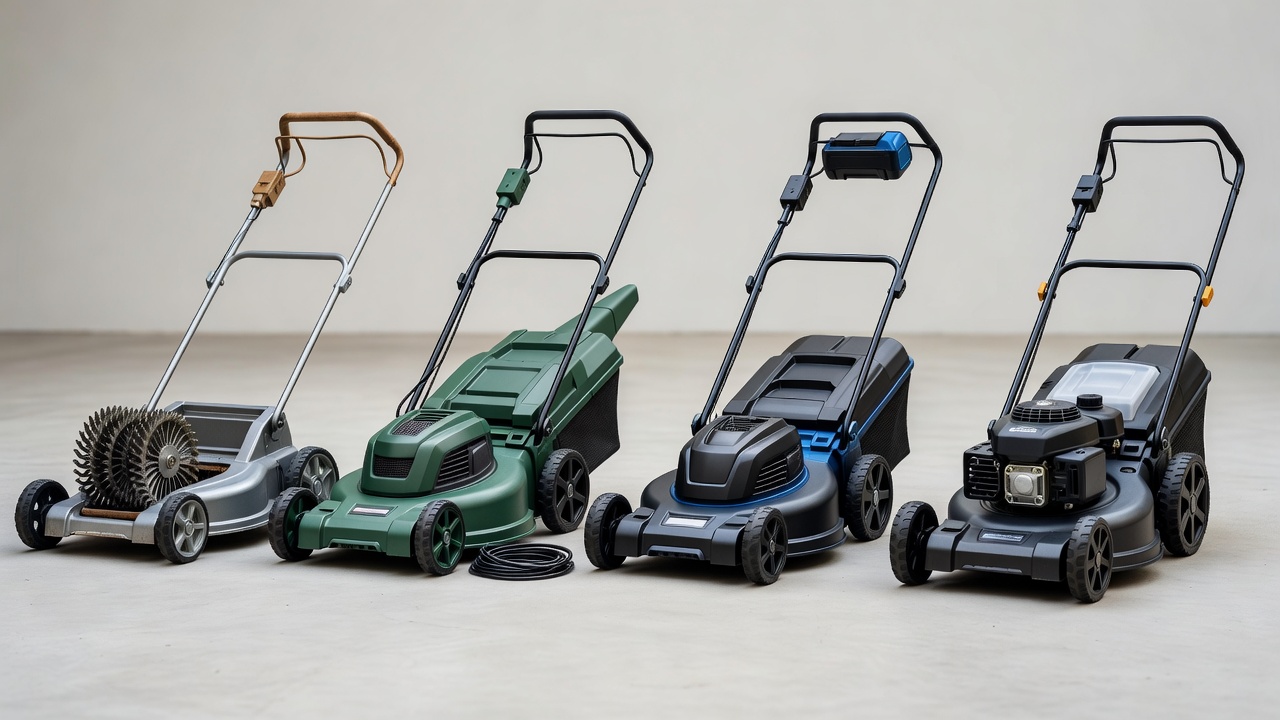
The term “push mower” covers a wide range of machines, from human-powered reel mowers to heavy gas-powered self-propelled units. What makes a mower “best” changes completely depending on whether you prioritize upfront cost, long-term operating expense, cutting power, noise level, environmental impact, or physical effort. A model that excels on a flat, quarter-acre lot with thin grass will struggle on a sloped half-acre with thick Bermuda or St. Augustine.
Main Categories of Push Mowers
- Manual push reel mowers: Human-powered, cylinder blades scissor-cut grass. Quiet, zero emissions, minimal maintenance, but only practical for small, flat, well-maintained lawns.
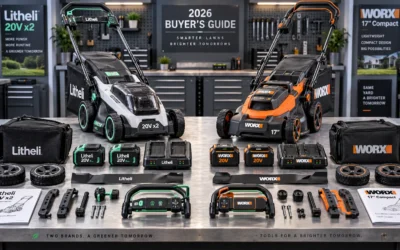
- Battery-powered (cordless) electric mowers: Run on rechargeable lithium-ion batteries. Quiet, no fuel or oil changes, instant start. Runtime limited by battery capacity; best for small to medium yards.
- Corded electric mowers: Plug into an outlet. Unlimited runtime but tethered by cord length. Best for very small yards near a power source.
- Gas-powered mowers: Internal combustion engines. Highest power and longest runtime. Heavier, louder, require fuel, oil changes, spark plug and air filter maintenance. Still the standard for large or demanding lawns.
How Yard Size and Grass Type Narrow Your Options
Start by measuring your lawn area. A quarter acre (about 10,890 square feet) is a common dividing line. Below that, battery and manual mowers become viable. Above it, gas gains a strong advantage. Grass species matters too. Cool-season grasses like fescue and bluegrass cut easily. Warm-season grasses like Bermuda, Zoysia, and St. Augustine are denser and tougher, demanding more torque and blade speed. If your lawn has thick thatch, weeds, or uneven terrain, you need more power and larger wheels regardless of total area. Before finalizing equipment decisions, refer to our comprehensive jbl partybox club 120 vs sony srs xv500 comparison.
Key Factors to Consider When Choosing a Push Mower
Lawn Size and Cutting Width
Cutting width determines how many passes you need. Common widths range from 14 inches on small electric models to 21 or 22 inches on full-size gas and battery units. For lawns under 5,000 square feet, a 16- to 18-inch deck keeps the mower light and maneuverable. For 5,000 to 10,000 square feet, a 20- to 21-inch deck reduces mowing time noticeably. Over 10,000 square feet, a 21- to 22-inch self-propelled deck becomes practical. Wider decks weigh more and turn less sharply around obstacles. Before finalizing equipment decisions, refer to our comprehensive jbl partybox club 120 vs sony srs xv500 comparison.
Power Source: Gas vs. Electric vs. Battery
| Factor | Gas | Battery (Cordless) | Corded Electric | Manual Reel |
|---|---|---|---|---|
| Power | Highest | Moderate to high | Moderate | Human only |
| Runtime | Unlimited (refuel) | 30-60 min per charge | Unlimited | Unlimited |
| Noise | Loud (85-95 dB) | Quiet (65-75 dB) | Moderate (70-80 dB) | Near silent |
| Maintenance | Regular (oil, plugs, filters, fuel) | Minimal (blade, battery care) | Minimal | Blade sharpening only |
| Weight | Heaviest (60-90+ lbs) | Moderate (40-65 lbs with battery) | Light (30-50 lbs) | Lightest (20-40 lbs) |
| Emissions | Exhaust | None at point of use | None at point of use | None |
| Best for | Large, thick, hilly lawns | Small to medium, flat to moderate | Very small, flat, near outlet | Small, flat, manicured lawns |
Self-Propelled vs. Manual Push
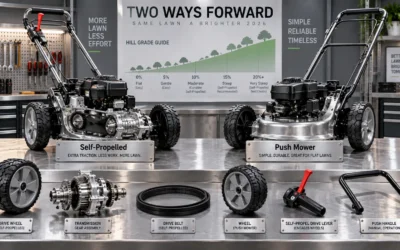
Self-propelled mowers drive their wheels, so you guide rather than push. This makes a major difference on slopes, thick grass, and larger areas. Front-wheel drive pulls well on flat ground but can lose traction on hills when the bag fills. Rear-wheel drive maintains traction on slopes and with a full bag. All-wheel drive offers the best traction but adds cost and weight. Manual push mowers (non-self-propelled) are lighter, simpler, and cheaper. They work fine on flat, small lawns with thin grass. If you have any hills, a large yard, or physical limitations, self-propelled is worth the extra cost.
Features That Affect Ease of Use and Maintenance
- Height adjustment: Single-lever systems adjust all four wheels at once; dual-lever or individual-wheel systems take longer.
- Deck material: Steel decks resist impact but can rust. Aluminum and composite decks resist corrosion and reduce weight.
- Bagging, mulching, side discharge: Three-in-one versatility lets you adapt to conditions. Mulching returns nutrients; bagging keeps clippings off walks and pools; side discharge handles tall, wet grass.
- Blade brake clutch (gas): Stops blade without killing engine, useful for crossing drives or emptying bag.
- Battery compatibility: If you own other tools on the same platform, sharing batteries reduces total cost.
- Fold-over handle: Enables vertical storage, saving garage space.
- Wheel size and bearings: Larger rear wheels (10-12 inches) with ball bearings roll easier over rough ground than small plastic wheels.
Step-by-Step Guide to Selecting Your Ideal Push Mower
1. Measure Your Lawn and Assess Terrain
Walk your property and estimate square footage. Use a measuring wheel, property survey, or online mapping tool. Note slopes, narrow passages, tree roots, flower beds, and surface irregularities. A flat, open rectangle is easy. A yard with steep banks, tight corners, and obstacles favors a lighter, more maneuverable mower with smaller deck and good wheel bearings. For broader ecosystem context, read through our operational guide on z890 vs x870e motherboard.
2. Identify Your Grass Type and Condition
Cool-season grasses (fescue, bluegrass, rye) cut cleanly with less power. Warm-season grasses (Bermuda, Zoysia, St. Augustine, centipede) are tougher and may need higher blade speed and torque. If your lawn is thick, weedy, or rarely mowed short, you need more power regardless of grass type. A battery mower rated for “up to 1/2 acre” may only handle 1/4 acre in thick St. Augustine.
3. Match Power Source to Yard Demands
- Under 5,000 sq ft, flat, cool-season grass: Manual reel, corded electric, or compact battery mower all work.
- 5,000-10,000 sq ft, flat to moderate slopes: Battery self-propelled (5.0 Ah or larger battery) or gas push/self-propelled.
- Over 10,000 sq ft, or any size with thick warm-season grass, slopes, or rough terrain: Gas self-propelled (rear-wheel or all-wheel drive) is the most reliable choice.
- Noise or emission restrictions, HOA rules, preference for low maintenance: Battery self-propelled with a second battery for extended runtime.
4. Set a Realistic Budget
Price ranges overlap, but general tiers exist. Manual reel mowers start around $100-$200. Corded electric models run $150-$300. Battery push mowers (non-self-propelled) typically cost $300-$500 for tool-only; kits with battery and charger add $150-$300. Battery self-propelled models range from $500-$900+ depending on battery size and features. Gas push mowers start near $300-$400; gas self-propelled models run $450-$800+. Premium features (electric start, blade brake clutch, aluminum deck, large batteries) push prices higher. Factor in long-term costs: gas, oil, filters, spark plugs, and potential repairs for gas; battery replacement (every 3-5 years) for cordless. For troubleshooting and reliability insights, consult our in-depth marshall stanmore iii vs harman kardon onyx studio 8 report.
5. Research Reliable Reviews and Comparisons
Look for reviews from independent testing organizations, established lawn care publications, and verified purchaser feedback on retailer sites. Pay attention to reviews from users with similar yard size, grass type, and terrain. Watch for patterns in complaints about starting, durability, bagging performance, or customer service. Manufacturer warranty terms (typically 2-5 years for residential use, sometimes longer on deck or battery) indicate confidence. Dealer support and parts availability matter for gas mowers you may keep 10+ years.
Direct Answer: Top Recommendations by Category
The following categories reflect common buyer priorities. No single model is best for everyone. Match the category to your situation. Readers comparing setup options can review our technical analysis on dyson v8 cyclone vs bissell featherweight stick.
Best Overall for the Average Homeowner
A battery-powered self-propelled mower with a 21-inch deck, rear-wheel drive, and a 5.0 Ah or larger battery hits the sweet spot for many suburban lawns under a quarter acre. It starts instantly, runs quietly, requires no fuel or oil, and handles typical cool-season grass with ease. Look for a model with single-lever height adjustment, three-in-one cutting modes, and a fold-over handle for vertical storage. If you already own tools on a compatible battery platform, buying tool-only saves significantly.
Best Budget-Friendly Option
For the lowest upfront cost on a small, flat lawn, a manual push reel mower (14-18 inch cutting width) costs roughly $100-$200 and has near-zero operating cost. If you prefer powered, a corded electric mower (14-16 inch) runs $150-$250 and eliminates battery replacement expense. A basic gas push mower (20-21 inch, non-self-propelled) starts around $300-$350 and handles larger areas than electric at this price, but adds maintenance. Avoid the cheapest battery kits; undersized batteries (2.0-2.5 Ah) often disappoint on anything but the smallest yards. For complementary field maintenance guidelines, examine our breakdown of bissell crosswave hydrosteam vs shark stainforce.
Best Battery-Powered for Quiet, Emission-Free Operation
Prioritize a self-propelled model with rear-wheel drive, a brushless motor, and at least a 5.0 Ah battery (7.5 Ah or 10 Ah is better for larger yards). A 21-inch deck with three-in-one capability covers most needs. Brushless motors run cooler and last longer. Check whether the battery fits other tools you own or plan to buy. Some platforms offer rapid chargers that restore a 5.0 Ah pack in 30-40 minutes, effectively extending runtime if you can pause mid-mow.
Best Gas Push Mower for Power and Performance
Choose a self-propelled model with a 21-22 inch steel or aluminum deck, rear-wheel or all-wheel drive, and a reputable engine (typically 140cc-190cc). Features worth having: blade brake clutch (stop blade without stopping engine), single-lever height adjustment, large rear wheels with ball bearings, and a washout port for deck cleaning. Electric start (battery-assisted) removes the pull-cord hassle. For thick warm-season grass or hilly terrain, all-wheel drive provides the surest traction, especially when the bag is full.
Best Manual Push Mower for Small, Flat Lawns
A quality reel mower with 16-18 inch cutting width, 5-7 heat-treated blades, and adjustable cutting height (0.5-2.5 inches) delivers a clean scissor cut that promotes healthier grass than rotary blades. Look for sealed ball bearings in the reel and wheels, a sturdy steel or composite frame, and a comfortable handle grip. These mowers only work well on flat, debris-free lawns mowed frequently (never removing more than one-third of blade height). They cannot handle tall, wet, or weedy grass, twigs, or uneven ground.
Final Considerations Before You Buy
Storage and Transport
Measure your storage space. Gas mowers are heaviest and widest; some won’t fit through a standard 32-inch gate. Battery and electric mowers with fold-over handles store vertically against a wall, needing only 18-24 inches of floor depth. If you must lift the mower into a truck or up stairs, weight matters. Manual reel and corded electric are lightest. Battery self-propelled models weigh 50-70 lbs with battery; gas self-propelled can exceed 85 lbs.
Local Regulations and Community Rules
Some municipalities restrict gas-powered equipment during certain hours or seasons. HOAs may have noise or emissions rules. Battery and manual mowers avoid these issues entirely. Check local ordinances before investing in gas.
Long-Term Ownership
Gas mowers can last 10-15 years with maintenance. Engines are serviceable; parts are widely available. Battery mowers depend on battery chemistry and platform longevity. Lithium-ion packs typically last 3-5 years or 300-500 charge cycles. Replacement batteries cost $100-$300. Choose a brand with a stable product line and good parts support. Manual reel mowers can last decades with blade sharpening every 1-2 seasons.
Safety Reminders
- Read the operator’s manual before first use.
- Wear closed-toe shoes, eye protection, and hearing protection (especially with gas).
- Clear the lawn of stones, toys, and debris before mowing.
- Never bypass safety controls (blade brake, dead-man handle, discharge chute guard).
- Mow across slopes with walk-behind mowers, never up and down.
- Keep children and pets indoors while mowing.
- Allow engine to cool before refueling gas mowers.
- Store batteries per manufacturer guidelines (temperature, charge level).
Frequently Asked Questions About Best Push Lawn Mower
Can a battery mower handle a half-acre lot?
Only with multiple high-capacity batteries (7.5 Ah or larger) and ideal conditions: flat, cool-season grass, mowed frequently. In real-world conditions with thick grass or slopes, most battery mowers cover 1/4 to 1/3 acre per charge. For a consistent half-acre, gas remains more practical.
Is self-propelled worth the extra cost?
Yes, if you have any slopes, a yard over 5,000 square feet, thick grass, or physical limitations. The reduced fatigue and more consistent cut quality justify the $100-$200 premium for most users in those situations. On a flat, small lawn with thin grass, manual push is fine.
How often should I sharpen the blade?
Rotary mower blades (gas, battery, corded) should be sharpened at least once per season, more often if you hit sand, grit, or debris. A dull blade tears grass, causing brown tips and disease susceptibility. Reel mower blades need professional sharpening or a quality sharpening kit every 1-2 seasons depending on use.
What cutting height should I use?
Follow the one-third rule: never remove more than one-third of the grass blade in a single mowing. Cool-season grasses generally thrive at 2.5-3.5 inches. Warm-season grasses vary: Bermuda 1-2 inches, Zoysia 1-2.5 inches, St. Augustine 2.5-4 inches. Higher settings shade soil, reduce weeds, and promote deeper roots.
Should I bag, mulch, or side discharge?
Mulching returns nitrogen and organic matter, reducing fertilizer needs. It works best when mowing frequently and grass is dry. Bagging is useful for leaf cleanup, disease management, or when grass is too long to mulch cleanly. Side discharge handles tall, wet, or thick grass without clogging but leaves windrows. Three-in-one flexibility lets you choose per conditions.
How do I winterize my mower?
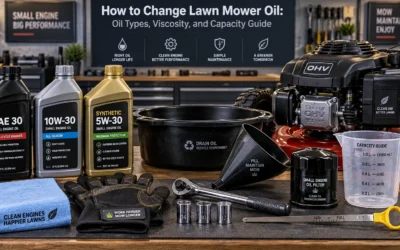
Gas: Add fuel stabilizer to fresh fuel, run engine to distribute, then drain or run dry. Change oil. Clean deck. Remove spark plug, add a teaspoon of oil, pull starter slowly, reinstall plug. Store in dry place. Battery: Charge to 40-60%, remove from mower, store indoors at 40-70°F. Clean deck. Manual: Clean, dry, sharpen blades, oil moving parts, store dry.
For more detailed testing breakdowns and top recommendations, check our in-depth guide to residential zero-turn lawn mower guide.
For more hands-on benchmarks and buying recommendations, consult our guides on heavy-duty chainsaw buyer guide, as well as high-CFM commercial leaf blower guide, as well as durable ride-on lawn tractor guide, as well as automated robotic lawn mower guide.
Mechanical safety standards, operational tolerances, and protective gear guidelines align with benchmark specifications established by the American National Standards Institute (ANSI).

Pros
- Commercial-grade electric performance with instant torque and no gas engine maintenance.
- Large included battery package and fast charger improve runtime and turnaround time.
- Heavy-duty 54-inch fabricated deck is built for durability and wider coverage per pass.
- Comfort-focused operator features are better than many basic riding mowers in this class.
- Backed by a 4-year limited warranty for added purchase confidence.
Cons
- At 848.78 pounds, it is very heavy and will be difficult to move manually or transport without proper equipment.
- The large footprint, with dimensions of 76.77 x 73.23 x 56.3 inches, requires substantial storage space.
- The premium feature set and battery system may be more than many small-yard owners need.
Overview & Design: The Greenworks 80V 54" MaximusZ Zero Turn Riding Lawn Mower is a commercial-style electric mower built for large residential properties. Its 54-inch 10-gauge fabricated steel deck, zero-turn layout, and premium operator seat give it a serious, heavy-duty feel right away.
Performance & Key Features: This model is positioned as a 41HP gas-equivalent machine with instant torque, a constant 17,900 FPM blade speed, and SmartCut technology that adapts to changing grass conditions. The included battery kit with (2) 16.0Ah and (4) 6.0Ah batteries is designed to support up to 4+ acres per charge, while the 1.5kW fast charger helps reduce downtime.
Drawbacks & Considerations: The mower is extremely heavy at 848.78 pounds, so it is not easy to move or store in tight spaces. It is also a major investment and may be excessive for smaller yards or users who do not need the runtime and power of a large battery-electric zero-turn.
Verdict: This is a strong fit for homeowners with large lawns who want powerful, low-maintenance mowing performance and premium comfort features. Buyers who need a wide cutting deck, long runtime, and electric operation will likely get the most value from it.

Pros
- Brushless motor system delivers gas-equivalent power without emissions or excessive noise
- High-capacity battery kit enables cutting coverage of up to 4.4 acres per charge set
- Durable 10-gauge steel deck and constant high blade tip speed handle dense grass effectively
- Premium seating and lighting features support comfortable extended operation
- 4-year warranty provides strong protection for the investment
Cons
- Runtime tops out around 4.4 acres depending on conditions, requiring recharges for bigger properties
- Electric design depends on charging infrastructure and battery management rather than simple refueling
- Height adjustment is noted only basically without extensive position details in available specs
The Greenworks 60V MaximusZ Zero Turn Riding Lawn Mower is a commercial-grade electric machine built for large lawns. Its primary construction centers on a heavy-duty 60-inch 10-gauge fabricated steel deck that prioritizes durability and airflow, paired with premium comfort elements including an adjustable suspension seat with lumbar support and foldable armrests for a solid first impression of quality and user focus.
Performance shines through an intelligent brushless motor system offering power equivalent to a 31HP gas engine with zero emissions. Three high-torque brushless hub motors sustain a constant 17,900 FPM blade speed, while SmartCut Technology auto-adapts to prevent bogging in thick or wet grass. The complete kit supplies (2) 20.0Ah suitcase batteries plus (4) 8.0Ah batteries and a 1.5kW fast charger for up to 4.4 acres of cutting. Additional capabilities include a 4-in-1 deck for mulching, bagging, rear and side discharge, 300 lb towing capacity with front/rear hitch, dual LED headlights, and an LCD display.
Drawbacks and considerations include the practical need to recharge the battery set after maximum runtime, which can interrupt work on properties exceeding 4.4 acres. Being fully electric means reliance on power sources for recharging instead of fuel, and height adjustment is referenced only in basic terms without more granular position data in the specifications.
In verdict, the Greenworks 60V MaximusZ delivers the most value to homeowners and professionals managing medium-to-large properties who want quiet, emission-free commercial power, versatile cutting options, and the security of a 4-year warranty in a comfortable zero-turn package.

Pros
- Strong stated cutting capacity for large properties, with up to 4 acres per charge.
- Zero-turn design supports fast, precise mowing around obstacles.
- Uses battery power instead of gas, reducing maintenance-related chores and emissions.
- Includes six high-capacity batteries and a charger, so it is ready for use out of the box.
Cons
- Heavy at 720 pounds, which may make transport, storage, or maneuvering by hand difficult.
- Large dimensions require substantial garage or shed space.
- The high upfront cost may put it out of reach for buyers with smaller lawns or limited budgets.
Overview & Design: The EGO Power+ ZT5207L is a 52-inch electric riding lawn mower with a zero-turn radius, built for users who need efficient coverage on larger properties. Its black finish, substantial frame, and 720-pound weight reflect a serious, full-size riding mower designed for demanding residential mowing.
Performance & Key Features: EGO says Peak Power+ technology combines up to six 56V ARC Lithium batteries, and the mower is rated at a 25 HP-equivalent output. The 52-inch deck and zero-turn steering should help reduce mowing time and improve control around landscaping, while the included six 56V 12.0Ah batteries are stated to support up to 4 acres per charge.
Drawbacks & Considerations: This model is large and heavy, so it will not suit every storage space or every user. Its premium positioning also means buyers should be confident they need this much capacity, since smaller yards may not justify the size, weight, or cost.
Verdict: The ZT5207L is best for homeowners with expansive lawns who want battery-powered convenience and zero-turn efficiency in one machine. It is a compelling option if you value gas-like performance, broad deck coverage, and compatibility with EGO's 56V battery ecosystem.

Pros
- Offers quiet, emission-free electric operation with power matching traditional 22 HP gas mowers.
- Includes four high-capacity 56V 10.0Ah batteries for up to 2 acres of runtime right out of the box.
- Customizable LCD interface and multiple driving modes enhance user control and ride comfort.
- Versatile 10-position cutting height and 3-in-1 deck options provide flexible lawn finishing.
- Fast two-hour full recharge capability supports productive multi-session mowing days.
Cons
- Maximum single-charge coverage is limited to about 2 acres without purchasing additional batteries for bigger properties.
- Requires access to a power outlet for recharging, which may interrupt workflow on very large or remote lawns.
- Battery management and storage add extra steps compared to simple gas-powered alternatives.
The EGO Power+ ZT4204L is a premium electric zero-turn riding lawn mower built for homeowners seeking a clean alternative to gas models. It features a robust 42-inch stamped steel deck and includes four 56V 10.0Ah ARC Lithium batteries plus a charger, delivering an immediate impression of high-quality engineering focused on power and convenience.
In real-world use, this mower matches the performance of a 22 horsepower gas unit while reaching speeds up to 8 MPH. The zero-turn radius combined with three selectable driving modes via the LCD interface allows smooth navigation and efficient cutting of up to 2 acres per charge. Users can fine-tune the cut across 10 height positions from 1.5 to 4.5 inches and choose between mulching, bagging, or side discharge for complete lawn care flexibility. Full recharges take roughly two hours with the included Z6 charger.
Potential drawbacks include the 2-acre limit on the stock battery set, meaning larger properties will need extra batteries for uninterrupted operation. As a fully electric system, it also depends on regular charging access rather than quick refueling, and battery handling requires more attention than traditional gas mowers.
Overall, the EGO Power+ ZT4204L is an excellent choice for environmentally conscious homeowners with lawns up to a few acres who value quiet operation, low maintenance, and precise control. Those with extensive grounds should plan for additional battery capacity to maximize its benefits.