How Many Calories Do You Burn Mowing the Lawn?
Most adults burn 250–400 calories per hour pushing a manual lawn mower, 150–250 calories per hour on a riding mower, and 300–500 calories per hour using a self-propelled mower. A 155-pound person typically burns around 280 calories per hour with moderate-effort push mowing; a 185-pound person burns approximately 335 calories in the same timeframe. The exact number depends on your body weight, mowing intensity, terrain, grass height, and the type of mower you use.
Factors That Affect Calorie Burn While Mowing
Calorie expenditure during lawn mowing is not one-size-fits-all. Several variables determine how much energy your body uses:
Body Weight
Heavier individuals burn more calories during the same activity because their bodies require more energy to move and maintain physical effort. A person weighing 200 pounds will burn significantly more calories mowing than someone weighing 140 pounds, even at identical intensity levels. This relationship is proportional: roughly 10% heavier means roughly 10% more calories burned.
Mower Type
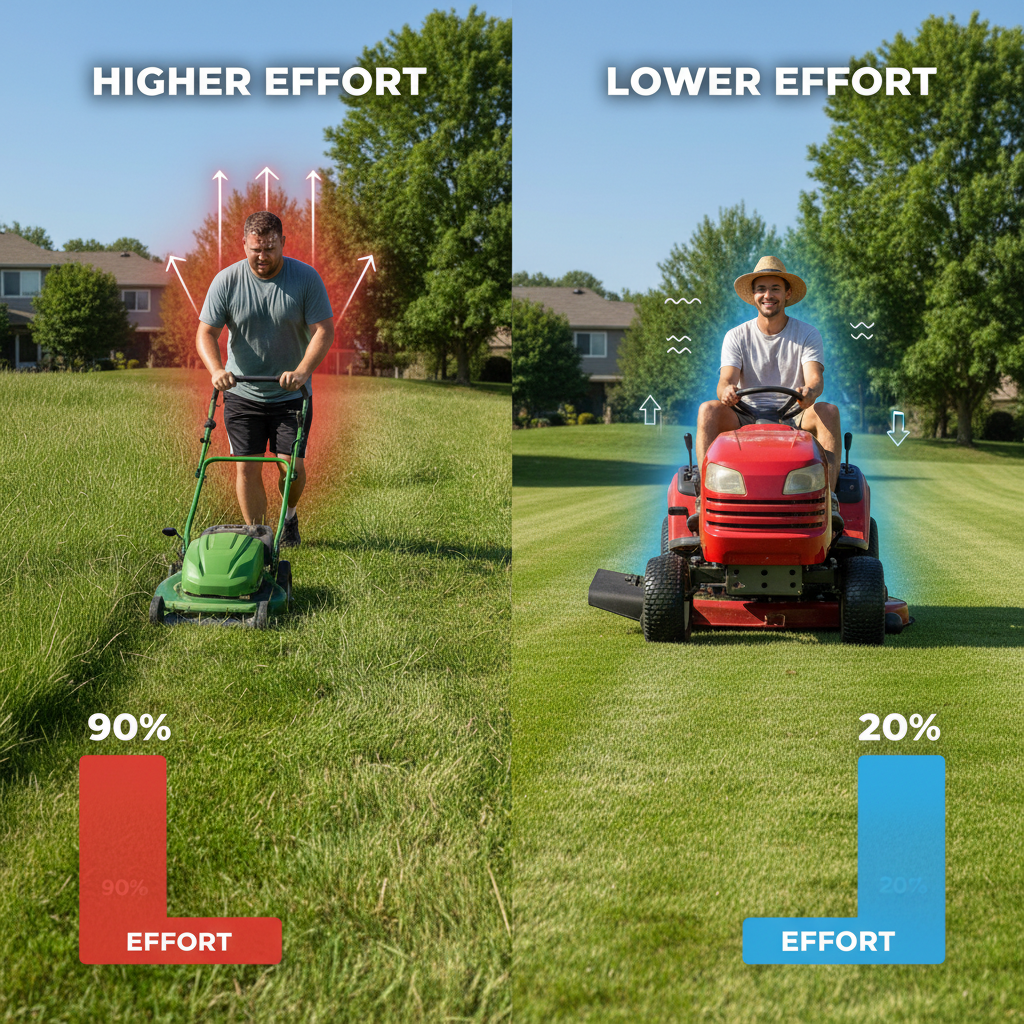
The equipment you choose dramatically changes physical demand. Push mowers require you to propel the mower forward using your own muscle power, engaging your arms, shoulders, core, and legs. Riding mowers shift most physical work to steering and minor adjustments, reducing calorie expenditure by 40–60%. Self-propelled mowers reduce effort compared to manual push mowers but still require active engagement. Electric and gas mowers of the same type burn similar calories, though the type of mower matters far more than its fuel source.
Terrain and Grass Conditions
Uneven terrain, thick or overgrown grass, and steep slopes all increase calorie burn. Mowing an uphill section engages larger muscle groups and requires greater force. Wet grass and thick lawn conditions create more resistance, demanding more physical effort. Conversely, flat, well-maintained lawns with short, dry grass require less energy.
Mowing Pace and Intensity
How quickly you mow and how hard you push affects energy expenditure. Aggressive, rapid mowing burns more calories than leisurely, slow mowing. Maintaining a steady, moderate pace for the entire session increases total burn compared to stop-and-go patterns.
Calorie Burn by Mower Type
The type of mower you select is the single largest factor determining caloric expenditure:
Push Mower (Manual)
Push mowers require you to propel and control the equipment, making them the most physically demanding option. Most adults burn 250–400 calories per hour using a manual push mower at moderate intensity. This qualifies as moderate-to-vigorous exercise comparable to brisk walking or light jogging. On hilly terrain or with thick grass, burn rates can exceed 400 calories per hour.
Self-Propelled Mower
Self-propelled mowers reduce the effort required to move the machine forward but still demand active control and engagement. Most adults burn 300–500 calories per hour because the mower assists with forward motion, allowing you to maintain a faster, more consistent pace. Some self-propelled models require minimal physical effort beyond steering, while others demand active participation in speed control and direction.
Riding Mower
Riding mowers are the least physically demanding option. You sit and steer while the machine does the work, resulting in 150–250 calories per hour burned. This is comparable to casual walking and is classified as light physical activity. The primary caloric expenditure comes from maintaining posture, steering, and occasional dismounting to adjust settings.
Electric vs. Gas Mowers
The fuel source (electric or gas) does not significantly affect calorie burn. A gas-powered push mower and an electric push mower of similar weight and design will result in virtually identical energy expenditure. The mower type and your body weight matter far more than whether it runs on electricity or fuel.
Calorie Burn by Body Weight
Your body weight is a key determinant of calorie burn. The following ranges represent approximate calories burned per hour at moderate intensity:
| Body Weight | Push Mower (calories/hour) | Self-Propelled Mower (calories/hour) | Riding Mower (calories/hour) |
|---|---|---|---|
| 130 lbs | 235–280 | 280–350 | 130–180 |
| 155 lbs | 280–335 | 335–420 | 155–215 |
| 185 lbs | 335–400 | 400–500 | 185–255 |
| 200+ lbs | 365–440 | 435–545 | 200–275 |
These estimates assume moderate effort on relatively flat terrain with typical grass conditions. Intensity variations and terrain will shift these numbers up or down.
Typical Mowing Duration and Total Energy Expenditure
Understanding how long a typical mowing session lasts helps contextualize total calorie burn:
Session Duration
Most residential lawn mowing sessions last 30–60 minutes, depending on yard size. A typical quarter-acre lot takes 30–40 minutes to mow with a push or self-propelled mower. Larger properties or riding mower use may extend to 60 minutes or longer.
Total Calorie Burn by Session
For a 155-pound person:
- 30-minute push mowing session: 140–168 calories
- 45-minute push mowing session: 210–252 calories
- 60-minute push mowing session: 280–335 calories
- 30-minute self-propelled session: 168–210 calories
- 60-minute self-propelled session: 335–420 calories
- 60-minute riding mower session: 155–215 calories
For a heavier person (200+ pounds), these values increase by approximately 30–40%.
How Lawn Mowing Compares to Other Physical Activities
Placing lawn mowing in context with other common activities helps assess its fitness value:
- Push mowing (moderate intensity): Equivalent to brisk walking (3.5 mph), recreational cycling, or light jogging. Burns 250–400 calories per hour for most adults.
- Self-propelled mowing: Similar to moderate-intensity aerobic exercise or faster cycling. Burns 300–500 calories per hour.
- Riding mowing: Comparable to casual walking or light housework. Burns 150–250 calories per hour.
- High-intensity push mowing (steep terrain, thick grass): Approaches vigorous-intensity exercise like running or intense cycling. Can exceed 400–500 calories per hour.
The American Heart Association classifies moderate-intensity activity as burning 3.5–7 metabolic equivalents (METs). Push mowing typically falls into this range, qualifying as legitimate cardiovascular exercise when performed consistently.
Tips to Maximize Calorie Burn While Mowing
If you want lawn mowing to serve as meaningful physical activity, consider these strategies:
Choose a Push Mower
Manual push mowers demand significantly more energy than riding or self-propelled models. If your lawn size and physical ability allow, a push mower maximizes caloric expenditure.
Increase Pace and Consistency
Maintain a steady, brisk mowing pace rather than stopping frequently or moving slowly. Faster movement increases heart rate and calorie burn without significantly extending session duration.
Mow on Varied Terrain
Whenever possible, mow in hilly or uneven areas. Slopes and terrain variations force your body to recruit more muscle groups and burn additional calories.
Avoid Letting Grass Become Overgrown
Paradoxically, regular mowing is easier physically than mowing overgrown grass. However, allowing grass to grow slightly thicker (within reasonable limits) increases resistance and calorie burn compared to very short, sparse grass.
Maintain Proper Posture
Engaging your core and maintaining upright posture while pushing engages more muscle groups and increases overall energy expenditure compared to slouching or leaning heavily on the mower.
Is Lawn Mowing Good Exercise?
Lawn mowing can contribute meaningfully to physical activity recommendations, particularly when using a manual push mower. The American Heart Association recommends 150 minutes of moderate-intensity aerobic activity weekly. A 60-minute push mowing session at moderate intensity covers a significant portion of this weekly goal. However, riding mower use provides minimal cardiovascular benefit and should not be counted as structured exercise.
Push mowing offers the added advantage of being practical, purposeful exercise—you maintain your property while improving fitness, rather than exercising purely for fitness’s sake.
Frequently Asked Questions
How many calories do you burn mowing for 30 minutes?
For a 155-pound person pushing a manual mower at moderate intensity, expect to burn approximately 140–168 calories in 30 minutes. A heavier person (200+ pounds) would burn 180–220 calories. On a riding mower, the same person burns only 75–110 calories in 30 minutes.
Does mowing the lawn count as exercise?
Push mowing qualifies as moderate-intensity exercise and contributes to cardiovascular activity guidelines. Riding mower use is too low-intensity to count as structured exercise. Self-propelled mowing falls between these extremes, providing some cardiovascular benefit.
Why do you burn more calories on a push mower than a riding mower?
Push mowers require your muscles to propel and control the equipment, engaging your arms, shoulders, core, and legs throughout the session. Riding mowers do most of the work mechanically, leaving you to primarily steer and maintain posture. This difference in physical demand accounts for the 40–60% reduction in calorie burn.
Does mower weight affect how many calories you burn?
Heavier mowers require slightly more force to push, increasing calorie burn marginally compared to lighter mowers of the same type. However, the difference is modest—usually 10–20 additional calories per hour. Mower type and your body weight are far more significant factors than mower weight itself.