
Why Electric Lawn Mowers Don’t Need Engine Oil
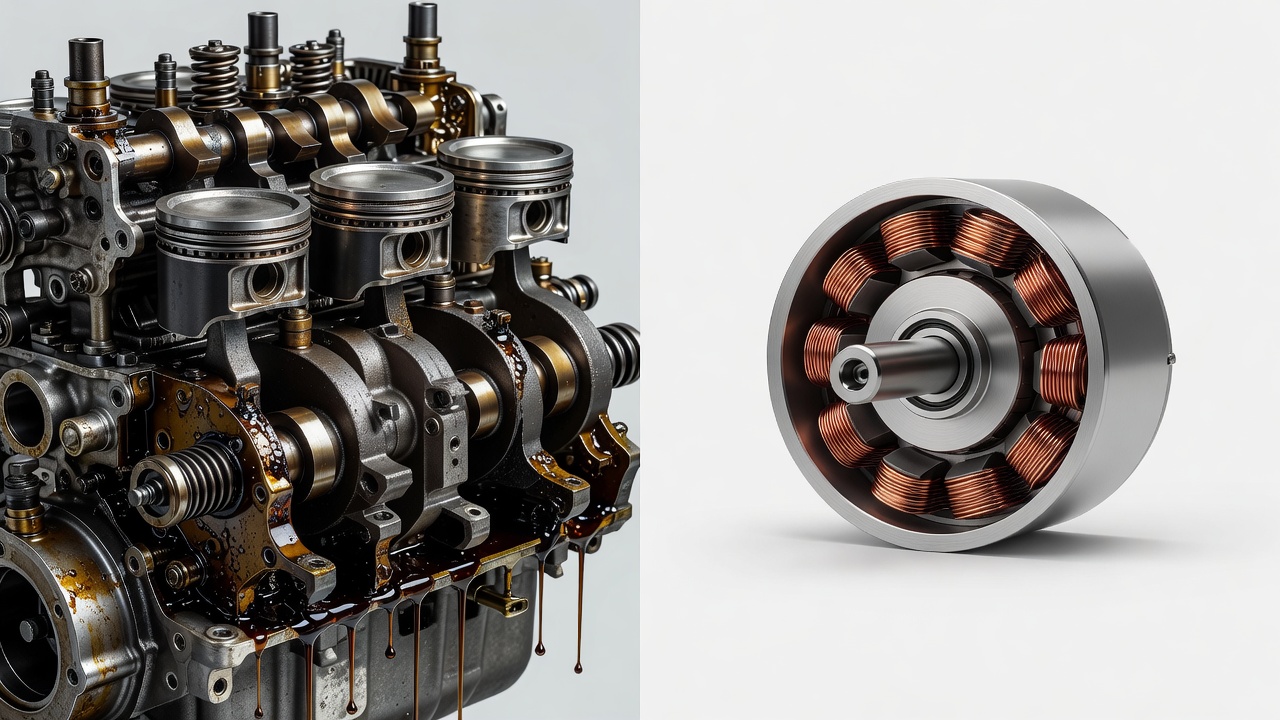
An electric motor works on a completely different principle than a gas engine, which eliminates the need for engine oil entirely. A gasoline engine relies on internal combustion — fuel ignites inside cylinders, creating pressure that moves pistons. Those metal parts generate extreme heat and friction, so engine oil circulates continuously to cool, lubricate, and protect them from wear and sludge buildup.
An electric motor, by contrast, uses electromagnetic force to spin a shaft. There are no explosions, no pistons, no cylinders, and far less internal friction. The motor runs cooler and cleaner, requiring no oil circulation. Whether your electric mower is corded (plugged into an outlet) or cordless (battery-powered), the motor mechanism is the same — and neither needs oil.
This fundamental difference is why electric mower owners skip one of the most routine gas mower chores: draining old oil, replacing the oil filter, and refilling with fresh oil every 50 operating hours or annually. For many homeowners, that’s a significant maintenance and cost reduction. Readers comparing setup options can review our technical analysis on jbl partybox club 120 vs sony srs xv500.
The One Exception: Self-Propelled Gearboxes and Blade-Spindle Lubrication
While the motor itself needs no oil, some electric mowers have separate systems that do require occasional lubrication: Readers comparing setup options can review our technical analysis on jbl partybox club 120 vs sony srs xv500.
Wheel-Drive Gearboxes on Self-Propelled Models
Self-propelled electric mowers use a gearbox to transfer power from the motor to the wheels, allowing the mower to move forward on its own. This gearbox contains meshing metal gears that do experience friction and wear. Depending on the manufacturer and model, the gearbox may require periodic gear oil or grease application — typically every 25–50 operating hours, or annually for residential use. For complementary field maintenance guidelines, examine our breakdown of z890 vs x870e motherboard.
Check your owner’s manual for lubrication points and the recommended product. Most manufacturers specify a lightweight gear oil or a waterproof lithium-based grease. This is a far simpler task than changing engine oil — you’re applying a small amount of lubricant to a specific port or joint, not draining and replacing several quarts of fluid.
Blade-Spindle Grease Points
Some electric mower models have a grease point where the blade spindle (the shaft that holds the cutting blade) connects to the deck. A small dab of grease at this point, applied once or twice per season, keeps the spindle rotating smoothly and reduces rust risk. Again, this is a minimal maintenance task — a tube of general-purpose grease and 30 seconds of work. For complementary field maintenance guidelines, examine our breakdown of z890 vs x870e motherboard.
The key: consult your specific mower’s manual. Not all electric mowers have these lubrication points. Many modern models are sealed and require no grease application at all.
Full Maintenance Checklist for Electric Lawn Mowers
No engine oil doesn’t mean no maintenance. Here’s what electric mower owners actually need to do: To evaluate matched hardware tolerances, consult our detailed overview of marshall stanmore iii vs harman kardon onyx studio 8.
- Blade sharpening: Every 20–30 hours of use, or at least once per season. A dull blade tears grass instead of cutting it cleanly, causing brown tips and disease risk. Sharpen at a 30–45-degree angle or replace the blade if damaged.
- Battery care (cordless models): Store the battery at 40–60% charge if not using the mower for extended periods. Fully charged or fully depleted batteries degrade faster. Keep the battery dry and out of extreme heat or cold. Lithium-ion batteries typically last 3–5 years with proper care.
- Mower deck cleaning: After each use, let the mower cool, then use a brush or compressed air to clear grass clippings and debris from the deck. Buildup can trap moisture, promote rust, and reduce cutting efficiency. Never use a hose on an electric mower — water can damage the motor and battery.
- Charger maintenance (cordless models): Keep the charger and battery contacts clean and dry. Wipe the metal terminals with a dry cloth if they look corroded or covered in debris.
- Cord inspection (corded models): Before each use, inspect the power cord for cuts, cracks, or exposed wires. Never run the cord under the mower or over sharp objects. Hang the cord neatly after use to prevent damage.
- Winter storage: For cordless mowers, charge the battery to 40–60% before storing. For corded models, disconnect the cord and store in a dry location. Clean the deck and blade thoroughly before long-term storage to prevent rust.
Electric vs. Gas Lawn Mower Maintenance: Side-by-Side Comparison
| Maintenance Task | Gas Mower | Electric Mower |
|---|---|---|
| Engine oil changes | Every 50 hours or annually; $20–$50 per change | Not needed |
| Spark plug replacement | Annually or every 2 years; $10–$30 | Not needed |
| Air filter replacement | Every 1–2 seasons; $15–$40 | Not needed |
| Fuel filter replacement | Annually; $10–$25 | Not needed |
| Carburetor cleaning | Every 1–2 years; $50–$150 in labor | Not needed |
| Blade sharpening | 2–3 times per season; $0–$20 if DIY, $30–$50 professional | 2–3 times per season; $0–$20 if DIY, $30–$50 professional |
| Gearbox lubrication | Rarely; depends on drive system | Occasionally on self-propelled models; grease or gear oil |
| Deck cleaning | Routine maintenance after each use | Routine maintenance after each use |
| Battery/charger maintenance | N/A | Annual inspection; battery replacement every 3–5 years ($100–$300) |
| Annual maintenance cost | $150–$350 (including parts, labor, or DIY supplies) | $20–$80 (grease, blade, miscellaneous; battery replacement amortized over 3–5 years) |
The numbers tell the story: electric mowers eliminate the bulk of seasonal maintenance that gas mowers demand. Over a decade of ownership, the time and cost savings are substantial — especially if you factor in no spark plugs, no fuel system cleanings, and no spring startups troubleshooting.
Common Maintenance Mistakes Electric Mower Owners Make
- Checking for oil that doesn’t exist: If you’re new to electric mowers and inherited a gas-mower habit, resist the urge to pop the hood looking for an oil dipstick. It’s not there, and poking around can damage the motor housing.
- Neglecting blade sharpening: Some owners assume an electric mower needs less blade maintenance because it’s electric. Wrong. A dull blade is a dull blade, and it will shred your grass and slow the motor. Sharpen on the same schedule as a gas mower.
- Using water to clean the deck: Never spray down an electric mower with a hose. Water can seep into the motor, battery (on cordless models), or electrical connections and cause shorts or corrosion. Use a brush or compressed air instead.
- Storing a fully charged or fully dead battery: Lithium-ion batteries last longest when stored at a partial charge state — around 40–60%. Leaving a battery fully charged or completely drained for months degrades its lifespan. Check your manual for the recommended storage charge level.
- Ignoring the owner’s manual lubrication points: If your manual lists gearbox or blade-spindle grease points, don’t skip them. These minor lubrication tasks prevent premature wear and are quick to complete. Conversely, don’t invent lubrication tasks that aren’t in the manual — manufacturers design sealed systems for a reason.
Common Questions on Do Electric Lawn Mowers Need Oil Answered
Do I ever need to add oil to an electric lawn mower?
No engine oil, ever. However, if your manual specifies a gearbox lubrication point on a self-propelled model, you may apply a small amount of gear oil or grease once or twice per season. This is not the same as engine oil — it’s a targeted spot application, not a fluid system fill. When planning workspace deployment, consider the engineering criteria outlined in our dyson v8 cyclone vs bissell featherweight stick guide.
What happens if I never sharpen the blade on my electric mower?
A dull blade tears grass fibers instead of cutting them cleanly. This causes brown or ragged leaf tips, increases disease susceptibility, and stresses the motor by forcing it to work harder. Mow through a few seasons with a dull blade and you risk motor burnout and a sickly lawn. Sharpen every 20–30 hours of use, or at least once per season.
Can I store my electric mower with a fully charged battery?
It’s not ideal. Lithium-ion batteries degrade faster when stored at full charge. Most manufacturers recommend storing cordless mowers with the battery at 40–60% charge. If you’re storing for months, unplug the charger after reaching the recommended charge level and keep the battery in a cool, dry location. For additional operational safety benchmarks, see our published testing notes on bissell crosswave hydrosteam vs shark stainforce.
Are there any fluids I need to check on an electric mower?
No fluids to check in the traditional sense. On cordless models, monitor battery health (charge time, runtime, any swelling or damage). On corded models, inspect the power cord for damage. Self-propelled models may have a gear-oil or grease level to verify before the season if specified in the manual, but this is rare and depends entirely on the manufacturer design.

Pros
- Large-size design named in product title
- Sharpening and balancing functions listed
- Listed as a new upgraded version

Pros
- Adjustable 15-to-45-degree range in title
- Sharpening and balancing functions listed

Pros
- Sharpener and balancer functions in title
- 15-to-45-degree adjustable setting listed
- Built for lawn mower blade maintenance
Pros
- Includes replacement gaskets and a 98079-55846 spark plug
- Matches Honda HRR216 and HRS216 lawn mower models
- Designed around the 16100-Z8B-901 carburetor specification
Cons
- Restricted to select Honda GCV160 mower applications
- Installation requires basic mechanical tools and skills
For more hands-on benchmarks and buying recommendations, consult our guides on heavy-duty chainsaw buyer guide, as well as high-CFM commercial leaf blower guide, as well as automated robotic lawn mower guide.
Mechanical safety standards, operational tolerances, and protective gear guidelines align with benchmark specifications established by the American National Standards Institute (ANSI).