
How a Lawn Mower Works: The Direct Answer
A lawn mower operates by using a small internal combustion engine to power a rapidly spinning blade or series of blades that cut grass. Fuel ignites in the engine’s cylinder, creating controlled explosions that drive a piston connected to a crankshaft. This rotational energy transfers through a transmission or drive belt to spin the cutting blade at high speed (typically 3,000–4,000 RPM for rotary mowers), while the mower’s wheels move the cutting deck over the lawn. The spinning blade creates a slicing action that severs grass stems, and the deck design directs clipped grass toward a chute for collection or discharge.

Pros
- Powerful 80V brushless motor delivers 32HP gas-equivalent performance with quiet fume-free operation and no engine maintenance.
- Complete kit includes four 6.0Ah batteries and 600W charger for substantial runtime up to 1.5 acres.
- SmartCut technology and 42-inch heavy-duty steel deck ensure consistent cuts without bogging in tough conditions.
- Versatile towing up to 350 lbs and optional cargo hauling plus comfort features like high-back seat and LED lights.
- Strong 4-year limited warranty and full compatibility with the Greenworks 80V tool ecosystem.
Cons
- Rear utility cargo bed for 200 lb hauling is sold separately and not included in the kit.
- Runtime of up to 1.5 acres varies with conditions and may require recharging or battery swaps on larger properties.
- As a fully cordless model continuous operation depends on battery levels unlike gas engines with unlimited runtime.
The Greenworks 80V 42" CrossoverT Cordless Riding Lawn Tractor is a ready-to-mow zero-emission tractor designed for homeowners managing medium to large lawns. It features a reinforced 42-inch stamped steel deck of 12-gauge construction along with premium comfort elements such as a high-back padded seat with foldable armrests. The overall build emphasizes durability and user convenience right out of the box with the included battery and charger set.
Performance centers on the 80V TruBrushless motor that provides 32HP gas-equivalent power with instant torque and quiet fume-free operation. SmartCut technology senses grass conditions and automatically adjusts power to maintain a consistent cut even in tall thick or wet areas. The four 6.0Ah batteries support runtime for up to 1.5 acres depending on conditions while dual LED headlights and a 7-position deck height range from 1.5" to 4.5" add practicality. Front and rear attachments further allow towing up to 350 lbs for added yard utility.
Key considerations include that the rear utility storage bin capable of hauling 200 lbs is sold separately so full cargo functionality requires an extra purchase. Runtime remains condition-dependent and may fall short for properties significantly larger than 1.5 acres without using the 600W charger or swapping batteries. The cordless design prioritizes ease and low maintenance but trades off the continuous runtime of traditional gas models.
This tractor delivers strong value for eco-conscious owners of residential properties who want gas-like power without the emissions noise or upkeep. It suits those who already use or plan to expand into the Greenworks 80V family of tools and who appreciate the 4-year limited warranty. Users with exceptionally large or commercial-scale lawns should evaluate battery logistics carefully before purchase.

Pros
- Delivers strong 21 horsepower equivalent power comparable to gas riding mowers.
- Provides up to 1.5 acres of runtime on a full charge with the six included batteries.
- Features low-maintenance dual brushless motors without belts for greater durability.
- Offers versatile 12-position cutting height adjustment from 1.5 to 4.5 inches.
- Includes digital controls for blade settings, drive speeds, and cruise control.
Cons
- Limited to 1.5 acres of cutting per charge without purchasing additional batteries for bigger lawns.
- Requires recharging time for the six 56V batteries after each use session.
- Relies solely on battery power with no hybrid or gas backup option for extended operation.
The EGO Power+ TR4204 is a cordless electric riding lawn mower built as a modern tractor alternative for residential use. It features a robust 42-inch stamped steel deck and arrives ready to go with six 56V 6.0Ah batteries plus a charger, creating an immediate impression of convenience and solid construction free from gas engine complexity.
Performance shines through its equivalent 21 horsepower output and top speed of 6 MPH, allowing efficient coverage of up to 1.5 acres on a single charge. Dual brushless cutting motors operate without belts for added durability and less upkeep, while the digital display lets users select three blade settings, three drive speeds, and cruise control. The 12 adjustable heights ranging from 1.5 to 4.5 inches combined with anti-scalp wheels deliver precise results across varied terrain.
Drawbacks center on battery dependency, as larger properties beyond 1.5 acres require extra batteries and recharging intervals can interrupt workflow. The fully electric design eliminates fuel storage needs but demands access to power sources between sessions.
This mower suits homeowners with medium to large yards who value quiet, emission-free operation and reduced maintenance. Those seeking expandable battery capacity for bigger areas will find the EGO Power+ TR4204 a strong long-term investment in cordless lawn care.
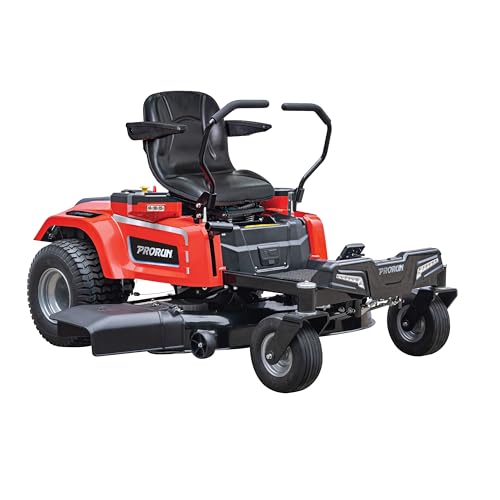
Pros
- High-efficiency brushless motors maximize power output and durability over traditional motors
- Up to 2 acres runtime with three included 10.0 Ah batteries supports substantial mowing sessions
- Zero-emission operation with gas-equivalent 20 HP power for quieter environmentally friendly use
- Six-port auto-switchover battery system provides flexible extended runtime options
- Durable 42-inch steel deck plus included mulch and towing kits add immediate functionality
Cons
- Runtime is limited to approximately 70 minutes or 2 acres which may require recharging for larger properties
- Fully battery-dependent design means performance relies on charge levels and spare battery availability
- 42-inch deck size may require more passes on expansive lawns compared to wider commercial models
The PRORUN PZT60V42 is a fully electric 60V zero-turn riding lawn mower built for residential and light commercial use. Its primary design centers on a robust 42-inch 14-gauge stamped steel twin blade deck powered by direct-drive brushless motors, giving an immediate impression of solid construction and modern battery-focused engineering. The mower arrives complete with three 10.0 Ah batteries, a charger, mulch kit, and towing kit for ready-to-work versatility.
In performance terms, four high-efficiency brushless motors deliver power equivalent to a 20 HP gas engine while producing zero emissions. The system supports up to 2.0 acres or 70 minutes of runtime, and six battery ports with auto switchover intelligently manage all PRORUN 60V battery sizes for continuous operation. A washout port on the steel deck further simplifies post-mow maintenance during real-world sessions.
Potential drawbacks include the finite 70-minute runtime window which can limit coverage on larger properties without spare batteries or recharge breaks. As a fully electric model, it also depends entirely on battery charge levels rather than continuous fuel refills, and the 42-inch deck width may demand extra passes compared with wider traditional options.
Overall the PRORUN PZT60V42 offers strong value for homeowners and small-property managers who want gas-like cutting power without emissions or noise. Those with medium-sized lawns seeking quiet efficient zero-turn performance and included accessories will benefit most from this electric mower.

Pros
- Strong 24HP FR730 engine power for demanding cutting conditions
- Wide 54-inch FAB deck reduces total mowing time
- Zero turn design delivers excellent maneuverability
- Fabricated deck supports durable everyday operation
Cons
- Sparse details beyond engine and deck leave other features unspecified
- Gas-powered FR730 engine needs regular fuel and maintenance
- Large 54-inch deck size may feel oversized on compact properties
The Husqvarna Z254F is a zero turn mower from the established Husqvarna brand in the riding lawn mowers category. It centers on a solid build that pairs a 24HP 726cc FR730 engine with a 54-inch FAB deck for straightforward residential grass care.
Performance stems directly from the listed specifications. The FR730 engine delivers the horsepower needed for steady operation across typical lawns while the wide FAB deck completes passes efficiently. Zero turn handling improves control in real yard layouts based on the model design.
Considerations arise from the limited data available. Secondary elements such as comfort features fuel capacity or extras receive no mention and the gas engine format involves routine upkeep. The large deck suits open areas better than confined spaces.
The Husqvarna Z254F provides the most value for owners of medium or large properties who want reliable engine power and a broad cutting width. Users with smaller lots or those seeking extensive accessory options should weigh the core specs carefully before purchase.
The Engine: Fuel to Power
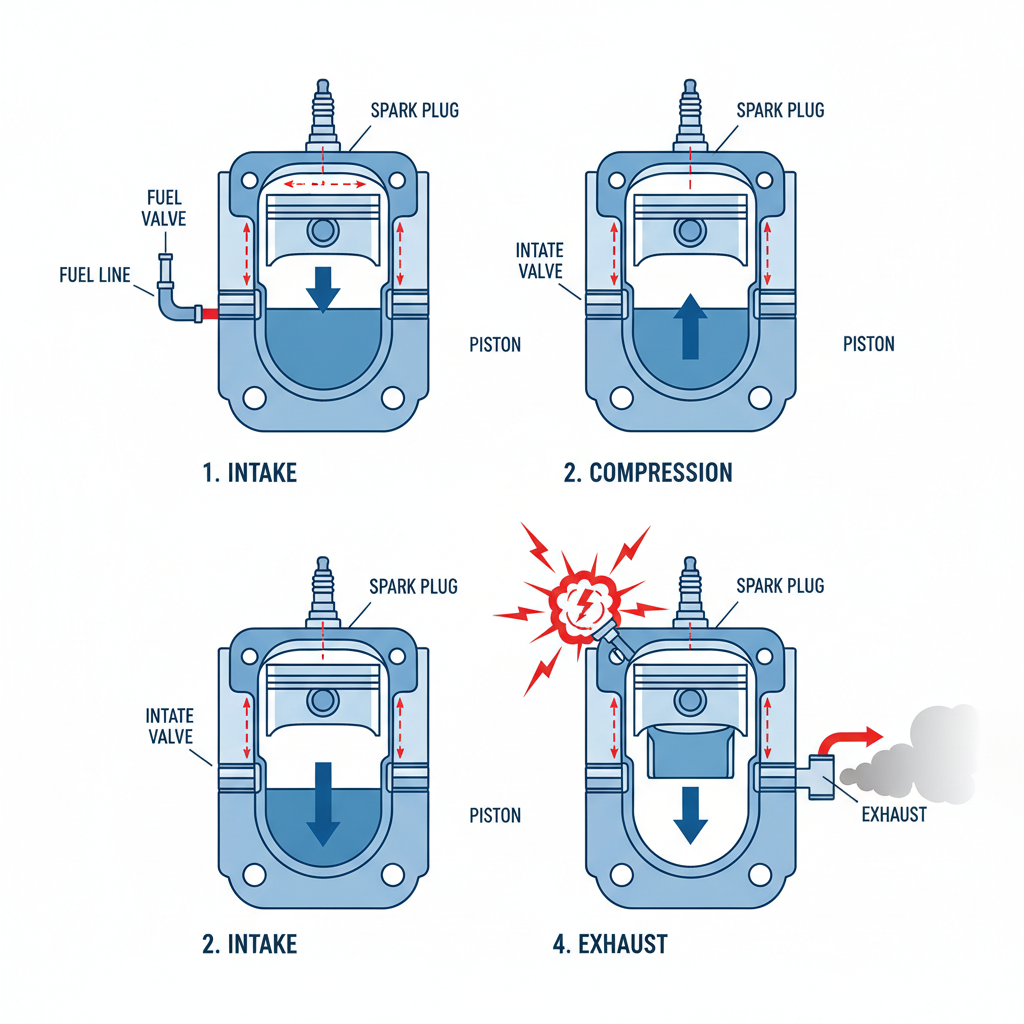
Most residential lawn mowers rely on small internal combustion engines—either four-stroke or two-stroke designs—to generate the power needed to spin the cutting blade. Understanding how the engine works is key to understanding the entire machine.
Four-Stroke vs. Two-Stroke Engines
The majority of modern walk-behind and riding mowers use four-stroke engines, which complete a full power cycle in four piston strokes:
- Intake stroke: The piston moves down, drawing a fuel-air mixture into the cylinder.
- Compression stroke: The piston moves up, compressing the fuel-air mixture.
- Power stroke: A spark plug ignites the compressed mixture, creating an explosion that drives the piston down with force.
- Exhaust stroke: The piston moves up again, pushing burned gases out through an exhaust valve.
Two-stroke engines complete the same process in just two strokes and are lighter and simpler, but less fuel-efficient and more polluting. They’re less common in modern mowers but still found in some handheld or older models.
The Role of the Spark Plug
The spark plug is essential to ignition. When you pull the starter cord or turn the key, the engine’s magneto (a permanent magnet) generates an electrical charge. This charge reaches the spark plug at precisely the right moment, creating a spark that ignites the compressed fuel-air mixture in the cylinder. Without a functioning spark plug, the engine won’t start. A fouled or worn spark plug is one of the most common reasons lawn mowers fail to start and is a simple maintenance task to address.
Fuel System and Carburetor
Gasoline stored in the mower’s fuel tank flows through a fuel line to the carburetor, a device that mixes fuel with air in the correct ratio. The carburetor regulates this mixture automatically based on engine load and speed. The fuel-air mixture then enters the cylinder for combustion. In modern mowers, a small filter prevents debris from clogging the carburetor—one reason why regular maintenance is important.
The Crankshaft and Power Transmission
The explosive force from each power stroke drives a piston, which connects to a crankshaft—a metal shaft that converts the piston’s up-and-down motion into continuous rotational motion. Think of it like pedaling a bicycle: just as your legs push down on pedals to turn the chain, the piston pushes down to rotate the crankshaft.
How Power Transfers to the Blade
The spinning crankshaft connects to the mower’s cutting blade through a transmission system. In most rotary mowers, the crankshaft drives the blade directly or through a pulley and belt system. The blade is mounted on a spindle (a shaft) attached to the underside of the cutting deck, positioned horizontally so it rotates in a plane parallel to the ground. For walk-behind mowers, the engine power is also used to drive the wheels forward; a clutch mechanism allows the operator to disengage the blade while keeping the wheels moving. For riding mowers, the engine powers both the blade and the transmission that drives all four wheels.
Engine Governor
Most lawn mower engines include a governor—an automatic device that maintains a constant engine speed regardless of load. As the blade encounters thicker grass and slows down, the governor automatically increases fuel flow to prevent the engine from stalling. This keeps the blade spinning at an optimal cutting speed even when conditions change.
The Cutting Blade and Cutting Deck
The blade is where the actual cutting happens. In a rotary mower, a single metal blade extends horizontally from a central spindle. As the crankshaft spins at high speed, the blade rotates at 3,000–4,000 RPM, creating a high-speed cutting action.
How the Blade Cuts Grass
Despite its reputation, the rotary blade doesn’t work like scissors. Instead, it operates more like a high-speed bludgeon: the blade’s sharp leading edge impacts grass stems at extreme speed, chopping them off through impact and shear force. As the blade rotates, it creates a circular cutting path. The curved design of the blade creates an updraft that lifts grass stems before cutting, ensuring even coverage across the cutting width.
Blade Sharpness and Maintenance
A dull blade tears grass rather than cleanly cutting it, leaving ragged edges that brown and damage the lawn. Sharp blades directly affect both mower efficiency and grass health. Most operators should sharpen or replace their blade once per season, or more frequently if mowing over rough terrain where rocks can dull the edge quickly.
The Cutting Deck Design
The cutting deck is the metal housing that surrounds the blade. Its primary job is to contain the cutting action and direct airflow. As the blade spins, it creates a vortex of air inside the deck that lifts cut grass clippings. The deck’s shape funnels these clippings toward a discharge chute. The deck also protects the operator from the spinning blade and prevents debris from being ejected at high speed.
Discharge, Collection, and Mulching
Lawn mowers handle clippings in three ways: discharge (side or rear chute that ejects clippings), collection (clippings are directed into a bag or hopper), or mulching (clippings are recirculated and finely chopped before being dispersed on the lawn). Mulching mowers have a specially designed deck and blade that creates multiple passes through the cutting zone, pulverizing clippings into smaller pieces that decompose quickly and return nutrients to the soil.
How Wheels and Movement Work
The wheels serve two functions: moving the mower forward and, in some cases, engaging the blade. In walk-behind push mowers, the operator provides the forward motion manually, while the engine powers only the blade. In self-propelled walk-behind mowers, the engine drives the wheels through a transmission with a friction disk, belt, or chain. The operator controls forward speed via a lever that engages or disengages the drive system.
Riding mowers use the engine to power both a transmission (similar to a car’s) and the blade. The transmission typically includes a clutch, gears, and a differential that allows the rear wheels to turn at different speeds when cornering.
Types of Lawn Mowers and How They Differ
While rotary mowers are the most common, other designs use different cutting mechanisms suited to specific needs.
Reel Mowers
A reel mower uses a cylinder of rotating blades that scissors against a stationary blade beneath them—similar to how hedge clippers work. These produce an extremely clean cut and are preferred for fine ornamental lawns and golf courses. They require more precision maintenance but are quieter and more fuel-efficient. Reel mowers come in manual (push) or motorized versions; manual models require physical effort but use no fuel.
Riding Mowers and Lawn Tractors
Riding mowers feature a seat and steering wheel, with the cutting deck positioned underneath or in front of the driver. They’re designed for large lawns and use a larger engine—typically a four-stroke or gas-powered system—to power both the blade and wheels. Zero-turn-radius mowers use independent wheel controls to enable tight turns and efficient mowing patterns. Some professional models use diesel engines for added durability and fuel efficiency.
Robotic Lawn Mowers
Modern robotic mowers operate autonomously using electric motors powered by rechargeable batteries. They use small rotary or reel blades and rely on GPS, boundary wires, or sensors to navigate the lawn in predetermined patterns. Rather than bagging clippings, they mulch and disperse them continuously. These mowers are quieter, produce no emissions, and require minimal operator involvement, though they’re limited to smaller residential lawns and higher purchase prices.
Fuel System and Engine Start
Understanding how fuel reaches the engine and how ignition begins clarifies several common mower problems and maintenance needs.
The Fuel Tank and Fuel Line
Gasoline is stored in a plastic or metal tank, typically holding 1–5 quarts depending on mower size. A fuel filter screens out debris. The fuel line draws fuel toward the carburetor using gravity or, in some cases, a small fuel pump driven by engine vibration.
Starting the Engine
When you pull the starter cord (or turn the ignition key on an electric-start mower), you’re mechanically spinning the engine’s crankshaft to initiate the combustion cycle. The pull engages a pulley that winds a rope around the crankshaft and jerks it rapidly, forcing the piston through the intake and compression strokes. Once the engine speed is high enough, the spark plug ignites, and the power stroke takes over, keeping the engine running. Electric-start mowers use a small electric motor and battery to accomplish the same result without manual effort.
Priming and Choke
Many mowers have a primer bulb or choke. The primer forces extra fuel into the carburetor to ensure a rich mixture for starting. The choke restricts air intake temporarily, further enriching the fuel mixture so the engine will start more easily when cold. Once the engine warms up, the choke gradually opens, returning the fuel mixture to normal.
Safety Features
Modern mowers include several built-in protections to prevent injury during operation.
Blade Brake Clutch
When you release the handle or controls on a walk-behind mower, a blade brake clutch disengages the blade from the crankshaft within seconds, stopping blade rotation without stopping the engine. This is a critical safety feature that prevents accidental contact with the spinning blade. Riding mowers have similar clutches controlled by steering-wheel switches or foot pedals.
Deck Shields and Guards
The deck itself acts as a physical barrier preventing hands or feet from contacting the blade. Most mowers include additional shields around the discharge chute and wheels. These guards are removable for maintenance but should never be operated with guards removed.
Dead-Man Switch
Many modern mowers include a dead-man switch on the handle that stops the blade immediately if the operator loses grip or falls. This prevents the mower from continuing to run unattended.
Regular Maintenance and Longevity
A lawn mower’s lifespan depends heavily on basic maintenance. The engine requires regular oil changes (typically every 50 hours of use), air filter replacement, spark plug inspection, and fuel system cleaning. The blade needs sharpening and inspection for cracks or bent edges. Keeping the fuel system clean and using fresh gasoline (not old fuel left in the tank over winter) prevents carburetor clogs. Draining fuel before long-term storage prevents gum buildup. These tasks ensure reliable starts, efficient cutting, and years of trouble-free operation.
Buyer FAQs: How Does A Lawn Mower Work Solved
Why won’t my lawn mower start?
The most common causes are a fouled spark plug, stale or contaminated fuel, a clogged carburetor, or a weak battery (for electric-start models). Start by checking the spark plug: remove it, inspect the electrode for deposits or gap spacing, and replace it if needed. If the mower has sat for more than a month, drain old fuel and refill with fresh gasoline. If the carburetor is clogged, use a carburetor cleaner or run fuel stabilizer through the system. If problems persist, the carburetor may need professional cleaning.
How fast does a lawn mower blade spin?
A typical rotary mower blade spins at 3,000–4,000 RPM (revolutions per minute), though some high-performance models can exceed 4,500 RPM. At 3,600 RPM, the blade’s tip travels at approximately 150 mph, generating enough force to impact and sever grass stems effectively. Reel mowers typically rotate much more slowly—around 400–600 RPM—but achieve a precise scissor cut.
What’s the difference between mulching and bagging clippings?
Bagging collects clippings in a hopper for removal and disposal. Mulching recirculates and finely chops clippings before dispersing them on the lawn. Mulched clippings decompose quickly, returning nitrogen and other nutrients to the soil, reducing the need for fertilizer. Bagging removes clippings entirely, which some prefer for appearance or to prevent thatch buildup, though it’s more labor-intensive and produces waste.
How often should I sharpen my mower blade?
Most homeowners should sharpen or replace the blade once per season (typically in spring before heavy mowing begins), or more frequently if you mow rough terrain with rocks or debris that can quickly dull the edge. A sharp blade cuts cleanly, leaves grass healthier, and requires less engine effort. You can tell a blade is dull when the mower leaves ragged, torn grass tips instead of clean cuts.