

Quick Answer: How Much Horsepower Does a Lawn Mower Have?
A lawn mower engine typically produces 3–20+ horsepower (HP) depending on its type and intended use. Walk-behind push mowers run on 3–7 HP engines, self-propelled mowers on 4.5–8.75 HP, riding mowers on 12–16 HP, and zero-turn mowers on 16–20+ HP. Commercial-grade mowers can exceed 25 HP. Electric and battery-powered mowers do not carry HP ratings — they are rated in volts and amps instead.

Pros
- Powerful 80V brushless motor delivers 32HP gas-equivalent performance with quiet fume-free operation and no engine maintenance.
- Complete kit includes four 6.0Ah batteries and 600W charger for substantial runtime up to 1.5 acres.
- SmartCut technology and 42-inch heavy-duty steel deck ensure consistent cuts without bogging in tough conditions.
- Versatile towing up to 350 lbs and optional cargo hauling plus comfort features like high-back seat and LED lights.
- Strong 4-year limited warranty and full compatibility with the Greenworks 80V tool ecosystem.
Cons
- Rear utility cargo bed for 200 lb hauling is sold separately and not included in the kit.
- Runtime of up to 1.5 acres varies with conditions and may require recharging or battery swaps on larger properties.
- As a fully cordless model continuous operation depends on battery levels unlike gas engines with unlimited runtime.
The Greenworks 80V 42" CrossoverT Cordless Riding Lawn Tractor is a ready-to-mow zero-emission tractor designed for homeowners managing medium to large lawns. It features a reinforced 42-inch stamped steel deck of 12-gauge construction along with premium comfort elements such as a high-back padded seat with foldable armrests. The overall build emphasizes durability and user convenience right out of the box with the included battery and charger set.
Performance centers on the 80V TruBrushless motor that provides 32HP gas-equivalent power with instant torque and quiet fume-free operation. SmartCut technology senses grass conditions and automatically adjusts power to maintain a consistent cut even in tall thick or wet areas. The four 6.0Ah batteries support runtime for up to 1.5 acres depending on conditions while dual LED headlights and a 7-position deck height range from 1.5" to 4.5" add practicality. Front and rear attachments further allow towing up to 350 lbs for added yard utility.
Key considerations include that the rear utility storage bin capable of hauling 200 lbs is sold separately so full cargo functionality requires an extra purchase. Runtime remains condition-dependent and may fall short for properties significantly larger than 1.5 acres without using the 600W charger or swapping batteries. The cordless design prioritizes ease and low maintenance but trades off the continuous runtime of traditional gas models.
This tractor delivers strong value for eco-conscious owners of residential properties who want gas-like power without the emissions noise or upkeep. It suits those who already use or plan to expand into the Greenworks 80V family of tools and who appreciate the 4-year limited warranty. Users with exceptionally large or commercial-scale lawns should evaluate battery logistics carefully before purchase.

Pros
- Delivers strong 21 horsepower equivalent power comparable to gas riding mowers.
- Provides up to 1.5 acres of runtime on a full charge with the six included batteries.
- Features low-maintenance dual brushless motors without belts for greater durability.
- Offers versatile 12-position cutting height adjustment from 1.5 to 4.5 inches.
- Includes digital controls for blade settings, drive speeds, and cruise control.
Cons
- Limited to 1.5 acres of cutting per charge without purchasing additional batteries for bigger lawns.
- Requires recharging time for the six 56V batteries after each use session.
- Relies solely on battery power with no hybrid or gas backup option for extended operation.
The EGO Power+ TR4204 is a cordless electric riding lawn mower built as a modern tractor alternative for residential use. It features a robust 42-inch stamped steel deck and arrives ready to go with six 56V 6.0Ah batteries plus a charger, creating an immediate impression of convenience and solid construction free from gas engine complexity.
Performance shines through its equivalent 21 horsepower output and top speed of 6 MPH, allowing efficient coverage of up to 1.5 acres on a single charge. Dual brushless cutting motors operate without belts for added durability and less upkeep, while the digital display lets users select three blade settings, three drive speeds, and cruise control. The 12 adjustable heights ranging from 1.5 to 4.5 inches combined with anti-scalp wheels deliver precise results across varied terrain.
Drawbacks center on battery dependency, as larger properties beyond 1.5 acres require extra batteries and recharging intervals can interrupt workflow. The fully electric design eliminates fuel storage needs but demands access to power sources between sessions.
This mower suits homeowners with medium to large yards who value quiet, emission-free operation and reduced maintenance. Those seeking expandable battery capacity for bigger areas will find the EGO Power+ TR4204 a strong long-term investment in cordless lawn care.
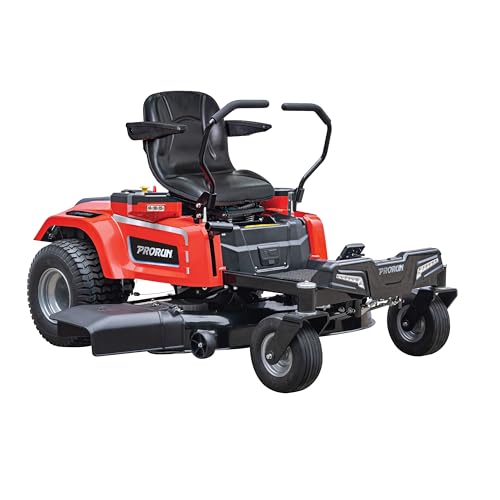
Pros
- High-efficiency brushless motors maximize power output and durability over traditional motors
- Up to 2 acres runtime with three included 10.0 Ah batteries supports substantial mowing sessions
- Zero-emission operation with gas-equivalent 20 HP power for quieter environmentally friendly use
- Six-port auto-switchover battery system provides flexible extended runtime options
- Durable 42-inch steel deck plus included mulch and towing kits add immediate functionality
Cons
- Runtime is limited to approximately 70 minutes or 2 acres which may require recharging for larger properties
- Fully battery-dependent design means performance relies on charge levels and spare battery availability
- 42-inch deck size may require more passes on expansive lawns compared to wider commercial models
The PRORUN PZT60V42 is a fully electric 60V zero-turn riding lawn mower built for residential and light commercial use. Its primary design centers on a robust 42-inch 14-gauge stamped steel twin blade deck powered by direct-drive brushless motors, giving an immediate impression of solid construction and modern battery-focused engineering. The mower arrives complete with three 10.0 Ah batteries, a charger, mulch kit, and towing kit for ready-to-work versatility.
In performance terms, four high-efficiency brushless motors deliver power equivalent to a 20 HP gas engine while producing zero emissions. The system supports up to 2.0 acres or 70 minutes of runtime, and six battery ports with auto switchover intelligently manage all PRORUN 60V battery sizes for continuous operation. A washout port on the steel deck further simplifies post-mow maintenance during real-world sessions.
Potential drawbacks include the finite 70-minute runtime window which can limit coverage on larger properties without spare batteries or recharge breaks. As a fully electric model, it also depends entirely on battery charge levels rather than continuous fuel refills, and the 42-inch deck width may demand extra passes compared with wider traditional options.
Overall the PRORUN PZT60V42 offers strong value for homeowners and small-property managers who want gas-like cutting power without emissions or noise. Those with medium-sized lawns seeking quiet efficient zero-turn performance and included accessories will benefit most from this electric mower.

Pros
- Strong 24HP FR730 engine power for demanding cutting conditions
- Wide 54-inch FAB deck reduces total mowing time
- Zero turn design delivers excellent maneuverability
- Fabricated deck supports durable everyday operation
Cons
- Sparse details beyond engine and deck leave other features unspecified
- Gas-powered FR730 engine needs regular fuel and maintenance
- Large 54-inch deck size may feel oversized on compact properties
The Husqvarna Z254F is a zero turn mower from the established Husqvarna brand in the riding lawn mowers category. It centers on a solid build that pairs a 24HP 726cc FR730 engine with a 54-inch FAB deck for straightforward residential grass care.
Performance stems directly from the listed specifications. The FR730 engine delivers the horsepower needed for steady operation across typical lawns while the wide FAB deck completes passes efficiently. Zero turn handling improves control in real yard layouts based on the model design.
Considerations arise from the limited data available. Secondary elements such as comfort features fuel capacity or extras receive no mention and the gas engine format involves routine upkeep. The large deck suits open areas better than confined spaces.
The Husqvarna Z254F provides the most value for owners of medium or large properties who want reliable engine power and a broad cutting width. Users with smaller lots or those seeking extensive accessory options should weigh the core specs carefully before purchase.
Lawn Mower HP by Type: At-a-Glance Comparison Table
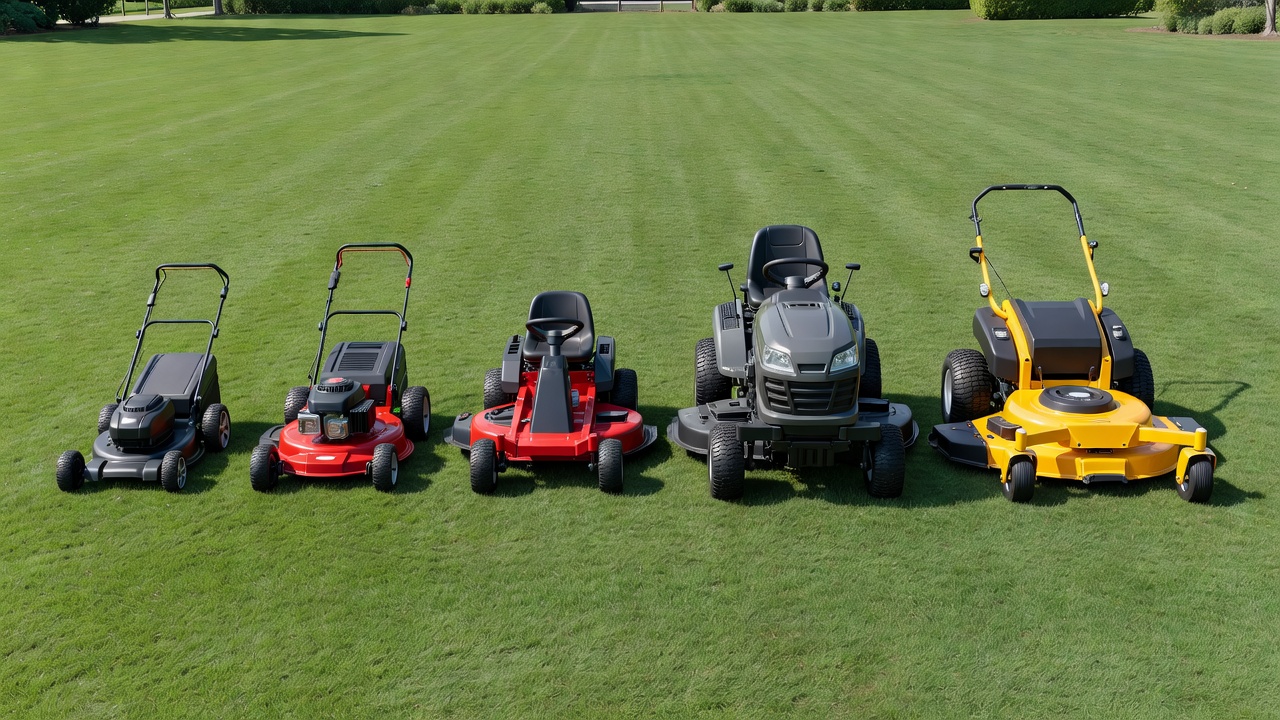
The table below covers the standard horsepower ranges across every major mower category. Use it to identify where your current or prospective mower falls before reading the detailed breakdown that follows.
| Mower Type | Typical HP Range | Approximate CC Range | Best For |
|---|---|---|---|
| Walk-behind push mower | 3–7 HP | 100–190 cc | Flat yards up to ¼ acre |
| Self-propelled mower | 4.5–8.75 HP | 140–220 cc | Yards up to ½ acre, mild slopes |
| Rear-engine riding mower | 10–13 HP | 344–420 cc | ½–1 acre, flat to gentle terrain |
| Front-engine riding mower | 12–16 HP | 420–540 cc | 1–2 acres, varied terrain |
| Zero-turn mower | 16–25 HP | 540–725 cc | 1–5 acres, speed-focused mowing |
| Commercial/professional mower | 25–35+ HP | 725 cc+ | Large acreage, daily professional use |
| Electric/battery mower | Not rated in HP | N/A | Small to medium yards, low-noise use |
What Do Lawn Mower Horsepower Numbers Actually Mean?
Horsepower measures the rate at which an engine converts fuel into mechanical work — specifically, the force applied to the cutting blade or drive system over time. A higher HP rating means the engine can sustain greater load without bogging down, which matters most when cutting thick, wet, or overgrown grass. For complementary field maintenance guidelines, examine our breakdown of jbl partybox club 120 vs sony srs xv500.
Why Manufacturers Now List CC Instead of HP
Since the adoption of the SAE J1940 standard governing small-engine power ratings for outdoor power equipment, many manufacturers shifted from advertising peak HP figures to listing engine displacement in cubic centimeters (cc) and gross torque. The change addressed years of inflated and inconsistent HP claims on consumer packaging. Today, Briggs & Stratton, Kawasaki, and Honda primarily publish cc and torque figures on residential engine lines, while HP may still appear on commercial specifications. For complementary field maintenance guidelines, examine our breakdown of jbl partybox club 120 vs sony srs xv500.
How to Convert CC to Horsepower
A widely used rule of thumb in small-engine engineering is that approximately 32–35 cc of displacement equals 1 HP under standard operating conditions. This is an approximation — actual output varies with engine design, compression ratio, and cooling method — but it provides a practical benchmark when comparing mowers listed only in cc. To evaluate matched hardware tolerances, consult our detailed overview of z890 vs x870e motherboard.
- 140 cc ≈ 4–4.5 HP
- 160 cc ≈ 4.5–5 HP
- 190 cc ≈ 5.5–6 HP
- 220 cc ≈ 6–7 HP
- 382 cc ≈ 10–11 HP
- 540 cc ≈ 15–17 HP
- 725 cc ≈ 20–23 HP
Use this scale as a starting point when a mower lists only cc. Always cross-reference the engine model number against the manufacturer’s published spec sheet for confirmed output figures.
Gross Torque vs. Net Horsepower
Gross torque measures peak rotational force produced by the engine alone, tested without accessories attached. Net horsepower measures output after standard accessories (air cleaner, muffler, charging system) are fitted — it is the more realistic figure for real-world cutting performance. When comparing mowers, net HP gives the more accurate picture of what reaches the blade. To evaluate matched hardware tolerances, consult our detailed overview of z890 vs x870e motherboard.
Lawn Mower HP by Mower Type: Full Breakdown
Walk-Behind Push Mowers (3–7 HP)
Push mowers carry the smallest engines in the consumer category, typically 140–190 cc single-cylinder four-stroke engines. Briggs & Stratton’s 500E and 550EX series sit at the lower end (140–150 cc), while Honda’s GCV160 and GCV190 engines represent the upper residential push-mower tier. A 3–5 HP engine handles standard grass on flat ground without difficulty. Moving toward 6–7 HP becomes useful only if the yard has obstacles requiring frequent blade engagement at varying load.
Self-Propelled Mowers (4.5–8.75 HP)
Self-propelled mowers drive their own rear or front wheels, placing additional mechanical load on the engine beyond just spinning the blade. Engines in this category typically run 140–220 cc. The Honda GCV200 (200 cc) and Briggs & Stratton 725EXi (163 cc) are common fitments. Higher-end self-propelled models — particularly those with wide 21–22 inch decks or variable-speed drives — use engines approaching the 8.75 HP ceiling to maintain consistent blade speed under load. When planning workspace deployment, consider the engineering criteria outlined in our marshall stanmore iii vs harman kardon onyx studio 8 guide.
Rear-Engine Riding Mowers (10–13 HP)
Rear-engine riding mowers (sometimes called garden tractors in compact form) position a single-cylinder engine behind the operator. They typically carry 344–420 cc single-cylinder engines producing 10–13 HP. These models suit yards in the ½–1 acre range on flat to gently sloping terrain. Deck widths usually run 30–33 inches, and the modest HP is sufficient for single-blade cutting at manageable speeds.
Front-Engine Riding Mowers (12–16 HP)
Front-engine riding mowers — the most common residential riding category — mount larger single- or twin-cylinder engines ahead of the operator. Engine displacement runs 420–540 cc, with twin-cylinder configurations common above 14 HP. Kohler’s 7000 Series and Briggs & Stratton’s Intek twin engines are standard fitments at this tier. Deck widths of 42–54 inches are driven by these power levels across terrain ranging from flat lawn to moderate hills. For additional operational safety benchmarks, see our published testing notes on dyson v8 cyclone vs bissell featherweight stick.
Zero-Turn Mowers (16–25 HP)
Zero-turn mowers prioritize speed and maneuverability, using two independently driven rear wheels controlled by lap bars. Their engines must sustain high blade-tip speed across wide decks (42–72 inches) while powering hydraulic drive systems simultaneously. Consumer-grade zero-turns start around 16–18 HP with engines such as the Kawasaki FR series or Kohler 7000 twin. Prosumer models push toward 20–25 HP using Kawasaki FX or Briggs & Stratton Commercial Turf engines.
Commercial Lawn Mowers (25–35+ HP)
Commercial walk-behind and stand-on mowers, as well as large-deck commercial zero-turns, use purpose-built engines from Kawasaki (FX801V at 25.5 HP), Kohler Command Pro, and Briggs & Stratton Vanguard series. Decks of 52–72 inches at high blade speeds demand consistent torque delivery across full operating days — these engines are designed for durability under continuous load rather than peak HP numbers alone. Diesel-powered commercial mowers (used in large municipal and sports-turf applications) measure power in kilowatts and can exceed 35 HP equivalent output. To compare alternative configurations, check our hands-on review of bissell crosswave hydrosteam vs shark stainforce.
Gas vs. Electric Lawn Mowers: How to Compare Power Without an HP Rating
Electric and battery-powered mowers are not rated in horsepower. The Outdoor Power Equipment Institute (OPEI) and manufacturers rate them using voltage (V), amperage (A), and wattage (W) — the electrical equivalents of engine output. Converting to horsepower is possible using the formula: 1 HP = 746 watts.
Practical Equivalency Framework
- 40V battery mower — comparable in cutting performance to a 140–150 cc (≈4–4.5 HP) gas push mower on standard residential grass
- 56–60V battery mower — comparable to a 160–190 cc (≈5–6 HP) gas push mower; handles thicker turf with less bogging
- 80–82V battery mower — approaches self-propelled gas-mower territory for sustained power output
- Dual-battery 80V+ systems — marketed by brands such as Greenworks and EGO as equivalents to mid-range self-propelled gas engines
Electric motors deliver peak torque immediately at startup — unlike gas engines that build torque through RPM — which means an electric mower can feel more responsive in short-burst cutting situations even at lower nominal wattage. However, battery capacity (amp-hours) limits runtime in ways that a gas tank does not, and sustained heavy-load cutting drains charge faster than spec-sheet runtime figures suggest.
For large yards or commercial use, gas remains the practical choice. For yards under ¼ acre or in areas with noise restrictions, a 56V+ battery mower delivers equivalent cutting results to a 5–6 HP gas push mower in normal grass conditions.
How Much Horsepower Do You Actually Need? (Lawn Size and Terrain Guide)
Matching HP to yard size is the most practical use of this information. Over-buying HP wastes fuel and money; under-buying causes engine strain, premature wear, and poor cut quality in demanding conditions.
| Lawn Size | Terrain | Recommended HP Range | Mower Type |
|---|---|---|---|
| Under ¼ acre | Flat, standard grass | 3–5 HP | Walk-behind push mower |
| ¼–½ acre | Flat to mild slope | 5–7 HP | Self-propelled mower |
| ½–1 acre | Flat to moderate slope | 7–13 HP | Self-propelled or rear-engine riding |
| 1–2 acres | Mixed terrain | 13–18 HP | Front-engine riding or entry zero-turn |
| 2–5 acres | Varied, including hills | 18–25 HP | Zero-turn or large front-engine riding |
| 5+ acres | Any | 25+ HP | Commercial zero-turn or tractor |
Slope and Terrain Adjustments
Slopes require disproportionately more engine power than flat ground because the mower must overcome gravity while maintaining blade RPM. As a practical rule, add 2–3 HP to your baseline estimate for yards with grades exceeding 15 degrees. Wet or overgrown grass increases cutting resistance significantly — if your lawn regularly goes uncut for 10+ days, size up one HP tier from the flat-ground recommendation.
Mulching and Bagging
Mulching blades recirculate clippings for finer cutting and require more blade torque than standard discharge blades. Bagging adds resistance through the collection system. Both functions consume effective HP at the blade. If you primarily mulch or bag rather than side-discharge, factor in a 10–15% effective power reduction when matching HP to lawn size.
Common Lawn Mower Engine Brands and Their Typical HP Ranges
Briggs & Stratton
The most widely used small-engine brand in North America across residential mowers. Their consumer lines — the 500 Series, 550EX, 725EXi, and Intek twin — cover 3–19 HP. The Vanguard commercial series extends to 35+ HP and is built for continuous professional-use duty cycles. Briggs & Stratton engines are found across virtually every major OEM mower brand at the residential tier.
Honda GCV Series
Honda’s GCV160 (160 cc) and GCV200 (200 cc) engines are standard fitments on premium walk-behind and self-propelled mowers, producing approximately 4.4–5.1 HP net. Known for reliable starting and fuel efficiency, Honda GCV engines occupy the upper-quality residential tier rather than the commercial tier. Honda’s GX commercial series scales higher, reaching into the 10+ HP range for larger applications.
Kawasaki
Kawasaki targets the prosumer and commercial market with its FR, FS, FX, and FJ series. The FR600V produces approximately 18 HP, the FX801V reaches 25.5 HP, and the FX1000V tops out near 35 HP for large-deck commercial zero-turns. Kawasaki engines are associated with low vibration, high durability, and consistent power under sustained load — attributes that justify their premium price point on professional equipment.
Kohler
Kohler’s 7000 Series twin-cylinder engines (18–26 HP) are common on residential riding mowers and zero-turns from brands including Husqvarna, Cub Cadet, and John Deere. The Command Pro series extends into commercial territory at 20–38 HP. Kohler engines are recognized for strong torque curves and straightforward serviceability, which makes them a dominant fitment in the prosumer zero-turn segment.
Tecumseh
Tecumseh engines, once common on budget walk-behind mowers in the 3.5–6.75 HP range, have become less prevalent in new equipment since the brand’s manufacturing consolidation. Tecumseh engines remain in service on older mowers and are still supported with replacement parts, but new mower purchases rarely feature them as OEM fitments.
Everything You Need to Know: How Much Horsepower Does A Lawn Mower Have FAQ
Does lawn mower horsepower decrease with age?
Yes. Engine wear, carbon buildup in the combustion chamber, degraded valve seals, and a dirty air filter all reduce effective output over time. A well-maintained engine loses minimal power over years of use; a neglected one can lose 20–30% of its effective HP through accumulated wear and fouled components. Annual tune-ups — fresh spark plug, clean air filter, fresh oil, and sharpened blade — preserve rated output longer.
Does running a mulching blade reduce effective horsepower?
Not technically — HP is an engine output figure, not a blade figure. However, mulching blades create greater cutting resistance than standard discharge blades because they lift and recut clippings multiple times per rotation. This increased blade load draws more power from the engine, leaving less headroom before the engine bogs under load. The practical effect is that a mower feels less powerful with a mulching blade in dense or wet grass, even though the engine’s rated HP is unchanged.
Is 190 cc the same as a specific horsepower rating?
190 cc equates to approximately 5.5–6 HP using the standard 32–35 cc per HP rule of thumb. Briggs & Stratton’s 190 cc engines (such as the 725EXi) are rated at roughly 6 gross torque foot-pounds rather than a direct HP figure in current spec sheets, reflecting the SAE J1940 shift away from peak HP marketing. For practical purposes, a 190 cc engine is well-suited to a 21-inch walk-behind or entry-level self-propelled mower on yards up to ½ acre.
Why does my lawn mower lose power under load?
Power loss under load typically points to one of four causes: a clogged air filter restricting combustion airflow, a partially blocked fuel line or dirty carburetor limiting fuel delivery, a worn or incorrectly gapped spark plug failing to ignite the full charge, or a dull blade creating excessive cutting resistance that overwhelms the engine’s available torque. Diagnosing in that order covers the most common causes before moving to internal engine inspection.
For more hands-on benchmarks and buying recommendations, consult our guides on heavy-duty chainsaw buyer guide.
Mechanical safety standards, operational tolerances, and protective gear guidelines align with benchmark specifications established by the American National Standards Institute (ANSI).









