


Pros
- Large-size design named in product title
- Sharpening and balancing functions listed
- Listed as a new upgraded version

Pros
- Adjustable 15-to-45-degree range in title
- Sharpening and balancing functions listed

Pros
- Sharpener and balancer functions in title
- 15-to-45-degree adjustable setting listed
- Built for lawn mower blade maintenance
Pros
- Includes replacement gaskets and a 98079-55846 spark plug
- Matches Honda HRR216 and HRS216 lawn mower models
- Designed around the 16100-Z8B-901 carburetor specification
Cons
- Restricted to select Honda GCV160 mower applications
- Installation requires basic mechanical tools and skills
Honda Lawn Mower Oil Capacity by Engine Model
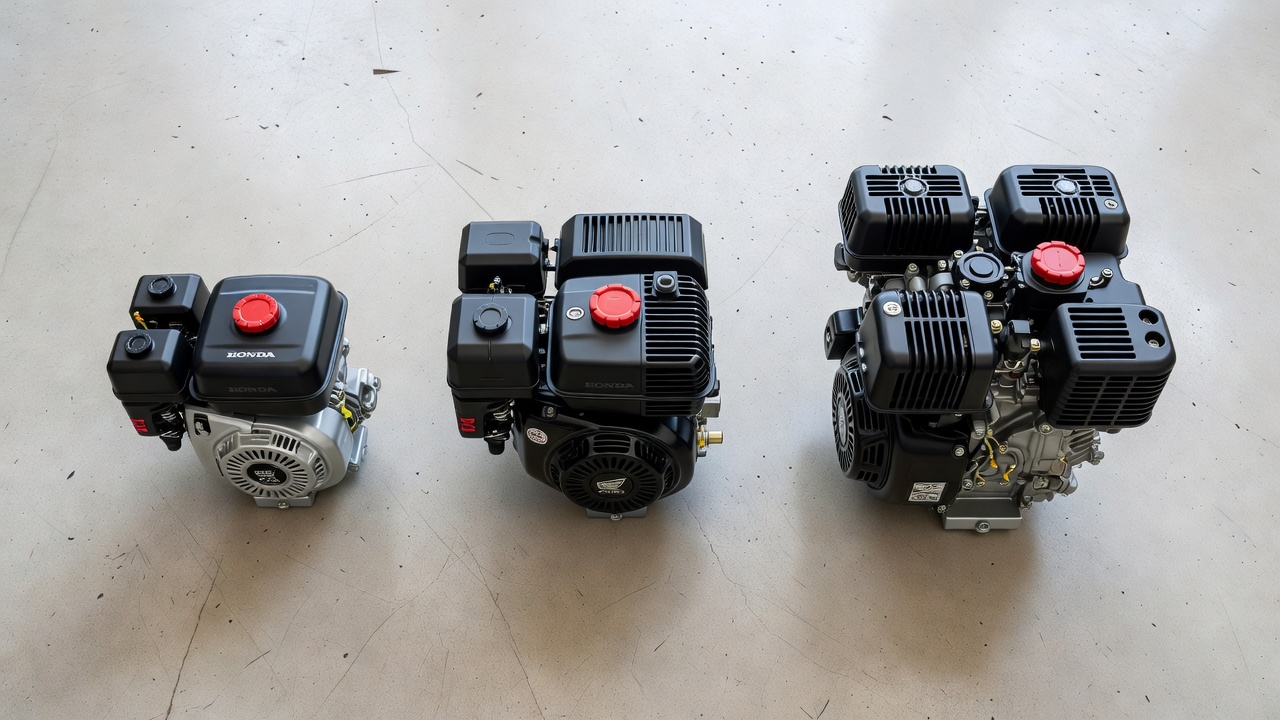
The table below covers the most commonly searched Honda lawn mower engines. Walk-behind models such as the Honda HRR216 and Honda HRX217 use GCV-series engines; commercial and contractor units use GX-series engines; Honda riding mowers carry their own, larger sumps.
| Engine Model | Common Mower Models | Oil Capacity (qt) | Oil Capacity (oz) | Oil Capacity (ml) | Recommended Oil |
|---|---|---|---|---|---|
| Honda GCV160 | HRR216, HRS216 | 0.58 qt | 18.6 oz | 550 ml | SAE 10W-30 (API SJ+) |
| Honda GCV190 | HRX217, HRR216VYA | 0.58 qt | 18.6 oz | 550 ml | SAE 10W-30 (API SJ+) |
| Honda GX160 | Commercial walk-behind, tillers | 0.61 qt | 19.6 oz | 580 ml | SAE 10W-30 (API SJ+) |
| Honda GX200 | Commercial walk-behind, generators | 0.63 qt | 20.3 oz | 600 ml | SAE 10W-30 (API SJ+) |
| Honda GX270 | Commercial mowers, pressure washers | 1.06 qt | 34.0 oz | 1,000 ml | SAE 10W-30 (API SJ+) |
| Honda GX390 | Commercial mowers, large equipment | 1.16 qt | 37.2 oz | 1,100 ml | SAE 10W-30 (API SJ+) |
| Honda Riding Mower (HF / HT series) | HF2220, HF2417, HT3813 | 1.5–2.0 qt | 48–64 oz | 1,420–1,890 ml | SAE 10W-30 (API SJ+) |
Key takeaway: The GCV160 and GCV190 share the same 0.58 qt sump — the most common capacity you will encounter. GX-series engines scale up significantly with displacement. Riding mower capacity varies enough by sub-model that you should pull the owner’s manual or check the engine tag before purchasing oil.
What Type of Oil Does a Honda Lawn Mower Need?
Honda’s Standard Recommendation: SAE 10W-30, API SJ or Later
Honda Power Equipment specifies SAE 10W-30 with an API service rating of SJ or later for general-purpose use across all GCV and GX engine families. This grade handles the wide temperature range typical of lawn mower operation — from a cool spring morning start to sustained high-load summer cutting. To compare alternative configurations, check our hands-on review of jbl partybox club 120 vs sony srs xv500.
Can You Use 5W-30 in a Honda Lawn Mower?
Yes — with a condition. Honda owner’s manuals permit SAE 5W-30 when operating in temperatures below 0 °C (32 °F). The lower cold-viscosity rating (the “5W” prefix) allows easier cold cranking in freezing conditions. For temperatures above freezing, 10W-30 remains the standard call. Do not substitute 5W-30 as a year-round alternative simply because it is on the shelf — it provides no benefit and runs slightly thinner at operating temperature. To compare alternative configurations, check our hands-on review of jbl partybox club 120 vs sony srs xv500.
Is Synthetic Oil Compatible with Honda Lawn Mower Engines?
Honda does not prohibit synthetic oil in GCV or GX engines, provided it meets the SAE 10W-30 viscosity grade and API SJ or later service classification. Full-synthetic 10W-30 is an acceptable choice and can offer improved high-temperature stability and slightly extended drain intervals. Honda does not publish a separate extended drain schedule for synthetic use in small engines, so defaulting to the standard 50-hour or annual interval remains the conservative and safe approach. Users looking for related component recommendations can explore our z890 vs x870e motherboard breakdown.
Oil Viscosity by Temperature — Quick Reference
| Operating Temperature | Recommended Viscosity |
|---|---|
| Above 0 °C (32 °F) | SAE 10W-30 |
| Below 0 °C (32 °F) | SAE 5W-30 |
| Sustained high heat / commercial use | SAE 10W-30 synthetic acceptable |
Honda Riding Mower Oil Capacity vs. Walk-Behind: What’s the Difference?
Walk-behind mowers — the HRR216, HRX217, and similar models — use compact GCV-series engines with sumps sized for their lighter workload: 0.58 qt in both the GCV160 and GCV190. These engines are designed for residential use, typically 1–2 hours of operation per session.
Honda riding mowers (HF and HT series) use larger single-cylinder or twin-cylinder engines with oil sumps ranging from 1.5 qt to 2.0 qt. The increased capacity reflects longer continuous run times, higher thermal load, and greater engine displacement. Underfilling a riding mower engine by even half a quart creates meaningful lubrication risk given those sustained duty cycles. Users looking for related component recommendations can explore our z890 vs x870e motherboard breakdown.
Commercial GX-series engines sit between these two categories. The GX270 holds 1.06 qt and the GX390 holds 1.16 qt — nearly double the GCV160 sump, which surprises many users who assume all Honda mower engines share the same capacity.
How to Identify Your Honda Engine Model
- Locate the engine tag on the side or top of the engine block — it prints the model number (e.g., GCV160, GX390) directly.
- Cross-reference with your mower’s deck label, which lists the mower model (e.g., HRX217) — Honda’s website maps mower models to engine families.
- GCV-series engines have a vertical shaft and an overhead-cam design with a rounded, compact profile. GX-series engines are visually bulkier with external cooling fins more prominent on the block.
How to Check the Oil Level on a Honda Lawn Mower
Checking oil before each use is the single highest-value maintenance habit for a Honda mower engine. Honda GCV160 and GCV190 engines do not include an oil pressure warning light — if the oil drops critically low, the engine can seize without warning. Before finalizing equipment decisions, refer to our comprehensive marshall stanmore iii vs harman kardon onyx studio 8 comparison.
- Park on level ground. An unlevel surface skews the dipstick reading by routing oil away from the sump center.
- Let the engine cool if it has been running — hot oil expands and reads falsely high.
- Locate the oil fill cap / dipstick. On the Honda HRR216 and HRX217, it sits on the left side of the engine near the base, marked with an oil-can icon. The cap and dipstick are a single integrated unit.
- Remove the cap, wipe the dipstick clean with a lint-free cloth.
- Reinsert the dipstick fully — thread it in or seat it completely, depending on your engine — then remove it again to read.
- Read the level. Oil should appear between the upper and lower marks on the dipstick. If it reads below the lower mark, add oil in small increments (1–2 oz at a time).
- Do not overfill. Oil above the upper mark causes foaming, which degrades lubrication and can push oil past seals into the air filter or combustion chamber.
How Much Oil to Add If the Dipstick Reads Low
Add oil in 1-ounce (30 ml) increments, recheck the dipstick after each addition. The distance between the low and high marks on a GCV160 dipstick represents roughly 3–4 oz (90–120 ml) of oil. Pouring in a full cup at once risks overfilling past the high mark.
Step-by-Step: How to Change the Oil on a Honda Lawn Mower
What You Need
- Fresh SAE 10W-30 oil (API SJ or later) — 1 qt bottle covers one full change with oil left over
- Oil drain pan or sealable container
- Clean funnel
- Lint-free rags
- Optional: oil extractor pump (cleaner alternative to drain-plug method)
Drain-Plug Method (GCV160 / GCV190)
- Warm the engine for 2–3 minutes. Warm oil flows faster and carries more suspended contaminants out of the sump. Do not run it long enough to reach full operating temperature — the drain plug area will be uncomfortably hot to handle.
- Shut the engine off. Disconnect the spark plug wire as a safety measure before working near any moving or mechanical parts.
- Position your drain pan under the engine’s oil drain plug. On the GCV160 and GCV190, the oil drain plug is located on the lower side of the engine block — check your owner’s manual diagram for exact placement as it varies slightly between production years.
- Remove the drain plug and allow all oil to drain fully — allow 3–5 minutes minimum.
- Reinstall the drain plug and torque it snugly. Honda does not specify a torque figure for consumer GCV engines; firm hand-tight plus a quarter turn with a wrench is standard practice.
- Add fresh oil through the fill port. Pour in approximately 0.5 qt (16 oz), then use the dipstick to top up incrementally to the full mark. Total fill for GCV160 and GCV190 is 0.58 qt (18.6 oz / 550 ml).
- Reinstall the fill cap / dipstick, reconnect the spark plug wire, and run the engine for 30 seconds. Shut off, wait 1 minute, and re-check the dipstick level as a final confirmation.
- Dispose of used oil properly. Pour it into a sealed container and drop it off at an automotive parts retailer (AutoZone, O’Reilly, Advance Auto Parts) or municipal recycling center — most accept used motor oil at no charge.
How Often to Change the Oil
- First oil change: After the first 5 hours of operation on a new engine — this purges any metal particles from engine break-in.
- Subsequent changes: Every 50 hours of operation or once per season, whichever comes first. Honda’s maintenance schedule in GCV160 and GCV190 owner’s manuals lists this as the standard interval.
- More frequent changes are warranted for dusty conditions (fine dust clogs oil passages faster) or if you notice oil appears dark and gritty before the 50-hour mark.
Common Oil Mistakes with Honda Lawn Mowers (and How to Avoid Them)
Mistake 1: Mixing Oil with Fuel
Honda GCV and GX lawn mower engines are 4-stroke engines. They use straight, unmixed gasoline in the fuel tank and separate engine oil in the crankcase. There is no fuel-oil premix involved. Two-stroke engines (common on older chainsaws and some trimmers) require premixed fuel — Honda walk-behind mowers are not two-stroke. Pouring oil into the fuel tank of a Honda mower will foul the carburetor and require a complete fuel system flush. For broader ecosystem context, read through our operational guide on dyson v8 cyclone vs bissell featherweight stick.
Mistake 2: Overfilling the Crankcase
Overfilling past the dipstick’s upper mark forces oil into areas it is not designed to reach. The consequences include:
- Oil foaming — the crankshaft whips excess oil into froth, reducing lubricating film quality
- Oil pushed into the air filter — a saturated air filter restricts airflow and causes rough running or no-start conditions
- Oil entering the combustion chamber — causes white or blue smoke and carbon buildup on the piston and valves
- Seal damage from elevated crankcase pressure
If you overfill, remove excess oil via the drain plug or an oil extractor before starting the engine. For troubleshooting and reliability insights, consult our in-depth bissell crosswave hydrosteam vs shark stainforce report.
Mistake 3: Skipping the Pre-Season Oil Check
Oil degrades chemically even during storage. Oil left in the sump over winter absorbs moisture and oxidizes. At minimum, check the oil level and condition (color, smell) before the first cut of each season. If the oil appears dark brown-black or smells burnt, change it before running the mower — regardless of hours logged.
Mistake 4: Using the Wrong Viscosity Year-Round
Running 5W-30 in summer or a heavier viscosity like 20W-50 in place of 10W-30 is not recommended. Honda’s GCV and GX engines are clearanced for 10W-30 at normal operating temperatures. Heavier oil increases pumping losses; lighter oil thins too much under heat load. Stick to the spec unless operating in sub-freezing temperatures.
Mistake 5: Checking Oil on a Slope
Reading the dipstick while the mower sits on a hill gives a false level. On a significant slope, oil pools to one side of the sump — the dipstick may read full when one side of the crankshaft journal is already oil-starved. Always move the mower to flat ground before checking.
Frequently Asked Questions About How Much Oil For Honda Lawn Mower
How much oil does a Honda GCV160 take?
The Honda GCV160 holds 0.58 qt (18.6 oz / 550 ml) of SAE 10W-30 (API SJ or later) engine oil. This capacity is shared by the GCV190. Always use the dipstick to confirm the final level rather than relying solely on volume.
Can I use 5W-30 instead of 10W-30 in my Honda lawn mower?
Honda permits SAE 5W-30 for operation in temperatures below 0 °C (32 °F). Above freezing, SAE 10W-30 is the specified grade. Substituting 5W-30 in warm-weather operation provides no benefit and runs thinner than the engine’s design clearances assume.
How often should I change the oil in a Honda lawn mower?
Honda specifies every 50 hours of use or once per season, whichever occurs first, per the GCV160 and GCV190 maintenance schedules. The very first oil change on a new engine should happen after just 5 operating hours to clear break-in debris.
What happens if I put too much oil in a Honda lawn mower?
Overfilling causes oil foaming, restricts the air filter, and can push oil into the combustion chamber — resulting in rough running, white or blue smoke, and potential valve or piston damage. If overfilled, drain the excess before starting the engine.
For more hands-on benchmarks and buying recommendations, consult our guides on heavy-duty chainsaw buyer guide, as well as high-CFM commercial leaf blower guide, as well as durable ride-on lawn tractor guide.
Mechanical safety standards, operational tolerances, and protective gear guidelines align with benchmark specifications established by the American National Standards Institute (ANSI).









