
Quick Answer: How To Check Spark Plugs Lawn Mower?
The spark plug is one of the most critical components in a lawn mower engine. It creates the electrical spark that ignites the fuel-air mixture in the combustion chamber, enabling the engine to start and run. Over time, spark plugs accumulate carbon deposits, wear out, or foul due to fuel residue, reducing spark intensity and engine performance. Regular inspection of…

Pros
- Large-size design named in product title
- Sharpening and balancing functions listed
- Listed as a new upgraded version

Pros
- Adjustable 15-to-45-degree range in title
- Sharpening and balancing functions listed
Pros
- Includes replacement gaskets and a 98079-55846 spark plug
- Matches Honda HRR216 and HRS216 lawn mower models
- Designed around the 16100-Z8B-901 carburetor specification
Cons
- Restricted to select Honda GCV160 mower applications
- Installation requires basic mechanical tools and skills
Why Checking the Spark Plug Matters
A worn or fouled spark plug generates a weaker spark, making it harder for the engine to ignite fuel consistently. This results in difficulty starting, rough idling, decreased power during mowing, and poor fuel efficiency. Neglecting spark plug maintenance can leave you stranded mid-season or cause unnecessary wear on other engine components as they work harder to compensate for weak ignition.
The frequency of spark plug checks depends on how often you use your mower and the conditions in which you operate it. Most manufacturers recommend checking the spark plug at the start of each mowing season and at least once during heavy-use periods. If you use your mower frequently or in dusty conditions, inspect the spark plug more often, perhaps monthly during the active season. Routine inspection takes just minutes and can prevent starting failures or performance issues when you need to mow.
Tools and Safety Preparation
Before you begin, gather the necessary tools: a socket wrench or spark plug socket that fits your mower’s spark plug (typically 13/16 inch or 14mm for small engines), a feeler gauge set for checking the spark plug gap, and a clean dry cloth or soft brush. Consult your mower’s manual to identify the correct spark plug size and gap specification for your specific engine model.
Always disconnect the spark plug wire before removing the plug. This critical safety step prevents accidental engine ignition while you work. To disconnect, grip the rubber boot of the wire firmly and twist gently while pulling it away from the spark plug. Do not pull the wire itself, as this can damage the conductor inside the boot.
Ensure the engine is cool before starting work. A warm engine can cause burns, and hot metal is difficult to handle safely. Move your mower to a well-lit work area, ideally outdoors or in a garage with good ventilation. Lay out your tools nearby so you can work efficiently and avoid delays that prolong exposure to fuel vapors or fumes.
How to Remove and Inspect the Spark Plug
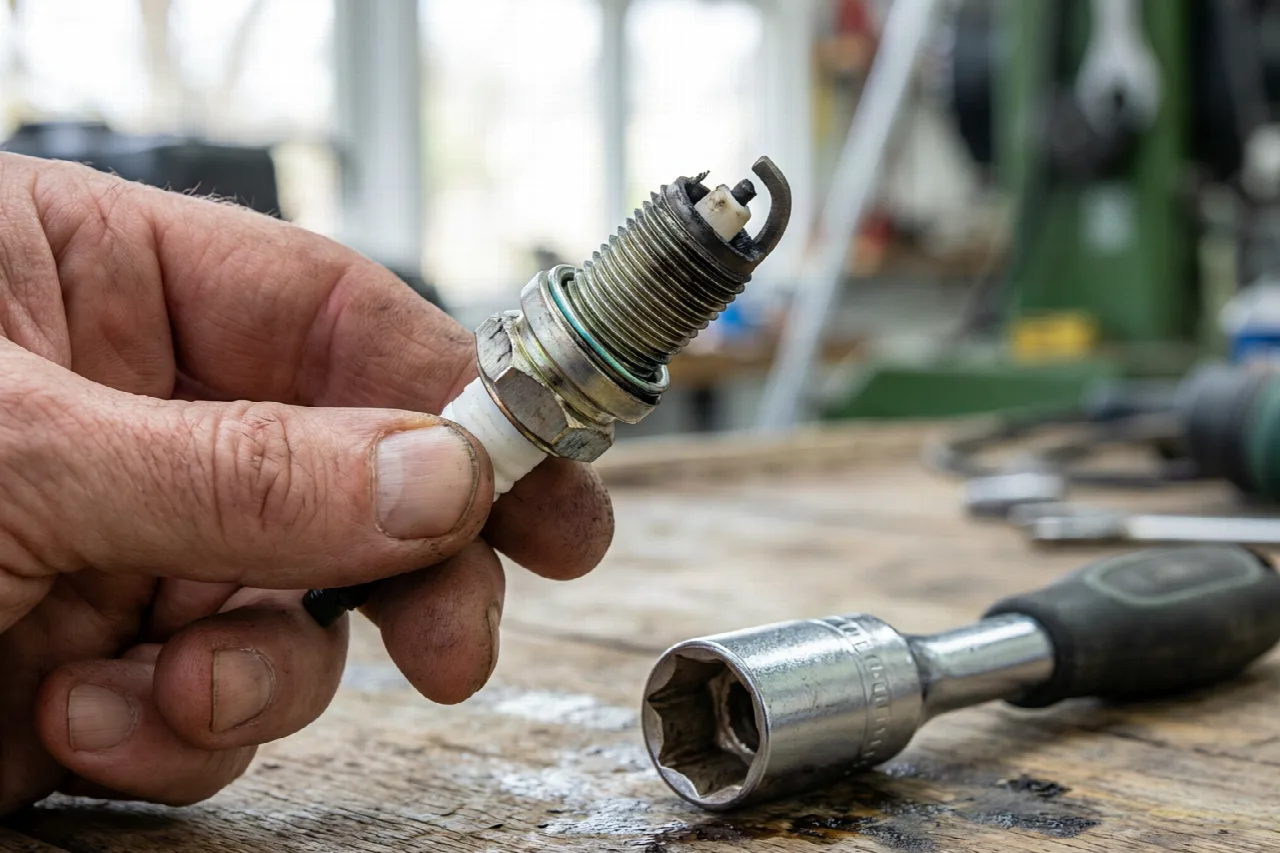
With the spark plug wire disconnected, position your socket wrench over the top of the spark plug. Apply gentle downward pressure and turn counterclockwise until the plug is loose, then unscrew it by hand the rest of the way. Carefully lift the spark plug out of its well, taking care not to drop it or damage the ceramic insulator.
Examine the plug’s condition in good light. A healthy spark plug has a light tan or gray insulator and a clean electrode. Carbon buildup appears as black or sooty deposits on the electrode and insulator, a sign that the plug is fouled and should be replaced. Check for cracks in the ceramic insulator, chips at the electrode tip, or excessive erosion of the electrode itself. Any of these defects indicate replacement is necessary. If the electrode appears worn flat rather than having a sharp point, the plug is nearing the end of its service life and replacement is recommended even if it still functions.
A fouled spark plug often results from running the engine on too-rich a fuel mixture, which can occur if the air filter is dirty or the carburetor is out of adjustment. If the plug is fouled, address the underlying cause after replacing the plug, or the new plug will foul quickly as well.
Checking and Adjusting the Spark Plug Gap
The spark plug gap is the distance between the center electrode and the ground electrode at the plug’s tip. This gap must be correct for proper spark generation. Most lawn mower engines specify a gap between 0.028 and 0.040 inches, though the exact specification depends on your engine model. Consult your mower’s manual or the spark plug manufacturer’s label for the correct gap for your plug. For additional operational safety benchmarks, see our published testing notes on marshall stanmore iii vs harman kardon onyx studio 8.
To check the gap, use a wire feeler gauge or a gapped gauge tool. Insert the appropriate gauge thickness between the electrodes. The gauge should fit snugly with slight resistance, not so tight that it is difficult to insert or remove, and not so loose that it falls through freely. If the gap is too large, the spark may not bridge the gap reliably. If the gap is too small, the spark may be too weak or misdirected.
If adjustment is needed, gently tap the ground electrode (the outer curved piece) against a hard surface to close the gap, or carefully pry it open to increase the gap. Only adjust the ground electrode; never bend the center electrode, as this can cause cracks. After adjustment, recheck the gap with the feeler gauge to confirm accuracy. To compare alternative configurations, check our hands-on review of dyson v8 cyclone vs bissell featherweight stick.
When to Replace the Spark Plug
Replace the spark plug if it is fouled (black, sooty deposits), cracked, or worn. A heavily worn or damaged plug cannot be cleaned or gapped back to working condition. Most manufacturers recommend replacing the spark plug every 100 to 300 hours of engine operation, though this interval varies by engine design and fuel quality. If your mower is stored for the winter, replace the spark plug when you recommission the mower in spring, as a year-old plug may have accumulated surface oxidation that weakens the spark.
If a newly installed plug continues to foul within a few hours of operation, the problem lies not with the plug but with the engine. Investigate whether the air filter is clogged, the fuel mixture is too rich, or the carburetor needs adjustment. Running on old, degraded fuel can also cause plug fouling; if you suspect stale fuel, drain the tank and refill with fresh gasoline. Users looking for related component recommendations can explore our bissell crosswave hydrosteam vs shark stainforce breakdown.
Reinstalling the Spark Plug
Thread the new spark plug into the spark plug well by hand first to avoid cross-threading, which can damage the well. Once the plug is hand-threaded a few turns, use your socket wrench to tighten it. Be firm but not forceful; over-tightening can strip the threads or crack the insulator. Most lawn mower spark plugs are tightened to between 15 and 25 foot-pounds of torque, though exact specifications vary. If you do not have a torque wrench, tighten the plug until it is snug and stops turning with moderate hand pressure on the wrench.
After tightening, reconnect the spark plug wire by pushing the rubber boot firmly back onto the plug until it seats completely. You should feel a slight resistance and hear a soft click as the connection locks. Start the engine and listen for smooth, consistent ignition. The engine should start promptly and idle smoothly. If the engine still has difficulty starting or runs rough, recheck the spark plug connection and consider whether other maintenance items, such as air filter cleaning or fuel system inspection, are needed.
Related Maintenance and Operating Guides
To keep your equipment running at peak operating efficiency, explore our related technical walkthroughs and maintenance tutorials:
- Consult our detailed breakdown on heavy-duty chainsaw buyer guide.
Technical Standards and Compliance
Mechanical safety standards, operational tolerances, and protective gear guidelines align with benchmark specifications established by the American National Standards Institute (ANSI).