

Quick Answer: How To Clean Bottom Of Lawn Mower?
To clean the bottom of a lawn mower, start by prioritizing safety: disconnect the spark plug on a gas mower or remove the battery on an electric model. Tip the mower backward on a gas unit so the air filter and carburetor face upward, or follow the manufacturer’s guidelines for side-tipping. Use a plastic scraper, putty knife, or stiff brush…

Pros
- Large-size design named in product title
- Sharpening and balancing functions listed
- Listed as a new upgraded version

Pros
- Adjustable 15-to-45-degree range in title
- Sharpening and balancing functions listed
Pros
- Includes replacement gaskets and a 98079-55846 spark plug
- Matches Honda HRR216 and HRS216 lawn mower models
- Designed around the 16100-Z8B-901 carburetor specification
Cons
- Restricted to select Honda GCV160 mower applications
- Installation requires basic mechanical tools and skills
Safety Preparations Before You Start
Cleaning the underside of a mower deck is straightforward, but skipping safety steps can lead to serious injury or expensive damage. The most critical rule is to ensure the mower cannot start while you are working near the blade. On a gas mower, disconnect the spark plug wire and secure it away from the plug terminal. On an electric mower, remove the battery completely. This eliminates any risk of accidental ignition, which is especially important because you will be reaching under the deck near the blade.
Next, you must position the mower safely. For most gas mowers, tipping the unit backward is the recommended approach because it keeps the air filter and carburetor side facing up. If you tip a gas mower with the air filter facing down, oil and fuel can leak into the carburetor or air intake, which can cause hard starting, smoking, or engine damage. Some manufacturers, however, explicitly prohibit tipping their mowers in any direction due to oil system design. If your owner’s manual forbids tipping, you have two alternatives: use a mower lift or ramp to raise the front end, or clean the deck while the mower sits on a flat surface using a long-handled scraper and a mirror to guide you.
Before you begin, also take a moment to clear the work area. Place the mower on a flat, stable surface such as a concrete driveway or garage floor. Wear heavy-duty work gloves to protect your hands from sharp grass clippings and the blade edge, and consider safety glasses to guard against debris falling from the deck. If you are working with a pressure washer or hose, wear closed-toe shoes with good grip to avoid slipping on wet surfaces. Finally, always let the engine cool completely before cleaning. A hot muffler or engine block can cause burns, and hot metal can ignite grass clippings that fall onto it.
Tools and Methods for Removing Dry Debris
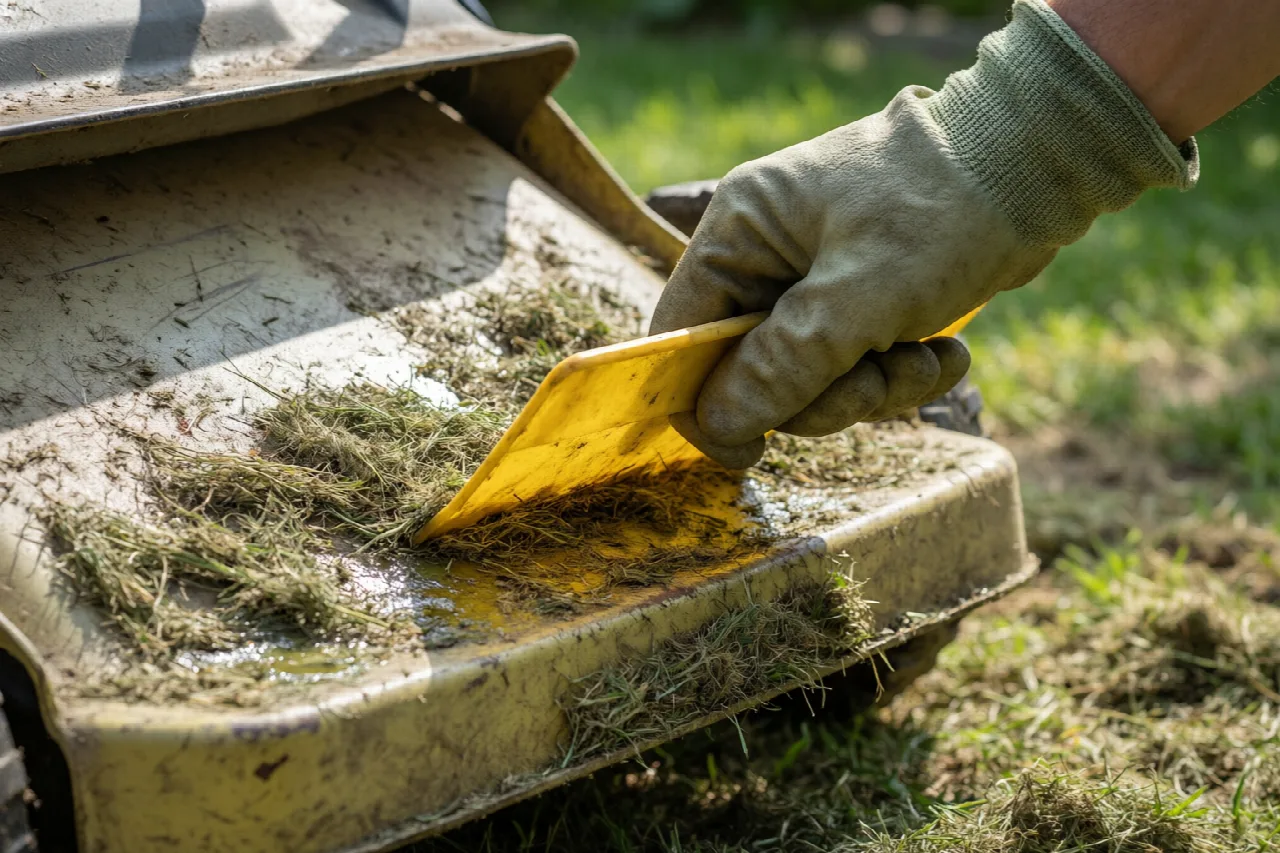
Once the mower is safely positioned, the first step is removing the bulk of dry, caked-on grass. This mechanical scraping is the most important part of the job because it breaks up the thick layer that builds up over multiple mowing sessions. The best tools for this are a plastic scraper, a putty knife, or a stiff-bristled brush. A plastic scraper is ideal because it is firm enough to dislodge compacted grass but soft enough to avoid scratching the deck’s paint. A metal putty knife works well too, but use it with a flat angle to minimize the risk of gouging the metal surface. Avoid wire brushes or abrasive pads, as these can strip the protective paint and leave the bare metal exposed to rust.
Work systematically from one side of the deck to the other. Start at the outer edges and scrape toward the center, pushing the loosened grass into a pile that you can sweep up afterward. Pay special attention to the area around the blade spindle and the discharge chute, as these are the spots where grass tends to accumulate most heavily. If the buildup is extremely thick and hard, you can soften it by spraying the deck lightly with water and letting it sit for ten minutes before scraping again. This rehydrates the dried clippings and makes them easier to remove without excessive force.
Whether you should remove the blade depends on how thorough you want to be. For a routine clean, you can leave the blade in place and scrape around it carefully. For a deep clean, removing the blade gives you full access to the spindle area and allows you to inspect the blade for wear or damage. To remove the blade, disconnect the spark plug or battery first, then use a socket wrench to loosen the center bolt. The bolt is typically reverse-threaded, meaning you turn it clockwise to loosen it. Secure the blade with a block of wood wedged between the blade and the deck to prevent it from spinning. Once removed, clean the blade separately with a scraper and a wire brush, then check for nicks or excessive wear before reinstalling it.
Rinsing and Pressure Washing Techniques
After scraping away the bulk of the debris, you can move on to wet cleaning to remove the remaining film of grass residue and dirt. The easiest method is to use a built-in deck-wash port if your mower has one. This is a small brass or plastic fitting, usually located on the top of the deck, designed to accept a standard garden hose. To use it, connect the hose, turn on the water, and start the mower engine (with the blade engaged) so the spinning blade flings water across the underside of the deck. Run the mower for a few minutes, then turn it off and disconnect the hose. This method is effective for routine maintenance because it flushes out fresh clippings before they have a chance to dry and harden.
If your mower does not have a deck-wash port, you can rinse the underside manually with a garden hose. Tilt the mower as described in the safety section, then spray the underside with a steady stream of water. Use a nozzle with a wide, fan-shaped spray pattern rather than a concentrated jet, which can force water into seals and bearings. Angle the spray so that water flows away from the blade spindle and the engine side of the deck. The goal is to wash debris off the surface, not to blast it into the crevices where it can cause rust or damage. For broader ecosystem context, read through our operational guide on marshall stanmore iii vs harman kardon onyx studio 8.
For heavily caked-on buildup, a pressure washer can be very effective, but it must be used with caution. Set the pressure washer to a low PSI setting, ideally below 1500 PSI, and use a wide-angle nozzle (at least 25 degrees) to diffuse the spray. Hold the nozzle at least 12 inches away from the deck surface and keep the stream moving continuously. Never aim the pressure washer directly at the blade spindle bearings, the engine, the carburetor, the electrical wiring, or any rubber seals or gaskets. High-pressure water can force past these components and cause bearing failure, electrical shorts, or water ingress into the engine. If you are unsure about your pressure washer’s settings, start with the lowest pressure and work up gradually until you find a level that removes the debris without damaging the paint. For most homeowners, a standard garden hose with a good nozzle is sufficient for regular cleaning, and the pressure washer should be reserved for a few deep cleans per season.
Drying and Preventive Coating Application
Once the deck is clean, drying is a critical step that many people skip. Leaving moisture on the metal surface promotes rust, which can weaken the deck over time and create rough spots where grass clings even more readily. After rinsing, use a clean, dry cloth or an air compressor to remove as much water as possible from the underside. If you used a pressure washer, pay extra attention to the spindle area and any crevices where water may have pooled. Allow the mower to sit in a dry, well-ventilated area for at least 30 to 60 minutes before reattaching the battery or spark plug. This drying time ensures that any residual moisture has evaporated and reduces the risk of electrical issues when you restart the mower. For troubleshooting and reliability insights, consult our in-depth dyson v8 cyclone vs bissell featherweight stick report.
After the deck is completely dry, applying a non-stick coating is the single most effective way to reduce future grass buildup. A silicone-based spray or a dedicated mower deck coating creates a slick surface that grass clippings slide off instead of sticking to. Spray a thin, even layer across the entire underside of the deck, including the area around the blade spindle and the discharge chute. Avoid getting the spray on the blade itself, as this can affect its balance, and keep it away from the engine and any rubber components. Let the coating dry for the time specified on the product label before reassembling the mower.
When choosing a coating, you have a few options. Dedicated mower deck sprays are formulated specifically for this purpose and typically offer the best durability. Silicone lubricant sprays are a good general-purpose alternative and are widely available. Some homeowners use cooking spray or vegetable oil as a low-cost option, and while these do work in the short term, they tend to break down quickly and can attract dirt and grit, which may actually increase wear over time. A dedicated product is generally worth the small additional cost for longer-lasting protection. Whichever product you choose, reapply it periodically throughout the mowing season, as the coating wears off with use and exposure to the elements.
When to Schedule Regular vs. Deep Cleaning
Understanding the difference between routine maintenance and deep cleaning helps you keep your mower in top condition without overdoing it. A quick scrape and rinse should be done after every mowing session, or at least every other session, especially if you are cutting grass that is slightly damp or tall. This routine clean prevents fresh clippings from drying and hardening onto the deck, which makes the job much harder later. If you have a deck-wash port, using it after each mow takes less than five minutes and is the easiest way to stay on top of buildup. Readers comparing setup options can review our technical analysis on bissell crosswave hydrosteam vs shark stainforce.
A deep clean, involving scraping, pressure washing, and possibly blade removal, should be scheduled a few times per season. A good rule of thumb is to do a deep clean at the beginning of the season, once in the middle, and once at the end before storing the mower for winter. You may need to deep clean more frequently if you mow very tall grass, wet grass, or grass that is high in moisture content, as these conditions produce more clippings that pack tightly onto the deck. Similarly, if you mow a large lawn, the sheer volume of clippings will accelerate buildup.
There are several signs that accumulated debris is affecting your mower’s performance. If you notice that the mower is leaving uncut strips of grass, or if the engine seems to be working harder than usual, a clogged deck is a likely culprit. A thick layer of grass under the deck reduces airflow, which prevents the blade from lifting the grass upright for a clean cut. You may also see grass clippings being thrown unevenly from the discharge chute, or you may simply notice that the underside of the deck looks heavily caked. If you see any of these signs, it is time for a deep clean. Paying attention to these cues and sticking to a regular cleaning schedule will extend the life of your mower deck, keep your cuts clean and even, and make each cleaning session faster and easier than the last.
Related Maintenance and Operating Guides
To keep your equipment running at peak operating efficiency, explore our related technical walkthroughs and maintenance tutorials:
- Consult our detailed breakdown on heavy-duty chainsaw buyer guide.
Technical Standards and Compliance
Mechanical safety standards, operational tolerances, and protective gear guidelines align with benchmark specifications established by the American National Standards Institute (ANSI).









