
Quick Answer: How To Drive Zero Turn Mower?
Driving a zero-turn mower (ZTR) is fundamentally different from a lawn tractor because there is no steering wheel, you steer with two lap bars. Follow these steps: (1) Before starting, perform safety checks: engage the parking brake, make sure the PTO (blade engagement) is disengaged, and sit in the seat so the operator-presence switch is satisfied. (2) Start the…
Why Zero-Turn Mowers Are Different (No Steering Wheel)
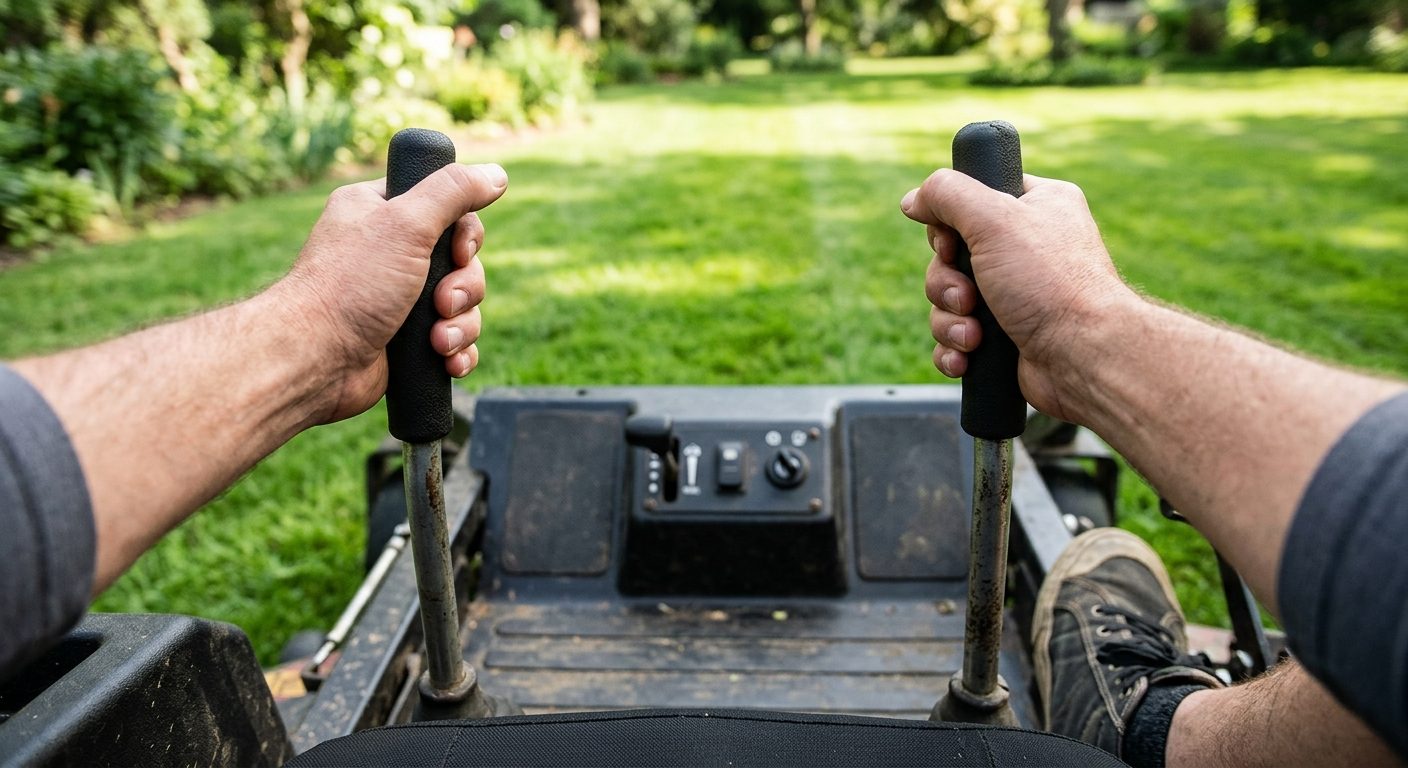
Traditional lawn tractors use a steering wheel connected to the front wheels. A zero-turn mower replaces this with a pair of steering levers, often called lap bars. These levers directly control the speed and direction of the rear wheels via a hydrostatic transmission. This independent wheel control is what allows the mower to pivot on its own axis, creating a zero-radius turn. Understanding this core difference is the first step to operating the machine safely and effectively.
Before You Start: Pre-Drive Safety Checks
Before turning the key, always complete this safety checklist. These interlocks are designed to prevent accidental startup and injury.
- Engage the Parking Brake: The mower will not start unless the parking brake is set. This is a primary safety interlock.
- Disengage the PTO: The PTO (Power Take-Off) engages the cutting blades. Ensure the PTO switch is in the “off” or “disengaged” position before starting the engine.
- Sit in the Seat: Most zero-turn mowers have an operator-presence system (a seat switch). The engine will shut off if you leave the seat while the blades are engaged or the parking brake is off.
- Check the Throttle and Choke: Set the throttle to a mid-range position. If the engine is cold, you may need to engage the choke.
Step-by-Step: How to Steer with Lap Bars
Once the engine is running, focus on the lap bars. They are your steering wheel, accelerator, and brake all in one.
Going Straight Forward
To move forward, push both lap bars forward simultaneously and evenly. The further you push them, the faster you go. Keep your movements smooth and gradual.
Stopping and Reversing
To slow down or stop, pull both levers back toward the neutral (center) position. To reverse, pull both levers back past neutral. Always look behind you before reversing.
Turning
To turn, you create a speed difference between the rear wheels. For a gentle left turn, push the right lever slightly further forward than the left. For a sharper left turn, pull the left lever back toward neutral while keeping the right forward.
The Zero-Radius Pivot Turn
This is the signature move. To spin in place to the left, push the right lever forward while simultaneously pulling the left lever back. The mower will pivot around its center. Practice this slowly at first. To compare alternative configurations, check our hands-on review of marshall stanmore iii vs harman kardon onyx studio 8.
Practice Drill: Learn in an Open, Flat Area
Before mowing your lawn, find a large, open, flat area like a driveway or empty field. Spend 15-20 minutes practicing:
- Smooth Starts and Stops: Practice pushing both levers forward to a slow, steady speed, then pulling them back to neutral to stop smoothly.
- Straight Lines: Try to drive in a perfectly straight line by keeping the levers perfectly even.
- Gentle Turns: Practice making wide, sweeping turns by slightly offsetting the levers.
- Pivot Turns: Once comfortable, practice the zero-radius pivot in both directions.
The goal is to build muscle memory for smooth, gradual lever movements. Jerky motions will make the mower lurch and are difficult to control. Users looking for related component recommendations can explore our dyson v8 cyclone vs bissell featherweight stick breakdown.
Common Mistakes and How to Avoid Them
- Jerky Lever Movement: Beginners often push or pull the levers too quickly. Focus on slow, deliberate motions. Think of it like a dimmer switch, not an on/off button.
- Gripping Too Tightly: A death grip on the levers leads to fatigue and jerky inputs. Hold them firmly but relaxed, with your arms resting comfortably.
- Turning on Slopes: Never attempt a zero-radius pivot turn on a slope. This is a major cause of rollovers. Always mow up and down slopes, not across them.
- Forgetting the Parking Brake: If the mower won’t start, the first thing to check is that the parking brake is fully engaged.
Slope and Terrain Safety: Where to Be Extra Careful
Zero-turn mowers have a higher center of gravity than some lawn tractors, making slope safety critical.
- Mow Up and Down Slopes: Always drive straight up and straight down slopes. Mowing across a slope increases the risk of a rollover.
- Avoid Pivoting on Slopes: Never perform a zero-radius turn on an incline. Complete your pass, drive to flat ground, and then turn.
- Wet or Uneven Terrain: Avoid mowing wet grass or very uneven ground, as this can reduce traction and control.
- Know Your Limits: If a slope feels too steep or the terrain is too rough, it may be safer to use a different type of mower.
Everything You Need to Know: How To Drive Zero Turn Mower FAQ
Why does my zero-turn mower jerk when I move the levers?
Jerky movement is almost always caused by moving the lap bars too quickly. The hydrostatic transmission responds directly to lever position. Practice moving the levers slowly and smoothly from neutral to your desired speed. It takes time to develop the fine motor control needed for seamless operation. Before finalizing equipment decisions, refer to our comprehensive bissell crosswave hydrosteam vs shark stainforce comparison.
How do I know if I’m mowing on too steep of a slope?
Consult your owner’s manual for the maximum recommended slope angle, often expressed as a percentage (e.g., 15%). As a general rule, if you feel uncomfortable or the machine feels unstable, the slope is too steep. Always err on the side of caution and mow up and down, not across.
Can I use a zero-turn mower on hills?
Yes, but with extreme caution. You must mow straight up and down the slope, never across it. Avoid any pivoting turns on the incline. If the slope is too steep for safe operation, a walk-behind mower or a tractor with a lower center of gravity may be a better choice.
What is the PTO and why must it be off to start?
The PTO (Power Take-Off) is the mechanism that engages the cutting blades. It’s a safety requirement to have it disengaged before starting the engine to prevent the blades from spinning unexpectedly, which could cause serious injury or damage.
Related Maintenance and Operating Guides
To keep your equipment running at peak operating efficiency, explore our related technical walkthroughs and maintenance tutorials:
- Consult our detailed breakdown on residential zero-turn lawn mower guide.
Technical Standards and Compliance
Mechanical safety standards, operational tolerances, and protective gear guidelines align with benchmark specifications established by the American National Standards Institute (ANSI).