

Quick Answer: How to Start a Lawn Mower
For a gas push mower, ensure the tank has fresh fuel, open the fuel valve, set the choke to CLOSED (FULL), press the primer bulb three times, hold the safety bail lever, and pull the starter cord with one firm stroke. If the mower still won’t start, work through the fault checklist below — fuel, spark plug, and air filter resolve the vast majority of no-start conditions. Battery mowers require a fully charged pack seated correctly and the safety key inserted before pressing the start button.

Pros
- Large-size design named in product title
- Sharpening and balancing functions listed
- Listed as a new upgraded version

Pros
- Adjustable 15-to-45-degree range in title
- Sharpening and balancing functions listed

Pros
- Sharpener and balancer functions in title
- 15-to-45-degree adjustable setting listed
- Built for lawn mower blade maintenance
Pros
- Includes replacement gaskets and a 98079-55846 spark plug
- Matches Honda HRR216 and HRS216 lawn mower models
- Designed around the 16100-Z8B-901 carburetor specification
Cons
- Restricted to select Honda GCV160 mower applications
- Installation requires basic mechanical tools and skills
Quick-Start Checklist Before You Pull the Cord
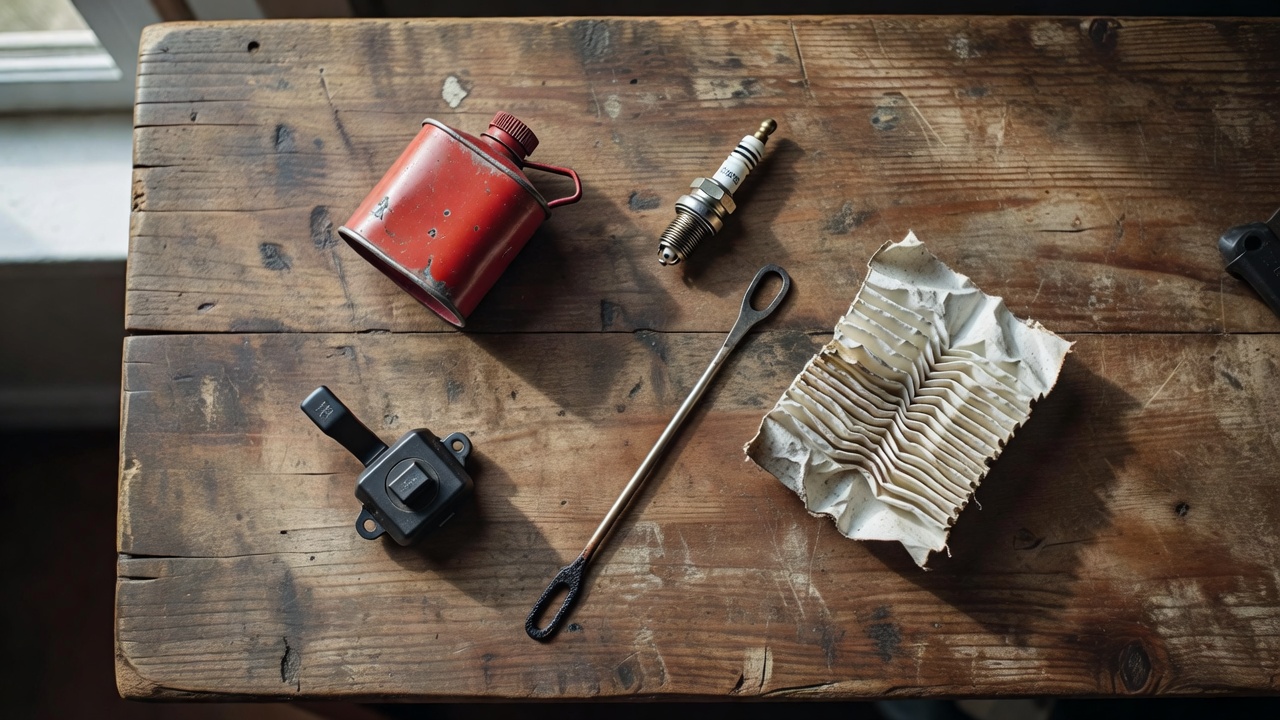
Run through this list first. Most no-start calls are resolved here in under two minutes.
- Fuel in the tank? Confirm visually. Low fuel is the single most overlooked cause.
- Fuel fresh? Gasoline older than 30 days without a fuel stabilizer degrades and can varnish the carburetor, preventing a start.
- Fuel valve open? Many mowers have a shutoff valve under the tank. It must be in the ON (open) position.
- Safety bail lever held? The operator presence control (the bar you squeeze against the handle) must be depressed continuously. Releasing it cuts the engine — or prevents it from starting.
- Choke set correctly? Cold engine = choke CLOSED. Warm engine = choke OPEN. Wrong choke position is a top cold-start failure point.
- Oil level acceptable? Many modern engines have a low-oil shutdown sensor. Check the dipstick.
- Spark plug wire connected? A disconnected plug wire is a common post-maintenance oversight.
- Air filter not completely clogged? A severely blocked filter starves the engine of air and prevents combustion.
How to Start a Gas Lawn Mower (Cold Start Step-by-Step)
These steps apply to pull-start gas push mowers with a standard Briggs & Stratton, Honda GCV, or comparable single-cylinder engine. To compare alternative configurations, check our hands-on review of jbl partybox club 120 vs sony srs xv500.
- Fill with fresh fuel. Use clean, fresh unleaded gasoline (87 octane minimum). Note: E15 (15% ethanol) is not recommended for small engines by most OEM manufacturers — use E10 or ethanol-free fuel where available.
- Open the fuel valve. Turn the lever to the ON position (parallel to the fuel line on most models).
- Set the choke to CLOSED (FULL CHOKE). On a cold engine, the choke restricts airflow to enrich the fuel mixture. Locate the choke lever — typically labeled CHOKE, START, or with a symbol — and move it to the closed/full position.
- Prime the engine. Press the primer bulb (a small rubber dome near the carburetor) firmly three times. Briggs & Stratton and most OEM documentation specify three presses for a cold start; some Honda manuals specify two. Check your engine label if unsure. Each press forces a small shot of fuel directly into the carburetor.
- Set throttle to FAST (HIGH). Move the throttle control to the high or rabbit symbol position for starting.
- Hold the safety bail lever. Squeeze the operator presence bar firmly against the handle and keep it held throughout starting and operation.
- Pull the starter cord. Grip the handle, pull slowly until you feel resistance, then pull briskly and fully with one smooth stroke. Avoid letting the cord snap back — guide it. Repeat up to three times if needed.
- Adjust the choke once running. After the engine fires and warms for 30–60 seconds, move the choke to OPEN (RUN). Running too long on full choke floods the engine.
Electric Start Gas Mowers
Models with a push-button or key electric start follow the same fuel, choke, and primer steps above. Instead of pulling a cord, insert the key (if equipped), hold the safety bail, and press/hold the start button for up to five seconds. If the engine doesn’t fire, wait 10 seconds before retrying to protect the starter motor. To compare alternative configurations, check our hands-on review of jbl partybox club 120 vs sony srs xv500.
How to Start a Battery or Corded Electric Lawn Mower
Battery and corded electric mowers have no choke, no primer bulb, and no pull cord. Their no-start causes are simpler but distinct. Users looking for related component recommendations can explore our z890 vs x870e motherboard breakdown.
Battery Mower Start Procedure
- Charge the battery fully. Connect the pack to its charger and confirm the charge indicator shows full. A partially charged battery may power the display but lack enough voltage to spin the motor under load.
- Seat the battery pack correctly. Push the pack firmly into the deck slot until it clicks. A partially seated pack triggers the battery-detect safety circuit and prevents startup.
- Insert the safety key. Most battery mowers require a physical interlock key inserted into the handle or deck before the start button is active.
- Hold the operator presence bar or handle switch. Battery mowers use the same OPC logic as gas models.
- Press and hold the start button. Hold for one to two seconds. The blade should engage immediately.
Corded Electric Mower Start Procedure
Plug into a grounded outdoor-rated extension cord of the correct gauge (12 AWG minimum for runs over 50 feet), insert the safety key, hold the operator bar, and press the trigger or button. If it doesn’t start, check the circuit breaker on the mower’s handle (many have a reset button) and confirm the wall outlet is live.
Do Battery Mowers Have a Choke or Primer Bulb?
No. Battery and corded electric mowers are motor-driven, not combustion engines. There is no fuel system, choke, or carburetor. If an electric mower doesn’t start, the fault is always electrical: battery charge, connection, key, OPC switch, or motor. Users looking for related component recommendations can explore our z890 vs x870e motherboard breakdown.
How to Start a Riding Lawn Mower
Riding mowers have additional safety interlocks compared to push mowers. Bypassing the correct sequence prevents starting and can damage the starter.
- Sit in the seat. The seat safety switch must detect operator weight. The mower will not crank if the seat is unoccupied.
- Disengage the blade (PTO). The blade engagement lever or PTO switch must be in the OFF/DISENGAGED position. Starting with blades engaged is blocked by the PTO safety interlock on all modern riding mowers.
- Set the parking brake. Engage the parking brake or, on gear-drive models, depress the clutch/brake pedal fully and hold it.
- Set the throttle to FAST and choke to CLOSED for a cold start (same logic as a push mower).
- Turn the ignition key to START. Hold for up to five seconds. If the engine doesn’t fire, release, wait 10 seconds, and retry. Do not crank continuously — this overheats and can burn out the starter motor.
- Open the choke once the engine warms. Move choke to RUN/OPEN after 30–60 seconds.
Riding Mower Clicks But Won’t Crank
A single click or rapid clicking with no cranking almost always indicates a weak battery or corroded battery terminal — the starter solenoid is engaging but the battery cannot deliver enough amperage. Jump-start the battery or clean the terminals and retest before replacing the starter. Before finalizing equipment decisions, refer to our comprehensive marshall stanmore iii vs harman kardon onyx studio 8 comparison.
Blade Engagement Requirement
Yes — blades must be disengaged before a riding mower will start. This is a non-negotiable safety interlock on all current production riding and zero-turn mowers.
Lawn Mower Won’t Start: Fault Diagnosis by Most Likely Cause
Work through these in order. Fuel causes outnumber spark and air causes combined in residential mower no-start scenarios. For broader ecosystem context, read through our operational guide on dyson v8 cyclone vs bissell featherweight stick.
| Rank | Fault | Symptom | Fix |
|---|---|---|---|
| 1 | Old / stale fuel | Engine cranks, may briefly fire then die, smells sour | Drain tank completely, dispose of old fuel per local regulations, refill with fresh E10 or ethanol-free gasoline. Add fuel stabilizer if storing longer than 30 days. |
| 2 | Fouled or worn spark plug | Engine cranks but never fires; weak or no spark when tested | Remove plug with a spark plug wrench, inspect for carbon buildup, cracks, or worn electrode. Replace if in doubt — plugs are inexpensive. Briggs & Stratton specifies replacement every 100 hours or once per season, whichever comes first. |
| 3 | Clogged air filter | Engine may start but runs rough, smokes black, or bogs under load | Remove the filter cover (usually one bolt or clip). Tap a paper filter gently to dislodge debris, or replace it. Foam filters can be washed in soapy water, dried completely, and lightly oiled before reinstalling. |
| 4 | Gummed carburetor | Engine cranks, primer bulb is firm, spark is good, but no fuel smell and no fire | Stale fuel deposits varnish the carburetor jets. Spray carburetor cleaner into the air intake as a quick test. Full fix: remove carburetor bowl, soak in cleaner, clear jets with compressed air. Severely gummed carburetors may need replacement (typically $15–$40 for common push-mower carburetors). |
| 5 | Flooded engine | Strong fuel smell, engine won’t fire despite correct procedure | Move choke to OPEN, set throttle to FAST, hold safety bail, and pull the cord 6–8 times to clear excess fuel. Wait 10 minutes then restart with normal cold-start procedure. |
| 6 | Failed safety switch | Engine cranks only when certain switches are held or jumpered | Test the operator presence control, seat switch (riding mowers), or blade interlock with a multimeter. Replace the faulty switch — do not permanently bypass safety switches. |
| 7 | Low / no engine oil | Engine cranks briefly then stops; low-oil indicator light (if equipped) | Check dipstick, add oil to the FULL mark using manufacturer-specified grade (commonly SAE 30 or 10W-30). Do not overfill. |
Can Old Fuel Stop a Lawn Mower from Starting?
Yes. Gasoline begins to oxidize and degrade within 30 days of purchase when stored without a stabilizer. Ethanol-blended fuels (E10) absorb atmospheric moisture, which accelerates phase separation — the ethanol and water layer settles to the bottom of the tank and is drawn first into the carburetor, where it causes hard starting, rough running, and internal corrosion. Always drain the tank or add a fuel stabilizer before storing any gas mower for more than 30 days.
Ethanol and Small Engine Damage
The U.S. EPA and most small-engine OEMs (including Briggs & Stratton and Honda Power Equipment) warn that E15 (15% ethanol) fuel is not approved for small off-road engines. E15 can damage fuel lines, gaskets, and carburetor components not designed for higher ethanol concentrations. Use E10 maximum, or ethanol-free fuel where available. For troubleshooting and reliability insights, consult our in-depth bissell crosswave hydrosteam vs shark stainforce report.
First Start of the Season vs. Mower That Stopped Mid-Use
Spring / Seasonal Startup
A mower sitting all winter requires attention to three areas before the first start:
- Drain and replace fuel. Any fuel left in the tank from last season (unless stabilizer was added) should be drained and replaced with fresh gasoline.
- Replace the spark plug. Annual replacement is best practice regardless of condition — it eliminates one variable and costs under $5.
- Inspect and clean (or replace) the air filter. A season of storage can introduce dust, insects, and moisture into the filter housing.
- Check engine oil. Drain and replace with fresh oil if it’s dark or hasn’t been changed in the past season.
- Inspect the carburetor. If fuel was left without stabilizer, suspect a gummed carburetor before the first pull. Spray cleaner through the intake as an initial test.
Mower That Stopped Suddenly Mid-Use
A mower that ran fine then stopped mid-mow points to different causes than a seasonal no-start:
- Safety switch trip: Did you release the bail lever? Step off the riding mower seat? These cut power immediately.
- Overheating: Mowing thick, wet grass builds heat rapidly. Let the engine cool 10–15 minutes, check that the cooling fins and shroud are clear of grass clippings, then restart.
- Fuel starvation: Check fuel level. A clogged fuel filter or kinked fuel line can also starve the engine under load even if the tank has fuel.
- Vapor lock: On very hot days, fuel can vaporize in the fuel line before reaching the carburetor. Loosen the fuel cap slightly (to vent pressure), wait a few minutes, then restart. Note: modern vented fuel caps on residential mowers are designed to minimize vapor lock, so this is less common than in older designs — but it does still occur in high-heat conditions with clogged cap vents.
- Low oil shutdown: Modern engines with low-oil sensors shut off automatically to prevent damage. Check the dipstick immediately.
Brand-Specific Start Sequences: Honda, Husqvarna, Toro & Craftsman
Honda Lawn Mowers (Auto Choke)
Honda GCV160 and GCV200 engines — found on Honda HRX and HRN series mowers — feature an Auto Choke system that adjusts the choke automatically based on engine temperature. According to Honda Power Equipment documentation, there is no manual choke lever on these engines. The start procedure simplifies to: move the throttle to the START/CHOKE position, hold the bail bar, and pull the cord. The Auto Choke opens automatically as the engine warms. Do not attempt to manually choke a Honda Auto Choke engine — there is no provision to do so.
Husqvarna Lawn Mowers
Many Husqvarna push mowers use Briggs & Stratton or Honda engines and follow those respective procedures. Husqvarna riding mowers use a key ignition with the standard safety interlock sequence (seat, PTO off, brake/clutch in). Some models feature a Smart Switch electric start system — if the battery in the Smart Switch module is low, the electric start won’t engage; a backup pull cord is provided on select models. Check the battery in the Smart Switch key fob if electric start is unresponsive.
Toro Lawn Mowers
Toro’s Guaranteed-to-Start pledge (terms vary by model year and are detailed in Toro’s official warranty documentation) applies to specific Personal Pace and TimeMaster models. The start procedure matches the standard gas push mower sequence. Toro’s Recycler series with Briggs & Stratton engines uses the standard three-press primer and choke sequence. If a covered Toro fails to start per the warranty terms, Toro’s service network will repair it at no charge within the coverage period — verify current terms at Toro’s official site, as program details are model-specific.
Craftsman Lawn Mowers
Craftsman push mowers primarily use Briggs & Stratton engines. The primer bulb on many Craftsman models is located on the front of the carburetor beneath a plastic shroud — if you can’t find it, check the area just behind the air filter cover. Start sequence is standard: three primer presses, choke closed, bail lever held, pull cord. Craftsman riding mowers use a key ignition; follow the riding mower sequence detailed above (seat sensor, PTO off, parking brake, then key to START).
Frequently Asked Questions About How To Get Lawn Mower Started
How many times should I press the primer bulb to start a lawn mower?
Three presses is the most widely specified number in Briggs & Stratton documentation and on most engine decals. Honda GCV engines specify two presses in some manuals. Always check the label on your specific engine — it overrides general guidance. Pressing more than the specified number floods the carburetor and makes starting harder, not easier.
Why does my lawn mower start then immediately die?
The three most common causes are: (1) a gummed carburetor that allows brief combustion then starves the engine of fuel through clogged jets, (2) the choke left in the CLOSED position too long, flooding the engine once it warms, and (3) a stuck or dirty carburetor float needle preventing consistent fuel delivery. Clean or replace the carburetor if cleaning the jets with spray cleaner doesn’t resolve it.
Can I start a lawn mower without the primer bulb if it’s cracked or missing?
A cracked primer bulb introduces an air leak into the fuel system and prevents it from drawing fuel into the carburetor. Starting without a functional primer bulb is unreliable. Replacement bulbs are inexpensive (typically under $5) and are a standard repair. As a temporary measure on a warm engine, you can try starting with the choke partially open and no priming, but the engine must already have fuel in the carburetor to fire.
How do I start a lawn mower that has been sitting all winter?
Drain all old fuel first — stale gas is the primary reason a winter-stored mower won’t start. Replace the spark plug and inspect the air filter. Add fresh fuel (E10 or ethanol-free), open the fuel valve, set the choke to CLOSED, press the primer three times, and pull. If it still won’t fire after three pulls, the carburetor is likely varnished from the old fuel and needs cleaning or replacement before the engine will run reliably.
For more hands-on benchmarks and buying recommendations, consult our guides on high-CFM commercial leaf blower guide.
Mechanical safety standards, operational tolerances, and protective gear guidelines align with benchmark specifications established by the American National Standards Institute (ANSI).









